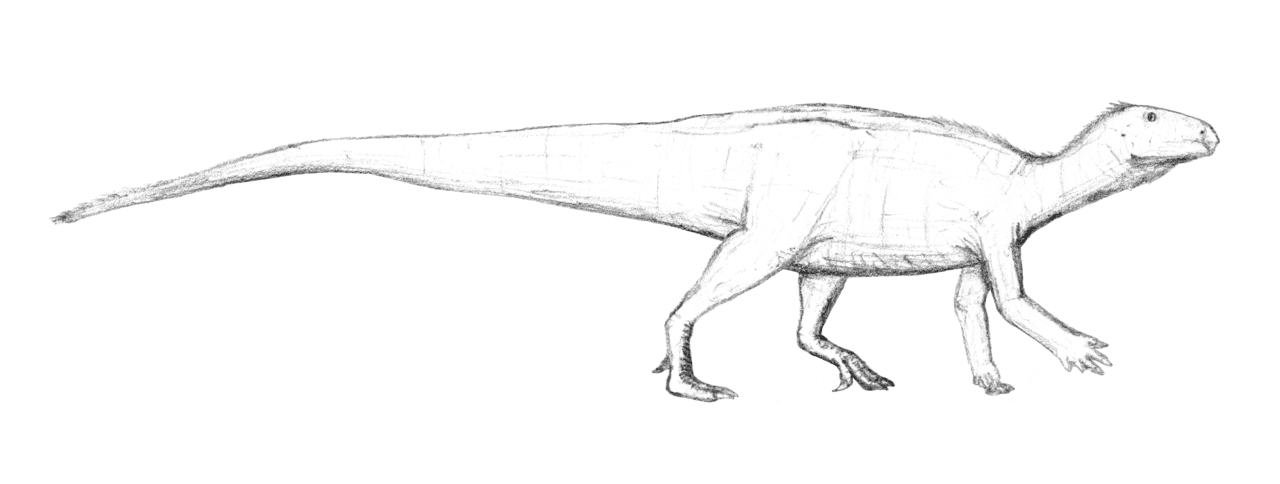
Lézard à tendons
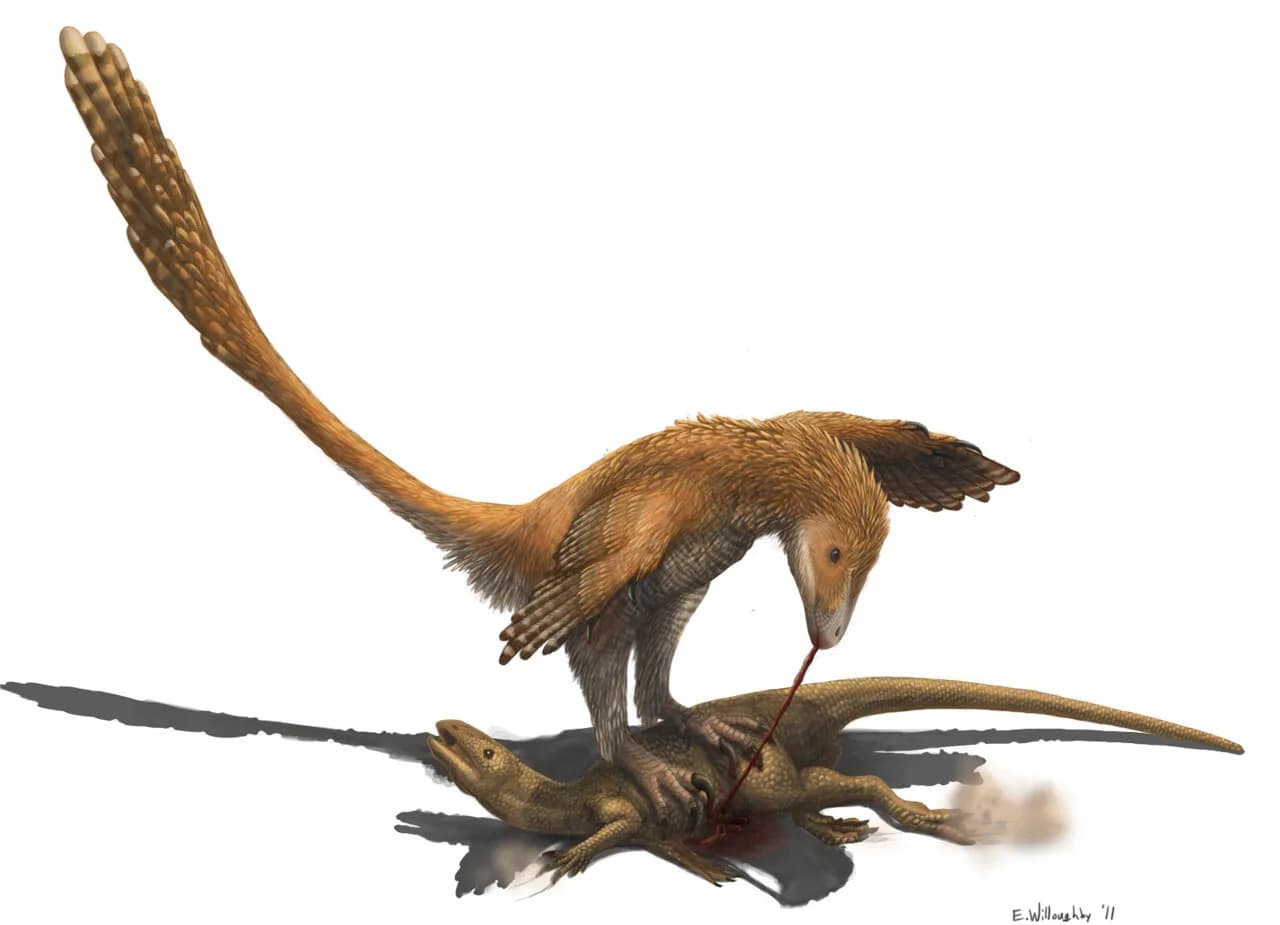
Tenontosaurus tilletti is regularly found associated with Deinonychus teeth and skeletons, which has made it the type prey invoked when discussing pack hunting among raptors. From 7.3 to 8 metres and around a tonne, described in 1970, it browsed Wyoming, Montana, Texas and Oklahoma 121 to 100 million years ago.
The herbivore with the most attacks in the game. Tail (Stun 2-3s), back kick (massive bleed), directional claws. A true Swiss army knife.
Playable in The Isle: Evrima
See Tenontosaurus tilletti's in-game stats, tier, strengths & weaknesses on our server.
Tenontosaurus lived during the Early Cretaceous, from the late Aptian to the late Albian, approximately 121.4 to 100.5 million years ago. Its time corresponds to an important palaeobiogeographic transition period, with North America crossed by floodplains and dense forests. Tenontosaurus was one of the most common ornithopod herbivores of its time on this continent, coexisting with theropods such as the formidable Deinonychus. It was named and described by paleontologist John Ostrom in 1970 from specimens in the Cloverly Formation (Wyoming, Montana). The genus name derives from the Greek 'tenon' (tendon) and 'sauros' (lizard), referencing the ossified tendons stiffening its long tail.
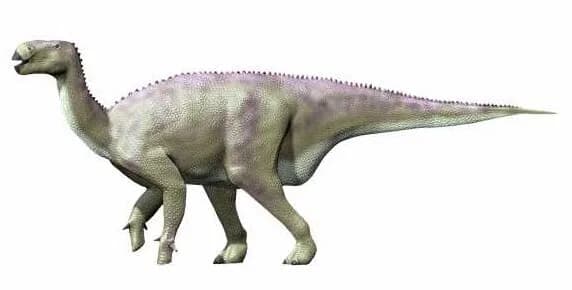
Tenontosaurus measured between 7.3 and 8 meters long, 3 meters tall on its hind legs, with an estimated weight of about 1 ton. Its most remarkable feature was its exceptionally long and muscular tail, reaching up to 4 meters — roughly half the total length of the animal. No trace of tail dragging has been observed in fossilized trackways, indicating it was carried raised horizontally. The stocky body featured long powerful hind legs and long robust five-fingered forelimbs. The animal could rear up on its hind legs to reach vegetation approximately 3 meters high.
An herbivore, Tenontosaurus fed on ferns, shrubs, and low to medium height vegetation. Its powerful U-shaped beak was perfectly adapted for cutting and tearing plants. The inclined cutting surfaces of its teeth allowed it to consume all parts of a plant: leaves, wood, fruit, and stems. By rearing up on its hind legs, it could reach vegetation up to 3 meters high, accessing resources unavailable to smaller herbivores. Its diet likely excluded the canopies of tall conifers and ginkgos, which were too high for it.
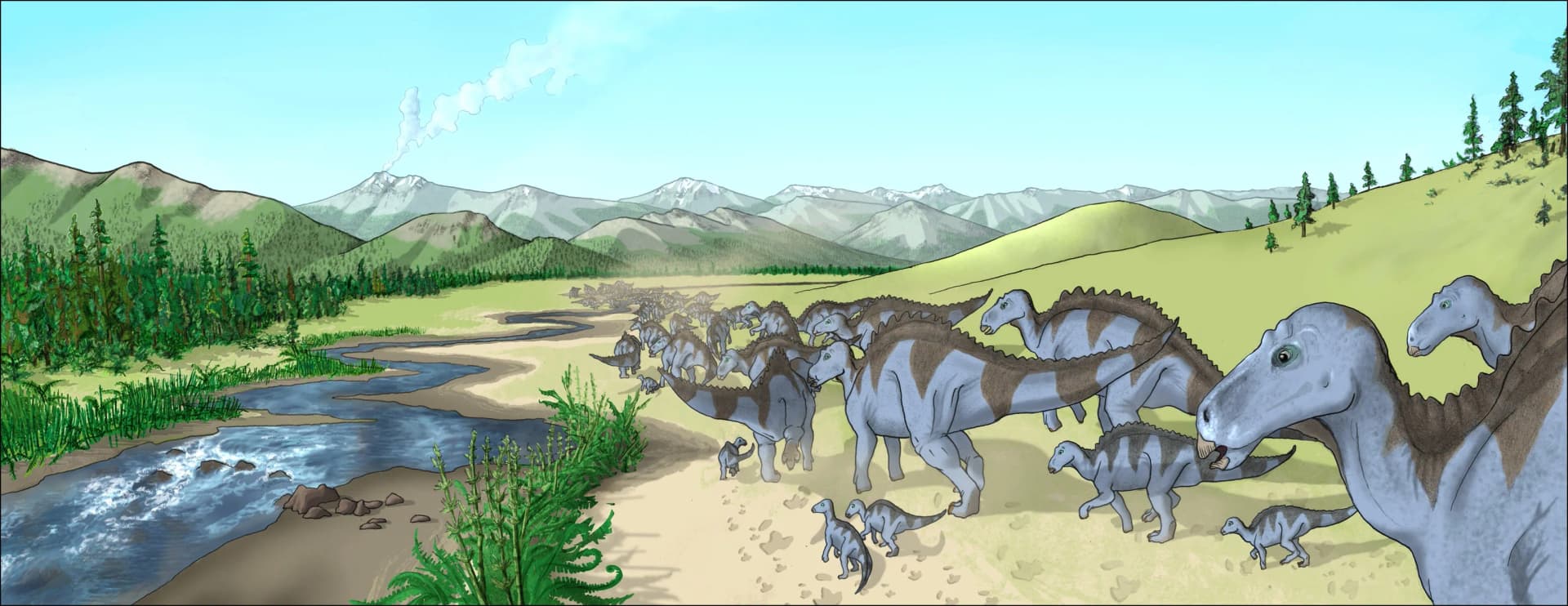
Tenontosaurus occupied the floodplains, open woodlands, and semi-arid environments of central-western North America during the Early Cretaceous period. The species T. tilletti is mainly known from the Cloverly Formation (Wyoming, Montana) and the Antlers Formation (Oklahoma), while T. dossi is known only from the Twin Mountains Formation in Texas. These geological formations reflect a floodplain environment crossed by seasonal rivers, bordered by conifer forests and areas of ferns and cycadophytes providing ample food resources. This open habitat favored both Tenontosaurus group movements across the landscape and the ambush hunting strategies employed by its primary predator, Deinonychus, whose fossils are frequently found in close association.
The main anatomical feature of Tenontosaurus is the presence of numerous ossified tendons gathered along the tail vertebral column, giving it exceptional rigidity and likely a formidable defensive force against attacking predators. The stocky body featured long, powerful hind legs built for sustained locomotion across open terrain. The forelimbs, notably long and robust for an ornithopod, ended in broad five-fingered hands well-adapted for both quadrupedal locomotion and grasping vegetation. The animal likely practiced mixed locomotion throughout its daily activities: quadrupedal at rest and while foraging at ground level, and bipedal to flee from predators or to feed on vegetation at greater heights.
Tenontosaurus was likely gregarious, as evidenced by multiple individuals of different ages found together. The predator-prey relationship between Tenontosaurus and Deinonychus is one of the most documented in paleontology: approximately 20% of Tenontosaurus fossils have been found associated with Deinonychus remains. This predator preferentially hunted young individuals or weakened adults, healthy adults likely being too large and dangerous. Its long rigid tail was its main defense — a well-aimed blow could stun or seriously injure an attacker. Its powerful hind legs also allowed devastating kicks.
Tenontosaurus tilletti was described by John Ostrom in 1970 from specimens in the Cloverly Formation (Wyoming, Montana). A second species, T. dossi, was described in 1997 by Winkler, Murray, and Jacobs, known only from the Twin Mountains Formation in Texas. A remarkable group of four skeletons — one adult and three juveniles attacked by Deinonychus — is reconstructed at the Academy of Natural Sciences in Philadelphia, constituting one of the most famous fossilized predation scenes in paleontology. The ossified tail tendons, often preserved in situ, have greatly contributed to understanding this animal's biomechanics. Tenontosaurus represents a crucial link in understanding the evolution of ornithopods toward the great iguanodontids.
| Period | Crétacé inférieur / Early Cretaceous |
| Era | Mésozoïque / Mesozoic |
| Age | 121-100 Ma |
| Location | Amérique du Nord (Wyoming, Montana, Texas, Oklahoma) / North America |
| Length | 7.3-8 m |
| Height | 3 m |
| Weight | ~1 tonne |
| Diet | Herbivore |
| Discovery | 1970 |
| Type (in-game) | Herbivore |
| Tier | Tier 4 |
About 20% of Tenontosaurus tilletti fossils have been found associated with Deinonychus remains in the Cloverly Formation (Wyoming, Montana). This high rate suggests a documented predator-prey relationship: Deinonychus preferentially hunted Tenontosaurus, targeting juveniles or weakened adults in groups. A famous reconstruction of four skeletons — one adult and three juveniles attacked by Deinonychus — is displayed at the Academy of Natural Sciences in Philadelphia.
Tenontosaurus tilletti's most distinctive feature was its ossified tendons gathered along the tail vertebrae, stiffening a tail reaching 4 meters — half the total body length of 7.3-8 meters. This rigid tail served as a counterbalance during bipedal locomotion and as a formidable defensive weapon against Deinonychus. No evidence of tail dragging was observed in fossilized trackways.
Tenontosaurus lived during the Early Cretaceous, from the late Aptian to the late Albian, approximately 121.4 to 100.5 million years ago. The species T. tilletti is mainly known from the Cloverly Formation (Wyoming, Montana) and the Antlers Formation (Oklahoma). A second species, T. dossi, is known only from the Twin Mountains Formation in Texas. It was one of the most abundant ornithopods of western North America during the Early Cretaceous.
Tenontosaurus at Perot Museum
Wikipedia Commons
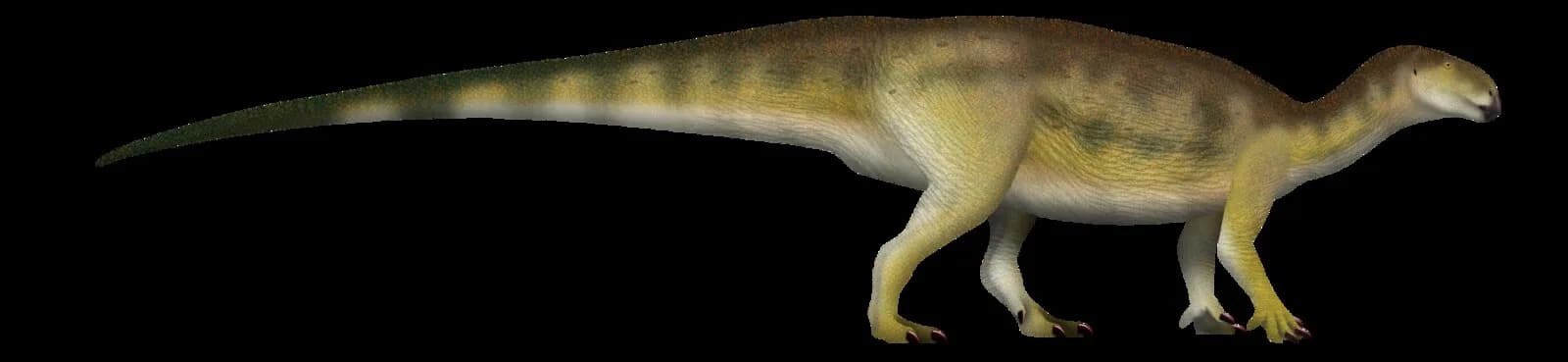
Tenontosaurus tilletti life reconstruction
TotalDino, CC BY 4.0