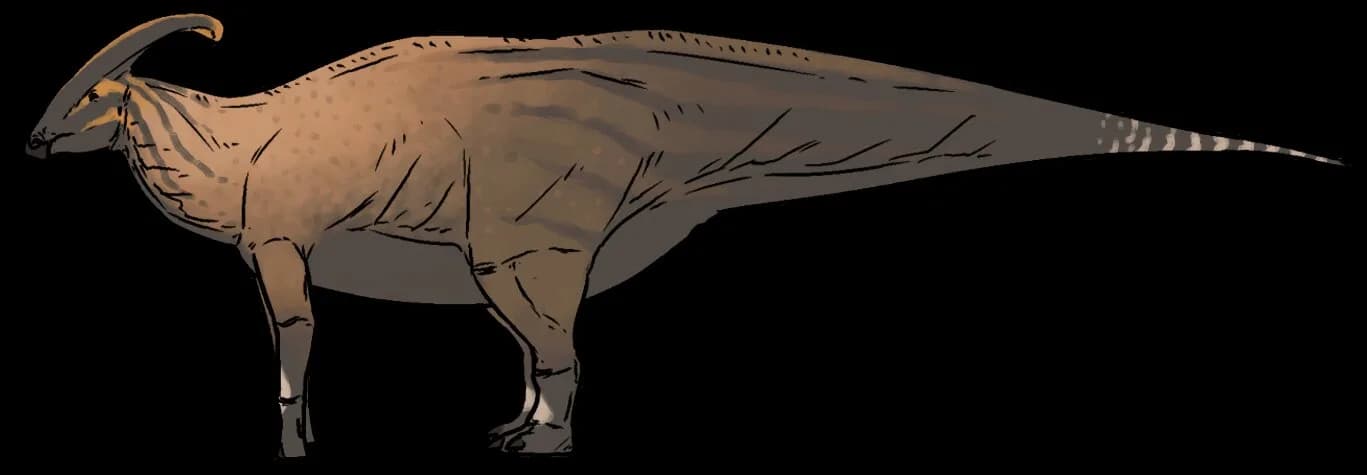
Iguanodon
Iguanodon bernissartensis was a European herbivore about 10 metres long and 3 to 4.5 tonnes, living 126 to 122 million years ago. First reported in 1822, it was the second dinosaur ever named and one of the three species Richard Owen used to define the word dinosaur. Thirty-one skeletons were recovered from a Belgian coal mine in 1878.
Playable in Path of Titans
See Iguanodon bernissartensis's stats, abilities and role on our survival server.
Iguanodon lived during the Early Cretaceous, approximately 126 to 122 million years ago, during the Barremian to Aptian stages. This period was characterized by a globally warm and humid climate, with no polar ice caps. Europe was then an archipelago of large islands separated by shallow seas. Iguanodon is one of the most historically important dinosaurs, as it was among the very first to be scientifically described, playing a fundamental role in the birth of modern paleontology in the 19th century.
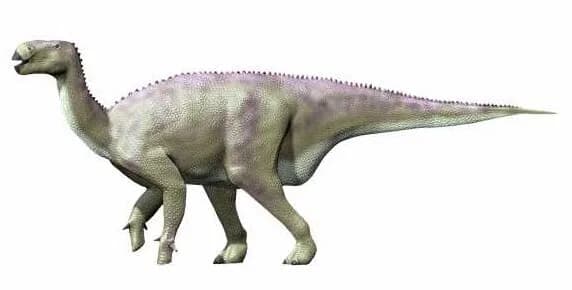
Iguanodon was a large ornithopod measuring between 9 and 13 meters long, with an estimated weight of 3 to 4.5 tonnes. It stood approximately 3 meters tall at the hips when walking quadrupedally, but could reach an impressive 5 meters tall when rearing up on its powerful hind legs to feed or survey its surroundings. Its skull measured about 50 centimeters long, with a toothless beak at the front and batteries of grinding teeth at the back designed for processing tough vegetation. Its rigid, muscular tail served as an essential counterweight during bipedal locomotion, maintaining balance and stability.
Iguanodon was a herbivore that fed on ferns, horsetails, cycads, and low conifers. Its horny beak without teeth at the front of the jaw allowed it to cut vegetation with precision, while its interlocking tooth batteries at the back efficiently ground the toughest plant materials. Studies of its jaw mechanics revealed a unique transverse movement (pleurokinesis), where the upper jaw spread laterally during chewing, creating very efficient grinding. This sophisticated dental adaptation likely contributed to the evolutionary success of ornithopods.
Iguanodon inhabited a variety of environments across western Europe, from coastal plains to inland forests during the Early Cretaceous period. Its fossils have been found in England, Belgium, France, Germany, and Spain, attesting to a vast geographical distribution across the continent. It preferred wooded areas near waterways and floodplains where vegetation was abundant and provided ample feeding opportunities throughout the year. The Wealden Formation, where many well-preserved specimens were found, represented an environment of meandering rivers, shallow lakes, and swamps in a warm subtropical climate that supported diverse plant and animal communities.
Iguanodon possessed a robust and versatile anatomy. Its most famous feature is the conical thumb spike, a pointed bone approximately 15 centimeters long that likely served as a defensive weapon. Its three central fingers were equipped with flattened hooves for walking, while its fifth finger was flexible and prehensile, capable of grasping vegetation. Its forelimbs, though shorter than the hindlimbs, were robust enough to support its weight during quadrupedal walking. It could alternate between bipedal and quadrupedal posture depending on the situation.
Iguanodon was likely a gregarious animal living in social groups, as strongly suggested by the discovery of numerous individuals assembled together in the coal mines of Bernissart, Belgium. This remarkable fossilized herd of over 30 individuals indicates well-developed social behavior, possibly with hierarchical group structures and coordinated movement patterns. It could move quadrupedally to graze at ground level or rear up on its powerful hind legs to reach higher vegetation in the tree canopy. When confronting predators like Eotyrannus or Neovenator, it likely used its distinctive thumb spikes as formidable defensive weapons, capable of inflicting serious wounds on an attacking carnivore.
The fossil history of Iguanodon is legendary in paleontology. The first teeth were discovered in 1822 by Mary Ann Mantell (or her husband Gideon Mantell) in Tilgate Forest, Sussex, England. Gideon Mantell described it in 1825, noting the resemblance of its teeth to those of a giant iguana — hence its name meaning 'iguana tooth.' The most spectacular discovery occurred in 1878 in the coal mines of Bernissart, Belgium, where over 30 skeletons were extracted from 322 meters depth. These Bernissart specimens, displayed at the Royal Belgian Institute of Natural Sciences in Brussels, finally allowed the animal to be correctly reconstructed.
| Period | Crétacé inférieur / Early Cretaceous (Barremien–Aptien) |
| Era | Mésozoïque / Mesozoic |
| Age | 126–122 Ma |
| Location | Europe (Belgique, Angleterre, Allemagne, Espagne) / Europe (Belgium, England, Germany, Spain) |
| Length | ~10 m |
| Height | ~3 m |
| Weight | 3 000–4 500 kg |
| Diet | Herbivore |
| Discovery | 1822 |
In 1878, over 30 Iguanodon bernissartensis skeletons were extracted from 322 meters depth in the coal mines of Bernissart, Belgium. Before this discovery, erroneous reconstructions placed its thumb spike on the nose like a horn. The complete Bernissart skeletons, displayed at the Royal Belgian Institute of Natural Sciences in Brussels, finally enabled correct reconstruction and revealed a bipedal and quadrupedal animal of 9 to 13 meters. This is the fossil discovery that confirmed this species's gregarious behavior.
The conical thumb spike of Iguanodon bernissartensis, about 15 centimeters long, was likely a defensive weapon against predators like Neovenator or Eotyrannus. It could inflict deep wounds during confrontations. The three central fingers bore flattened hooves for walking, and the fifth finger was flexible and prehensile for grasping vegetation — a uniquely versatile anatomy among ornithopods. In early 19th-century reconstructions, this pointed bone was mistakenly placed on the snout, an error corrected after the Bernissart discoveries.
Iguanodon bernissartensis is among the first scientifically described dinosaurs: named in 1825 by Gideon Mantell — after teeth were found in 1822 in Sussex, England — it was the second dinosaur ever named, just after Megalosaurus. Together with Megalosaurus and Hylaeosaurus, it was one of three original species that allowed Richard Owen to define the concept of 'Dinosauria' in 1842. Its discovery founded modern paleontology in Europe.
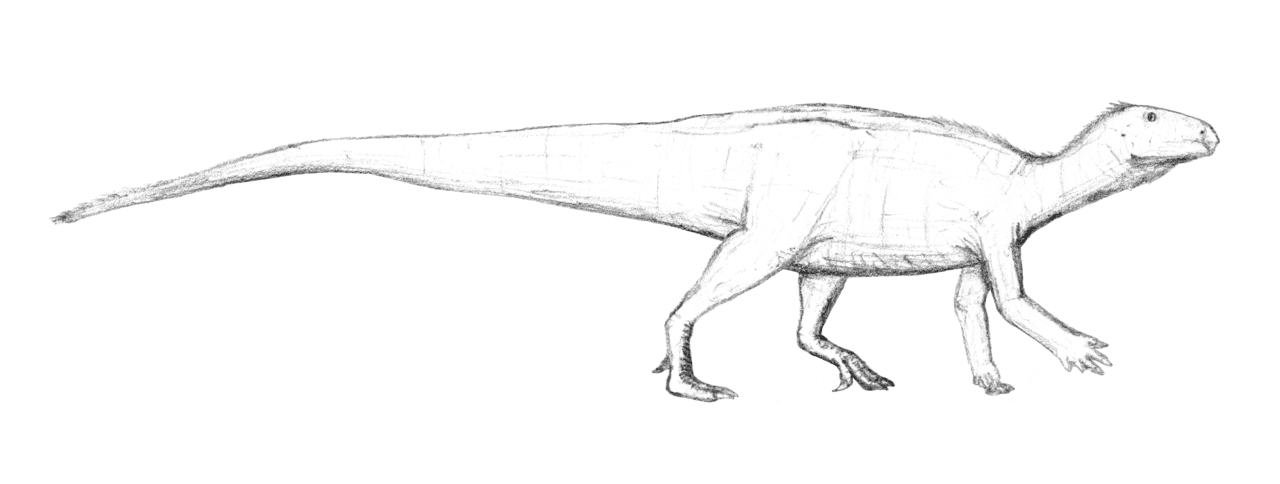
Life restoration of Iguanodon bernissartensis
Nobu Tamura, CC BY-SA 4.0, via Wikimedia Commons
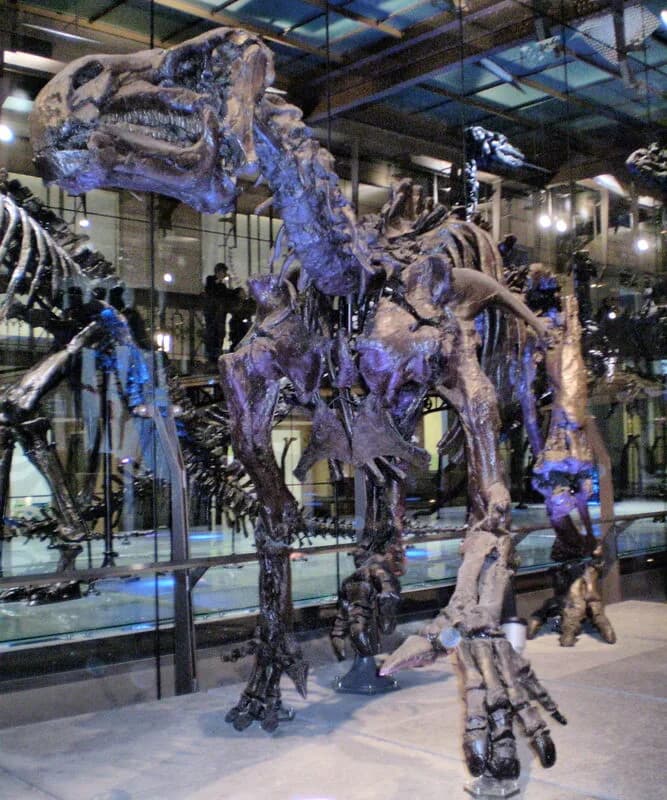
Iguanodon skeleton from Bernissart, RBINS
Ben2, CC BY-SA 3.0