Bon lézard maternel
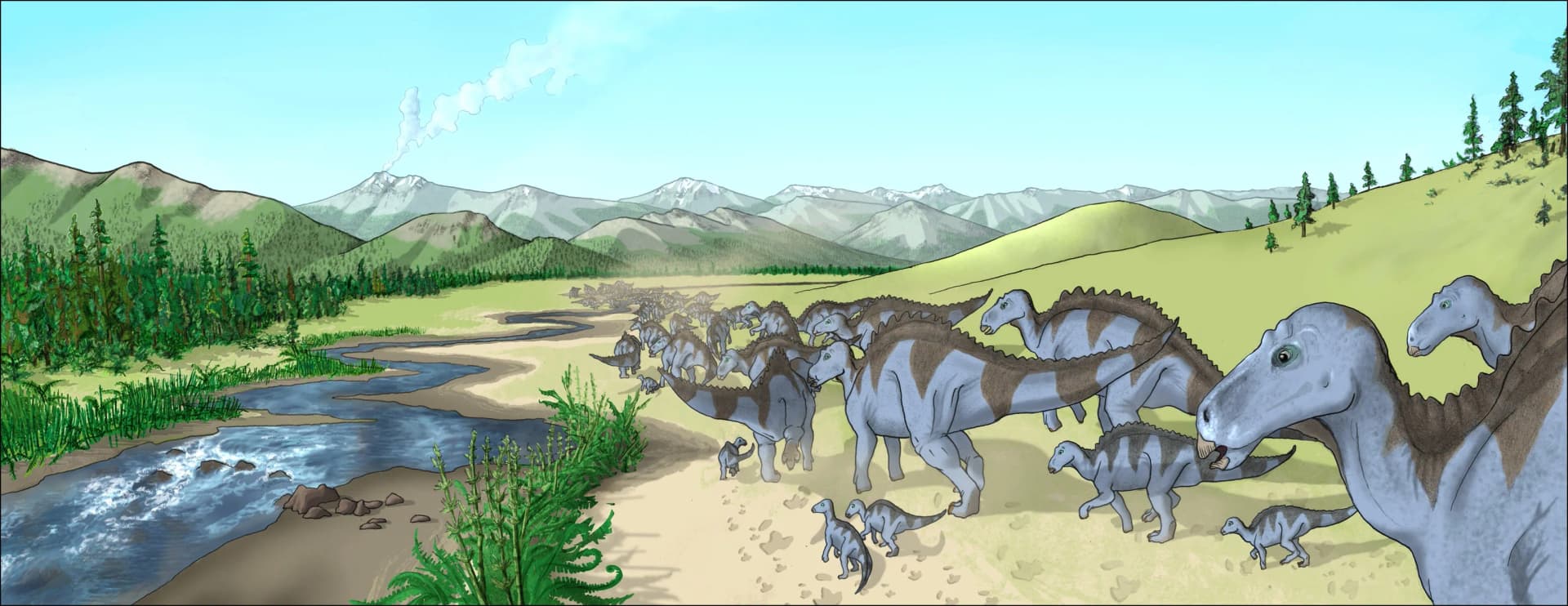
Maiasaura peeblesorum is the first dinosaur for which parental care was demonstrated: nests holding young too underdeveloped to leave the site were uncovered in Montana, hence its name « good mother lizard ». Described in 1979, it measured about 9 metres and up to 4 tonnes. One Montana bone bed gathers close to ten thousand individuals.
2nd largest herbivore in the game. Fast for its size but very hard to maneuver. Can switch between biped (claws) and quadruped (kicks) with CTRL/SPACE. Not recommended for beginners.
Playable in The Isle: Evrima
See Maiasaura peeblesorum's in-game stats, tier, strengths & weaknesses on our server.
Maiasaura lived during the Late Cretaceous period, approximately 86.3 to 70.6 million years ago, spanning the Santonian to Campanian stages. This large saurolophine hadrosaur evolved in the coastal plains of present-day Montana and the Canadian province of Alberta. An iconic fossil discovery, it is today recognized as the official state fossil of Montana. Its paleontological importance is truly immense: the discoveries of massive nesting sites at the famous Egg Mountain locality revolutionized our understanding of parental behavior in non-avian dinosaurs, proving for the first time that a dinosaur species actively fed and cared for its young within the nest.
Maiasaura reached approximately 9 meters in length with an estimated weight of up to 4 metric tons. Juveniles walked mainly on two legs; adults adopted a primarily quadrupedal posture as they grew larger. Its broad head featured a toothless 'duck-billed' front, but housed complex dental batteries with hundreds of continuously replaced teeth for grinding fibrous vegetation. A small solid crest between the eyes characterized its cranial profile — possibly used in male jousting contests. Growth was rapid: hatchlings measured between 41 and 147 cm during their first year. A study of 50 tibiae revealed notable sexual dimorphism: one sex was approximately 45% larger than the other.
A strict herbivore, Maiasaura was both a browser and a grazer with a remarkably varied diet: its food sources included fibrous plants, wood, rotting wood, bark, leaves, branches, ferns, and angiosperms — and possibly primitive grasses that were just beginning to diversify during the Late Cretaceous. Coprolites analyzed in 2007 by Chin (published in Paleobiology) confirmed the consumption of rotting wood, an unusual food source among dinosaurs. Its mosaic dental batteries, continuously self-replacing throughout the animal lifetime, allowed it to process even the toughest foodstuffs with remarkable efficiency. It shared food resources with other contemporary hadrosaurs such as Hypacrosaurus and Gryposaurus latidens.
Maiasaura inhabited the semi-arid floodplains and riparian forested zones of the Two Medicine Formation (Montana), dated 86.3 to 70.6 Ma. These Campanian landscapes were marked by volcanic ash layers, conifers, ferns, and horsetails. Maiasaura coexisted with the troodontids Troodon and Stenonychosaurus, the ornithopod Orodromeus, the dromaeosaurid Bambiraptor, and the tyrannosaurid Daspletosaurus. In the Oldman Formation (Alberta), its fauna also included ceratopsians (Chasmosaurus, Coronosaurus, Wendiceratops) and hadrosaurs (Brachylophosaurus, Corythosaurus, Parasaurolophus). Herds could reach 10,000 individuals according to mass bone bed evidence.
Maiasaura anatomy combines adaptations for bipedal locomotion (juveniles and fast-moving adults) and quadrupedal locomotion (resting or slowly walking adults). A small solid crest between the eyes — less developed than in crested hadrosaurs — may have served in ritual combat between males. Robust forelimbs and a broad muscular tail completed the morphology of this large herbivore. Juveniles showed different cranial proportions from adults: large eyes and a short snout — traits associated with triggering parental care in altricial animals. Un-fused cranial bones in neonates confirm very rapid post-hatching growth.
Maiasaura is the dinosaur with the best-known population biology in the world, thanks to the study of 50 individual tibiae (Woodward et al., 2015). Mortality rates: 89.9% in the first year; if they survived, it dropped to 12.7% through age 8 (skeletal maturity). Sexual maturity was reached as early as year 3. Fossil nests at Egg Mountain (Choteau, Montana) contained 30 to 40 ostrich-sized eggs arranged in circular or spiral patterns, incubated by rotting vegetation heat (parents did not brood). Fossilized eggs are black with prominent ridges. Hatchlings, helpless at birth, were fed by parents in the nest for 40–75 days. Nests within a colony were spaced roughly 7 meters apart — less than one adult body length — similar to modern colonial seabirds.
The first remains of Maiasaura were discovered in 1978 by Laurie Trexler in the Two Medicine Formation near Choteau, Montana. Marion Brandvold discovered a nest with eggs and embryos nearby the same year. The species was formally described in 1979 by Jack Horner and Robert Makela. The name 'peeblesorum' honors the families of John and James Peebles, who owned the land. Over 200 specimens have been identified, representing all life stages — making it the dinosaur species with the best-known ontogenetic record. In 1985, a Maiasaura bone fragment was taken to space by astronaut Loren Acton aboard the Challenger shuttle, making Maiasaura the first dinosaur in space.
| Period | Crétacé supérieur / Late Cretaceous |
| Era | Mésozoïque / Mesozoic |
| Age | 86.3-70.6 Ma |
| Location | Amérique du Nord (Montana, Alberta) / North America (Montana, Alberta) |
| Length | ~9 m |
| Height | 3 m |
| Weight | jusqu'à 4 tonnes / up to 4 metric tons |
| Diet | Herbivore |
| Discovery | 1979 |
| Type (in-game) | Herbivore |
| Tier | Sub-Apex |
Maiasaura peeblesorum is the first dinosaur for which direct evidence of parental care was established. Fossilized nests from Egg Mountain (Choteau, Montana, described by Jack Horner in 1979) contained babies with worn teeth — proof they were fed by parents in the nest for 40 to 75 days. The unfused cranial bones of neonates confirm they were altricial (helpless at birth).
Maiasaura peeblesorum reached approximately 9 meters long with a weight up to 4 tonnes at adulthood. Growth was rapid: hatchlings measured 41 to 147 cm in the first year alone. Sexual maturity was reached as early as year 3, and skeletal maturity around age 8. A study of 50 tibiae (Woodward et al., 2015) revealed a mortality rate of 89.9% in the first year.
In 1985, a Maiasaura peeblesorum bone fragment was taken to space by astronaut Loren Acton aboard the Space Shuttle Challenger (Spacelab 2 mission), making Maiasaura the first dinosaur to travel to space. This symbolic gesture celebrated this iconic Montana dinosaur, which is also the official state fossil of Montana since 1985.
Information on this page is based on peer-reviewed scientific publications.
Maiasaura skeleton mount
Wikipedia Commons
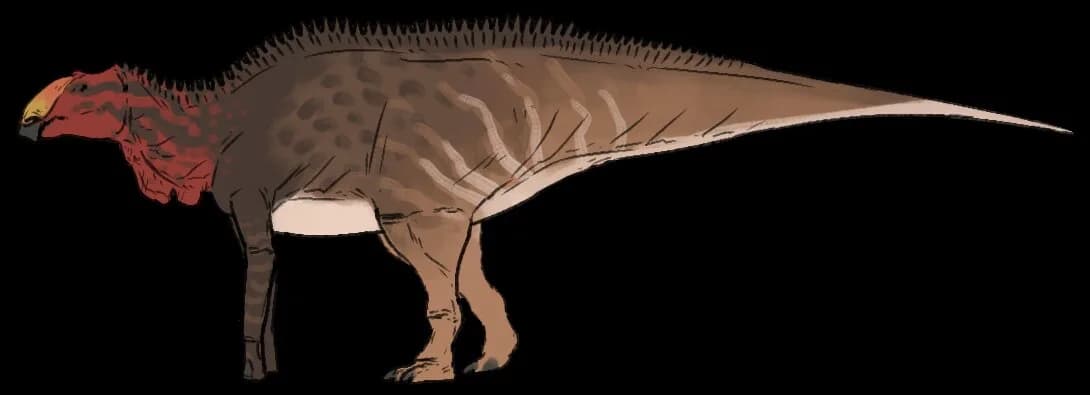
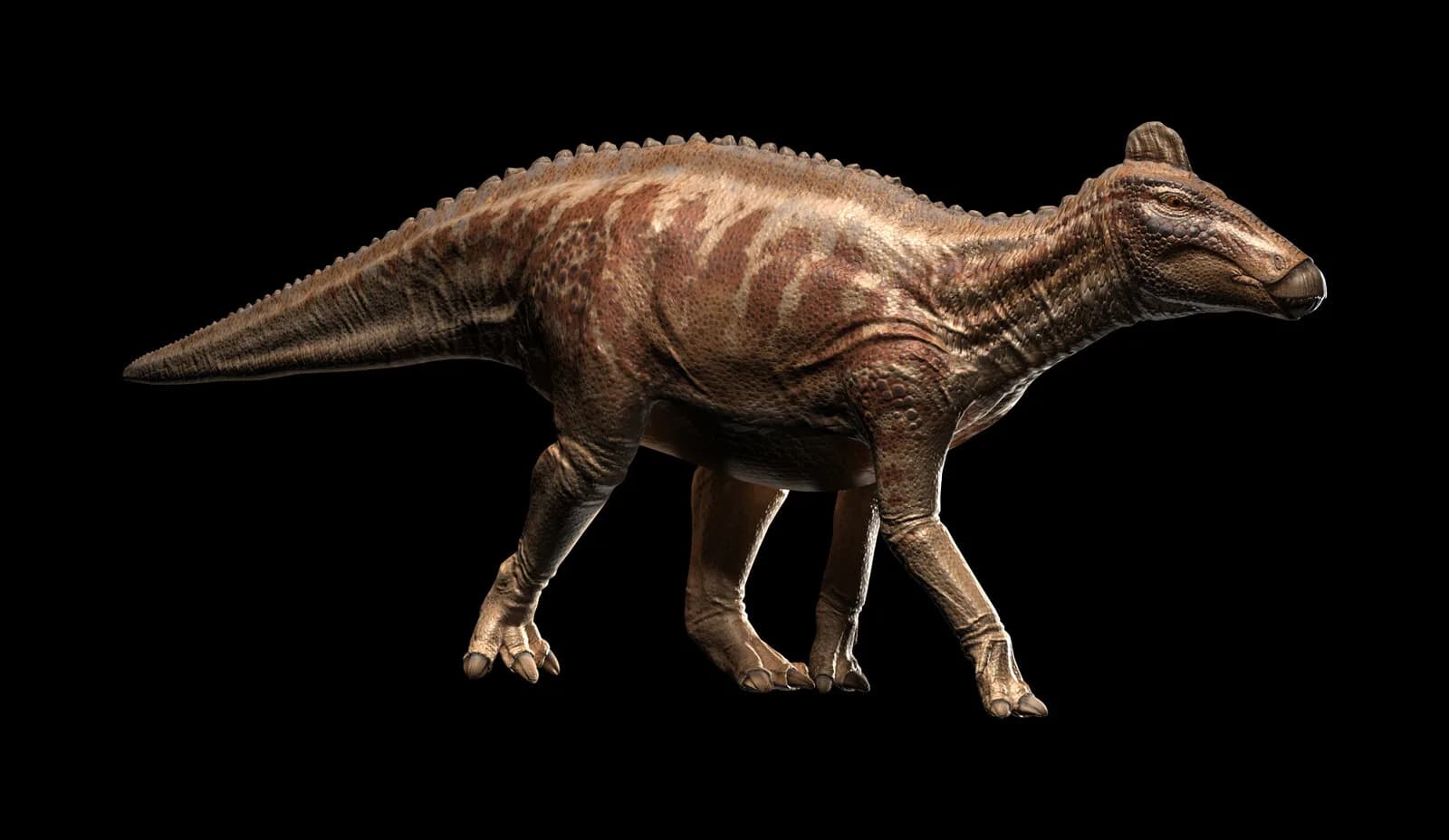
Maiasaura peeblesorum life reconstruction
Connor Ashbridge, CC BY-SA 4.0