Parasaurolophus
Parasaurolophus walkeri was a herbivorous hadrosaur from North America, described in 1922 and dated to 76 to 73 million years ago. It reached 9 to 10 metres and 2.5 to 4 tonnes, carrying a hollow crest roughly 1 metre long connected to its airways. Acoustic simulations have reconstructed the sound it produced: a low note carrying for several kilometres.
Parasaurolophus lived in the Late Cretaceous, approximately 76 to 73 million years ago, during the Campanian stage. It is the most iconic hadrosaur thanks to its spectacular tubular crest that has held the attention of public imagination since its discovery. It belonged to the Lambeosaurinae subfamily, hollow-crested hadrosaurs that reached great diversity in the Campanian of North America. Parasaurolophus coexisted with other crested hadrosaurs like Corythosaurus and Lambeosaurus, as well as ceratopsians and tyrannosaurids. The Campanian was a period of great dinosaur diversity, just before the final Maastrichtian decline.
A large hadrosaur 9 to 10 meters long and weighing 2,500 to 4,000 kg, roughly the size of a small elephant. Its hollow crest could reach 1.8 meters in length in large males, making Parasaurolophus one of the hadrosaurs with the most spectacular crest. Sexual dimorphism was probably marked: males possessed longer, straighter crests than females. Its robust body rested on powerful hind legs, allowing fast bipedal locomotion to flee predators. It could also walk on all fours to feed at ground level. Its long, muscular tail served as a counterbalance during bipedal locomotion.
Herbivorous, Parasaurolophus consumed conifers, palms, ferns, and other Cretaceous plants. Its dental battery, featuring hundreds of teeth organized in replacement columns, allowed it to efficiently grind even the toughest vegetation. Worn teeth were continuously replaced, ensuring an always-functional chewing surface. Its toothless beak at the front of the snout cut stems and leaves, while the posterior dental batteries ground plant material. Microwear analyses suggest a mixed diet including tender plants and tougher plant materials. Its size and significant caloric needs probably required it to spend much of the day feeding.
Parasaurolophus lived in coastal forests and floodplains of North America, primarily in the regions of Alberta (Canada), New Mexico, and Utah (United States). The Campanian environment of these regions was warm subtropical with abundant waterways, dense forests, and marshy plains. The Western Interior Seaway, which divided North America in two, created coastal conditions favorable to lush vegetation. The Dinosaur Park (Alberta) and Kirtland (New Mexico) geological formations have yielded the main Parasaurolophus fossils. The water-rich nature of these environments explains the exceptional diversity of hadrosaurs in these regions, with several species coexisting through differentiation of their food niches and acoustic signals.
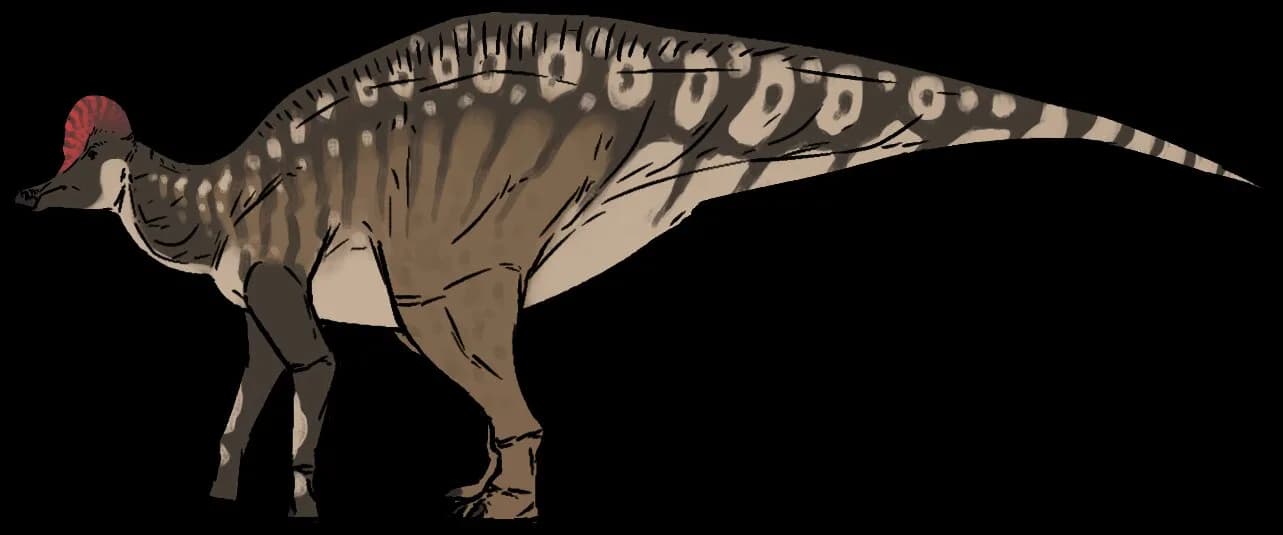
The most remarkable anatomy of Parasaurolophus is its hollow, backward-curved tube-shaped crest forming a natural acoustic resonator. The nasal cavities traversed the entire crest in a complex circuit of tubes — inhaled air traveled the full length of the crest before reaching the lungs, creating a resonance system unique in the animal kingdom. The total length of nasal passages within the crest exceeded 2 meters in large adults. This delicate but rigid bony structure was supported by a system of cartilage and connective tissue. The rest of the body was that of a typical hadrosaur: a toothless beak (duck bill), complex dental batteries, robust hind limbs, and four-fingered hands. Its skin, known from fossil impressions of other hadrosaurs, probably bore polygonal scales of varying sizes.
Parasaurolophus very likely used its crest to emit deep, resonant sounds, like a natural wind instrument, for communication, attracting mates, or alerting the herd to approaching predators. Modern acoustic simulations have reproduced these sounds, similar to a deep horn or baritone trombone — low frequencies that could carry several kilometers through dense forests. Each lambeosaurine species had a differently shaped crest, producing distinct sounds, enabling intraspecific recognition in an environment where several similar species coexisted. The crest also likely served as a visual display for sexual recognition and social hierarchy. Parasaurolophus lived in large herds, as suggested by fossil accumulations of related hadrosaurs. Its fast bipedal locomotion capability (estimated at 40-50 km/h) allowed it to flee predators such as tyrannosaurids.
Described in 1922 by William Parks from a specimen discovered in Alberta, Canada. Three species are recognized: P. walkeri (Alberta), P. tubicen (New Mexico), and P. cyrtocristatus (Utah). An exceptional juvenile specimen found in New Mexico in 1995 helped better understand crest growth, revealing that it developed progressively with age. Specimen RAM 14000 has one of the most complete and best-preserved crests. Parasaurolophus fossils have been found in the Dinosaur Park, Kirtland, and Fruitland formations. The relative rarity of Parasaurolophus compared to other hadrosaurs like Edmontosaurus or Corythosaurus remains unexplained. CT-scan studies of the crests have mapped the internal nasal passages without damaging the precious fossils.
| Period | Crétacé supérieur / Late Cretaceous (Campanien) |
| Era | Mésozoïque / Mesozoic |
| Age | 76–73 Ma |
| Location | Amérique du Nord / North America (Alberta, Utah, Nouveau-Mexique) |
| Length | 9–10 m |
| Height | ~4 m |
| Weight | 2 500–4 000 kg |
| Diet | Herbivore |
| Discovery | 1922 |
The crest of Parasaurolophus walkeri formed a natural acoustic resonator: nasal cavities traversed the entire crest in a tube circuit, with inhaled air traveling over 2 meters of passages before reaching the lungs. Modern acoustic simulations reproduced the resulting sound — similar to a low horn or baritone trombone. These low frequencies carried several kilometers through dense forests, enabling herd communication and predator alerts.
Three Parasaurolophus species are recognized: P. walkeri (Alberta, described by Parks in 1922), P. tubicen (New Mexico), and P. cyrtocristatus (Utah). Each species had a slightly different crest shape, producing distinct sounds. This variation enabled intraspecific recognition in environments where several crested lambeosaurines coexisted. A juvenile specimen from New Mexico found in 1995 showed that the crest developed progressively with age.
Parasaurolophus walkeri measured 9 to 10 meters long and 2,500 to 4,000 kg, supported on powerful hindlimbs. Its fast bipedal locomotion capability is estimated at 40-50 km/h, allowing it to outpace tyrannosaurids over short distances. It could also walk quadrupedally to graze. Living in large herds enhanced collective safety, with each individual able to detect predators and trigger loud alarm calls through its crest.
Information on this page is based on peer-reviewed scientific publications.
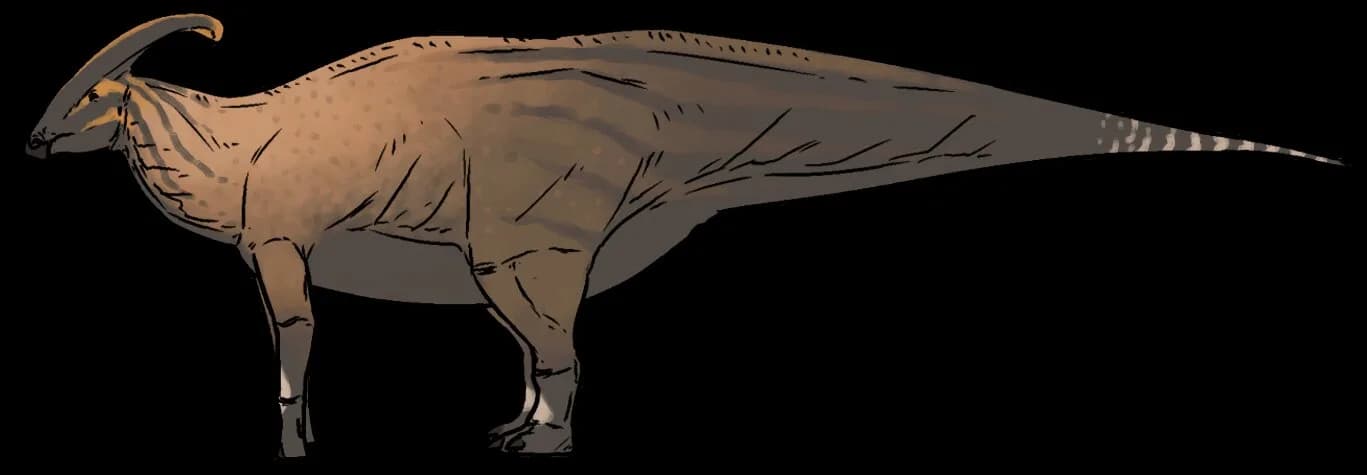
Life reconstruction of Parasaurolophus walkeri
Connor Ashbridge, CC BY-SA 4.0, via Wikimedia Commons
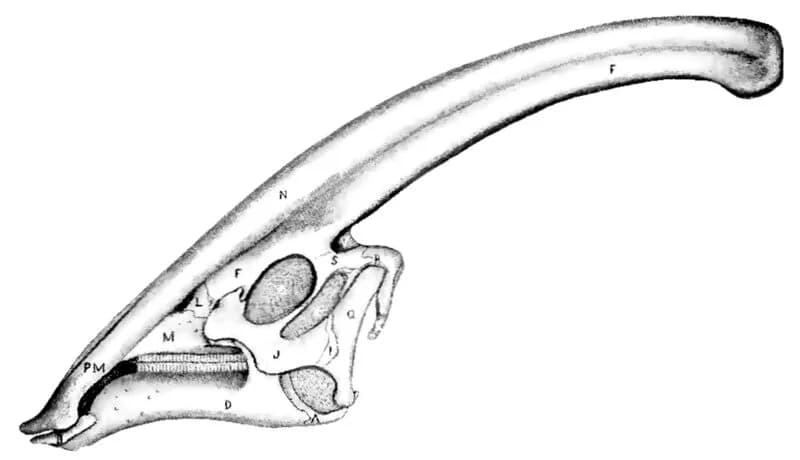
Original Parasaurolophus walkeri illustration by W.A. Parks
W. A. Parks, Public domain