Kentrosaurus
Kentrosaurus aethiopicus is the African stegosaur, unearthed in Tanzania during the German Tendaguru expedition and described in 1909. At 4.5 to 5 metres and 320 kilograms to a tonne, it lived 155 to 150 million years ago. Its rear half carries spikes rather than plates, making it a more defensive animal than the American Stegosaurus.
New arrival on the Evrima Public Branch (patch 0.21.720). This small stegosaurid fights back instead of fleeing: its back and tail spikes deal reflection damage to anything that hits it in melee. Its Defensive Stance amplifies that reflection and blocks certain enemy abilities, while its Power Swing delivers a charged tail attack. In-game stats coming soon — tier and exact values will be adjusted once balance is confirmed live.
Playable in The Isle: Evrima
See Kentrosaurus aethiopicus's in-game stats, tier, strengths & weaknesses on our server.
Playable in Path of Titans
See Kentrosaurus aethiopicus's stats, abilities and role on our survival server.
Kentrosaurus lived in the Late Jurassic, approximately 155 to 150 million years ago. An African cousin of North American Stegosaurus, it represents the stegosaurid lineage at its peak diversity. At that time, Africa and North America were still partially connected, allowing faunal exchanges between the two continents. The Tendaguru Formation of Tanzania, where Kentrosaurus was discovered, is one of Africa's most important fossil deposits, rivaling the Morrison Formation in North America for the richness of its Jurassic fauna. Kentrosaurus coexisted with the giant sauropod Giraffatitan (formerly 'Brachiosaurus' brancai) and the theropod Elaphrosaurus.
Smaller than Stegosaurus: 4.5 to 5 meters long and 320 to 1,000 kg. Despite its modest size, its spike arrangement was proportionally far more developed and dangerous than in its cousins. Its low, compact body with a low center of gravity ensured great stability during defensive tail movements. Its head, tiny relative to its body (a trait common to stegosaurids), contained a brain the size of a walnut. The posterior part of its body was considerably higher than the front, with raised hips giving it a characteristic forward-sloping silhouette.
A strict herbivore, Kentrosaurus consumed ferns, cycads, and low vegetation. Its toothless beak at the front and small teeth at the back indicate a diet of soft plant material — it could not chew tough vegetation like horsetails or hard conifers. Its small head limited the amount of food it could ingest per bite, implying it spent much time feeding. Like other stegosaurids, it fed exclusively at ground level and low height, unable to raise its head beyond about one meter. Gastroliths may have helped digest plant fibers in its voluminous digestive system.
Kentrosaurus lived in river plains and forests of what is now Tanzania, in the Tendaguru Formation. This environment was subtropical with a pronounced dry season, seasonal rivers bordered by conifer forests, and open plains covered with ferns. Tendaguru, located in southeastern Tanzania, was in the Late Jurassic a coastal area near the Tethys Sea, with conditions similar to the Morrison Formation in North America. German expeditions from 1909-1913 revealed a remarkably diverse Jurassic ecosystem, with giant sauropods, stegosaurs, theropods, and ornithopods. Semi-arid environmental conditions with drought episodes explain some of the massive fossil accumulations found at Tendaguru.
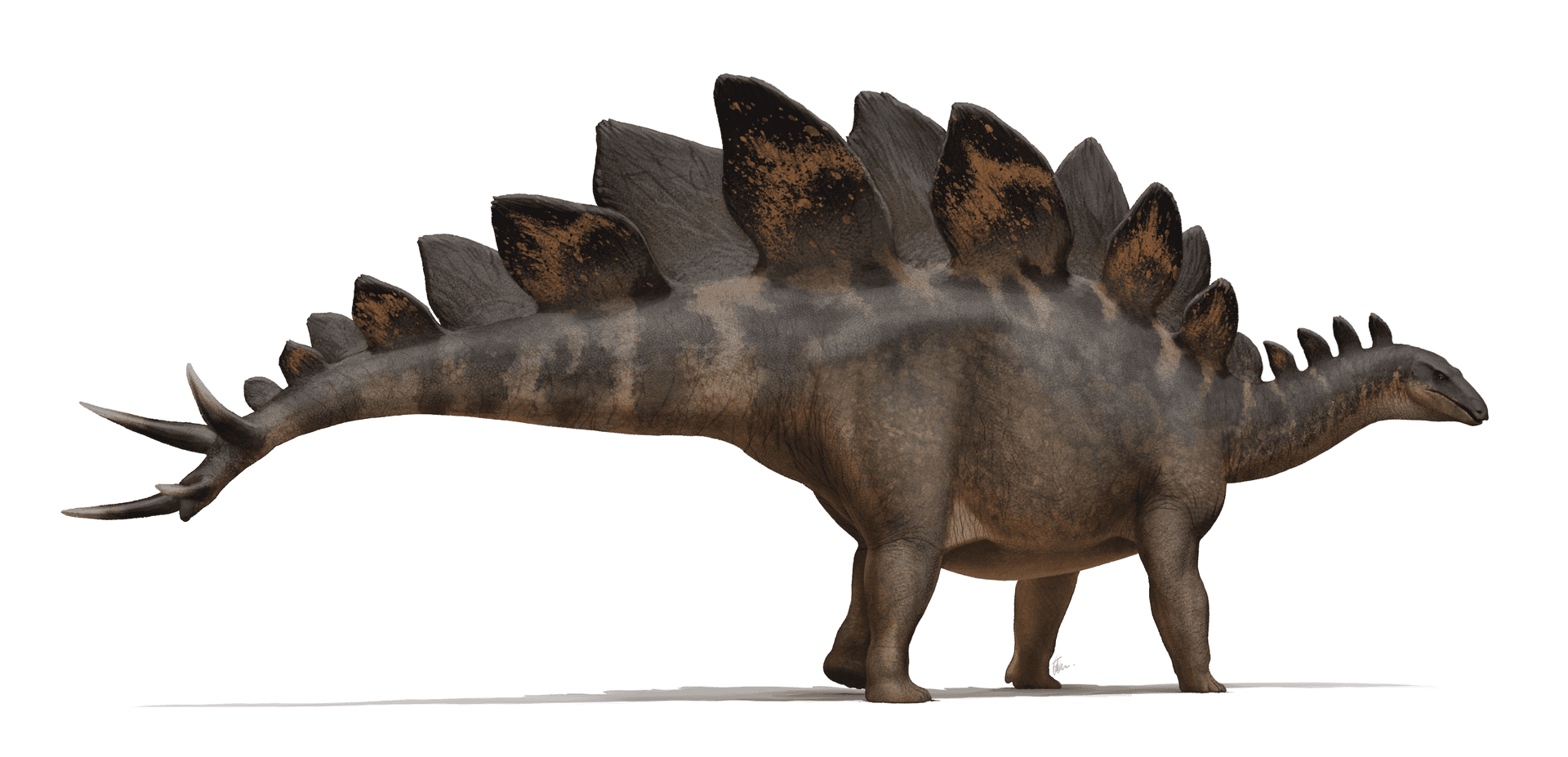
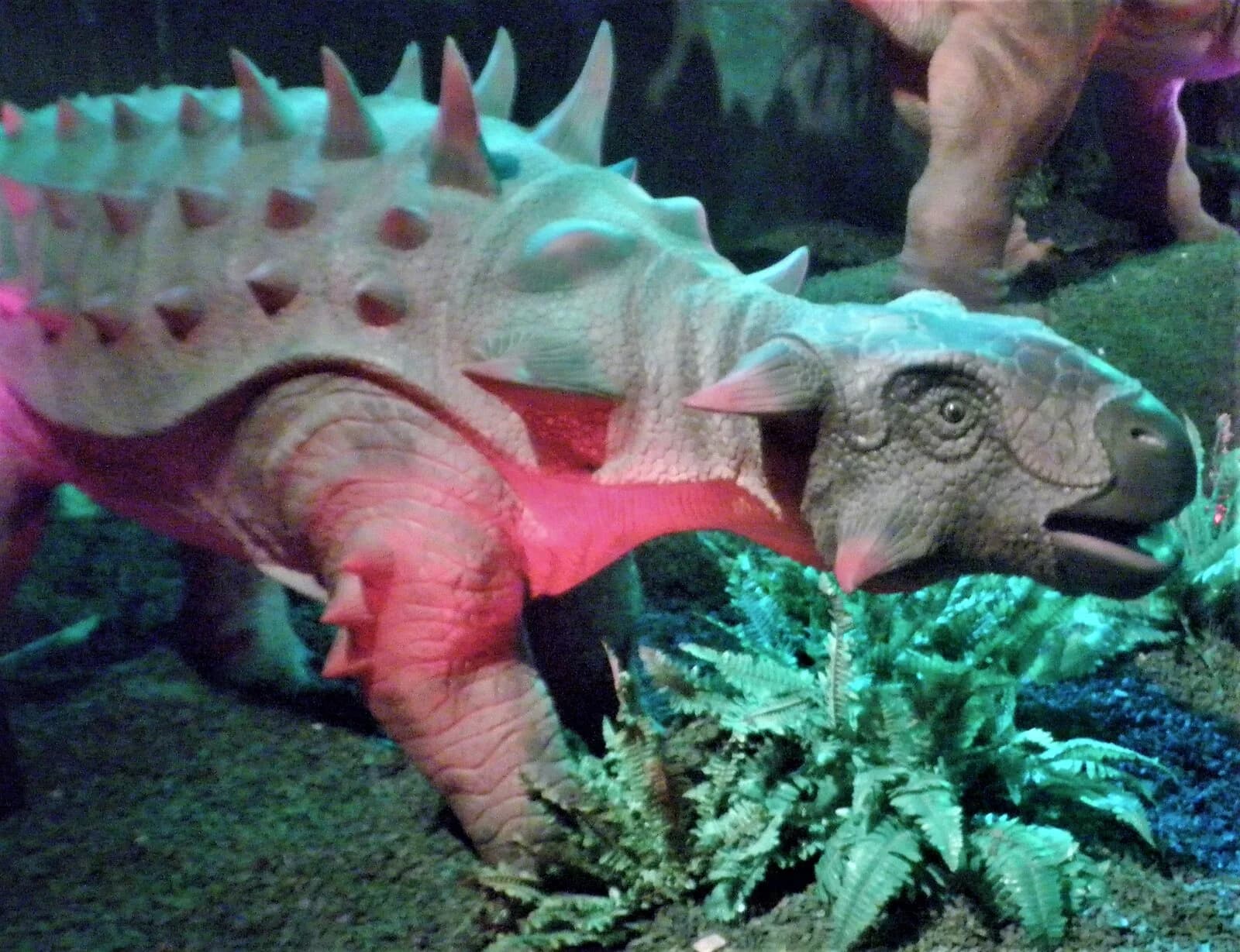
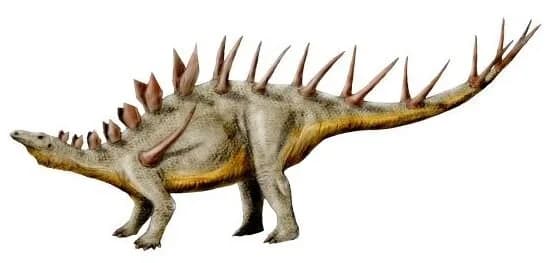
Kentrosaurus's vertebral column bore flattened bony plates on the neck and back, but sharp spikes up to 60 cm long on the hips, tail, and shoulders. This plate/spike combination is more extreme than in Stegosaurus, with a gradual transition from plates to spikes going from front to back. The spikes were probably keratinized in life, making them even longer and sharper than the bones alone suggest. A pair of long spikes emerged from the shoulders (parascapular), offering lateral protection against predators approaching from the flank. Its tail was flexible and muscular, capable of rapid and powerful movements to use the spikes as an offensive weapon. Kentrosaurus's brain was tiny — about 20 ml in volume — which long fueled the myth of a 'second brain' in the hips (actually a glycogenic enlargement of the spinal cord).
The tail armed with long, sharp spikes was a terribly effective defensive weapon. Biomechanical simulations showed Kentrosaurus could swing its tail at high speed, generating force sufficient to seriously injure or even kill any predator like Ceratosaurus or Allosaurus. Unlike Ankylosaurus's club which crushed, Kentrosaurus's spikes pierced and lacerated, causing potentially fatal hemorrhaging. Its defensive behavior probably consisted of turning its hindquarters toward the attacker, presenting its battery of spikes while protecting its vulnerable head. Massive fossil accumulations at Tendaguru suggest gregarious behavior, with individuals perhaps gathering for migration or around water sources. Stegosaurids were probably rather slow and sedentary animals, relying on their defensive armament rather than flight for survival.
Hundreds of specimens were excavated at Tendaguru, Tanzania, between 1909 and 1913 by German expeditions led by Werner Janensch. These massive excavations, involving hundreds of local workers, were one of the largest paleontological enterprises in history. The Natural History Museum in Berlin holds the most complete composite skeleton in the world, reconstructed from multiple individuals. Over 900 Kentrosaurus bones were recovered from Tendaguru, representing dozens of individuals from all growth stages. Unfortunately, a significant portion of the original material was lost during the bombing of Berlin in World War II. The type species, K. aethiopicus, was described in 1915 by Edwin Hennig. Tendaguru remains a major paleontological site, though access and funding conditions limit modern excavations.
| Period | Jurassique supérieur / Late Jurassic |
| Era | Mésozoïque / Mesozoic |
| Age | 155–150 Ma |
| Location | Afrique / Africa (Tanzanie / Tanzania) |
| Length | 4.5–5 m |
| Height | ~1.8 m |
| Weight | 320–1 000 kg |
| Diet | Herbivore |
| Discovery | 1909 |
| Type (in-game) | Herbivore |
| Tier | Tier 3 |
Kentrosaurus aethiopicus measured 4.5 to 5 metres (320–1,000 kg) versus 9 metres for Stegosaurus. Its main difference lies in its ornamentation: Kentrosaurus bore plates on the front and long sharp spikes (up to 60 cm) on the hips, tail, and shoulders, a more aggressive armament than its North American cousin.
Kentrosaurus aethiopicus lived 155 to 150 million years ago in the plains and forests of present-day Tanzania (Tendaguru Formation). This site is one of Africa's richest Jurassic deposits, rivalling the North American Morrison Formation, where Kentrosaurus coexisted with the sauropod Giraffatitan.
Biomechanical simulations show that Kentrosaurus aethiopicus could swing its tail at high speed, generating enough force to seriously injure an Allosaurus or Ceratosaurus. Unlike Ankylosaurus's club which crushed, Kentrosaurus's spikes pierced and lacerated, causing potentially fatal haemorrhaging.
Life reconstruction of Kentrosaurus aethiopicus
Nobu Tamura, CC BY-SA 3.0, via Wikimedia Commons
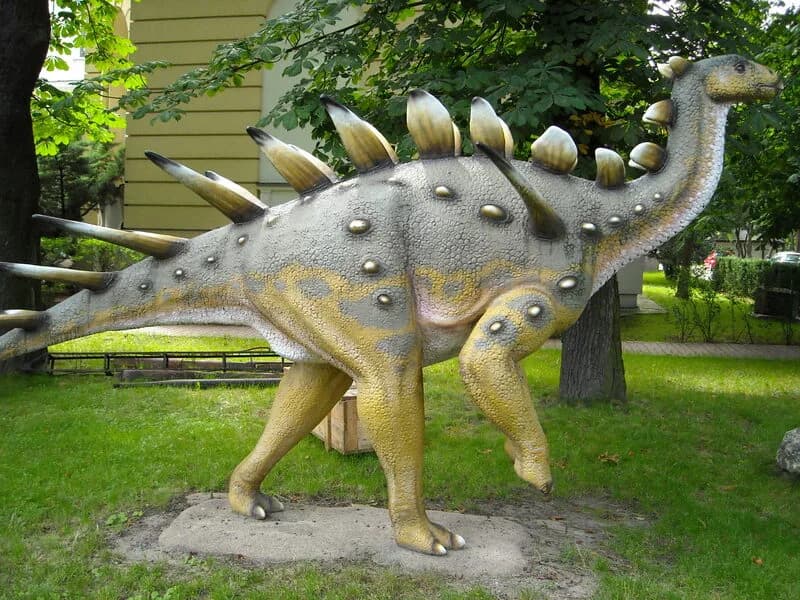
Mounted Kentrosaurus aethiopicus skeleton
Wikipek, CC BY 3.0