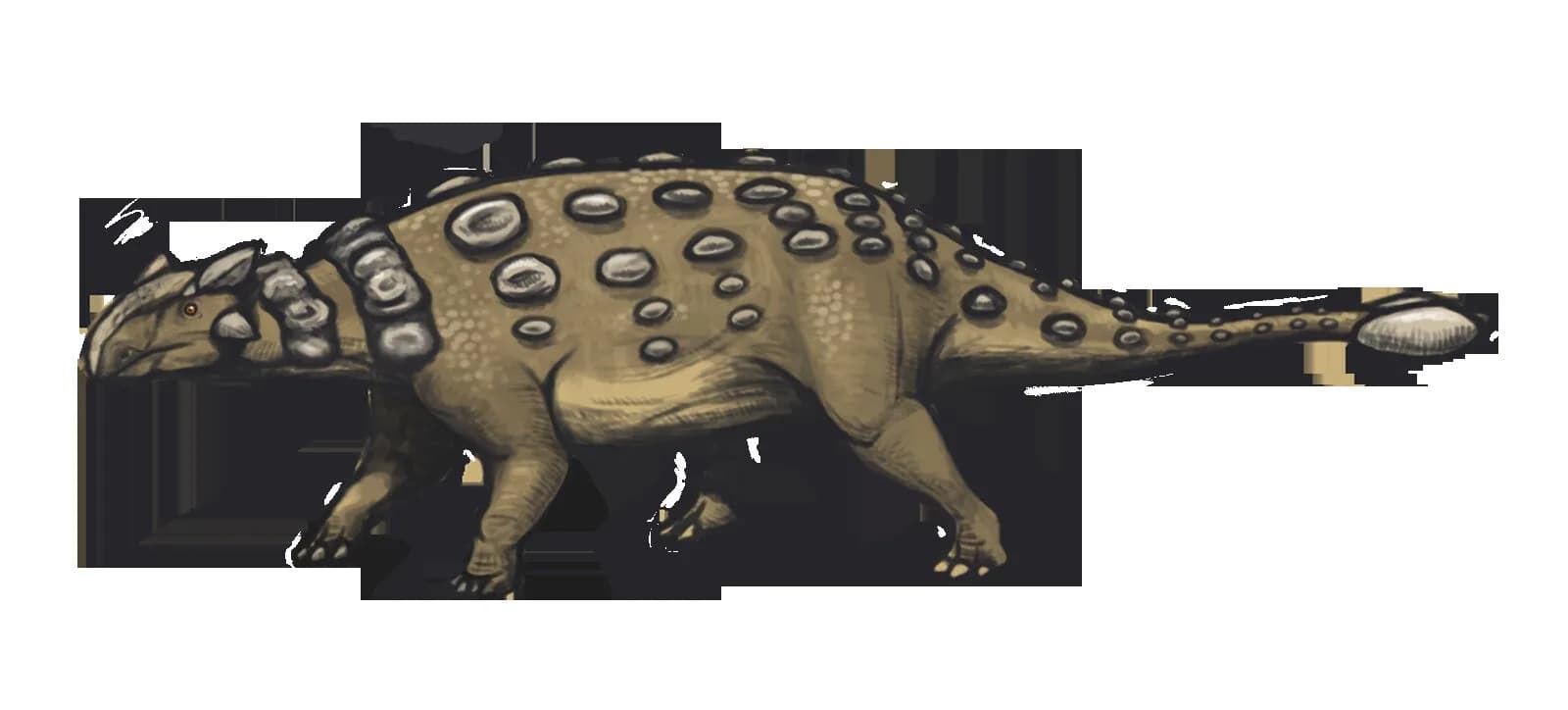
Ankylosaure
Ankylosaurus magniventris was an armoured herbivore from North America, described in 1908 and a contemporary of Tyrannosaurus rex 68 to 66 million years ago. It measured 6 to 8 metres and weighed 4 to 8 tonnes, covered in fused bony plates that give it the name fused lizard. Its tail club could break bone; when threatened it pressed flat to the ground to shield its belly.
Ankylosaurus lived in the very Late Cretaceous, approximately 68 to 66 million years ago, during the Maastrichtian stage. It was one of the last and largest ankylosaurs, contemporary with Tyrannosaurus and Triceratops in the final dinosaur ecosystems before the K-Pg extinction. It was among the last non-avian dinosaurs to walk the Earth, disappearing during the Chicxulub asteroid impact. The Maastrichtian was a period of gradual decline in dinosaur diversity according to some researchers, though this hypothesis remains debated. Ankylosaurus represents the evolutionary pinnacle of its group, with armor and defensive weaponry pushed to the extreme.
The largest known ankylosaur: 6 to 8 meters long and 4,000 to 8,000 kg, roughly the size of a modern tank. Despite its mass, its low, wide body plan allowed some agility and remarkable stability. Its dorsal armor covered an area of several square meters, forming a virtually impenetrable bony shell. Its width at the hips reached about 1.7 meters, giving it a very low center of gravity. The skull itself was armored, with triangular horns at the rear corners and fused bony plates covering the upper surface. Its tail club, one of the most formidable biological weapons in the animal kingdom, weighed approximately 30 to 60 kg.
A strict herbivore, Ankylosaurus grazed on low vegetation — ferns, cycads, and small shrubs — using its wide horny beak adapted for cutting large quantities of plant matter. Its dentition was relatively simple for a dinosaur of this size: small leaf-shaped teeth poorly suited for intensive grinding. This dentition suggests it swallowed food in large pieces, relying on a voluminous digestive system to ferment cellulose. Its wide snout indicates non-selective feeding — it grazed on whatever was within reach. Gastroliths may have aided mechanical digestion of food. Its massive body and probably slow metabolism meant it didn't need as much food as its size might suggest.
Ankylosaurus lived in the forests and plains of Cretaceous North America. The Hell Creek Formation, where most specimens have been found, represented a humid subtropical environment with meandering rivers, swamps, and dense forests of sequoias, cypresses, and angiosperms. It was one of the last dinosaur ecosystems in North America, harboring diverse fauna including Tyrannosaurus rex, Triceratops, Edmontosaurus, and pachycephalosaurs. The climate was significantly warmer than today in the same region, with mean annual temperatures exceeding 20°C. The region's major rivers drained toward the Western Interior Seaway, which was gradually retreating.
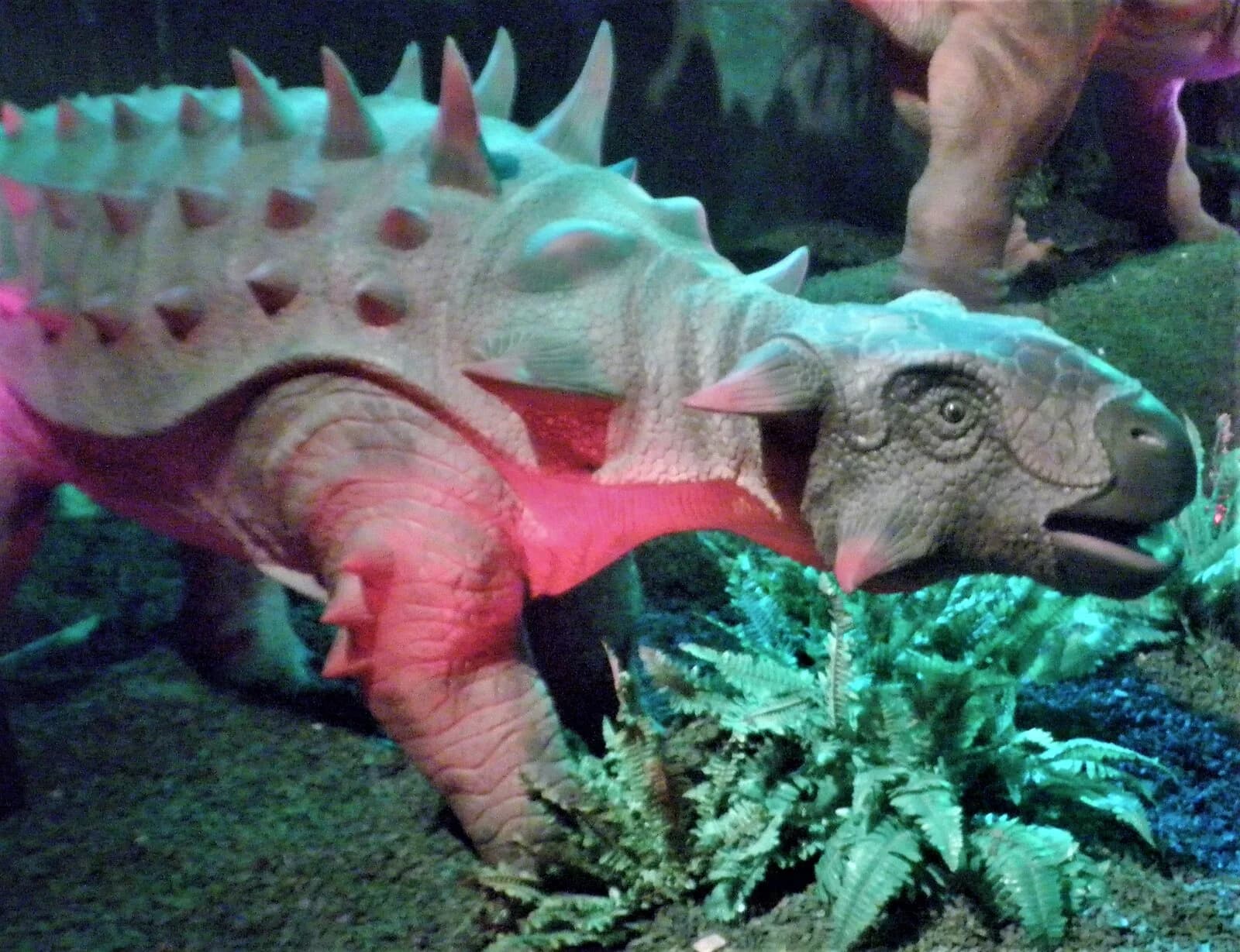
Ankylosaurus anatomy is a textbook case of defensive adaptation pushed to the extreme. Its armor was exceptional: bony plates (osteoderms) of various sizes, embedded in the skin, covered the back, neck, flanks, and even the top of the head. These osteoderms were reinforced with collagen and a keratin layer, making them even more resistant than bone alone. Its tail ended in a bony club formed from several osteoderms fused to the last caudal vertebrae, weighing 30 to 60 kg and capable of generating an estimated impact force of 3,800 Newtons. Even its eyelids were armored with bony plates, offering total eye protection from predator bites. A secondary palate in its skull allowed it to eat and breathe simultaneously, an advanced adaptation. Its nostrils featured a complex chamber system that warmed and humidified inhaled air.
Ankylosaurus's tail club was a formidable defensive weapon, capable of breaking the leg bones of an attacking Tyrannosaurus. Biomechanical simulations showed the tail could be swung with enough force to fracture a tyrannosaur tibia. When facing a predator, Ankylosaurus probably adopted a low defensive posture, pressing itself to the ground to protect its unarmored belly — its only real vulnerability. Ankylosaurus fossils found flipped onto their backs in river deposits suggest that carcasses, floating belly-up due to decomposition gases, ended up on their backs when they washed ashore. Ankylosaurs were probably solitary animals or lived in small groups, moving slowly through their environment searching for low vegetation. Their slow metabolism and armored protection allowed them to survive on less food than comparably-sized but unarmored herbivores.
The first Ankylosaurus specimen was described in 1908 by the famous paleontologist Barnum Brown, known as 'the man who found T. rex.' Surprisingly rare despite its popularity: fewer than 5 specimens are known, and most are incomplete, making its exact dimensions difficult to establish with certainty. The holotype (AMNH 5895) includes the skull top, vertebrae, ribs, and osteoderms. The most complete specimen, found in Montana in 1910, confirmed the presence of the characteristic tail club. Fossils have been found primarily in Montana and Alberta. Ankylosaurus's rarity in the fossil record contrasts with its great popularity with the public and in popular culture. This rarity could be explained by a forested habitat unfavorable for fossilization, or by a low population density in its ecosystem.
| Period | Crétacé supérieur / Late Cretaceous (Maastrichtien) |
| Era | Mésozoïque / Mesozoic |
| Age | 68–66 Ma |
| Location | Amérique du Nord / North America (Montana, Wyoming, Alberta) |
| Length | 6–8 m |
| Height | ~1.7 m |
| Weight | 4 000–8 000 kg |
| Diet | Herbivore |
| Discovery | 1908 |
The tail club of Ankylosaurus magniventris was formed from several osteoderms fused to the last caudal vertebrae. It weighed 30 to 60 kg and could generate an estimated impact force of 3,800 Newtons according to biomechanical simulations. Studies showed this force was sufficient to fracture the tibia of an attacking Tyrannosaurus rex. The animal pivoted on its hindlimbs to swing the tail laterally with precision and power.
Ankylosaurus magniventris was armored on nearly every surface: back, neck, flanks, and even eyelids bore bony plates (osteoderms) reinforced with collagen and keratin. Its only true vulnerability was the unarmored belly. Under attack, it pressed itself flat to the ground to protect this zone. Fossils found flipped upside-down in river deposits are explained by the natural belly-up floating of carcasses during decomposition.
The first Ankylosaurus magniventris specimen was described in 1908 by Barnum Brown, the paleontologist famous for discovering T. rex. Fewer than 5 specimens are known to date, most incomplete — a surprising rarity for such a popular animal. The holotype (AMNH 5895) includes the skull top, vertebrae, ribs, and osteoderms, found primarily in Montana and Alberta. This fossil scarcity may be explained by a forested habitat poorly suited for fossilization.
Information on this page is based on peer-reviewed scientific publications.
Reconstruction of Ankylosaurus magniventris
Emily Willoughby, CC BY-SA 3.0, via Wikimedia Commons
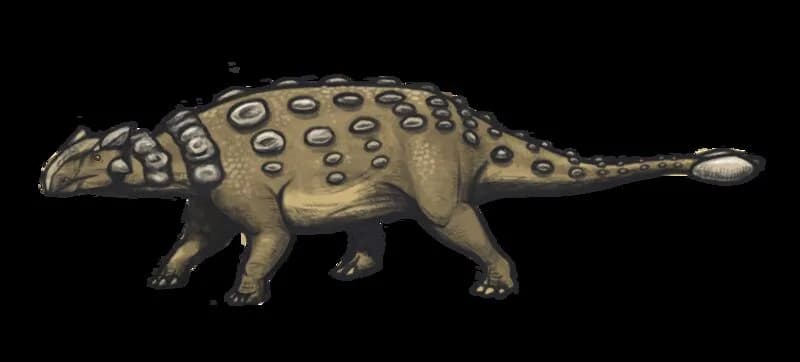
Ankylosaurus magniventris life reconstruction
Emily Willoughby, CC BY-SA 3.0