Nodosaure
Nodosaurus textilis gave its name to the whole nodosaurid family, the ankylosaurs without a tail club. The genus nonetheless remains poorly known, for lack of complete material. Four to 6 metres long and 1 to 3 tonnes, described in 1889 from Wyoming and Kansas, it lived 108 to 98 million years ago. Its name refers to the bony nodules of its armour.
Nodosaurus lived during the Late Cretaceous, approximately 113 to 98 million years ago, during the Albian to Cenomanian stages. North America at this time was seeing the progressive rise of the Western Interior Seaway that would soon divide the continent. The climate was warm and humid, with forested coastal plains. Nodosaurus is one of the first ankylosaurs discovered and the type dinosaur that gave its name to the family Nodosauridae, a group of ankylosaurs without a tail club but with impressive body armor.
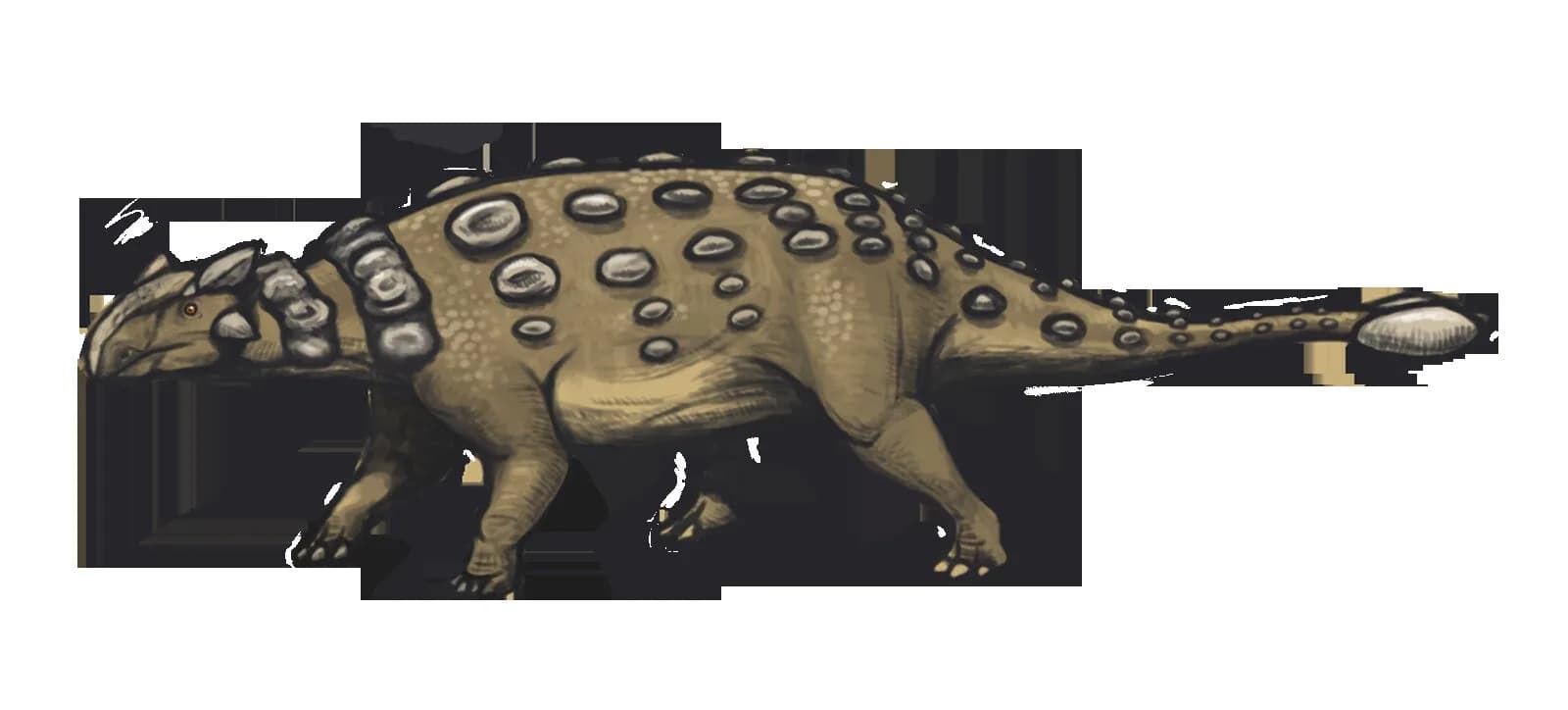
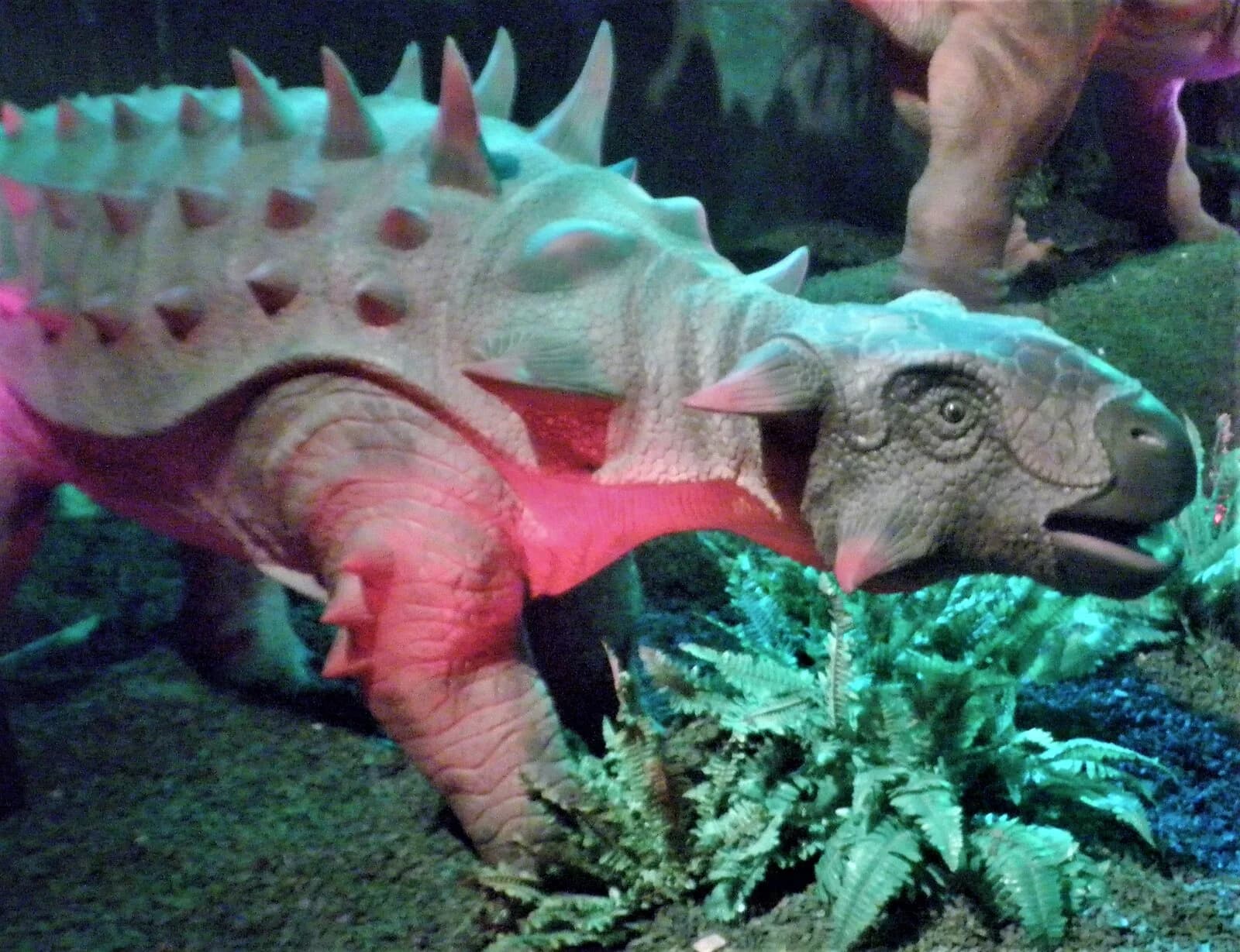
Nodosaurus measured between 4 and 6 meters long with an estimated weight of 1 to 2 tonnes. It was a medium-sized ankylosaur, stocky and low-slung. Its body was wide and rounded, resembling an armored barrel set on four short but robust legs. Its head was relatively small compared to its body, with a rounded skull and narrow snout. Like all nodosaurids, it did not possess a tail club (unlike ankylosaurids like Ankylosaurus), but its tail was nonetheless rigid and muscular.
Nodosaurus was a herbivore that fed on the low vegetation of the Cretaceous period with a selective feeding strategy. Its narrow beak and small leaf-shaped teeth suggest it carefully chose the most tender and nutritious parts of plants rather than bulk-feeding indiscriminately. It probably fed on ferns, horsetails, cycads, and low-growing flowering plants that were becoming increasingly common during the mid-Cretaceous. Its low position close to the ground and relatively small head limited it to grazing at ground level and on the lowest shrubs in its environment. Like other ankylosaurs, it compensated for the absence of efficient chewing teeth through prolonged fermentative digestion in a vast, specialized intestinal system.
Nodosaurus inhabited the coastal plains of eastern North America during the mid-Cretaceous, with fossils found in Wyoming and Kansas in geological formations dating to this period. Its environment included alluvial plains crossed by rivers, wooded areas with diverse vegetation, and swamps near the shore of the nascent Western Interior Seaway that was beginning to divide the continent. The climate was warm and humid, supporting abundant vegetation of ferns, conifers, and the rapidly diversifying flowering plants. It shared its habitat with other mid-Cretaceous dinosaurs, including sauropods, various ornithopods, and predatory theropods. Its presence in Kansas indicates a clear proximity to coastal environments and suggests it may have frequented shoreline habitats.
Nodosaurus anatomy is defined by its impressive armor. Its back and flanks were covered with rows of bony plates (osteoderms) embedded in the skin, organized in parallel transverse bands. These osteoderms varied in size and shape, from large central oval plates to small lateral nodules. Unlike ankylosaurids, nodosaurids like Nodosaurus often possessed prominent lateral bony spines on the shoulders and flanks, forming a formidable passive defense. Its belly was the only unprotected part. Its skull was covered with fused bony plates, forming a natural helmet.
Nodosaurus was probably a solitary animal or lived in small groups, moving slowly through undergrowth in search of low vegetation. Its primary defense strategy was passive: when attacked by a predator, it could flatten itself to the ground, presenting its impenetrable armored back and protecting its vulnerable belly, like a giant land tortoise. The lateral spines on its flanks discouraged predators from attempting to flip it over. Its locomotion was slow and steady, adapted to a quiet bottom-browser lifestyle. It probably did not need to flee from predators thanks to its armor.
Nodosaurus was described in 1889 by Othniel Charles Marsh from a partial skeleton discovered in the Frontier Formation in Wyoming. The name means 'knob lizard,' referencing the nodular osteoderms of its armor. The holotype includes vertebrae, ribs, limb bones, and numerous osteoderms. Although it was one of the first ankylosaurs described and gave its name to an entire family (Nodosauridae), Nodosaurus paradoxically remains rather poorly known due to the fragmentary nature of its fossils. More recent discoveries of better-preserved nodosaurids, like the famous mummified Borealopelta specimen at the Royal Tyrrell Museum, have considerably improved our understanding of this group.
| Period | Crétacé inférieur-moyen / Early-Middle Cretaceous (Albien–Cénomanien) |
| Era | Mésozoïque / Mesozoic |
| Age | 108–98 Ma |
| Location | Amérique du Nord / North America (Wyoming, Kansas) |
| Length | 4–6 m |
| Height | ~1.2 m |
| Weight | 1 000–3 000 kg |
| Diet | Herbivore |
| Discovery | 1889 |
Nodosaurus textilis — the type nodosaurid described in 1889 by O.C. Marsh — had no tail club, unlike ankylosaurids like Ankylosaurus. Its defense was entirely passive: osteoderms in parallel rows, prominent lateral spines on flanks and shoulders, and a ground-flattening behavior to protect the vulnerable belly. Nodosaurids and ankylosaurids form two distinct lineages within Ankylosauria.
Nodosaurus textilis measured between 4 and 6 meters long with an estimated weight of 1,000 to 3,000 kilograms. Paradoxically, despite giving its name to the entire Nodosauridae family, it remains poorly documented due to the fragmentary nature of the holotype (vertebrae, ribs, limb bones, osteoderms from Wyoming). Better-preserved nodosaurids like Borealopelta, whose mummy at the Royal Tyrrell Museum even shows skin color, have clarified the group.
Nodosaurus textilis lived on the coastal plains of eastern North America (Wyoming and Kansas) during the progressive rise of the Western Interior Seaway — a marine arm that would soon divide the continent. The Frontier Formation (Wyoming) records an environment of alluvial plains and warm, humid coastal marshes, with vegetation of ferns, conifers, and early flowering plants.
Life reconstruction of Nodosaurus textilis
Vi Ko, CC BY-SA 4.0, via Wikimedia Commons
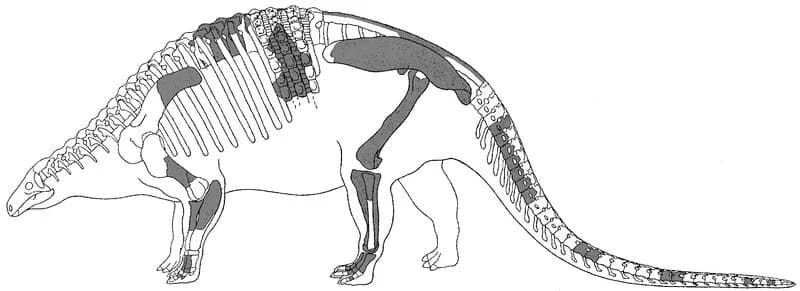
Original Nodosaurus textilis illustration
R. Lull, Public domain