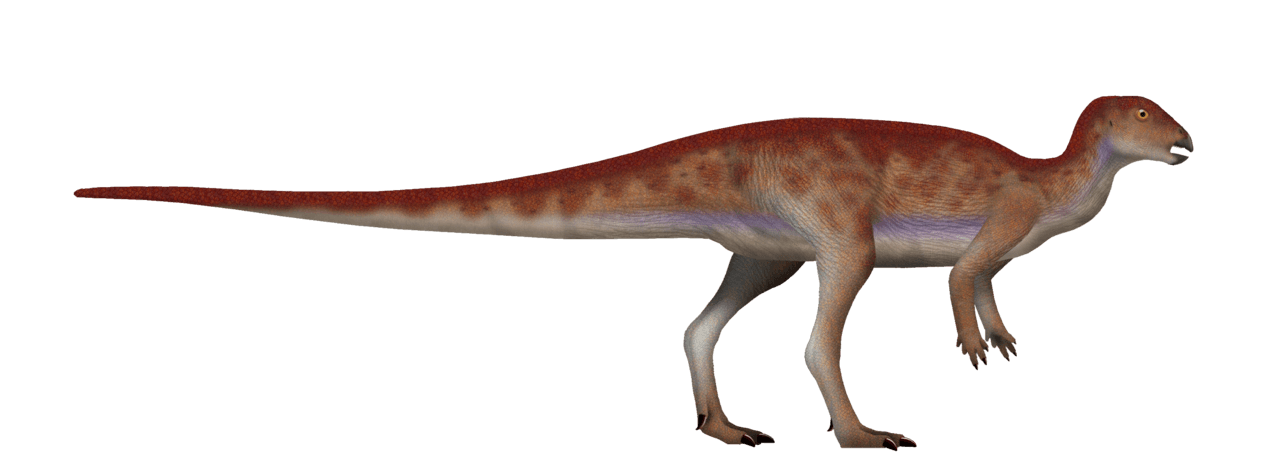
Dent en haute crête
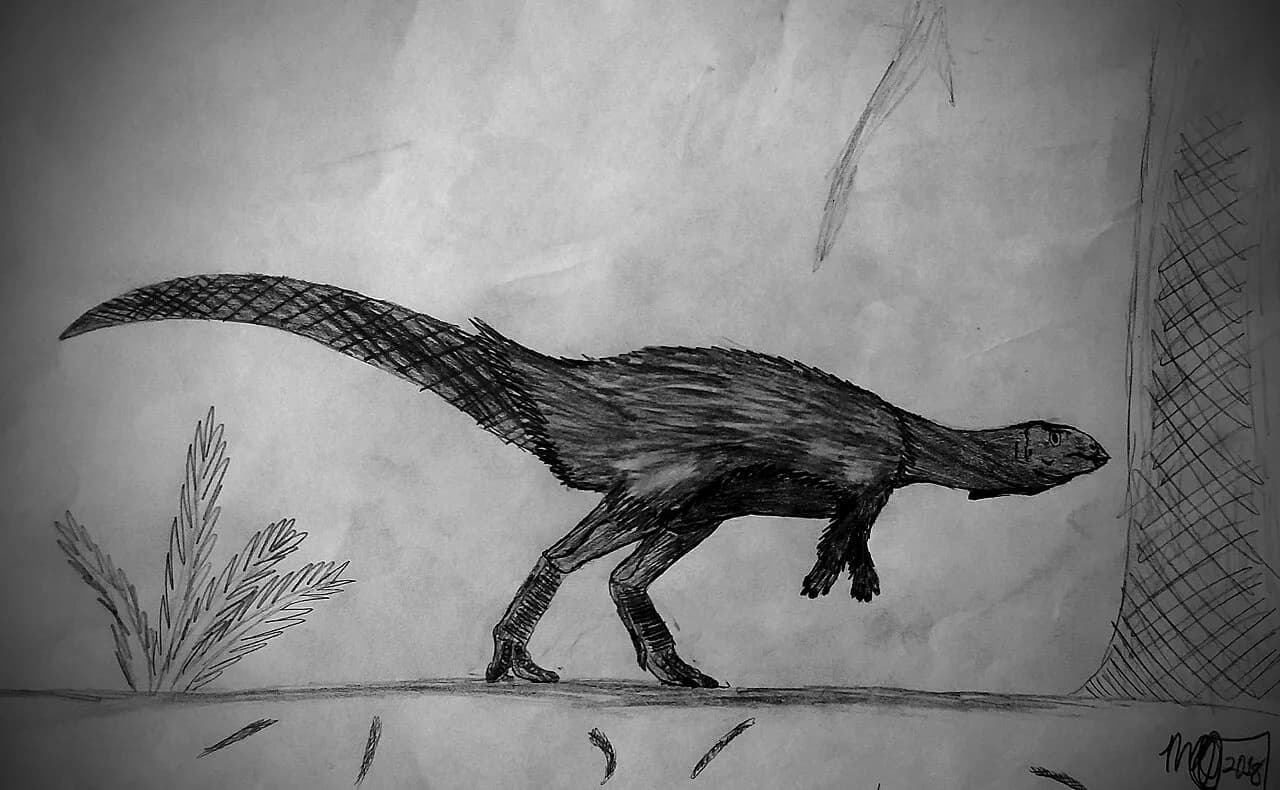
Hypsilophodon foxii spent a century regarded as a tree-dwelling dinosaur, before the idea was refuted: nothing in its anatomy allows climbing. At 1.5 to 1.8 metres and 20 to 25 kilograms, described in 1870, it lived in England and Spain 149 to 121 million years ago. Its hind legs are, proportionally, the longest of any ornithopod.
The smallest playable in the game. Its gastric acid spit blinds predators and its enhanced jump gives unique vertical mobility. Ultra-fast, its survival depends on speed.
Playable in The Isle: Evrima
See Hypsilophodon foxii's in-game stats, tier, strengths & weaknesses on our server.
Hypsilophodon lived from the late Tithonian of the Late Jurassic to the early Barremian of the Early Cretaceous, approximately 149 to 121 million years ago. It evolved in the Tethys archipelago, primarily in what is now the Isle of Wight in England and northern Spain. Its environment was that of a warm and humid Early Cretaceous, with riparian forests, coastal plains, and dense vegetation of ferns, conifers, and cycads. Hypsilophodon shared its ecosystem with other ornithopods like Iguanodon, and faced predators such as Baryonyx and various theropods. It is one of the few dinosaurs from the Wealden, the Early Cretaceous geological formation of northwest Europe.
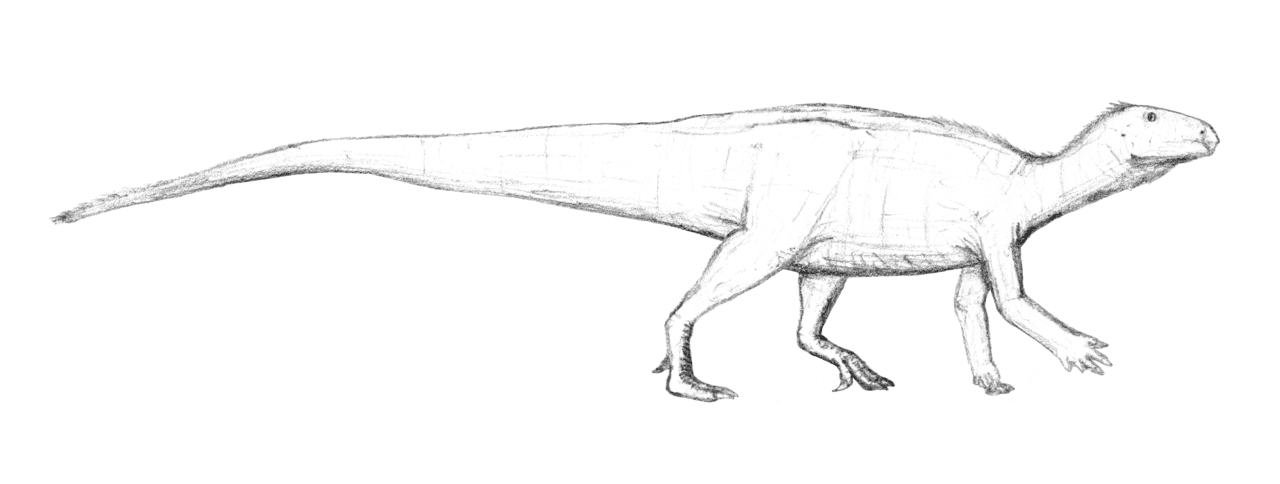
Hypsilophodon was a small dinosaur: typical specimens measured about 1.5 meters long, barely 0.5 meters tall, and weighed an estimated 20-25 kg. The maximum known length is 1.8 meters (specimen NHM R5829, femur of 202 mm), although a 1974 study initially suggested 2.28 m — a figure based on a femur that actually belonged to a Valdosaurus, corrected in 2009. Despite its small size, its body was entirely optimized for speed: lightweight skeleton, aerodynamic low posture, long muscular legs, and a tail stiffened by ossified tendons serving as a dynamic counterbalance during running.
A strict herbivore, Hypsilophodon fed on small vegetation: tender leaves, shoots, and young fronds. At the front of the snout, a horny beak similar to that of turtles served to cut plants. Behind this beak, the upper jaw still bore five pointed teeth in the premaxilla, a primitive feature rare among Early Cretaceous ornithischians. Further back, up to eleven upper maxillary teeth and sixteen fan-shaped lower mandibular teeth ensured grinding. Fleshy cheeks allowed the animal to retain food inside the mouth during chewing, an effective adaptation for tough plants.
Hypsilophodon lived primarily in forests and humid coastal areas of the Early Cretaceous in northwestern Europe. The majority of fossils come from the Wessex and Vectis Formations on the Isle of Wight (Hampshire Basin, England), with remains attributed to this genus also reported from northern Spain, and possibly the United States — though these American attributions remain uncertain. The environment was a semi-tropical deltaic landscape, crossed by rivers and dominated by dense vegetation of conifers, ferns, and horsetails. This forested biotope perfectly matched the morphology of Hypsilophodon, small and agile, capable of weaving between obstacles and jumping.
The skeleton of Hypsilophodon reflects extreme specialization for bipedal running. The hind legs, long and equipped with thin, lightweight bones, provided efficient propulsion. The tail, kept rigid by two distinct systems of ossified tendons, served as a dynamic counterbalance enabling rapid direction changes. The forelimbs had five fingers, with the fifth being slightly opposable — functional for grasping food. The skull was short and relatively broad, with very large eye sockets supported by a sclerotic ring of fifteen small bony plates. An old error had attributed dermal armor to Hypsilophodon based on fossils found with it; 2008 analyses showed these were actually internal intercostal plates (as in Thescelosaurus), not external armor.
Long depicted in artistic reconstructions perched on branches — an idea born from the anatomy of its feet deemed comparable to monkeys — Hypsilophodon was in reality a terrestrial runner, incapable of climbing trees. The shape of its toes did not allow gripping branches, as Galton demonstrated as early as 1974. Hypsilophodon was probably gregarious, living in small groups to protect against predators. Its survival strategy relied almost exclusively on rapid flight rather than combat, its only active defense being speed and agility. Its small size and agile behavior allowed it to navigate dense environments inaccessible to larger predators.
Hypsilophodon was described and named by Thomas Henry Huxley in 1870, from fossils discovered on the Isle of Wight. Only one species is recognized: Hypsilophodon foxii, honoring William Darwin Fox, the collector who gathered the first specimens. Numerous fossils have been found in Wealden formations, notably at Brighstone Bay on the Isle of Wight, where several partial and complete skeletons have been excavated. The holotype specimen is housed at the Natural History Museum in London (BMNH R 2477). The reference study by Peter Galton in 1974 remains the most comprehensive monograph on this species. In 2009, Galton revised the maximum size downward, after realizing that a femur attributed to the species actually belonged to Valdosaurus canaliculatus.
| Period | Crétacé inférieur / Early Cretaceous |
| Era | Mésozoïque / Mesozoic |
| Age | 149-121 Ma |
| Location | Europe (Angleterre, Espagne) / Europe (England, Spain) |
| Length | 1.5-1.8 m |
| Height | 0.5 m |
| Weight | 20-25 kg |
| Diet | Herbivore |
| Discovery | 1870 |
| Type (in-game) | Herbivore |
| Tier | Tier 1 |
No, this idea persisted for 100 years but was definitively refuted by paleontologist Peter Galton in 1974. The toe structure of Hypsilophodon foxii does not allow branch-gripping like a monkey. It was a fast ground runner, with a skeleton optimized for speed — including a tail stiffened by ossified tendons — that excluded any arboreal lifestyle.
Hypsilophodon foxii typically measured 1.5 meters long and 0.5 meters tall, weighing around 20 to 25 kg. The maximum known length is 1.8 meters (specimen NHM R5829). An earlier estimate of 2.28 m was corrected in 2009 by Galton: a femur wrongly attributed to Hypsilophodon actually belonged to Valdosaurus canaliculatus.
Hypsilophodon foxii lived from the late Tithonian to the early Barremian, between 149 and 121 million years ago (Early Cretaceous). Most fossils come from the Isle of Wight in England (Wessex and Vectis formations), with some remains attributed to northern Spain. It lived in a semi-tropical deltaic landscape of ferns, conifers and cycads.
Hypsilophodon at Brussels museum
Wikipedia Commons
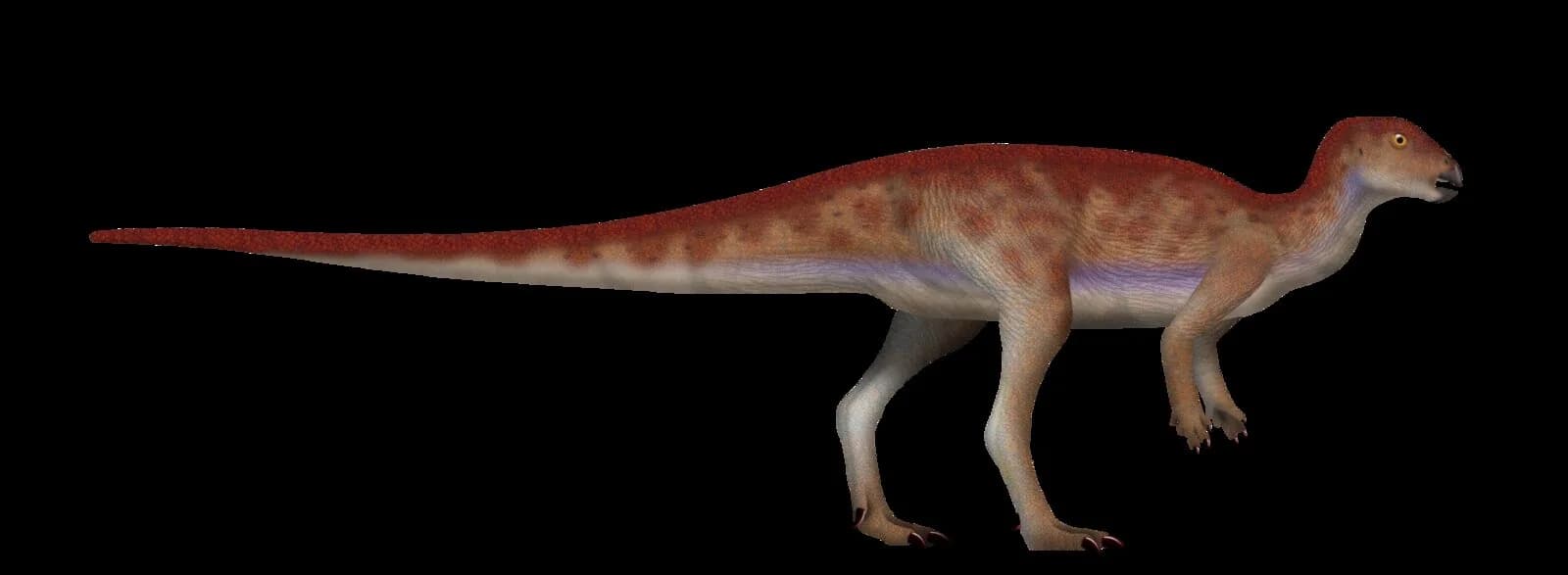
Hypsilophodon foxii life reconstruction
TotalDino, CC BY-SA 4.0