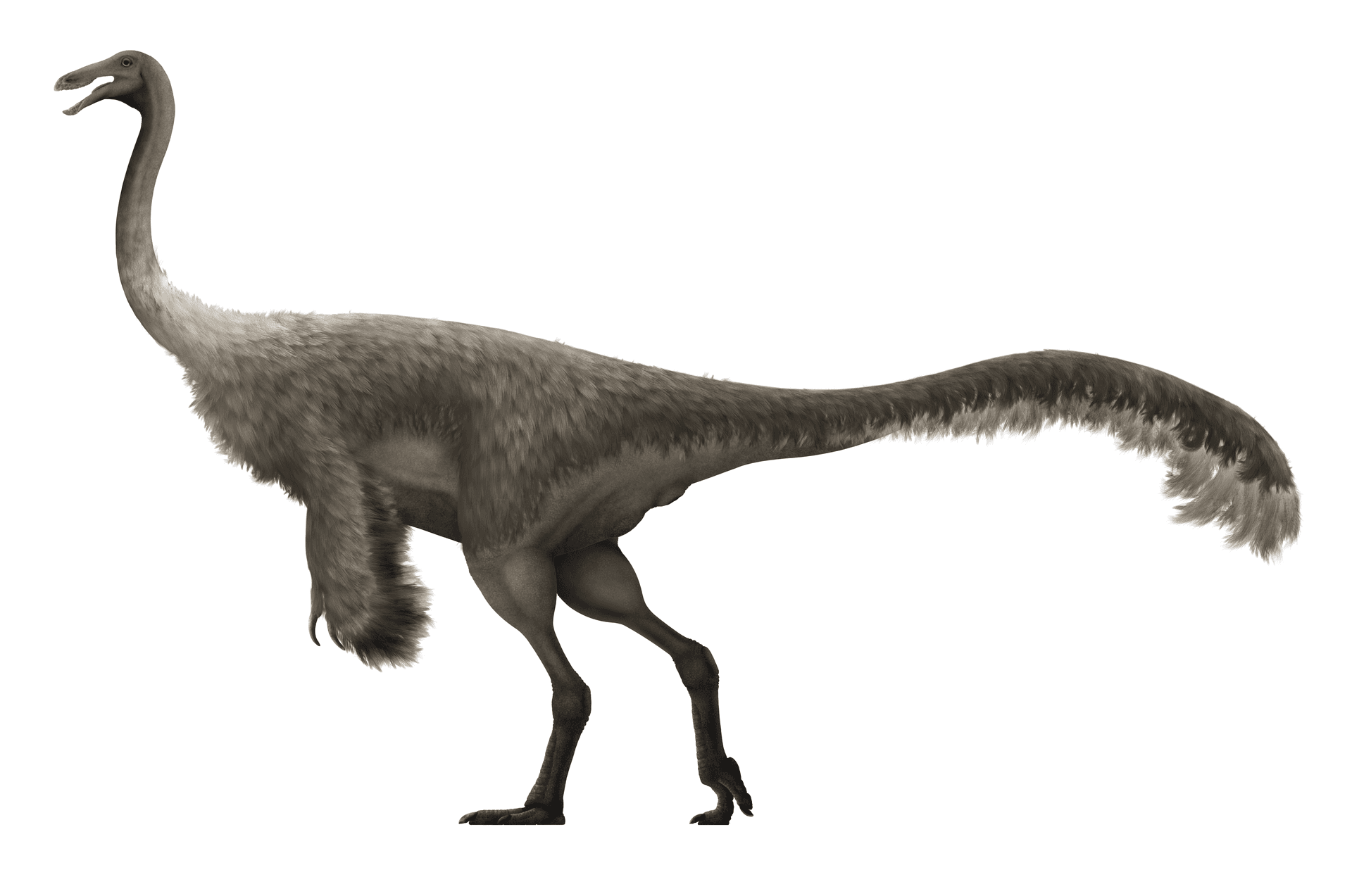
Imitateur de Poule
Gallimimus bullatus reached 65 kilometres per hour, the speed of a galloping horse, making it one of the fastest dinosaurs known. Six to 8 metres long and 440 to 500 kilograms, described in 1972 in Mongolia, it lived around 70 million years ago. Its name means « chicken mimic », which sits oddly on an animal of that size.
The fastest on land. Its exceptional stamina and speed make it a runner that's nearly impossible to catch. Omnivore, it eats anything. No viable solo combat.
Playable in The Isle: Evrima
See Gallimimus bullatus's in-game stats, tier, strengths & weaknesses on our server.
Gallimimus lived during the Late Cretaceous period, approximately 70 million years ago, during the Maastrichtian stage, in what is now the Nemegt Formation of Mongolia. This formation preserves a rich Late Cretaceous ecosystem that existed in a semi-arid climate with seasonal rivers and vast floodplains. Gallimimus shared its environment with formidable predators like Tarbosaurus and other diverse dinosaurs including hadrosaurs and ankylosaurs. The Nemegt Formation represents one of the most important windows into Late Cretaceous Asian ecosystems, documenting a period just before the catastrophic end-Cretaceous extinction event that would eliminate all non-avian dinosaurs.
Gallimimus was one of the largest ornithomimosaurs, reaching approximately 6 meters in length with an estimated weight of around 440 kilograms. Its build was remarkably similar to a modern ostrich but at a much larger scale, with a small head perched atop a very long, flexible neck. The hind limbs were extremely long and slender, clearly built for high-speed running, with estimates suggesting speeds up to 50 kilometers per hour or more. The forelimbs were relatively short with three-fingered hands bearing modest claws. The tail was long and stiffened, acting as a dynamic counterbalance during rapid directional changes while running at speed.
Gallimimus was likely omnivorous, as suggested by its toothless beak and the overall structure of its jaw apparatus. Its broad, flattened beak may have been used for filter-feeding in shallow water, similar to modern ducks, though this interpretation remains debated among paleontologists. It likely consumed a varied diet including small invertebrates, seeds, fruits, and possibly small vertebrates. The absence of teeth and presence of a keratinous beak suggest a generalist feeding strategy adapted to exploit multiple food sources. Some researchers have proposed that juvenile Gallimimus may have been more insectivorous while adults shifted toward a more herbivorous or omnivorous diet as they grew.
Gallimimus inhabited the semi-arid plains and open environments of the Nemegt Formation (Mongolia), an ancient landscape of floodplains and fluvial coastal zones. The Mongolian Cretaceous climate was probably more humid than today, with shrubby vegetation and dense vegetation zones along waterways. Similar formations in China have yielded close relatives. The Nemegt Formation also supported formidable predators including Tarbosaurus bataar — the apex theropod of the region — as well as the massive therizinosaur Therizinosaurus and the hadrosaur Saurolophus. This diverse ecosystem required Gallimimus to remain highly vigilant and rely on open terrain where its exceptional speed could be fully exploited. Seasonal river flooding likely concentrated food resources, drawing large herds of ornithomimosaurs to productive lowland zones.
Gallimimus anatomy was highly specialized for cursorial locomotion, making it one of the fastest dinosaurs ever to have lived. Its large orbits housed proportionally enormous eyes that provided excellent vision for detecting both predators and prey at great distances. The brain was relatively large for a dinosaur of its size, suggesting enhanced cognitive abilities and coordination needed for high-speed maneuvering. The hallux was reduced, resulting in a functionally tridactyl foot optimized for running efficiency. The vertebral column was lightweight with extensive pneumatization, reducing overall body mass. The hands bore three fingers with relatively straight claws that may have been used for digging or pulling down vegetation.
Gallimimus likely lived in groups or herds, as evidenced by bone beds containing multiple individuals. This gregarious strategy provided collective protection against large predators. Speed was its primary defense. Adult ornithomimosaurs could probably protect juveniles. Locomotion studies suggest a galloping gait similar to ostriches, with an exceptionally wide stride. Biomechanical estimates place its top speed between 50 and 65 km/h, making flight from predators such as Tarbosaurus its primary survival strategy. Its omnivorous diet allowed it to exploit whatever food sources were seasonally available — shifting between insects, small vertebrates, eggs, seeds, and plant matter depending on conditions. This behavioral flexibility was likely key to its success across the varied environments of Late Cretaceous Mongolia.
Gallimimus bullatus was described by Rinchen Barsbold, Halszka Osmólska, and Ewa Roniewicz in 1972, based on specimens collected during the Polish-Mongolian paleontological expeditions to the Gobi Desert in the late 1960s. The holotype includes a nearly complete skeleton that provided crucial information about ornithomimosaur anatomy and locomotion. Multiple specimens of varying ages have since been discovered in the Nemegt Formation, allowing paleontologists to study growth patterns and ontogenetic changes in this species. The discovery of a bone bed containing numerous Gallimimus individuals has provided strong evidence for gregarious behavior, suggesting these dinosaurs may have lived and moved in herds or flocks.
| Period | Crétacé supérieur / Late Cretaceous |
| Era | Mésozoïque / Mesozoic |
| Age | ~70 Ma |
| Location | Asie (Mongolie) / Asia (Mongolia) |
| Length | 6-8 m |
| Height | 2 m |
| Weight | 440-500 kg |
| Diet | Filtreur |
| Discovery | 1972 |
| Type (in-game) | Omnivore |
| Tier | Tier 2 |
Gallimimus bullatus is among the fastest known dinosaurs: biomechanical estimates give it a top speed between 50 and 65 km/h, comparable to a galloping horse. Its very elongated metatarsals and hollow bones reducing body mass were typical of specialized cursors. Against Tarbosaurus — the Asian equivalent of T. rex — flight across the open plains of the Nemegt Formation was its primary survival strategy, supplemented by herd living.
The diet of Gallimimus bullatus remains debated. Its toothless, flat beak shows structures resembling duck filtering lamellae in some reconstructions, suggesting filter-feeding in water or mud for small organisms. Other analyses point to an opportunistic omnivore — insects, small vertebrates, eggs, plants — similar to modern ostriches. The complete absence of teeth and beak morphology rule out hunting significant-sized prey, whatever dietary scenario is favored.
Gallimimus bullatus was described in 1972 by Rinchen Barsbold, Teresa Maryańska, and Halszka Osmólska from specimens collected in the 1960s-70s during the Polish-Mongolian Paleontological Expeditions in the Gobi Desert. The holotypes are housed at the Ulaanbaatar Museum in Mongolia. Multiple complete and juvenile skeletons are known, enabling detailed ontogenetic study. The stampede scene in Jurassic Park (1993) brought this dinosaur to widespread public attention worldwide.
Gallimimus at Natural History Museum London
Wikipedia Commons
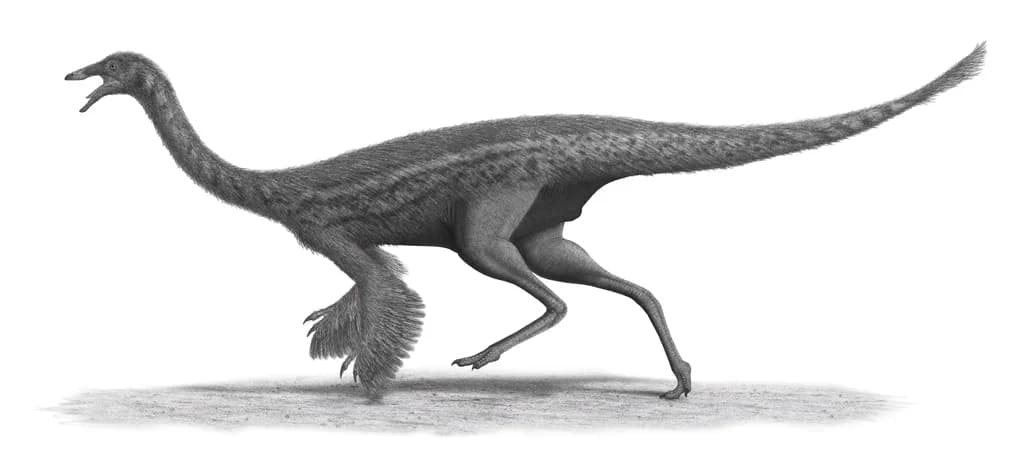
Feathered Gallimimus bullatus life reconstruction
Steveoc 86, CC BY 2.5