Lézard à deux crêtes
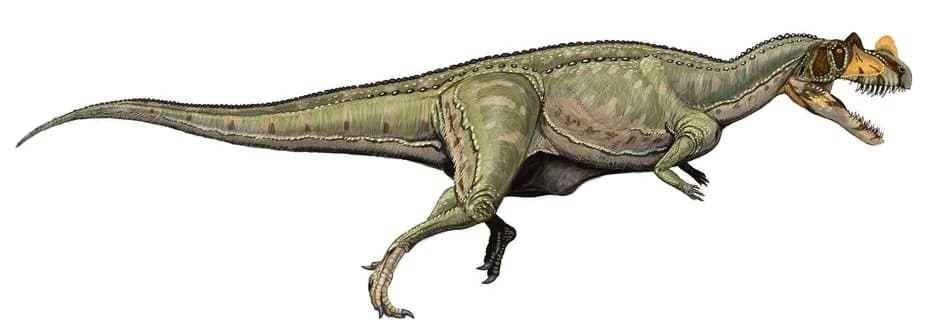
Dilophosaurus wetherilli was a carnivorous theropod of the Early Jurassic, about 193 million years old, described in 1954 from fossils found in Arizona. It measured 5.5 to 7 metres and weighed 300 to 500 kilograms, carrying two skull crests most likely used for display. Unlike its Jurassic Park version, it had neither a neck frill nor venom: both traits were invented for film.
The master of the night. Its hallucinogenic venom completely disorients the target — warped vision and inverted controls. Maximum night vision for hunting in darkness.
Playable in The Isle: Evrima
See Dilophosaurus wetherilli's in-game stats, tier, strengths & weaknesses on our server.
Dilophosaurus lived during the Early Jurassic, approximately 193 million years ago, during the Sinemurian stage. It was one of the first large theropod dinosaurs to appear after the end-Triassic mass extinction event that reshaped terrestrial ecosystems worldwide. This period marks a crucial transition in dinosaur evolution, with theropods beginning to dominate the top predator niches previously held by other archosaurs. The Early Jurassic climate was generally warm and humid across much of Pangaea. Dilophosaurus inhabited a world where dinosaurs were rapidly diversifying and filling ecological roles left vacant by the extinction, establishing the foundations for their later dominance throughout the Mesozoic era.
Dilophosaurus measured approximately 6 to 7 meters in length and weighed between 300 and 400 kilograms, making it one of the largest predators of its time in the Early Jurassic. Its skull was large but surprisingly lightweight due to extensive fenestration, and it bore two thin, parallel crests on its head that are its most recognizable feature. The body was slender and built for agility rather than brute force. The hind limbs were long and well-muscled, adapted for swift bipedal locomotion. The forelimbs were relatively long compared to later theropods like T. rex, with three functional fingers bearing sharp claws useful for grasping prey.
An active predator, Dilophosaurus likely hunted prosauropods and small herbivorous dinosaurs of its era using speed and agility rather than brute force. Despite popular depictions in the movie Jurassic Park, there is absolutely no scientific evidence that it spat venom or possessed a frill around its neck. Its teeth were slender and somewhat fragile, suggesting it may have used a bite-and-slash technique rather than crushing bites. Some researchers propose that Dilophosaurus also scavenged and consumed fish, given its proximity to aquatic environments. The jaw structure shows a distinctive notch between the premaxilla and maxilla, a feature that may have influenced its feeding mechanics and prey selection.
Dilophosaurus inhabited arid to semi-arid environments in what is now the southwestern United States, particularly the Kayenta Formation of Arizona. This region during the Early Jurassic featured seasonal rivers, floodplains, and scattered lakes surrounded by conifer forests and fern-dominated undergrowth. The landscape alternated between dry and wet seasons, creating a patchwork of habitats. Dilophosaurus likely favored areas near water sources where prey animals congregated. The geological evidence suggests a savanna-like environment with periodic droughts, forcing animals to adapt to fluctuating resource availability. Fossil trackways found in the region indicate that Dilophosaurus was an active and wide-ranging predator across this varied landscape.
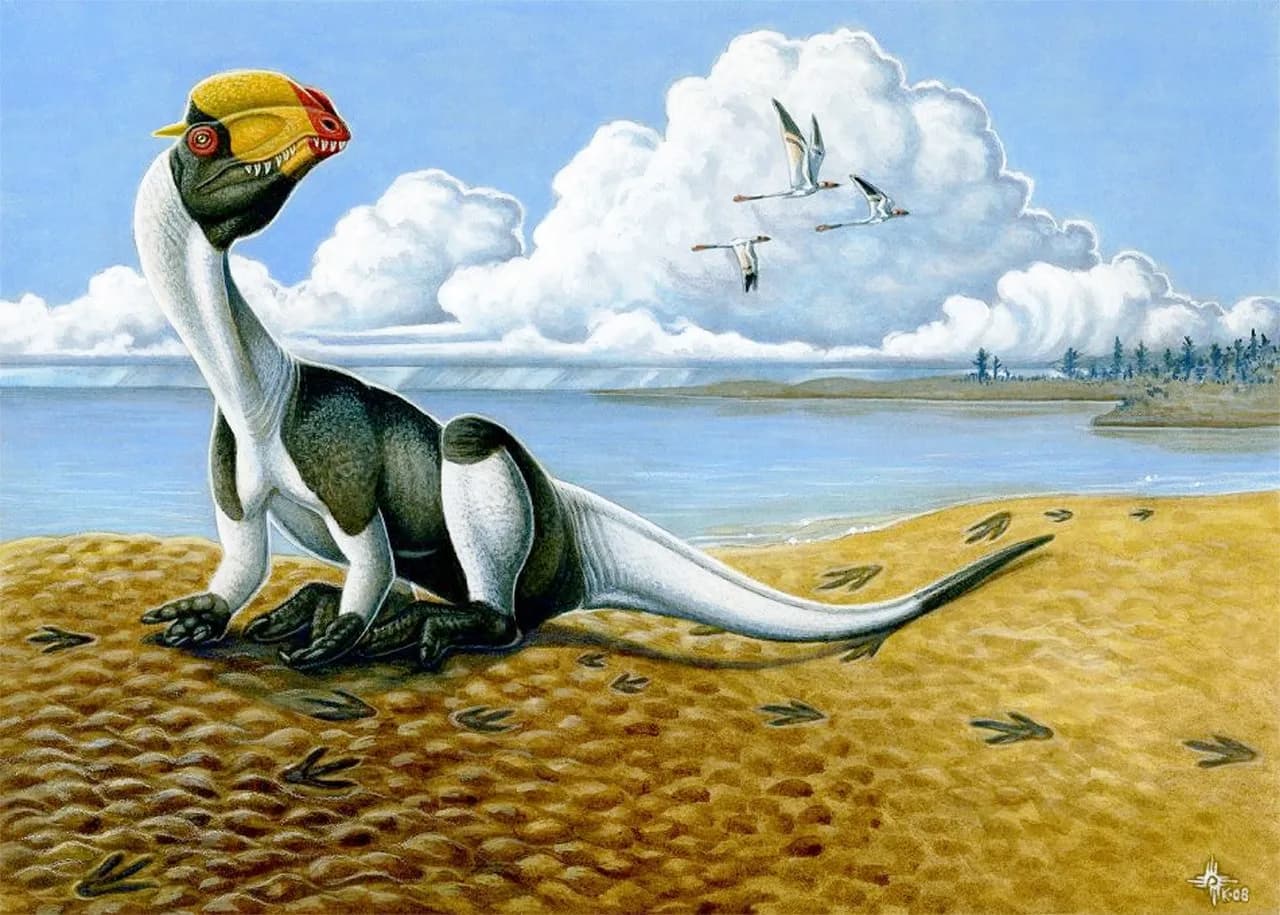
Dilophosaurus is most famous for its paired cranial crests, made of thin bone extending from the nasal and lacrimal bones along the top of the skull. These crests were too fragile for combat and almost certainly served as visual display structures for species recognition or mate attraction. The skull had a distinctive subnarial gap or kink in the upper jaw, giving it an unusual profile. The body was lightly built with hollow bones, an early adaptation for weight reduction seen in many theropods. The hands bore three large clawed fingers capable of grasping, and the feet had four toes with the first being a reduced dewclaw, typical of early theropod morphology.
Dilophosaurus likely hunted using ambush tactics and pursuit predation, relying on speed and agility to catch prey rather than overpowering it with size. The double cranial crests almost certainly played a role in visual communication and species recognition, possibly featuring bright colors during mating season. Discovery of multiple individuals at the same site suggests possible social behavior or at least aggregation near shared resources like water holes. Some trackway evidence indicates these dinosaurs may have traveled in small groups. As one of the earliest large theropods, Dilophosaurus occupied an apex predator role in its Early Jurassic ecosystem, facing little competition from other large carnivores.
Dilophosaurus wetherilli was described by Samuel Welles in 1954 from specimens discovered in 1940 near Tuba City, Arizona, in the Kayenta Formation. The original specimen lacked the distinctive crests, which were only recognized when a second, more complete skeleton was found in 1964. A comprehensive redescription published in 2020 by Adam Marsh and Timothy Rowe significantly revised understanding of this dinosaur, revealing it was more robust than previously thought. Additional specimens and numerous trackways attributed to Dilophosaurus have been found across the southwestern United States. The species remains one of the best-known Early Jurassic theropods, providing crucial data about early dinosaur evolution and diversification.
| Period | Jurassique inférieur / Early Jurassic |
| Era | Mésozoïque / Mesozoic |
| Age | ~193 Ma |
| Location | Amérique du Nord (Arizona), Asie (Chine) / North America, Asia |
| Length | 5.5-7 m |
| Height | 2 m |
| Weight | 300-500 kg |
| Diet | Carnivore |
| Discovery | 1954 |
| Type (in-game) | Carnivore |
| Tier | Tier 3 |
No. Dilophosaurus wetherilli had neither a deployable neck frill nor any ability to spit venom — these spectacular features are a purely cinematic invention from Jurassic Park (1993). The real Dilophosaurus measured 5.5 to 7 meters long, much larger than in the film, and was an active predator without any particularly defensive trait beyond its size.
The two parallel bony crests of Dilophosaurus wetherilli, formed by extensions of the nasal and lacrimal bones, were too fragile for combat use. Light and richly vascularized, they likely served for intraspecific visual recognition and courtship displays, potentially colored in vivid hues during mating season.
Dilophosaurus wetherilli lived in the Early Jurassic, approximately 193 million years ago (Sinemurian-Pliensbachian). It inhabited the semi-arid plains of present-day Arizona (Kayenta Formation) and possibly China (Lufeng Formation). It was one of the largest theropods of its era, weighing between 300 and 500 kg, at a time when dinosaurs were just beginning to dominate terrestrial ecosystems after the end-Triassic extinction.
Information on this page is based on peer-reviewed scientific publications.
Dilophosaurus at Royal Ontario Museum
Wikipedia Commons
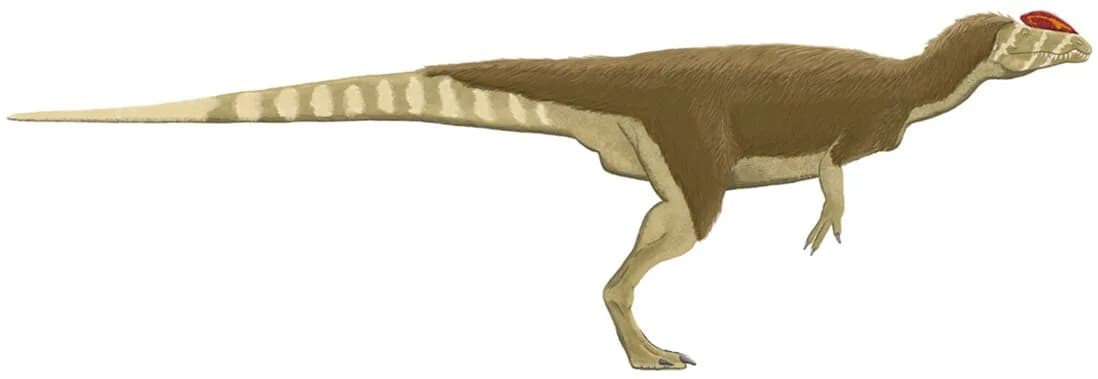
Dilophosaurus wetherilli life reconstruction
Leandra Walters, Phil Senter, James H. Robins, CC BY 2.5