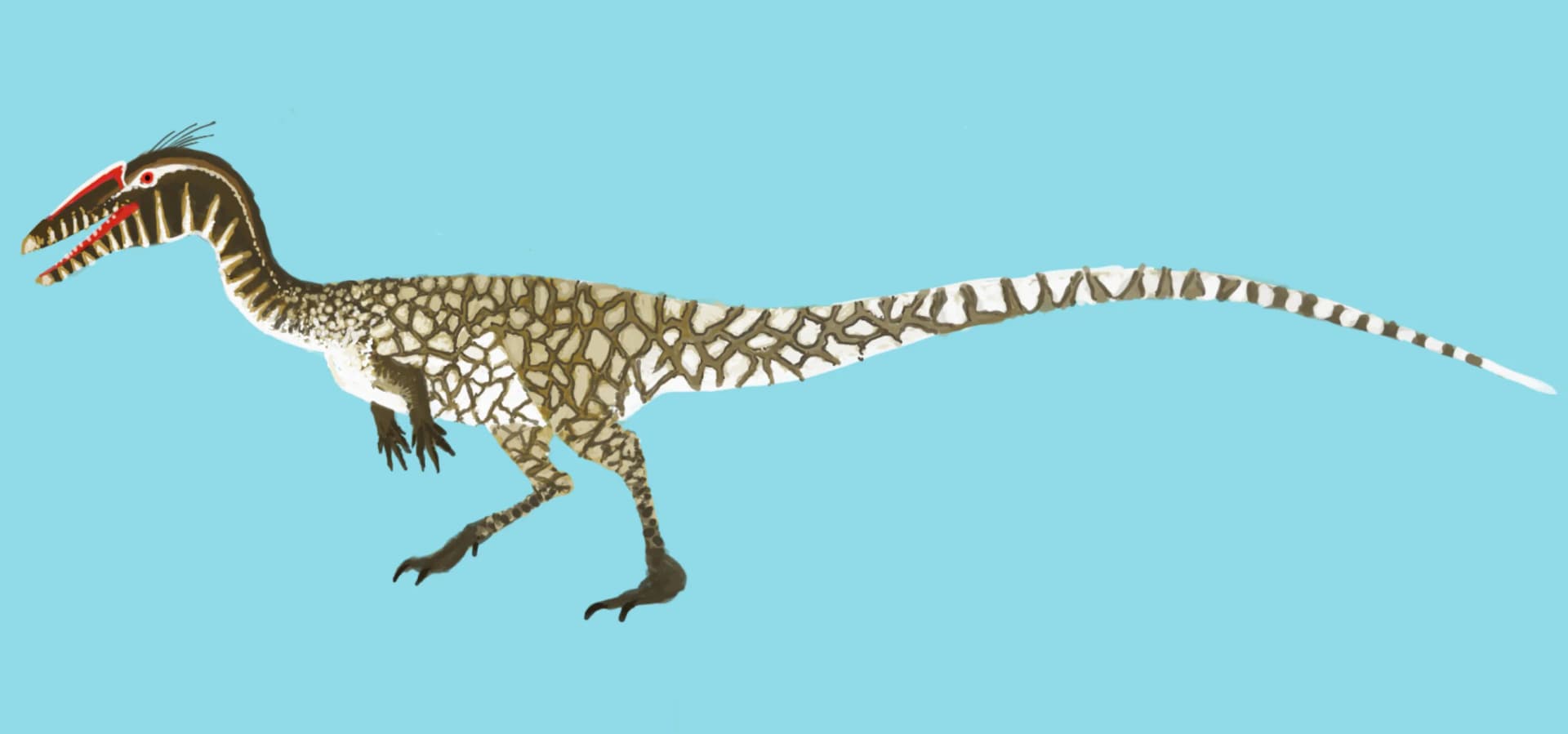
Cœlophyse
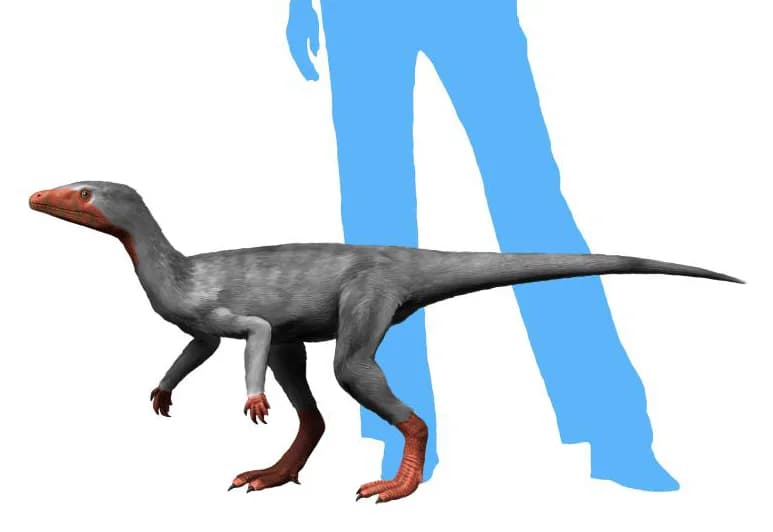
Coelophysis bauri is a slender theropod about 3 metres long and 15 to 20 kilograms, described in 1881 and dated to 216 to 203 million years ago. The Ghost Ranch site in New Mexico has yielded thousands of specimens piled on top of one another. It is that state's official fossil, and one of its bones flew aboard the shuttle Endeavour in 1998.
Coelophysis lived in the Late Triassic, approximately 216 to 203 million years ago, during the Norian and Rhaetian stages. It is one of the very first known theropod dinosaurs and among the best-documented from this pivotal period in the history of life. At that time, dinosaurs were just one group among many archosaurs, coexisting with rauisuchians, aetosaurs, and early primitive mammals. The Late Triassic marked the beginning of the dinosaurs' rise to ecological dominance, a process that would not be complete until the Jurassic. Pangaea was just beginning to fragment, and terrestrial environments were very different from those we know today. Coelophysis bears witness to an era when dinosaurs were developing the fundamental adaptations that would define their lineage for 165 million years.
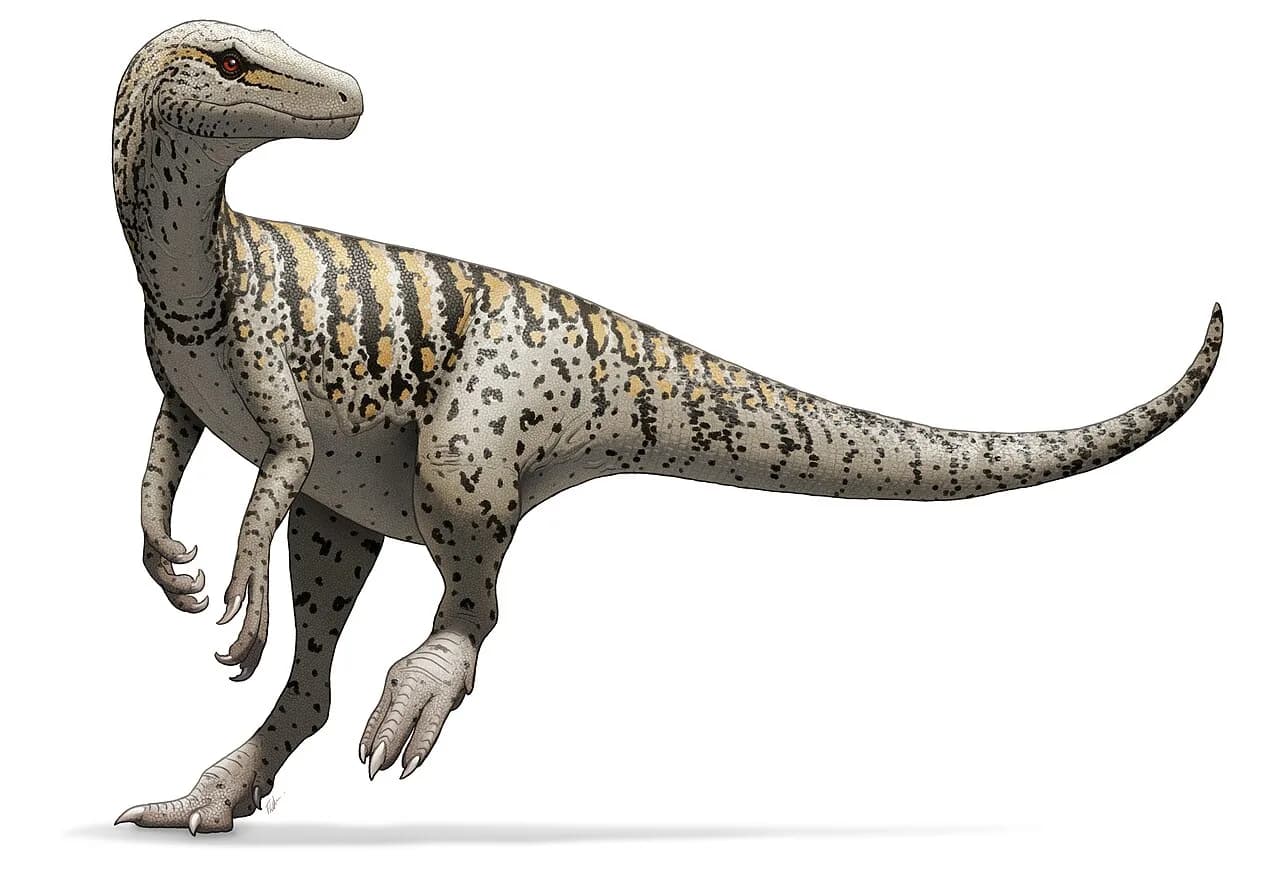
This small theropod measured about 3 meters in length and weighed an estimated 15 to 20 kg, barely the size of a large dog. Its slender build and graceful limbs made it a fast and agile runner, likely capable of reaching considerable speeds for its size. Despite its modest dimensions compared to later giant theropods, it was an effective predator in its Triassic environment. Its long and flexible neck, combined with a lightweight skull, allowed rapid head movements to catch small, agile prey. Sexual dimorphism appears present in Coelophysis, with some specimens being more robust than others, possibly reflecting differences between males and females.
An active and opportunistic carnivore, Coelophysis fed primarily on small lizards, insects, fish, and possibly small archosaur reptiles. Juvenile bones found within the rib cages of some adult specimens long suggested cannibalism, but more recent studies (2006) reinterpreted these remains as belonging to small crocodylomorphs that had been ingested. The shape of its teeth, small and finely serrated, was perfectly adapted for capturing small prey. Its diverse diet likely allowed it to adapt to seasonal variations in prey availability in its semi-arid environment. Coprolites (fossilized feces) associated with Coelophysis contain small vertebrate bone fragments, confirming its active carnivorous diet.
Coelophysis inhabited the semi-arid plains and sparse forests of what is now the American Southwest, primarily New Mexico and Arizona. The Triassic climate of this region was hot and dry, with strong seasonal variations and monsoon episodes. Vegetation was dominated by primitive conifers, ferns, and cycads, forming a discontinuous canopy over often rocky ground. Seasonal rivers and oases created concentration points for fauna, possibly explaining the massive fossil accumulations observed at Ghost Ranch. This geological formation (Chinle Formation) has yielded a diverse fauna also including phytosaurs, aetosaurs, and other archosaurs that shared the ecosystem with Coelophysis.
The anatomy of Coelophysis reveals a basal theropod remarkably well-adapted for running and active predation. Its long, narrow skull, measuring about 27 cm, bore numerous small recurved and serrated teeth, arranged in tight rows ideal for grasping slippery prey. The bones were hollow (pneumatized), a characteristic that would become emblematic of theropods and which considerably reduced body mass while maintaining structural strength. Its long, powerful hind limbs, combined with tridactyl feet, gave it fast and efficient bipedal locomotion. The shorter forelimbs possessed three functional clawed digits that served to grasp and manipulate prey. Its long, rigid tail served as a counterbalance during running, ensuring balance at high speed. The structure of its pelvis and vertebrae indicates great trunk flexibility, allowing rapid directional changes during hunting.
The exceptional fossil beds at Ghost Ranch, New Mexico, show hundreds of individuals gathered together, suggesting either habitual gregarious behavior or a mass death during a natural catastrophe such as a flash flood or prolonged drought. The most widely accepted hypothesis today is that of a gathering around a drying water source, followed by a catastrophic flood that buried the animals under sediment. If Coelophysis indeed lived in groups, this would make it one of the first dinosaurs to exhibit social behavior. Its partial binocular vision and large eyes suggest hunting capabilities in low-light conditions, potentially at dawn or dusk. Bite marks on some specimens indicate aggressive interactions between conspecifics, possibly related to territorial competition or reproduction.
The Ghost Ranch site in New Mexico has yielded thousands of Coelophysis specimens, making it one of the most abundant Triassic dinosaurs in the fossil record. Initially described in 1881 by Edward Drinker Cope from fragments, it was the spectacular Ghost Ranch discovery in 1947 by Edwin Colbert that truly revealed the complete anatomy of this animal. These fossils include individuals of all ages, from juveniles to aged adults, allowing detailed study of growth and development in this species. Coelophysis is the state fossil of New Mexico and one of the few dinosaurs whose bones have traveled to space, aboard the Space Shuttle Endeavour in 1998. Specimens have also been found in Arizona (Petrified Forest National Park) and possibly Utah. The preservation quality of the Ghost Ranch fossils, with articulated and complete skeletons, makes them invaluable reference material for the study of primitive theropods.
| Period | Trias supérieur / Late Triassic (Norien–Rhaétien) |
| Era | Mésozoïque / Mesozoic |
| Age | 216–203 Ma |
| Location | Amérique du Nord / North America (États-Unis) |
| Length | ~3 m |
| Height | ~0.9 m |
| Weight | ~15–20 kg |
| Diet | Piscivore |
| Discovery | 1881 |
Coelophysis bauri measured about 3 meters long weighing only 15 to 20 kg, roughly the size of a large dog. It lived in the Late Triassic (Norian-Rhaetian), 216 to 203 million years ago, in the American Southwest (New Mexico, Arizona). It is one of the oldest known theropods and among the best-documented thanks to the Ghost Ranch site in New Mexico.
The Ghost Ranch site in New Mexico, discovered in 1947 by Edwin Colbert, yielded thousands of Coelophysis bauri specimens of all ages — from juveniles to adults. This accumulation likely resulted from gathering around a drying water source followed by a catastrophic flood. Coelophysis is the official state fossil of New Mexico and one of the few dinosaurs whose bones traveled to space aboard Space Shuttle Endeavour in 1998.
Long accused of cannibalism, 2006 studies reinterpreted bones found in some adult rib cages: they belonged to small ingested crocodylomorphs, not Coelophysis juveniles. Its active carnivorous diet included small lizards, insects, fish, and primitive archosaur reptiles. Coprolites associated with Coelophysis contain small vertebrate bone fragments confirming this diet.
Life reconstruction of Coelophysis bauri
MakairodonX, CC BY-SA 4.0, via Wikimedia Commons
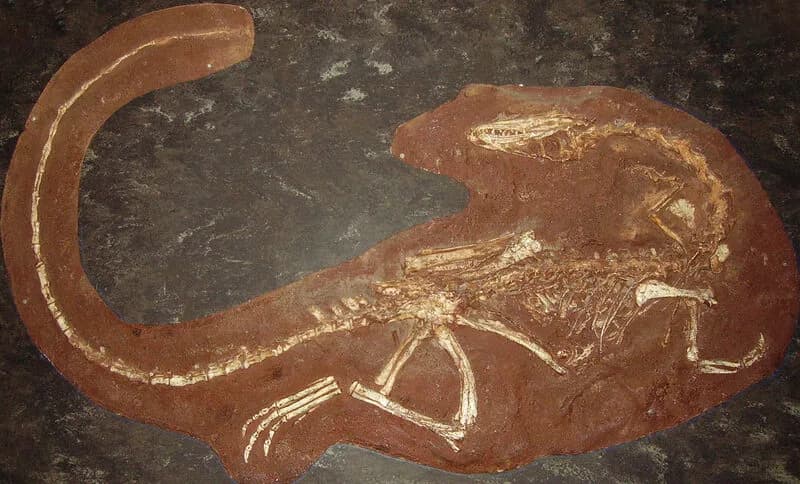
Mounted Coelophysis skeleton at the Natural History Museum
Ballista, CC BY-SA 3.0