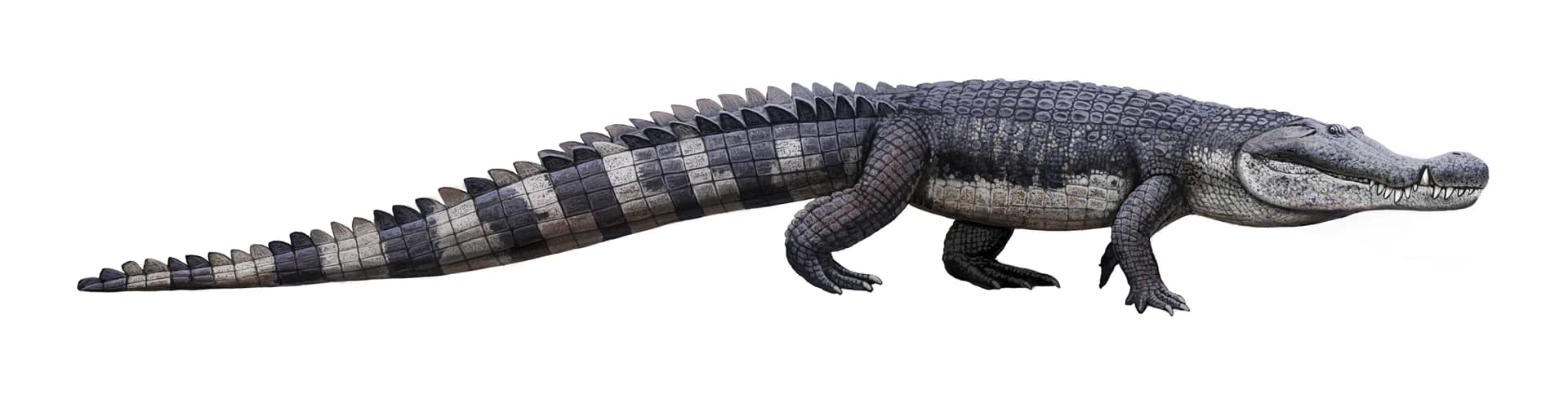
Terrible Crocodile
Deinosuchus was not a dinosaur but a giant Cretaceous crocodilian, described in 1858 and found across twelve US states and Mexico between 82 and 73 million years ago. At 8 to 12 metres and 2.3 to 8.5 tonnes, it outsized Tyrannosaurus rex. Its bite force is estimated at 102,000 newtons, close to double that of T. rex.
The undisputed master of waters. Its 'Lunge' captures any prey up to 4 tons. Perfect camouflage underwater, but nearly helpless on land.
Playable in The Isle: Evrima
See Deinosuchus hatcheri / rugosus's in-game stats, tier, strengths & weaknesses on our server.
Deinosuchus lived during the Late Cretaceous, approximately 82 to 73 million years ago (Campanian). Contrary to popular belief, this colossal reptile was not a true crocodile: it was a primitive member of the Alligatoroidea superfamily — a close relative of modern alligators and caimans rather than true crocodiles. It inhabited both shores of the Western Interior Seaway dividing North America, with fossils identified in twelve US states and northern Mexico. Four species are recognized: D. rugosus, D. hatcheri (type), D. riograndensis, and D. schwimmeri (2020).
Eastern populations (more common) reached about 8 meters in length and weighed approximately 2.3 tonnes; western specimens — rarer but considerably more massive — likely exceeded 10 to 12 meters at an estimated 5 to 8.5 tonnes. Its bite force is estimated at over 102,750 Newtons — six times that of the modern saltwater crocodile (16,460 N) and likely superior even to that of the fearsome T. rex. Its rear teeth, characteristically short, rounded, and blunt, were specifically adapted to crushing turtle shells and bones rather than tearing flesh, indicating a specialized durophagous feeding strategy.
An opportunistic super-predator whose dietary habits varied significantly by body size and geographic region: smaller eastern individuals from the Appalachian landmass primarily consumed fish, turtles, and small dinosaurs in a niche similar to the modern American alligator, while the considerably larger western giants from Laramidia attacked large hadrosaurs and other sizable dinosaurs. Hadrosaur caudal vertebrae bearing unmistakable Deinosuchus bite marks were found at Big Bend National Park in Texas. Crushed Bothremys sea turtle shells further testify to regular chelonian predation — its robust, flat rear teeth were ideally suited for crushing even the thickest carapaces.
Deinosuchus preferred brackish estuarine environments (coastal bays, river deltas) along the Western Interior Seaway, similar to modern alligators rather than saltwater crocodiles. The Aguja Formation (Texas) with its large Campanian bays is the most informative deposit. Rare specimens found in marine deposits were possibly displaced post-mortem. Eastern populations ranged across the Atlantic coastal plain from Georgia to New Jersey, while western populations occupied the Gulf Coast and interior river systems of Texas, Montana, and surrounding states. Water temperatures in these subtropical estuaries ranged from 20 to 30°C year-round, ideal for a large ectotherm. Potential prey included hadrosaurs such as Kritosaurus and Gryposaurus that frequented the water's edge, as well as abundant sea turtles, large fish, and smaller crocodilians sharing the same coastal waterways.
Its secondary bony palate allowed breathing with most of the head submerged beneath the water surface, an essential adaptation for an ambush predator. Its procoelous vertebrae (ball-and-socket joints) represent an important anatomical innovation characteristic of modern eusuchian crocodilians. Its dorsal osteoderms — exceptionally thick, semi-spherical with deep connective tissue anchoring pits — allowed it to support its massive weight on land with terrestrial agility surprisingly comparable to modern crocodiles despite its enormous size. Growth was remarkably slow: over 35 years to reach full adult size, with a likely lifespan exceeding 50 years.
Classic ambush predator employing a time-tested strategy: lying in wait motionless at the water's edge, launching a devastating surprise attack on terrestrial prey coming to drink, then forcing the victim underwater until drowning. Its colossal bite force and massive size made it the undisputed dominant super-predator in coastal zones — ecological territories where even large theropod dinosaurs could not follow it into the water. Bone growth evidence indicates that an adult Deinosuchus could have 'seen several generations of dinosaurs grow and disappear' (Erickson, 1999) due to its ultra-slow growth rate and extraordinary longevity.
In 1858, geologist Ebenezer Emmons described two fossil teeth from North Carolina as Polyptychodon rugosus. In 1909, William J. Holland created genus Deinosuchus (Greek: deinos 'terrible' + suchos 'crocodile') from Montana osteoderms and vertebrae discovered in 1903. The American Museum of Natural History produced a plaster skull reconstruction in 1954 (from Big Bend, Texas fragments), still exhibited today despite proportional inaccuracies. In 2020, D. schwimmeri was described from Alabama. Schwimmer's (2002) computer-based 90% skull reconstruction remains the current scientific reference.
| Period | Crétacé supérieur / Late Cretaceous |
| Era | Mésozoïque / Mesozoic |
| Age | 82-73 Ma |
| Location | Amérique du Nord (12 États + Mexique) / North America |
| Length | 8-12 m |
| Height | 1.5 m |
| Weight | 2.3-8.5 tonnes |
| Diet | Piscivore |
| Discovery | 1858 |
| Type (in-game) | Carnivore |
| Tier | Apex |
The bite force of Deinosuchus is estimated at over 102,750 Newtons — roughly 6 times that of the modern saltwater crocodile (16,460 N) and likely surpassing even Tyrannosaurus rex. Its short, blunt rear teeth were adapted for crushing turtle shells and bones rather than shearing flesh.
No. Contrary to popular belief, Deinosuchus was not a true crocodile but a primitive member of the Alligatoroidea — the group that includes modern alligators and caimans. Four species are recognized: D. rugosus, D. hatcheri (type species), D. riograndensis, and D. schwimmeri (described in 2020). It inhabited 12 US states and northern Mexico.
Deinosuchus growth was remarkably slow: it required over 35 years to reach full adult size, with a likely lifespan exceeding 50 years. An adult could thus witness several generations of dinosaurs come and go. Western Laramidian specimens exceeded 10 to 12 meters at an estimated 5 to 8.5 tonnes.
Deinosuchus at Utah Natural History Museum
Wikipedia Commons

Deinosuchus hatcheri life reconstruction
Connor Ashbridge, CC BY-SA 4.0