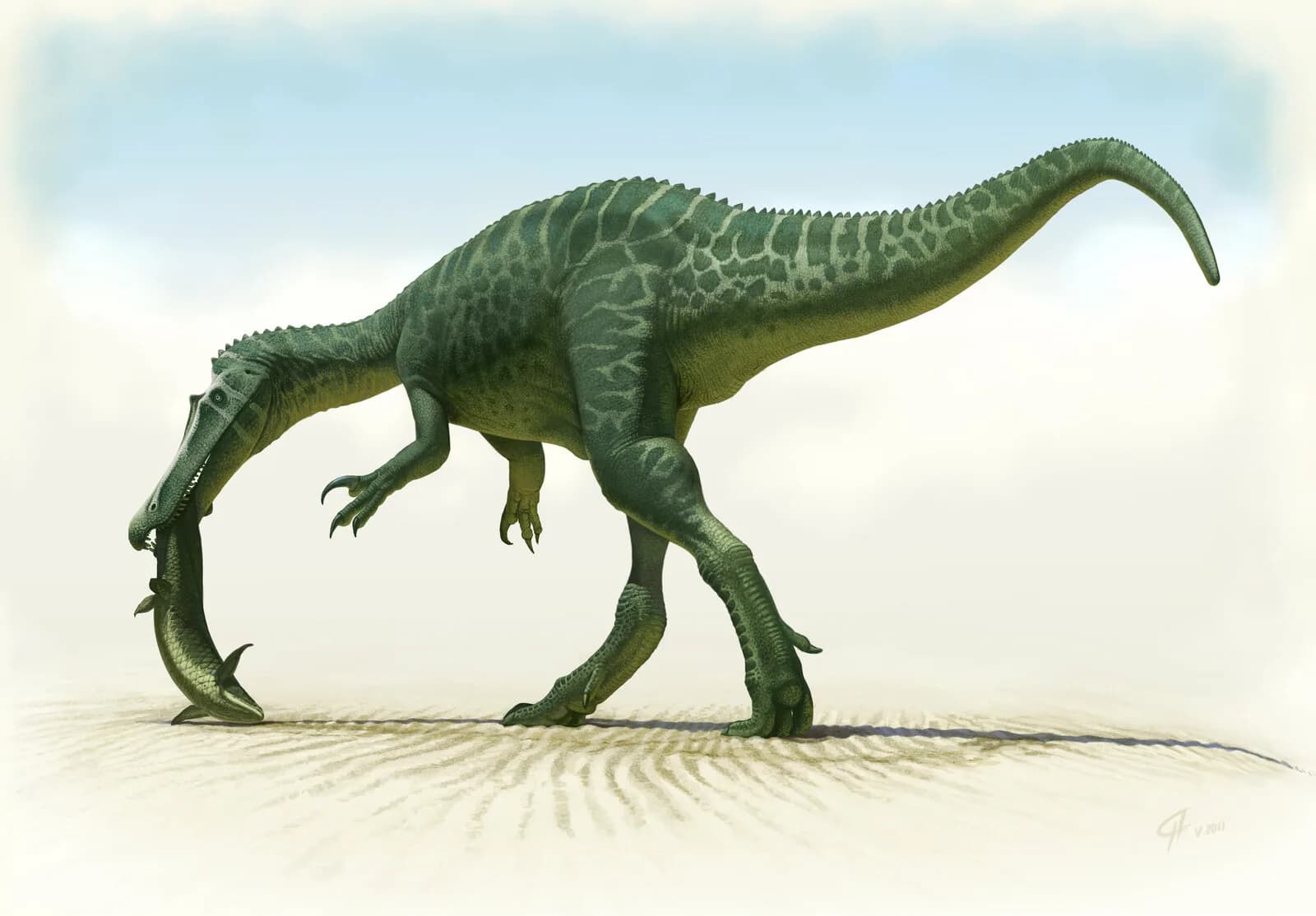
Baryonyx
Baryonyx walkeri is a spinosaurid 7.5 to 10 metres long and 1,200 to 1,700 kilograms, which fished across Europe 130 to 125 million years ago. Its name means « heavy claw »: the one on its thumb measures 31 centimetres. An amateur fossil hunter, William Walker, uncovered it in 1983 in a clay pit in Surrey, England.
Baryonyx lived during the Early Cretaceous period, approximately 130 to 125 million years ago, during the Barremian stage. It inhabited what is now southeastern England, in an environment that was very different from today's landscape. This period saw Europe as a series of islands and shallow seas with a warm, subtropical climate. Baryonyx thrived in deltaic and riparian environments near rivers and lakes that teemed with fish and other aquatic life. The Early Cretaceous was a time of significant dinosaur diversification, and Baryonyx represents one of the most specialized predatory adaptations among theropods — a shift toward piscivory that parallels modern fish-eating animals.
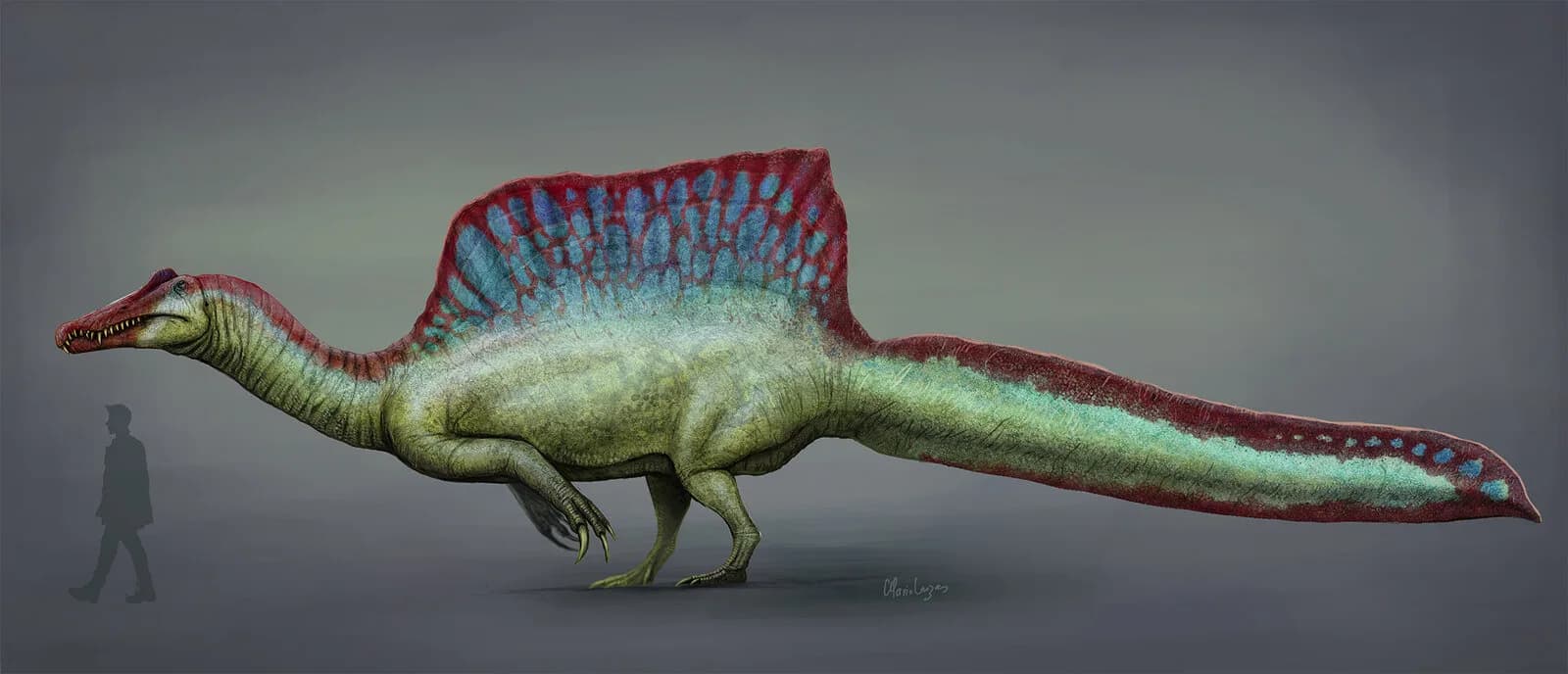
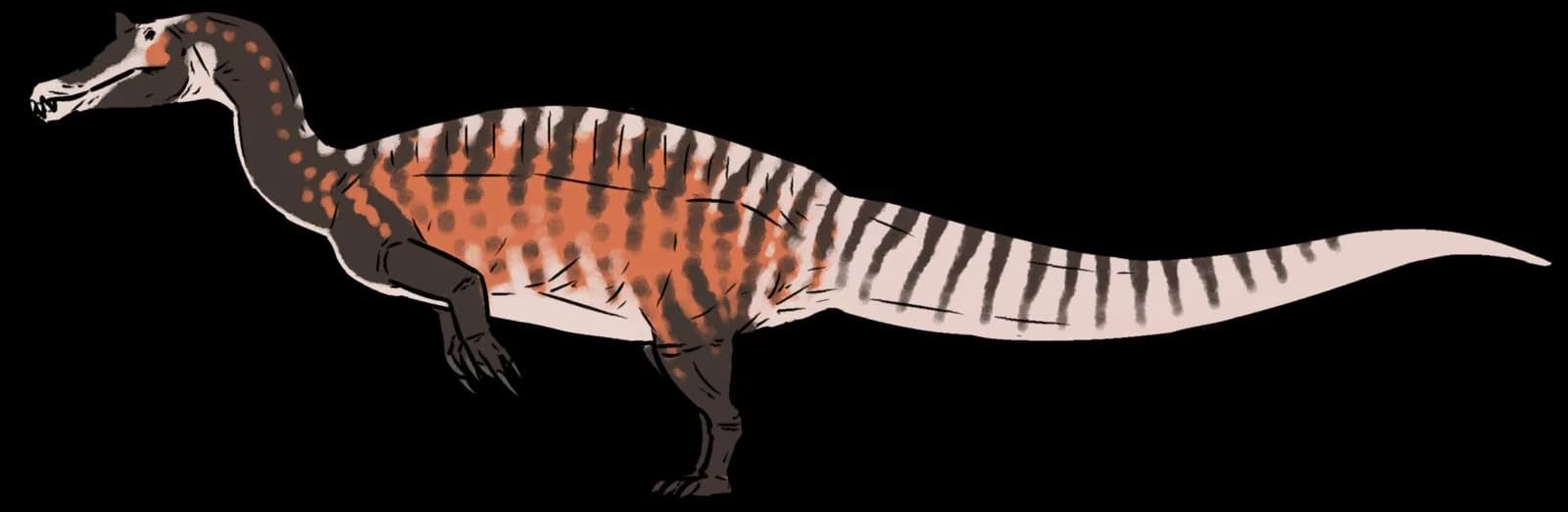
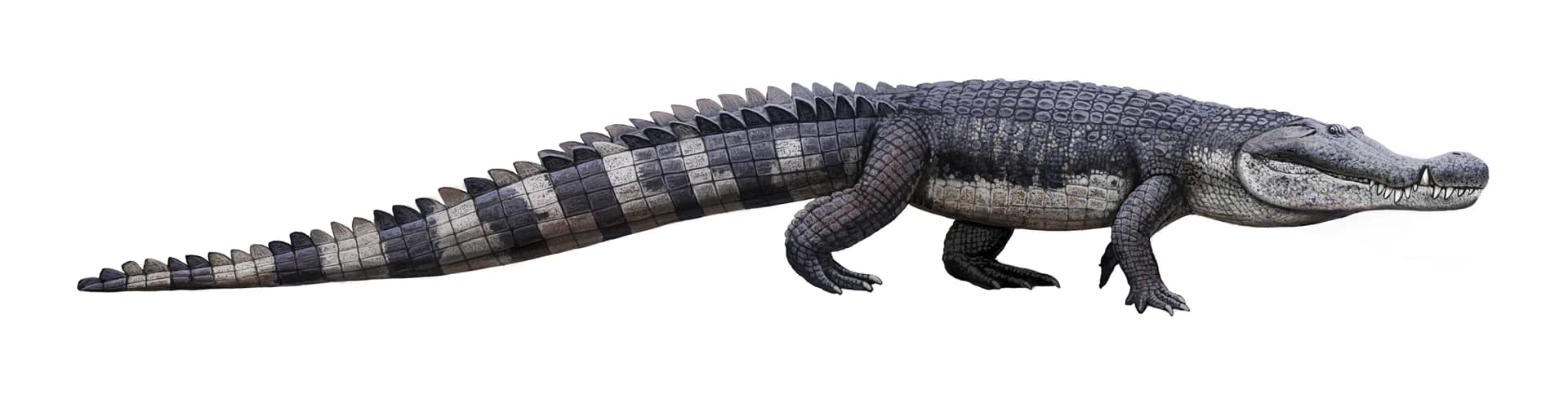
Baryonyx measured approximately 7.5 to 10 meters in length and weighed between 1.2 and 1.7 tons, making it a large but relatively lightly built theropod compared to other predators of similar length. Its skull was notably elongated and narrow, resembling that of a modern gharial or crocodilian, clearly adapted for catching fish. The most distinctive feature was an enormous curved claw on each hand, measuring about 31 centimeters along its outer edge, from which the genus derives its name meaning 'heavy claw.' The body was robust but more horizontal in posture than typical theropods, with relatively strong forelimbs suggesting they played an active role in prey capture.
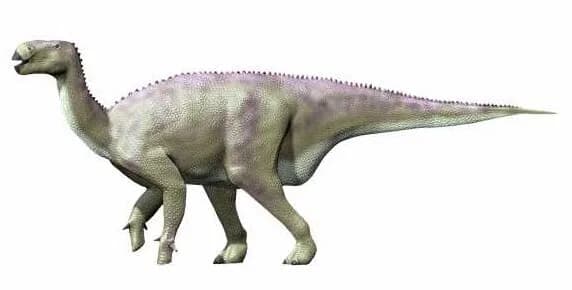
Baryonyx was primarily piscivorous, as dramatically confirmed by the discovery of fish scales and partially digested fish bones preserved within the abdominal cavity of the holotype specimen. Its long, narrow snout filled with conical, finely serrated teeth was perfectly adapted for catching slippery fish, similar to the jaws of modern gharials and fish-eating crocodilians. However, the remains of a juvenile Iguanodon were also found with the specimen, indicating it was not exclusively a fish-eater and opportunistically preyed on terrestrial animals as well. The large thumb claw may have been used to hook fish from the water, analogous to the fishing technique employed by modern grizzly bears.
Baryonyx inhabited the riverine and deltaic environments of the Wealden Group in what is now Surrey, England. During the Early Cretaceous, this region was a vast coastal floodplain with meandering rivers, freshwater lakes, and lagoons surrounded by lush subtropical vegetation including ferns, cycads, and conifers. The warm climate and abundant waterways created ideal conditions for a piscivorous predator, providing rich fishing grounds teeming with various species of fish and other aquatic organisms. Baryonyx likely spent much of its time near water, wading in shallows or patrolling riverbanks in search of prey, much like modern herons or bears do today.
Baryonyx's anatomy is remarkably adapted for fishing. Its elongated, narrow skull with a crocodile-like profile bore conical teeth rather than the blade-like cutting teeth typical of theropods. The most distinctive feature is the enormous curved claw on the first finger of each hand, from which its name meaning 'heavy claw' derives. Its arms were proportionally more robust and longer than those of most theropods, allowing it to effectively grasp prey. Its neck was less curved than in other theropods, forming a straighter line with the skull — an adaptation for plunging its head into water.
Baryonyx was likely a solitary predator that patrolled riverbanks and lakeshores in search of fish. Its hunting method probably combined ambush from the shore and active fishing in shallow water, using its powerful claws to harpoon prey. The discovery of Iguanodon bones in its stomach proves it did not disdain terrestrial prey when the opportunity arose. It could also have fed on carrion. Like reconstructed modern spinosaurids, it probably spent a significant portion of its time near water or partially submerged.
The Baryonyx holotype (BMNH R9951) was discovered in 1983 by amateur collector William Walker in a clay pit at Ockley, Surrey, England. Walker first found the enormous claw protruding from the rock, leading to the excavation of a remarkably complete skeleton for a European theropod — approximately 70% of the skeleton was recovered. Alan Charig and Angela Milner of the Natural History Museum in London described it in 1986 as Baryonyx walkeri, in honor of its discoverer. It was the first spinosaurid known from a substantial skeleton, revolutionizing our understanding of this family of fish-eating dinosaurs.
| Period | Crétacé inférieur / Early Cretaceous (Barremien) |
| Era | Mésozoïque / Mesozoic |
| Age | 130–125 Ma |
| Location | Europe (Angleterre / England, Espagne / Spain, Portugal) |
| Length | 7.5–10 m |
| Height | ~2.5 m |
| Weight | 1 200–1 700 kg |
| Diet | Piscivore |
| Discovery | 1983 |
Baryonyx walkeri primarily hunted giant fish like Lepidotes using its long, narrow snout — comparable to a modern gharial — armed with 96 conical teeth for gripping slippery prey. Its enormous 31 cm curved thumb claw likely served to harpoon fish in shallow water, much like a grizzly bear fishing for salmon. Fish scales were found in the abdominal cavity of the holotype specimen.
The Baryonyx walkeri holotype (BMNH R9951) was discovered in 1983 by William Walker, an amateur collector, in a clay pit at Ockley, Surrey, England. He first spotted the enormous claw protruding from the rock. Alan Charig and Angela Milner of the Natural History Museum in London described the specimen in 1986, naming the species in honor of Walker. The skeleton is approximately 70% complete — remarkable for a European theropod.
No. Baryonyx walkeri was primarily piscivorous, but opportunistic feeding is confirmed: partially digested bones of a juvenile Iguanodon were also found in the holotype's abdominal cavity. This Early Cretaceous spinosaurid (130-125 Ma) did not pass up terrestrial prey when the opportunity arose, making it a versatile predator of western European riverine environments.
Information on this page is based on peer-reviewed scientific publications.
Life reconstruction of Baryonyx walkeri
Andrey Atuchin, CC BY 4.0, via Wikimedia Commons
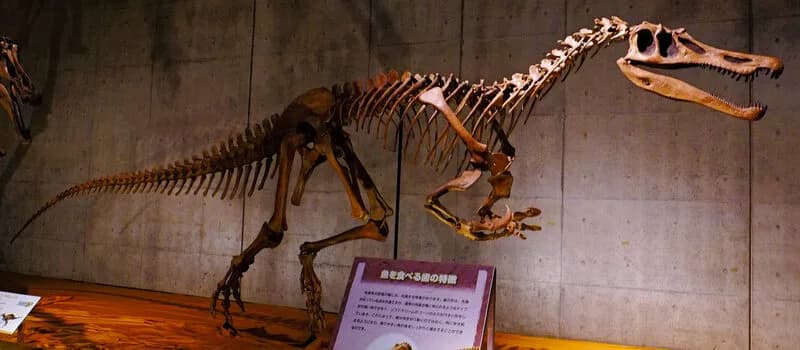
Mounted Baryonyx walkeri skeleton
Kumiko, CC BY-SA 2.0