Spinosaure
Spinosaurus aegyptiacus is the largest carnivorous dinosaur known: 14 to 15 metres long and 7 to 14 tonnes, roughly two metres longer than Tyrannosaurus rex. It lived in North Africa 95 to 93 million years ago and fed mainly on fish. Its original fossils, described in 1912, were destroyed in Munich during an air raid on 24 April 1944.
Playable in Path of Titans
See Spinosaurus aegyptiacus's stats, abilities and role on our survival server.
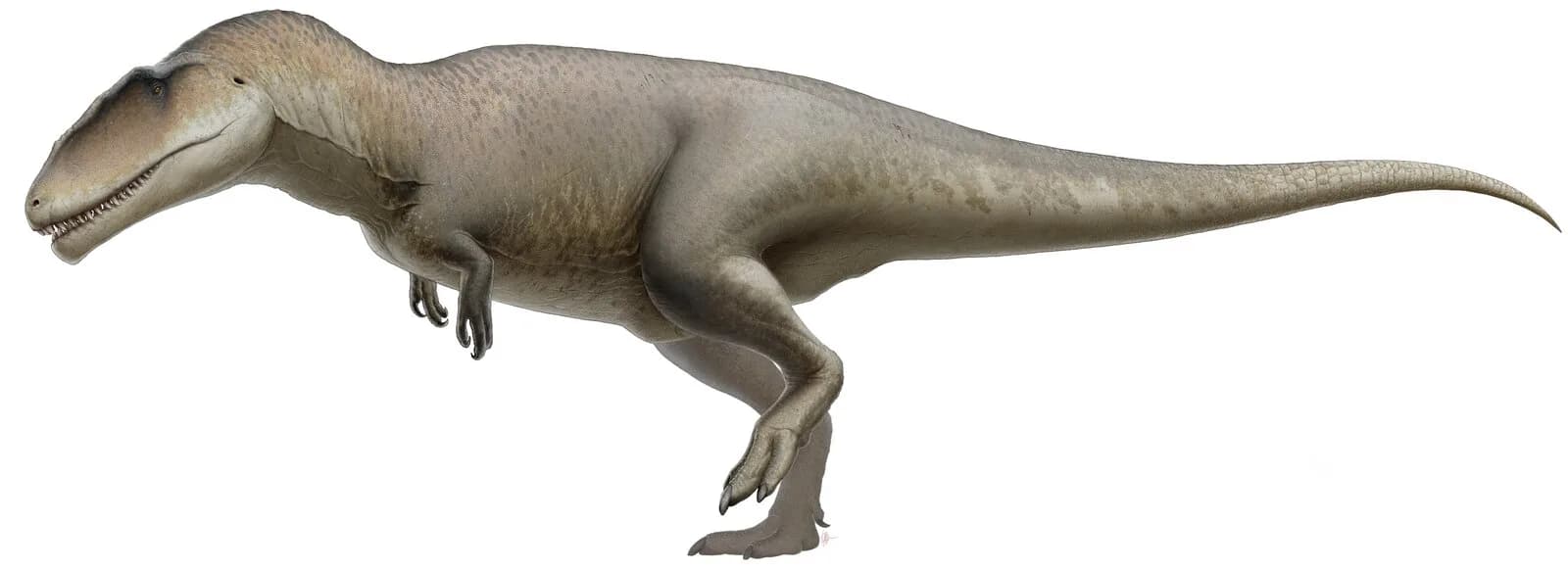
Spinosaurus lived in the Middle Cretaceous, approximately 95 to 93 million years ago, during the Cenomanian stage. It is considered the largest known terrestrial theropod, surpassing even Tyrannosaurus in length. Its discovery profoundly altered our understanding of theropod dinosaurs, revealing that at least one lineage had evolved toward a semi-aquatic lifestyle. The Cenomanian was a period of extreme heat with very high CO2 levels, creating lush tropical environments in North Africa. Spinosaurus coexisted with other large predators like Carcharodontosaurus, creating a unique ecosystem where two super-predators shared the same territory thanks to distinct ecological niches.
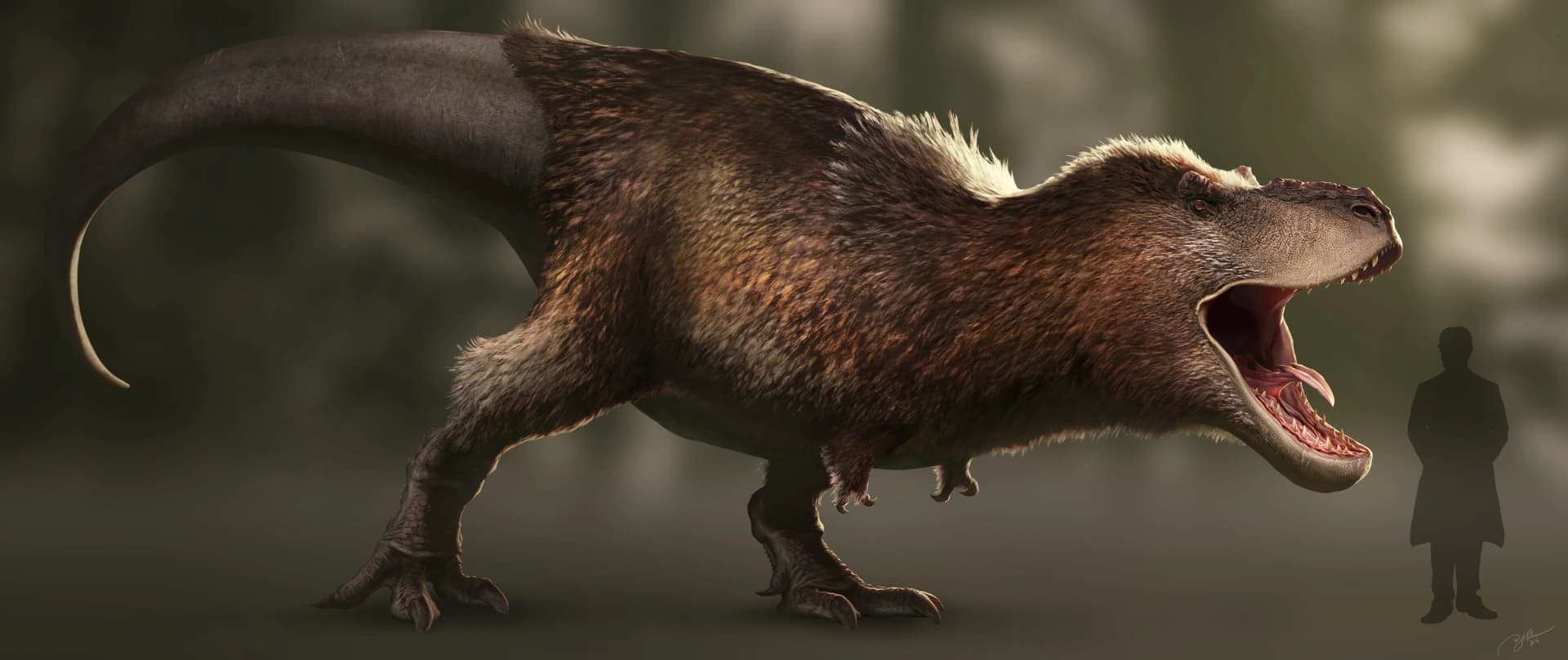
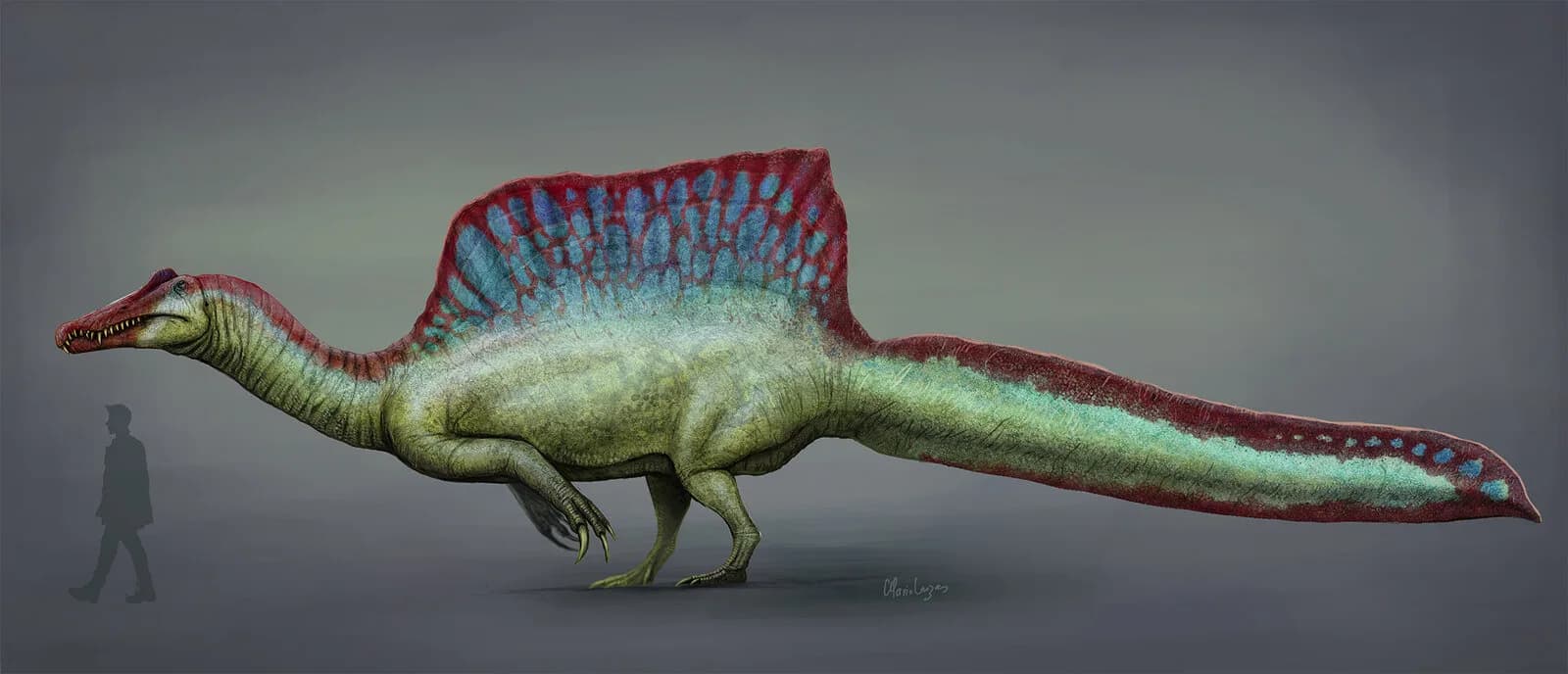
Estimated at 14-15 meters long and 7 to 14 tonnes, Spinosaurus exceeds all other known theropods in size. Its dorsal sail could reach 1.65 meters in height, formed by elongated neural spines on its dorsal and sacral vertebrae. This sail is one of the most spectacular structures in the entire prehistoric animal kingdom. Its skull measured about 1.75 meters long, one of the largest theropod skulls ever discovered, but with a narrow, elongated profile very different from T. rex's massive skull. Recent reconstructions (2020) have considerably modified our image of Spinosaurus, revealing a much more aquatic animal than previously thought.
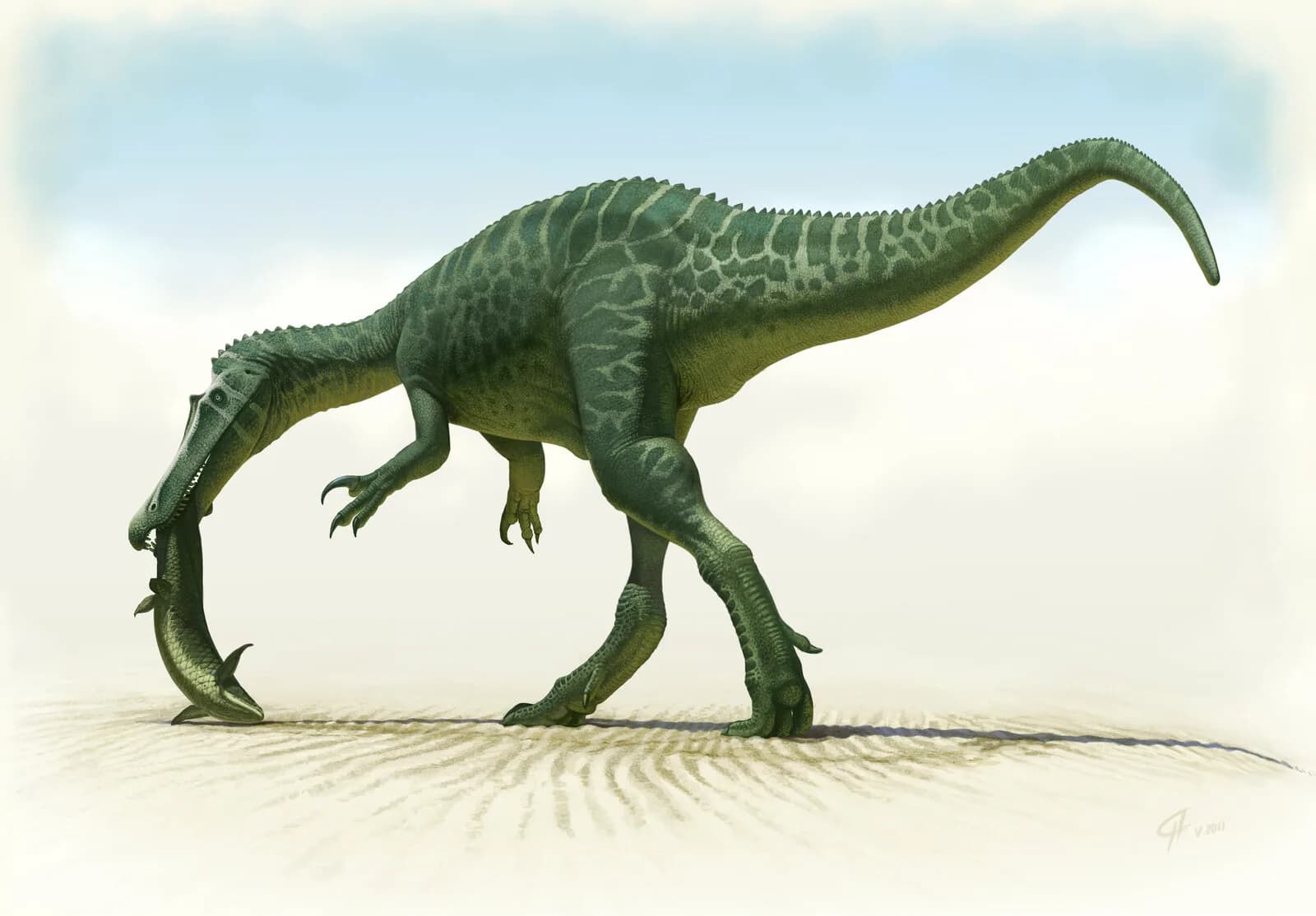
Primarily a semi-aquatic piscivore, Spinosaurus hunted giant fish like Onchopristis (a 6-meter sawfish) and crocodilians. Isotopic studies of its bones confirm a largely aquatic diet. Its long, narrow snout, armed with unserrated conical teeth, was perfectly adapted for catching slippery fish — similar to the modern gharial. Fish scales have been found in fossilized stomach contents associated with Spinosaurus. However, it could also hunt terrestrial prey: a pterosaur was found with a spinosaurid tooth embedded in a vertebra. Its dietary versatility allowed it to exploit both aquatic and terrestrial resources in its river delta-rich environment.
Spinosaurus inhabited the river deltas and coastal mangroves of North Africa, in what is now Morocco, Egypt, and Algeria. The environment was very humid subtropical, at the boundary between land and sea, with a dense network of rivers, estuaries, and lagoons. The Kem Kem river system (present-day Morocco) harbored an incredibly diverse aquatic fauna, including giant fish, 10-meter crocodilians, and sea turtles. The coexistence of Spinosaurus and Carcharodontosaurus in the same ecosystem was possible through niche separation: Spinosaurus dominating aquatic environments while Carcharodontosaurus ruled the land. Temperatures were extremely hot, with annual averages exceeding 30°C.
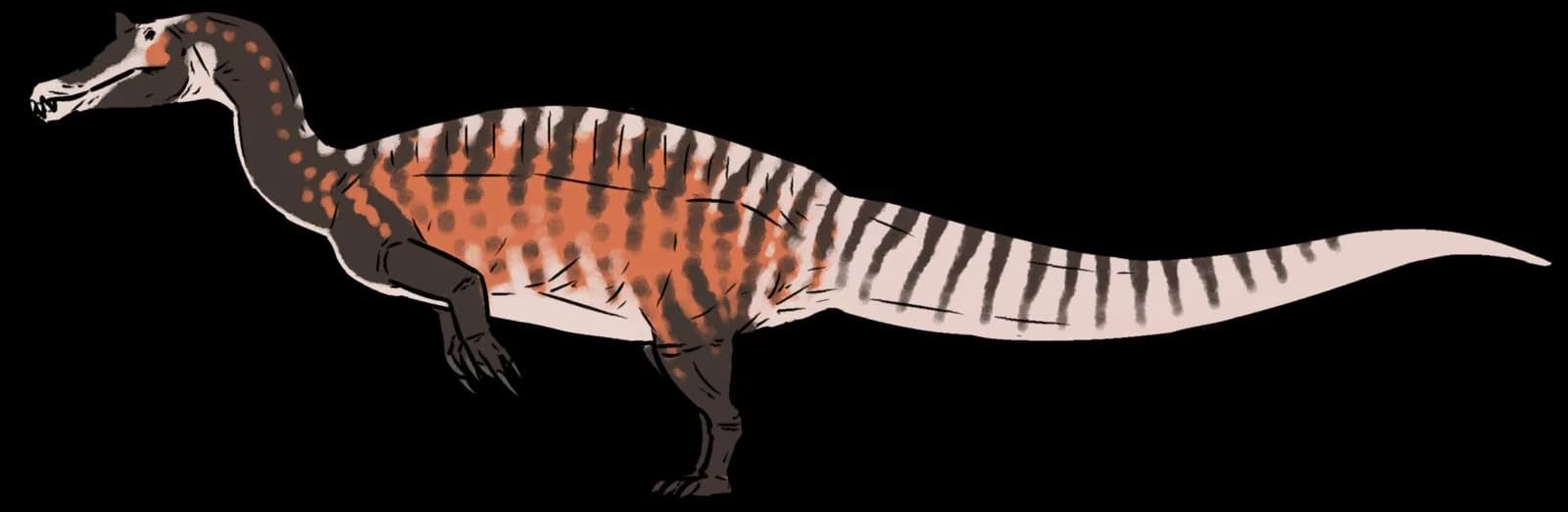
Spinosaurus anatomy reveals unprecedented aquatic adaptations among theropod dinosaurs. Its nostrils were positioned high on the skull, like crocodilians, allowing breathing with most of the head underwater. Its long, narrow snout, equipped with pressure sensors, could detect fish vibrations in water — a system similar to crocodilian lateral organs. Its hind legs were unusually short for a theropod of this size, and its broad, flat feet were possibly webbed. The revolutionary 2020 discovery revealed a laterally flattened paddle-like tail, confirming that Spinosaurus actively swam. Its bones were dense and heavy (osteosclerotic), like those of penguins and hippos, serving as ballast to keep the body submerged. The dorsal sail, spectacular but fragile, likely served as visual display for intraspecific communication and thermoregulation.
Contrary to the image popularized by Jurassic Park III, Spinosaurus was likely a specialized fish hunter rather than an active terrestrial predator. It spent much of its time in water, propelled by its paddle tail and possibly webbed feet. Its hunting method probably combined active swimming and semi-submerged ambush, like a giant crocodilian. On land, its posture was probably quadrupedal or semi-bipedal, with its robust forelimbs touching the ground. Computer simulations suggest it could swim at significant speeds through tail undulations. Its dorsal sail, clearly visible above the water surface, could serve to intimidate rivals or attract mates. Solitary and territorial, it probably controlled long stretches of rivers as hunting territory.
The history of Spinosaurus fossils is both tragic and remarkable. Described in 1915 by German paleontologist Ernst Stromer from Egyptian fossils, the originals were destroyed on April 24, 1944, during an Allied bombing of the Munich museum. For nearly 70 years, Spinosaurus was known only from Stromer's drawings and descriptions. In 2014, Nizar Ibrahim and his team described spectacular new fossils from Morocco, revealing the animal's aquatic adaptations for the first time. The discovery of the paddle tail in 2020 was published in Nature and made headlines worldwide. The Kem Kem fossil beds in Morocco continue to yield exceptional material, but the region suffers from fossil looting for illegal trade. Despite its fame, no complete Spinosaurus skeleton has yet been found, and many aspects of its anatomy remain debated.
| Period | Crétacé moyen / Middle Cretaceous (Cénomanien) |
| Era | Mésozoïque / Mesozoic |
| Age | 95–93 Ma |
| Location | Afrique du Nord / North Africa (Maroc, Égypte) |
| Length | 14–15 m |
| Height | ~4–5 m |
| Weight | 7 000–14 000 kg |
| Diet | Piscivore |
| Discovery | 1912 |
Yes: Spinosaurus aegyptiacus is estimated at 14 to 15 meters long and 7 to 14 tonnes, surpassing Tyrannosaurus rex (12-13 m) in length. However, its narrower skull and unserrated conical teeth were less powerful. Its dorsal sail could reach 1.65 meters in height, formed by elongated neural spines.
The discovery published in Nature in 2020 (Ibrahim et al.) revealed a laterally flattened paddle-shaped tail, confirming that Spinosaurus aegyptiacus actively swam. Its dense bones (osteosclerotic), high-positioned nostrils, and possibly webbed broad feet all support a semi-aquatic lifestyle, though Sereno et al. (eLife, 2022) still debate the extent of its aquatic capabilities.
Spinosaurus aegyptiacus was described in 1915 by Ernst Stromer from Egyptian fossils. The original specimens were destroyed on April 24, 1944, during an Allied bombing of the Munich museum in World War II. For nearly 70 years the species was known only from Stromer's drawings and descriptions, until new Moroccan discoveries described by Ibrahim et al. in 2014.
Information on this page is based on peer-reviewed scientific publications.
Spinosaurus 2020 reconstruction with semi-aquatic morphology
Mariolanzas, CC BY-SA 4.0, via Wikimedia Commons
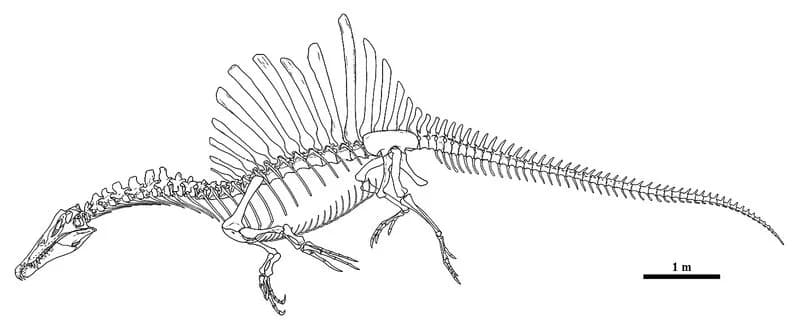
Spinosaurus aegyptiacus skeletal reconstruction
Marco Auditore et al., CC BY 4.0