Tylosaure
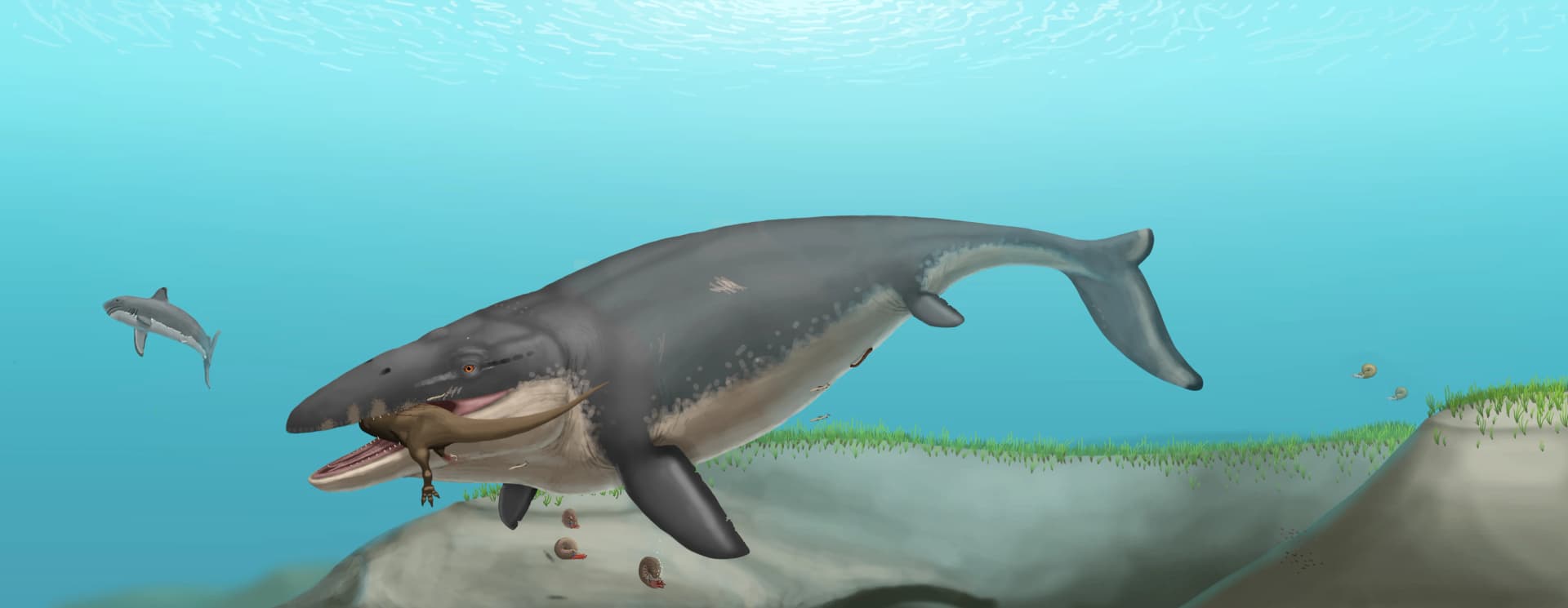
Tylosaurus proriger carried a rounded, toothless ram at the tip of its snout, most likely used to stun prey before seizing it. Twelve to 14 metres long and 7 to 12 tonnes, it hunted 92 to 66 million years ago, from Kansas to Manitoba, and as far as New Zealand and Angola.
Playable in Path of Titans
See Tylosaurus proriger's stats, abilities and role on our survival server.
Tylosaurus lived during the Late Cretaceous, approximately 92 to 66 million years ago (Turonian to Maastrichtian stages). This giant marine reptile belonged to the family Mosasauridae, the marine squamates that dominated the oceans of the terminal Cretaceous period. Tylosaurus is one of the largest mosasaurs ever discovered, rivaling Mosasaurus hoffmannii for the title of largest marine predator of its time. Its name means 'knob lizard' in reference to its rounded and prominent rostrum, a unique bony structure at the tip of its snout that distinguishes it from all other mosasaurs. It thrived primarily in the Western Interior Seaway that divided North America in two from the Gulf of Mexico to the Arctic Ocean, a warm, shallow marine environment teeming with prey of all sizes.
Tylosaurus proriger, the type species, is one of the largest marine reptiles that ever lived. The most complete specimens indicate a total length of 12 to 14 meters, with some estimates reaching up to 15 meters for the most massive individuals. Its weight is estimated between 7 and 12 tonnes depending on the reconstruction method used. Its skull alone could reach 1.2 to 1.5 meters in length, armed with robust conical teeth capable of crushing the shells of sea turtles. The upper jaw featured a massive rounded rostrum, devoid of teeth for the first few centimeters, which likely served as a battering weapon during attacks on prey. Its flexible double-hinged jaw allowed it to swallow large prey whole, a trait common to marine squamates inherited from their terrestrial varanid ancestors.
Tylosaurus was an opportunistic apex predator occupying the absolute summit of the Late Cretaceous marine food chain. Remarkably preserved fossilized stomach contents, notably in specimen KUVP-1075, reveal an incredibly varied diet comprising bony fish, a shark, a smaller mosasaur (Clidastes), a diving bird (Hesperornis), and even a plesiosaur. This extraordinary prey diversity makes it one of the most versatile predators ever documented in the marine fossil record. Its palatine pterygoid teeth, inherited from terrestrial squamate ancestors, allowed it to efficiently grip slippery prey and convey them toward the esophagus in a ratchet-like mechanism. Its rounded, massive rostrum could also function as a battering ram to stun or destabilize prey before delivering the fatal bite, a hunting strategy unique among mosasaurs.
Tylosaurus primarily inhabited the Western Interior Seaway, a shallow, warm sea that divided North America into two distinct landmasses during the Late Cretaceous, stretching from the Gulf of Mexico to the Arctic Ocean. This exceptionally productive marine environment harbored a diverse fauna including giant ammonites, bony fish, sharks, sea turtles, plesiosaurs, and other mosasaurs. Fossils of Tylosaurus have been discovered primarily in Kansas, South Dakota, Nebraska, and Alabama, but also in Canada (Manitoba, Saskatchewan). Related species have been reported from New Zealand, Japan, and Angola, suggesting a broader distribution than North America alone, although the genus was particularly diverse and abundant in North American seas during the Campanian and Maastrichtian stages of the Late Cretaceous period.
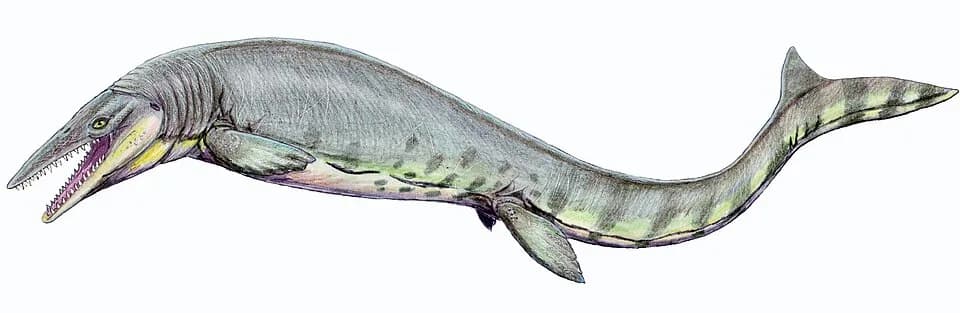
Tylosaurus possessed a massive, hydrodynamic body perfectly adapted for marine predation at the highest trophic levels. Its most distinctive anatomical feature is its elongated rostrum — a bony extension of the premaxilla devoid of teeth, forming a rounded and robust point at the front of the snout. This structure, unique among mosasaurs, likely served as a percussion weapon against prey and rivals alike, functioning much like a battering ram during high-speed attacks. Its four limbs were transformed into powerful flippers used primarily for steering and stabilization rather than propulsion. Its long, muscular tail, terminating in a hypocercal caudal fin with an elongated lower lobe, provided propulsion through lateral undulation similar to modern sea snakes. Like all mosasaurs, it possessed an intramandibular joint allowing it to open its jaws extremely wide and ingest voluminous prey items that would otherwise be impossible to swallow.
Tylosaurus was most likely an active and territorial predator, capable of impressive bursts of speed thanks to its powerful tail-driven propulsion system with its large caudal fin. Fossil evidence from stomach contents demonstrates that it actively hunted an extraordinarily diverse range of prey, from fast-swimming fish to rival mosasaurs, implying varied hunting strategies and considerable behavioral intelligence. Bite marks found on fossils of other mosasaurs and plesiosaurs testify to frequent intraspecific and interspecific combat in the Cretaceous seas. Its blunt rostrum may have served as a battering ram during territorial confrontations, similar to the behavior observed in modern marine iguanas and bighorn sheep. Isotopic studies suggest partial endothermy, conferring a significant metabolic advantage over ectothermic prey in the cooler waters of the higher latitudes within the Western Interior Seaway.
The first Tylosaurus fossils were discovered in the chalk formations of Kansas during the famous Bone Wars of the second half of the 19th century, when rival paleontologists Edward Drinker Cope and Othniel Charles Marsh competed fiercely to name the most new species. Cope described Tylosaurus proriger in 1869 from specimens collected in the Niobrara Formation, a geological unit renowned for its exceptional preservation of marine vertebrates. Kansas remains the most prolific site for Tylosaurus fossils, with dozens of remarkably complete specimens housed at the Sternberg Museum in Hays and the Natural History Museum in Lawrence. Specimen KUVP-1075 is particularly famous for its fossilized stomach contents containing five different identifiable prey items — a unique case in marine paleontology that provides unparalleled insight into mosasaur feeding ecology. In Canada, 'Bruce,' a 13-meter Tylosaurus pembinensis displayed at the Canadian Fossil Discovery Centre in Morden, Manitoba, is the largest mosasaur specimen on public display anywhere in the world. Several species are currently recognized: T. proriger, T. nepaeolicus, T. pembinensis, and T. saskatchewanensis.
| Period | Crétacé supérieur / Late Cretaceous |
| Era | Mésozoïque / Mesozoic |
| Age | 92-66 Ma |
| Location | Amérique du Nord (Kansas, Dakota du Sud, Manitoba), Nouvelle-Zélande, Angola / North America (Kansas, South Dakota, Manitoba), New Zealand, Angola |
| Length | 12-14 m |
| Height | 2-3 m |
| Weight | 7-12 tonnes |
| Diet | Piscivore |
| Discovery | 1869 |
No. Tylosaurus proriger was a mosasaur, a marine squamate reptile related to modern varanid lizards, not a dinosaur. Mosasaurs and dinosaurs are two distinct reptile groups. Tylosaurus dominated the Late Cretaceous seas 92 to 66 million years ago, reaching 12 to 14 meters in length, while dinosaurs ruled the land.
Tylosaurus proriger specimen KUVP-1075, housed in Kansas, is famous for its fossilized stomach contents containing five different identifiable prey: a bony fish, a shark, a smaller mosasaur (Clidastes), a diving bird (Hesperornis), and a plesiosaur. This menu represents the greatest prey diversity ever documented in a single marine predator fossil.
The rostrum of Tylosaurus proriger — a bony extension of the premaxilla devoid of teeth, forming a rounded, robust point — is unique among mosasaurs. This structure likely served as a percussion weapon during attacks, stunning or destabilizing prey before the fatal bite. The name Tylosaurus means 'knob lizard,' referencing this distinctive anatomical feature.
Life reconstruction of Tylosaurus pembinensis in marine environment
Dmitry Bogdanov / Wikimedia Commons
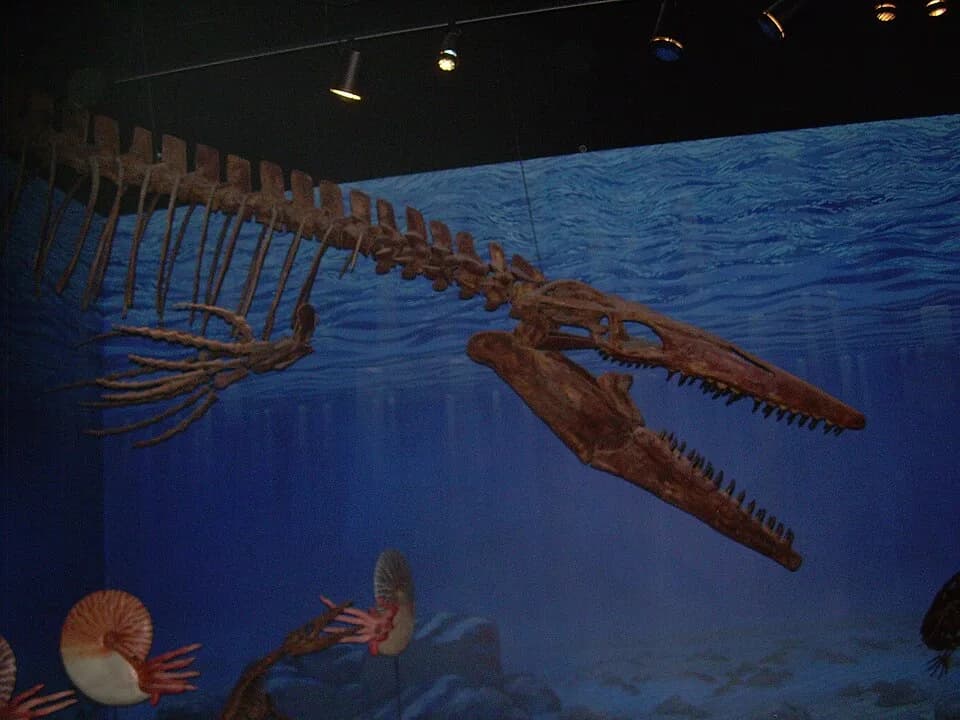
Mounted skeleton of Tylosaurus proriger at the Natural History Museum
Wikimedia Commons
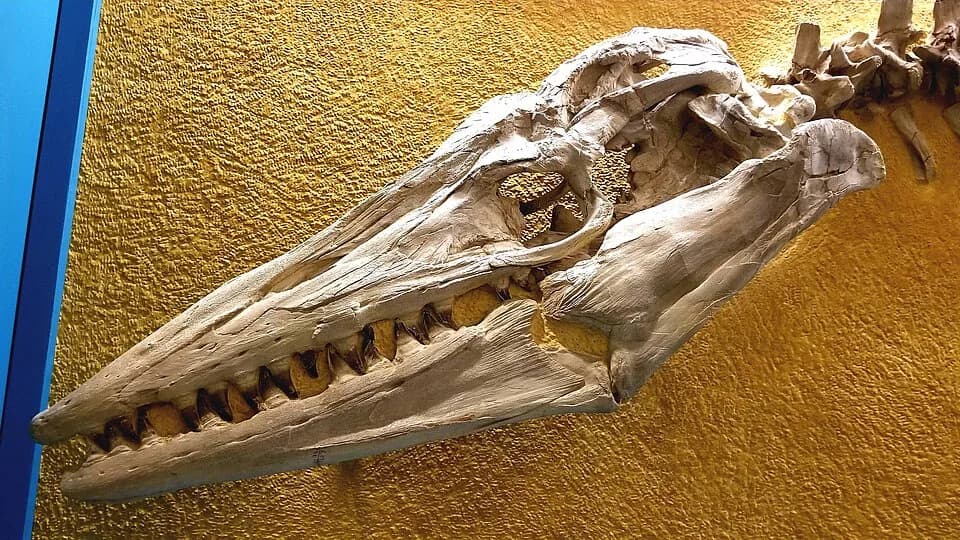
Fossil skull of Tylosaurus proriger (FHSM VP-3) at Sternberg Museum
Wikimedia Commons