Mosasaure
Mosasaurus hoffmannii was not a dinosaur but a marine reptile related to monitor lizards, 12 to 17 metres long and 5 to 15 tonnes. It hunted the world's oceans 82 to 66 million years ago, gripping prey with a second row of teeth set on the palate. Its Maastricht skull, described as early as 1764, was seized by French troops in 1795 and is still held in Paris.
Mosasaurus lived during the Late Cretaceous, approximately 82 to 66 million years ago (Campanian to Maastrichtian stages). Contrary to popular belief, it was not a dinosaur but a marine squamate reptile — a close relative of modern monitor lizards and snakes that became perfectly adapted to a fully oceanic lifestyle over millions of years of evolution. Mosasaurs as a group dominated the terminal Cretaceous seas as undisputed apex predators, filling the ecological void left by the earlier decline of ichthyosaurs and giant pliosaurs. Mosasaurus hoffmannii, the type species of the entire genus, is one of the largest and most robust representatives of the family Mosasauridae. Its extinction occurred abruptly during the K-Pg event 66 million years ago, when the Chicxulub asteroid impact and its catastrophic aftermath also annihilated non-avian dinosaurs, pterosaurs, and ammonites.
Mosasaurus hoffmannii is one of the largest known mosasaurs and among the most formidable marine predators of the Mesozoic era. Length estimates, based on skulls reaching an impressive 1.7 meters and proportional comparisons with more complete mosasaur specimens, place adult size between 12 and 17 meters from snout to tail tip. Its weight is estimated between 5 and 15 tonnes depending on the total length and degree of robustness assumed in body reconstructions. Its massive, heavily built skull armed with large recurved conical teeth made it one of the most powerful and fearsome predators of the Maastrichtian seas. Its bite force, while inherently difficult to estimate precisely from fossils alone, was undoubtedly considerable thanks to its voluminous temporal muscles and distinctive double-hinged jaw mechanism. Each tooth bore prominent carinae — longitudinal ridges — that facilitated deep penetration into the flesh and bone of its prey.
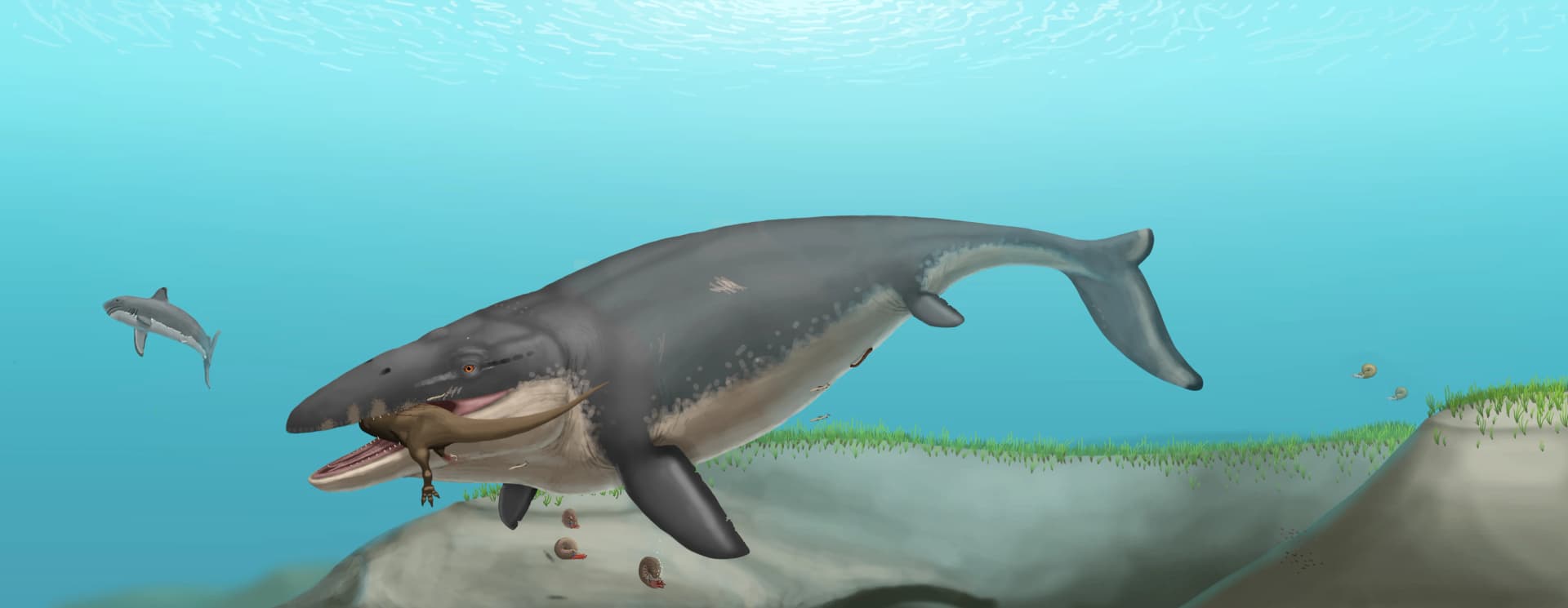
An opportunistic apex predator of extraordinary versatility, Mosasaurus fed on virtually everything the terminal Cretaceous seas could offer: large bony fish, ammonites and other cephalopods, sea turtles (fossilized Allopleuron shells bear unmistakable mosasaur bite marks), primitive diving birds like Hesperornis, and even smaller mosasaur species including juveniles of its own kind. Fossilized stomach contents found in closely related mosasaur species unambiguously confirm a varied and highly opportunistic diet that shifted with prey availability. Its pterygoid teeth — an additional row of recurved teeth located on the palate, a feature characteristic of squamate reptiles and inherited from their terrestrial ancestors — allowed it to efficiently grip and progressively swallow slippery, struggling prey. This palatal dentition was particularly effective for consuming hard-shelled ammonites and evasive fish, functioning as a ratchet mechanism that prevented any backward movement of prey within the mouth during the swallowing process.
Mosasaurus inhabited both epicontinental seas and open oceans across the entire globe during the final stages of the Cretaceous period. The first and most historically significant fossils come from the chalk quarries of Maastricht, in the Netherlands, extracted from deposits of the shallow Cretaceous sea that then covered much of northwestern Europe. Specimens have since been discovered across an impressive geographic range including North America, Africa (Morocco, Angola), the Middle East (Jordan), Antarctica, and New Zealand, attesting to a truly cosmopolitan distribution rivaling that of modern apex marine predators. It appears to have strongly preferred surface waters and coastal to pelagic environments rather than the deep abyssal ocean. The warm Tethys Sea and the vast Western Interior Seaway of North America were among its primary hunting territories, providing abundant prey and favorable warm-water conditions year-round.
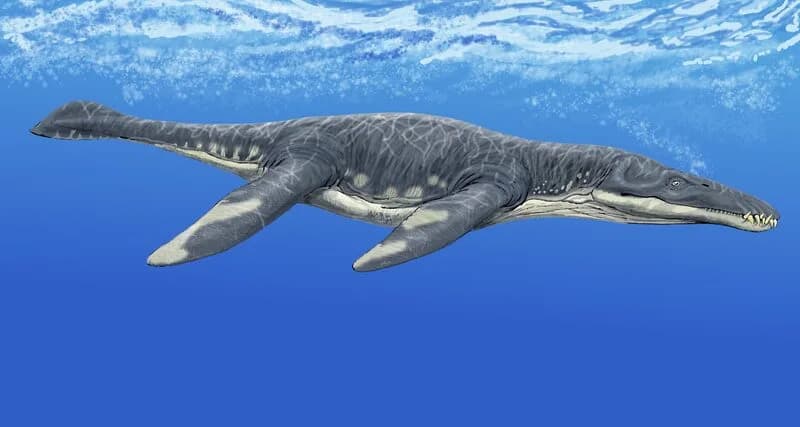
Mosasaurus possessed an elongated, hydrodynamic body perfectly adapted for swimming. Its four limbs were transformed into flippers (paddle-like appendages) with elongated, webbed digits, used for steering rather than propulsion. Its powerful tail, equipped with a crescent-shaped caudal fin in advanced species (confirmed by soft tissue impressions), provided the main thrust. Like modern snakes, its lower jaw possessed a flexible symphysis allowing it to swallow large prey. Its palatine pterygoid teeth, a feature inherited from terrestrial squamates, created a second set of fangs to grip and convey prey toward the esophagus. Its pulmonary respiratory system required regular returns to the surface.
Mosasaurus was an active and highly efficient predator of surface and mid-depth waters, capable of brutal accelerations and sustained cruising thanks to its powerful crescent-shaped tail fin. Unlike the pliosaurs that preceded them in marine ecosystems, mosasaurs swam primarily through lateral undulation of the entire body, in a manner closely resembling modern sea snakes and eels, rather than relying on flipper-based propulsion. Oxygen isotope analyses conducted on its tooth enamel suggest it could partially regulate its own body temperature through a form of partial endothermy, giving it a significant metabolic advantage over purely ectothermic prey in cooler waters. The discovery of very small juvenile mosasaur remains in open marine deposits — far from any shoreline — strongly suggests that Mosasaurus was viviparous, giving birth to live young in the open ocean rather than laying eggs on beaches, a reproductive strategy fundamentally different from that of contemporary sea turtles.
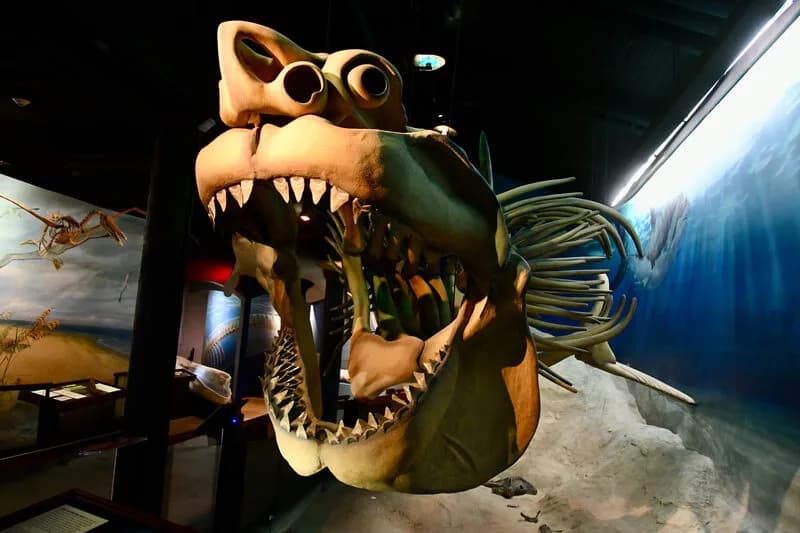
The first Mosasaurus fossil, a partial skull, was discovered in 1764 in an underground chalk quarry near Maastricht, the Netherlands. This discovery is one of the founding milestones of paleontology — it fueled the debate over species extinction at a time when the concept was not accepted. In 1795, French revolutionary troops seized the skull as war spoils, and it is now housed at the National Museum of Natural History in Paris. Geologist William Daniel Conybeare created the genus Mosasaurus ('Meuse lizard') in 1822. Georges Cuvier used this fossil as evidence that species could go extinct — a revolutionary concept at the time. Dozens of mosasaur species are now known, with M. hoffmannii remaining the type species.
| Period | Crétacé supérieur / Late Cretaceous |
| Era | Mésozoïque / Mesozoic |
| Age | 82-66 Ma |
| Location | Mondial (Pays-Bas, Amérique du Nord, Afrique, Antarctique) / Worldwide (Netherlands, North America, Africa, Antarctica) |
| Length | 12-17 m |
| Height | 2-3 m |
| Weight | 5-15 tonnes |
| Diet | Piscivore |
| Discovery | 1764 |
No, Mosasaurus hoffmannii was not a dinosaur. It was a marine squamate reptile — a close relative of modern monitor lizards and snakes — that lived from 82 to 66 million years ago. Mosasaurs form their own distinct group (Mosasauridae), separate from dinosaurs, pterosaurs, and plesiosaurs. They dominated the Late Cretaceous seas after the decline of ichthyosaurs and pliosaurs.
Mosasaurus hoffmannii measured between 12 and 17 meters long, based on estimates from skulls reaching 1.7 meters. Its weight is estimated between 5 and 15 tonnes. It is one of the largest known mosasaurs, with a massive skull armed with conical teeth bearing longitudinal ridges. According to Polcyn et al. (2014), it ranked among the most powerful apex predators of the Maastrichtian seas.
The first Mosasaurus fossil — a partial skull — was discovered in 1764 in an underground chalk quarry near Maastricht, the Netherlands. This specimen is one of the founding milestones of paleontology: Georges Cuvier used it to demonstrate that species could go extinct. In 1795, Napoleon's troops seized it as war spoils; the skull is now housed at the National Museum of Natural History in Paris.
Information on this page is based on peer-reviewed scientific publications.
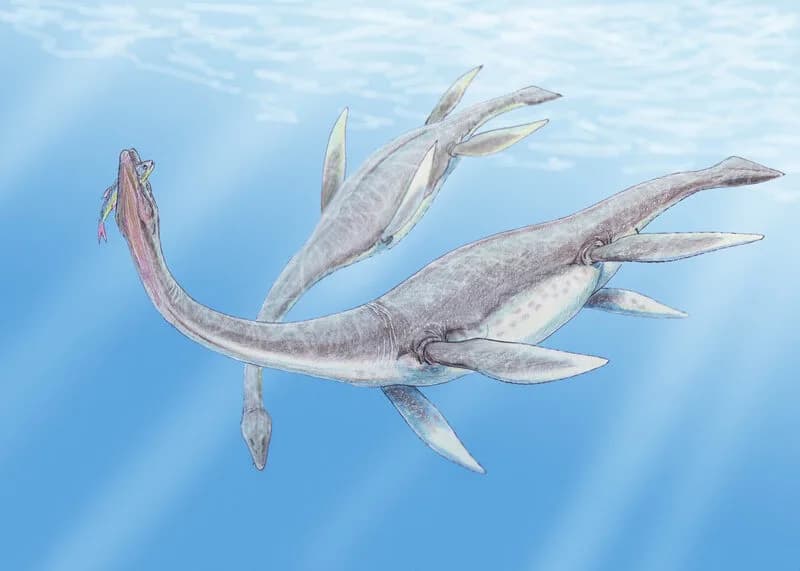
Life reconstruction of Mosasaurus hoffmannii hunting
Wikipedia Commons
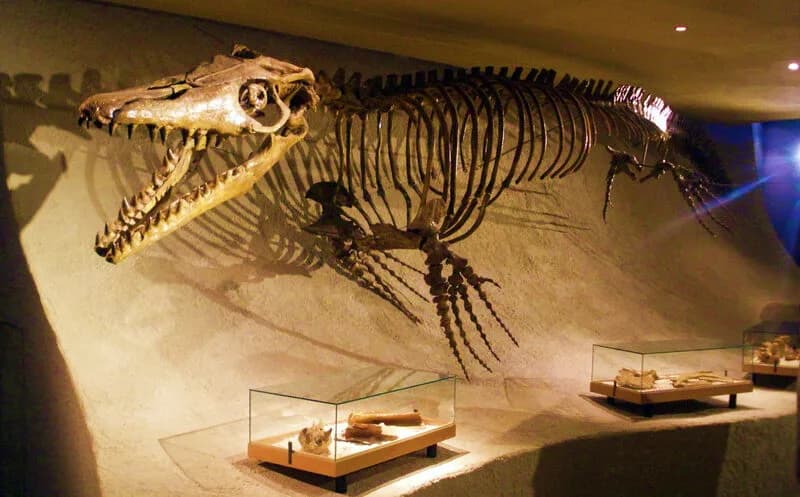
Fossil skull of Mosasaurus at the Maastricht Museum
Wikipedia Commons