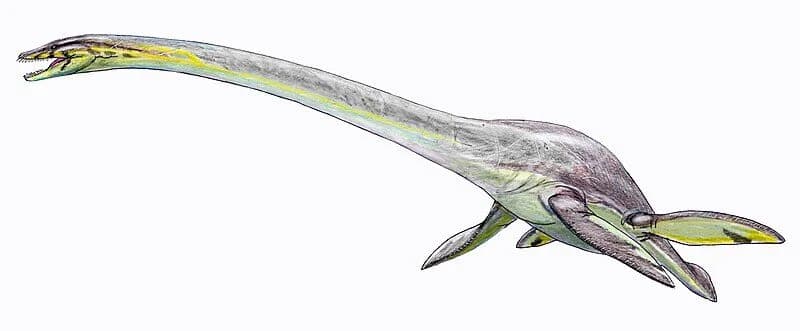
Élasmosaure
Elasmosaurus platyurus was a plesiosaur from Kansas, described in 1868 and dated to around 80.5 million years ago. At 10.3 metres and close to 2 tonnes, its neck held 72 cervical vertebrae — more than any known animal, where a giraffe has just seven. On describing it, Edward Drinker Cope placed the head at the end of the tail by mistake.
Elasmosaurus lived during the Late Cretaceous period, approximately 80.5 million years ago (Campanian stage). It was not a dinosaur but a marine reptile belonging to the order Plesiosauria, specifically to the family Elasmosauridae. Elasmosaurids represent the longest-necked group of plesiosaurs, a spectacular adaptation for predation in open marine environments. Elasmosaurus platyurus is the type species and the most famous member of this family. It inhabited the Western Interior Seaway, a shallow sea that divided North America into two distinct landmasses during the Late Cretaceous. Its extinction predated the K-Pg event, as the species disappears from the fossil record toward the end of the Campanian stage.
Elasmosaurus platyurus measured approximately 10.3 meters in total length, making it one of the largest plesiosaurs of its time. Its weight is estimated at roughly 2 tonnes. The most striking feature was its extraordinarily long neck, which accounted for more than half of its total body length, measuring approximately 7 meters. This neck was supported by 72 cervical vertebrae — the highest number ever recorded in any plesiosaur, and one of the highest in the entire animal kingdom. By comparison, giraffes possess only seven cervical vertebrae, like most mammals. Its skull was relatively small compared to the body, measuring barely 30 centimeters in length, and bore slender, pointed teeth adapted for catching slippery prey.
Elasmosaurus was a piscivorous predator specialized in catching fish and cephalopods. Its slender, elongated, and slightly curved teeth, arranged in a tightly interlocking pattern when the jaw closed, formed a perfect trap for ensnaring fish and squid in the Cretaceous seas. Its long neck likely allowed it to stealthily approach prey without moving its entire massive body, thereby reducing water disturbances and increasing capture success. Gastroliths — deliberately swallowed stones — have been found associated with elasmosaurid skeletons, suggesting they may have served as ballast for buoyancy control or as digestive aids, although their exact function remains debated among paleontologists.
Elasmosaurus inhabited the Western Interior Seaway, a vast epicontinental sea that stretched from the Gulf of Mexico to the Arctic Ocean, splitting North America in two. Fossils originate from the Pierre Shale formation in present-day Kansas, United States. This shallow, temperate sea harbored a rich and diverse marine fauna including mosasaurs, giant sea turtles such as Archelon, predatory fish like Xiphactinus, and large sharks. The warm, nutrient-rich waters provided an ideal environment for a predator like Elasmosaurus, which likely patrolled the upper layers of the water column in search of fish schools.
The body of Elasmosaurus was relatively compact and broad, contrasting sharply with the extraordinary length of its neck. Its four limbs were transformed into powerful paddle-shaped flippers composed of numerous elongated phalanges (hyperphalangy). Locomotion was achieved through the beating of all four flippers, a mode of propulsion sometimes described as 'underwater flight,' analogous to that of modern sea turtles. Its tail was relatively short and played only a minor role in propulsion. Recent biomechanical studies suggest that the neck of Elasmosaurus was not as flexible as previously imagined: it could curve laterally and ventrally, but vertical swan-neck movements were likely restricted by the vertebral structure.
Elasmosaurus was probably a relatively slow but enduring swimmer, patrolling surface and mid-depth waters in search of prey. Its long neck conferred a considerable strategic advantage: it could sweep a vast fishing zone while keeping its body relatively still, minimizing vibrations detectable by fish through their lateral line system. Some paleontologists suggest it hunted by ambush from below, projecting its neck upward to surprise fish near the surface. Like all marine reptiles, Elasmosaurus had to return regularly to the surface to breathe. Its reproduction was likely viviparous, as with other plesiosaurs, since its anatomy made it impossible to haul out onto land to lay eggs.
The first Elasmosaurus skeleton was discovered in 1868 by military officer and amateur naturalist Theophilus Turner in the Pierre Shale formation near Fort Wallace, Kansas. The specimen was sent to paleontologist Edward Drinker Cope, who described it the same year. Cope then committed one of the most famous errors in the history of paleontology: he reconstructed the skeleton with the head placed on the tail end, believing the long neck was actually a long tail. His rival Othniel Charles Marsh noticed the mistake, deeply embarrassing Cope and fueling the fierce 'Bone Wars' between the two men. The holotype, catalogued as ANSP 10081, is housed at the Academy of Natural Sciences of Philadelphia. Since then, additional elasmosaurid specimens have been discovered throughout North America.
| Period | Crétacé supérieur / Late Cretaceous |
| Era | Mésozoïque / Mesozoic |
| Age | ~80,5 Ma |
| Location | Kansas, États-Unis (Voie Maritime Intérieure Occidentale) / Kansas, USA (Western Interior Seaway) |
| Length | ~10,3 m |
| Height | ~1,5 m (corps sans le cou / body without neck) |
| Weight | ~2 tonnes |
| Diet | Piscivore |
| Discovery | 1868 |
Elasmosaurus platyurus held an anatomical record: 72 cervical vertebrae, the highest number ever recorded in any plesiosaur. Its neck measured approximately 7 meters out of a total length of 10.3 meters — more than half the body. By comparison, a giraffe has only 7 cervical vertebrae, like nearly all mammals. This exceptional neck allowed it to approach fish schools stealthily without moving its massive body.
In 1868, paleontologist Edward Drinker Cope described Elasmosaurus platyurus by placing the head at the tail end, mistaking the long neck for a long tail. His rival Othniel Charles Marsh pointed out the error, deeply embarrassing Cope. This incident contributed to triggering the famous 'Bone Wars,' a decade of fierce rivalry between the two men that led to the discovery of hundreds of species across North America.
No, recent biomechanical studies show that Elasmosaurus platyurus could not raise its neck vertically out of the water. The structure of its 72 cervical vertebrae allowed limited lateral and ventral movements but not a swan-neck extension. At the surface, the neck likely remained horizontal or slightly inclined. The popular image of the raised neck, often associated with the Loch Ness monster, is anatomically incorrect.
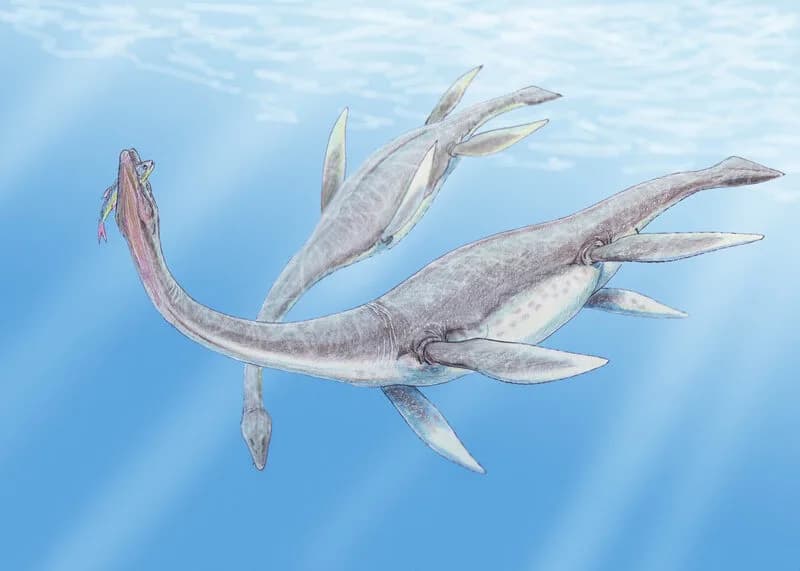
Life reconstruction of Elasmosaurus platyurus, a Late Cretaceous plesiosaur from North America
Dmitry Bogdanov, CC BY-SA 4.0
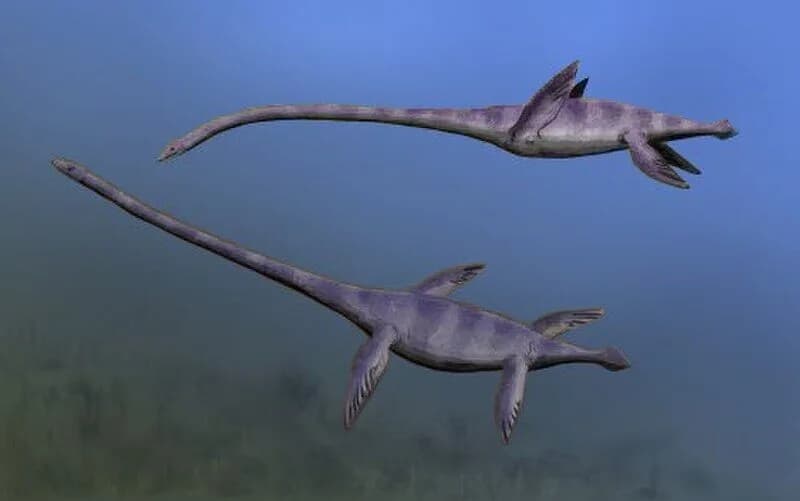
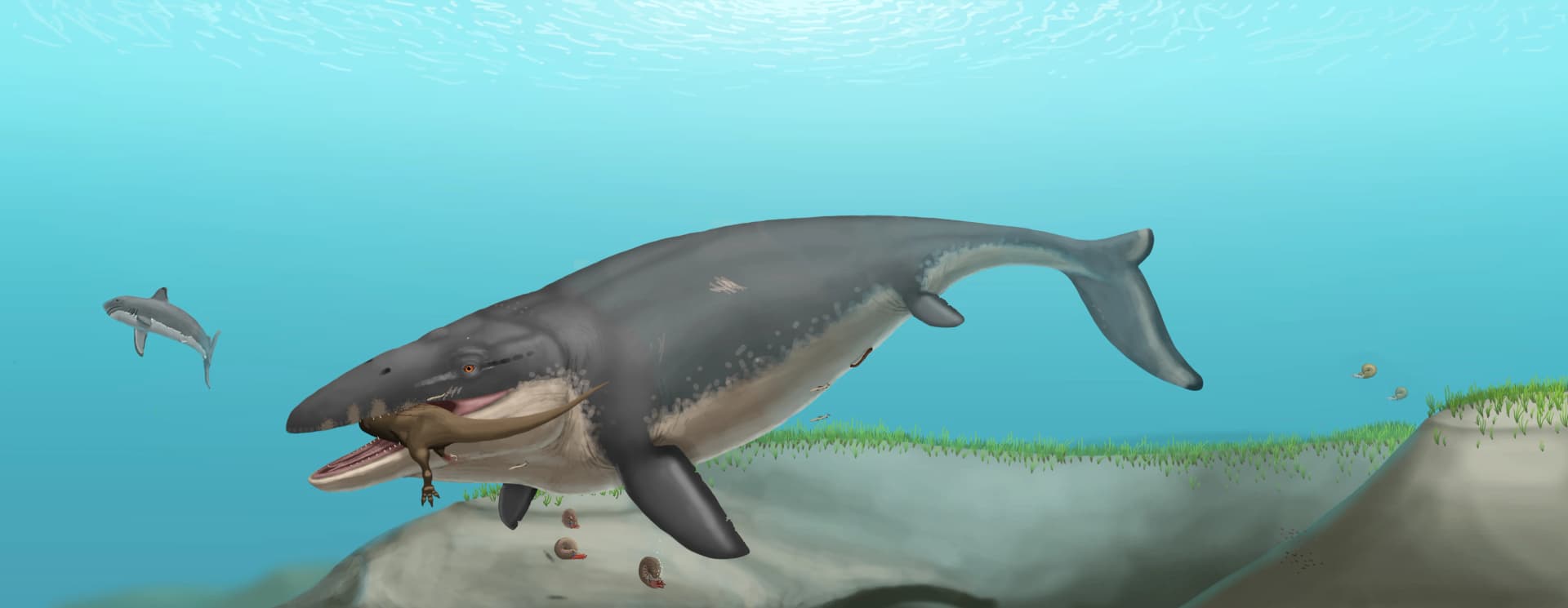
Elasmosaurus platyurus swimming with straight neck
Nobu Tamura, CC BY-SA 3.0