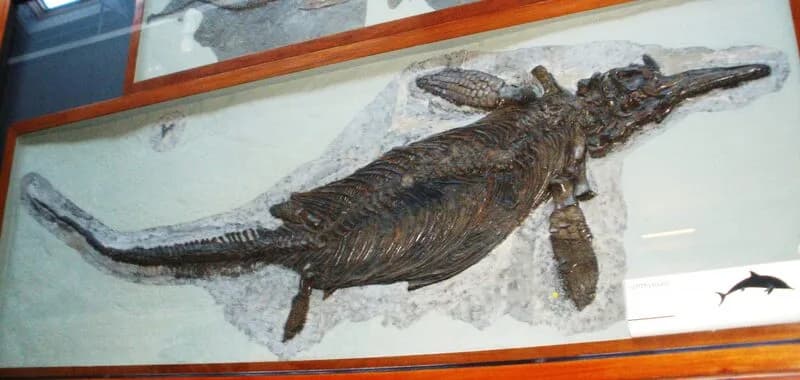
Lézard-poisson
Ichthyosaurus communis is among the very first fossil reptiles described: Mary Anning, aged twelve, freed a specimen from the cliffs of Lyme Regis in 1811. Two to 3.3 metres long and 80 to 150 kilograms, it swam 199 to 189 million years ago. Its dolphin-like shape owes nothing to kinship: it is a textbook case of convergent evolution.
Ichthyosaurus lived during the Early Jurassic period, approximately 199 to 189 million years ago, spanning the Hettangian to Pliensbachian stages. This period immediately follows the great Triassic-Jurassic mass extinction, which eliminated many marine competitors and opened vast ecological niches in the oceans. Ichthyosaurs as a group had appeared much earlier, in the Middle Triassic, approximately 250 million years ago, making them one of the oldest groups of Mesozoic marine reptiles. Ichthyosaurus communis, the type species of both the genus and the entire order Ichthyosauria, lived in the temperate epicontinental seas that covered southern England and western Europe. The Early Jurassic climate was warmer than today, with high sea levels and no polar ice caps. Ichthyosaurus shared its marine environment with the earliest plesiosaurs, marine crocodilians, giant ammonites, and a rich fauna of fish and invertebrates.
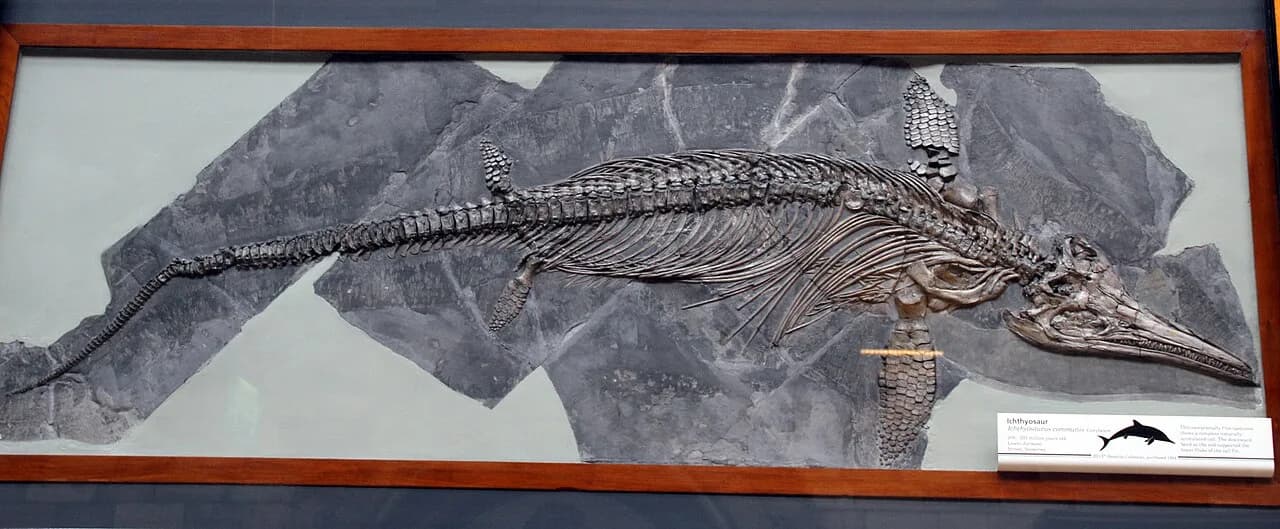
Ichthyosaurus was a moderately sized marine reptile, generally measuring between 2 and 3.3 meters in total length, though some specimens may have reached 3.5 meters. Its weight is estimated at 80 to 150 kilograms, comparable to a common dolphin. Its body was fusiform and perfectly hydrodynamic, presenting a remarkable evolutionary convergence with modern dolphins and tuna — a phenomenon where unrelated organisms develop similar forms under the same selection pressures. The skull was elongated and pointed, with a tapered snout representing approximately one-third of the total skull length. The orbits were enormous, among the proportionally largest of all vertebrates, and protected by bony sclerotic rings. Four paddle-shaped flippers, the anterior pair being larger than the posterior, provided steering and stabilization. A triangular soft-tissue dorsal fin (without bony support) and a powerful crescent-shaped caudal fin completed the silhouette.
A carnivorous piscivore and cephalopod-eater, Ichthyosaurus fed primarily on small to medium-sized fish, cephalopods (belemnites and small squid), and to a lesser extent crustaceans. Its conical, pointed teeth, implanted in a continuous dental groove (pleurodont thecodont dentition), were perfectly adapted for grasping and retaining slippery prey. Analyses of coprolites (fossilized feces) attributed to ichthyosaurs have revealed belemnite remains in large quantities, indicating these cephalopods formed a major part of the diet. The sclerotic rings protecting the eyes suggest vision adapted to moderate depths, potentially enabling crepuscular hunting or hunting in turbid water. Fossilized stomach contents found in some specimens confirm the consumption of small teleost fish swallowed whole. Ichthyosaurus likely hunted through active pursuit, using its velocity and maneuverability to catch fast prey in the water column.
Ichthyosaurus inhabited the shallow to moderately deep epicontinental seas of the Early Jurassic, primarily in what is now southern England, Wales, Belgium, and Germany. The majority of fossils come from the famous Jurassic Coast cliffs in Dorset and Somerset, England, particularly from the Blue Lias and Black Ven formations, consisting of alternating layers of limestone and clay shale deposited in a shallow marine environment. The waters in which Ichthyosaurus lived were temperate to subtropical, nutrient-rich, and teeming with marine life, forming a productive ecosystem comparable to modern continental shelves. Ichthyosaurus likely frequented surface and mid-depth waters, regularly ascending to breathe. The presence of fossilized gravid females in these deposits indicates that coastal areas served as birthing grounds, similar to coasts frequented by modern dolphins.
Ichthyosaurus anatomy represents one of the most spectacular examples of convergent evolution in the animal kingdom. Its fusiform body, strikingly similar to a dolphin's, is the result of millions of years of adaptation to exclusively aquatic life, starting from terrestrial reptilian ancestors. The eyes, among the largest of all known vertebrates (up to 10 centimeters in diameter in some species), were protected by sclerotic rings composed of bony plates forming a rigid circle. These oversized eyes allowed maximum light capture at depth and suggest capabilities for nocturnal vision or hunting in murky water. The skull possessed nostrils positioned far back, near the eyes, facilitating surface breathing. The limbs were completely transformed into rigid flippers composed of hyperphalangy (excessive number of phalanges per digit) and secondary polydactyly (additional digits), creating efficient bony paddles. The vertebral column contained numerous compact disc-shaped vertebrae, and the tail terminated in a marked ventral inflection supporting the lower lobe of a reversed heterocercal caudal fin, similar to a shark's but with the muscular lobe in the lower position.
Ichthyosaurus was a fast and agile swimmer, propelled primarily by lateral beats of its powerful caudal fin, in the manner of modern tuna and sharks. The anterior and posterior flippers served as rudders for steering and stabilization, while the dorsal fin prevented rolling. Biomechanical analyses suggest it could reach cruising speeds of approximately 5 to 10 km/h, with potential bursts of 25 to 40 km/h during pursuits. One of the most remarkable discoveries concerning Ichthyosaurus is the direct evidence of viviparity: several female specimens have been found with embryos in utero or in the process of giving birth, with the young emerging tail-first (like modern cetaceans) to avoid drowning. This means Ichthyosaurus was entirely pelagic, never returning to land, unlike sea turtles. The eye size and sclerotic ring structure suggest a lifestyle involving dives to moderate depths, possibly to hunt belemnites and fish at depth. Isotopic studies indicate some capacity for thermoregulation, allowing Ichthyosaurus to maintain a body temperature slightly higher than that of the surrounding water.
Ichthyosaurus was one of the first great fossil reptiles to be discovered and scientifically described. The first significant specimen, a partial skull, was found between 1809 and 1811 by Joseph Anning (Mary Anning's brother) on the cliffs of Lyme Regis in Dorset, England. The rest of the skeleton was subsequently excavated by Mary Anning herself, then only 12 years old, marking the beginning of her legendary paleontology career. The specimen was sold to collector Henry Hoste Henley for 23 pounds sterling. The genus Ichthyosaurus was formally named by Charles Konig in 1818 (from Greek ichthys 'fish' and sauros 'lizard'), though the animal had initially been mistaken for a crocodile or a giant fish. Since then, hundreds of specimens have been discovered, making Ichthyosaurus communis one of the best-documented marine reptiles in history. Mary Anning continued to discover numerous specimens throughout her life, contributing decisively to the understanding of marine paleontology. The Natural History Museum in London preserves some of the finest specimens, including several showing embryos in utero. Several species are recognized in the genus: I. communis, I. breviceps, I. conybeari, and I. anningae, the latter named in honor of Mary Anning in 2015, more than 170 years after her death.
| Period | Jurassique inférieur / Early Jurassic |
| Era | Mésozoïque / Mesozoic |
| Age | 199-189 Ma |
| Location | Europe (Angleterre, Allemagne, Belgique) / Europe (England, Germany, Belgium) |
| Length | 2-3.3 m |
| Height | 0.5-0.7 m |
| Weight | 80-150 kg |
| Diet | Piscivore |
| Discovery | 1811 |
No. Ichthyosaurus communis was a marine reptile belonging to the order Ichthyosauria, entirely distinct from dinosaurs. It lived 199 to 189 million years ago in the Early Jurassic epicontinental seas of Europe. Despite its dolphin-like shape, it was a reptile descended from terrestrial ancestors that secondarily colonized the oceans.
The first partial skull was found between 1809 and 1811 by Joseph Anning on the cliffs of Lyme Regis (Dorset, England). The rest of the skeleton was excavated by his sister Mary Anning, then only 12 years old, marking the start of her legendary career. The genus Ichthyosaurus was formally named by Charles König in 1818 (Greek: ichthys + sauros, 'fish lizard'). The species I. anningae was named in her honor in 2015.
Ichthyosaurus communis was viviparous: several fossilized females have been found with embryos in utero or in the act of giving birth, the young emerging tail-first — exactly like modern cetaceans — to prevent drowning. This proves Ichthyosaurus was entirely pelagic and never returned to land, unlike sea turtles.
Ichthyosaurus communis fossil at the Natural History Museum
Wikipedia Commons
Ichthyosaurus communis life reconstruction
Nobu Tamura, CC BY-SA 3.0