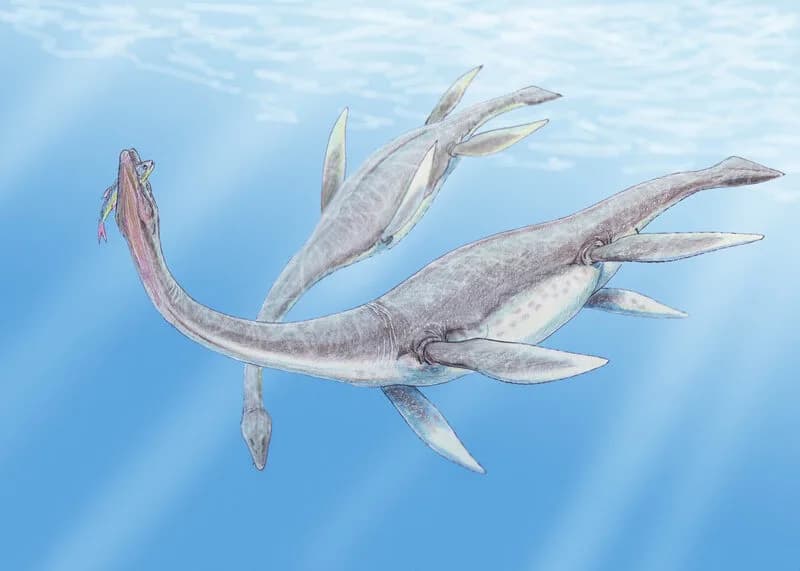
Plésiosaure
Plesiosaurus dolichodeirus carries more than forty neck vertebrae, against seven in humans — hence the period phrase, « a snake threaded through the body of a turtle ». Three to 5 metres long and 450 to 500 kilograms, it swam 199 to 175 million years ago. The first complete skeleton was freed at Lyme Regis by Mary Anning, aged twenty-four.
Plesiosaurus lived during the Early Jurassic, approximately 199 to 175 million years ago (Hettangian to Toarcian). This marine reptile appeared shortly after the great Triassic-Jurassic extinction that eliminated many marine competitors, opening new ecological niches. Plesiosaurs in the broad sense (order Plesiosauria) formed an extremely diverse group that dominated Mesozoic seas for over 135 million years, from the Late Triassic to the end of the Cretaceous. Plesiosaurus dolichodeirus, the type species described by Mary Anning and William Conybeare, is one of the most iconic and earliest marine reptiles of the group. It is often confused with its giant descendants like Elasmosaurus, but was actually a much more modestly sized animal.
Plesiosaurus dolichodeirus was a moderately sized marine reptile compared to its giant descendants. Its total length reached 3 to 5 meters, with roughly one-third accounted for by its characteristic neck. Its weight is estimated at 450 to 500 kilograms — comparable to a large bottlenose dolphin or a small beluga. Its skull, small and triangular, measured about 13 centimeters long, contrasting sharply with its long flexible neck composed of 40 to 42 elongated cervical vertebrae. Its four paddle-shaped flippers each measured nearly 70 centimeters and constituted its primary means of locomotion. Its slender morphology suggests an agile, fast animal rather than a brute-force predator.
Plesiosaurus fed primarily on small to medium-sized fish, cephalopods (belemnites, small squid, and early octopus relatives), and various crustaceans found in the shallow Jurassic seas. Its long, thin, interlocking conical teeth formed an ideal trap for catching slippery and evasive prey — the upper and lower teeth meshed together precisely like the bars of a cage when the mouth snapped closed, creating a virtually escape-proof enclosure. Polished gastroliths (stomach stones) have been frequently found in the abdominal cavity of many plesiosaur specimens, their exact function remaining actively debated among paleontologists: possible digestive aid for grinding food (as in modern crocodiles), ballast for fine-tuning buoyancy control during dives, or perhaps serving both purposes simultaneously. Its long, flexible neck likely allowed it to surprise densely packed fish schools by rapidly projecting its small head sideways or downward with minimal body movement, avoiding alerting the prey with a large pressure wave.
Plesiosaurus lived in the shallow, temperate to subtropical seas that covered much of Western Europe during the Early Jurassic, a time when the supercontinent Pangaea was beginning to fragment and new ocean basins were forming. Nearly all of its known fossils come from well-studied marine formations in southern England, particularly the dramatic coastal cliffs of Lyme Regis in Dorset (the famous 'Jurassic Coast,' now designated a UNESCO World Heritage Site for its outstanding geological record) and the quarries of Street in Somerset. These warm coastal waters, teeming with abundant fish, cephalopods, and crustaceans, provided ideal habitat for a medium-sized marine predator. Some fragmentary and tentatively assigned specimens have also been reported in Germany, suggesting a broader European distribution. The Jurassic sea that then covered much of what is now England was a shallow subtropical environment dotted with numerous small islands and rich coral-like reef systems.
The anatomy of Plesiosaurus is unique among marine reptiles. Its long flexible neck, composed of over 40 cervical vertebrae, gave it a silhouette recognizable above all others — often described as 'a snake threaded through a turtle.' Its four powerful, nearly equal-sized flippers constituted a unique propulsion system: recent hydrodynamic studies show it used all four paddles in coordination, with the forelimbs providing the main thrust and the hindlimbs optimizing water flow. Its pectoral and pelvic girdles, massive and flat, served as anchor points for the powerful flipper muscles. Its palate also bore small teeth, helping to retain prey. Like all marine reptiles, it breathed air at the surface.
Plesiosaurus was an active coastal predator that likely hunted using its long neck as a rapid trap — projecting its small head toward prey with surprising speed while its massive body remained relatively stable in the water. This hunting technique, called 'neck ambush,' is analogous to that of modern herons. Recent computer modeling studies suggest the plesiosaur neck was more rigid than previously thought, favoring rapid lateral movements rather than serpentine undulations. Viviparity is likely for Plesiosaurus, as evidenced by fossils of other plesiosaurs containing embryos. The presence of young juveniles in the same deposits as adults suggests possible parental care behavior.
The first near-complete Plesiosaurus skeleton was discovered in December 1823 by Mary Anning, the famous self-taught paleontologist from Lyme Regis, England. This discovery astounded the scientific community — geologist William Buckland presented the specimen to the Geological Society of London in February 1824, sparking intense debate about the reality of this extraordinary animal. William Conybeare had named the genus as early as 1821 from older fragments (Greek: plesios 'near to' + sauros 'lizard'). Georges Cuvier validated the authenticity of Anning's skeleton after initial suspicions of forgery. Mary Anning, though largely overlooked during her lifetime due to her gender and social class, is today recognized as one of the founders of modern paleontology. The type specimen is held at the Natural History Museum in London.
| Period | Jurassique inférieur / Early Jurassic |
| Era | Mésozoïque / Mesozoic |
| Age | 199-175 Ma |
| Location | Angleterre (Lyme Regis), Europe / England (Lyme Regis), Europe |
| Length | 3-5 m |
| Height | 1-1.5 m |
| Weight | 450-500 kg |
| Diet | Piscivore |
| Discovery | 1823 |
No. Plesiosaurus dolichodeirus was a marine reptile of the order Plesiosauria, distinct from dinosaurs. It lived in the Early Jurassic seas (199–175 Ma) and breathed air at the surface, like modern cetaceans. Plesiosaurs form their own distinct group, appearing in the Late Triassic and going extinct at the end of the Cretaceous.
Plesiosaurus dolichodeirus measured 3 to 5 meters in total length and weighed approximately 450 to 500 kilograms — comparable to a large dolphin. Its skull was only about 13 centimeters long, sharply contrasting with its neck made up of 40 to 42 cervical vertebrae. Each of its four flippers measured approximately 70 centimeters.
Mary Anning, a self-taught paleontologist from Lyme Regis, discovered the first near-complete Plesiosaurus dolichodeirus skeleton in December 1823. Georges Cuvier validated its authenticity after initial forgery suspicions. William Conybeare had named the genus as early as 1821 from earlier fragments. The type specimen is housed at the Natural History Museum in London.
Information on this page is based on peer-reviewed scientific publications.
Fossil skeleton of Plesiosaurus at the Natural History Museum in London
Wikipedia Commons
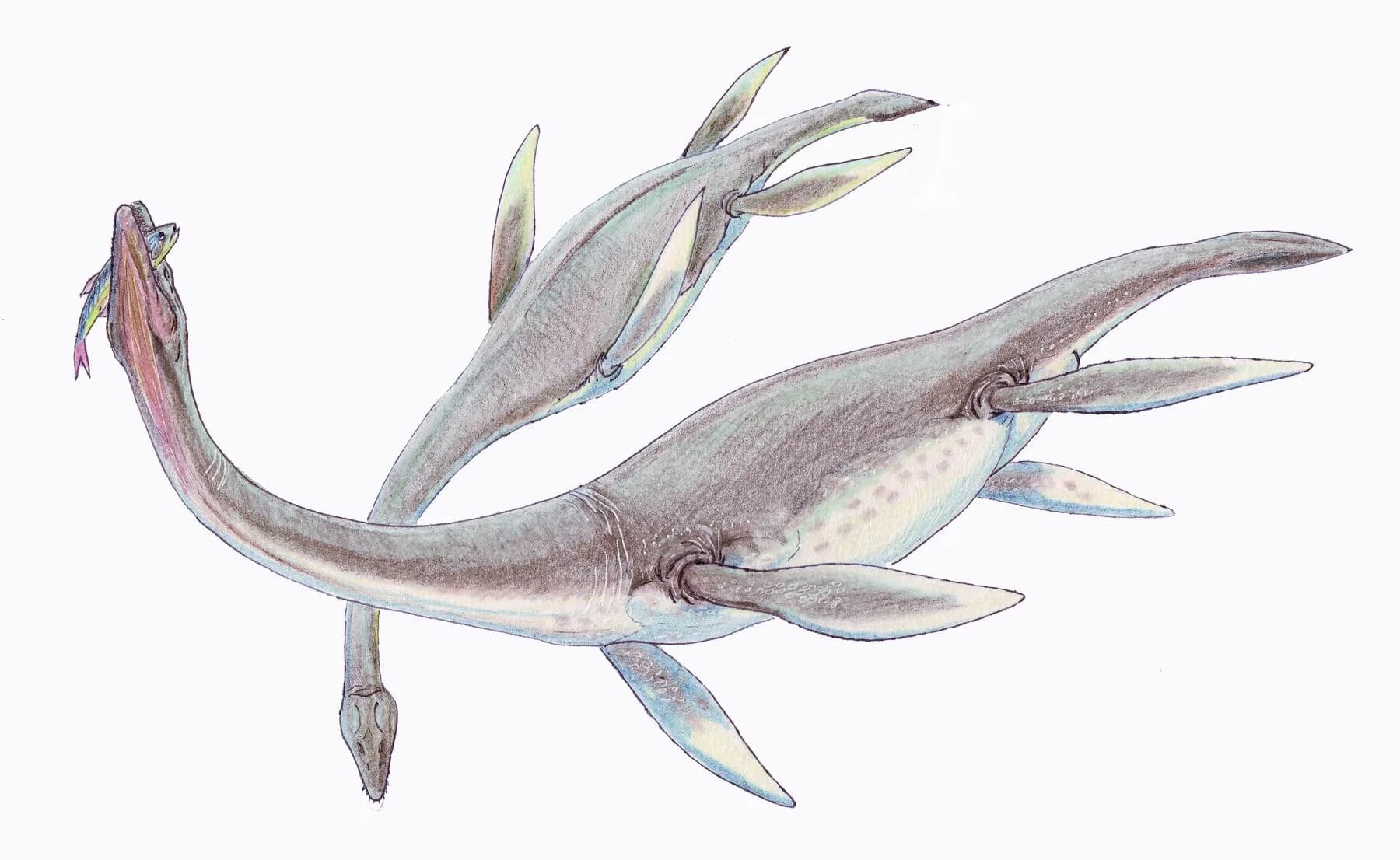
Life reconstruction of Plesiosaurus dolichodeirus in marine environment
Wikipedia Commons