Tricératops
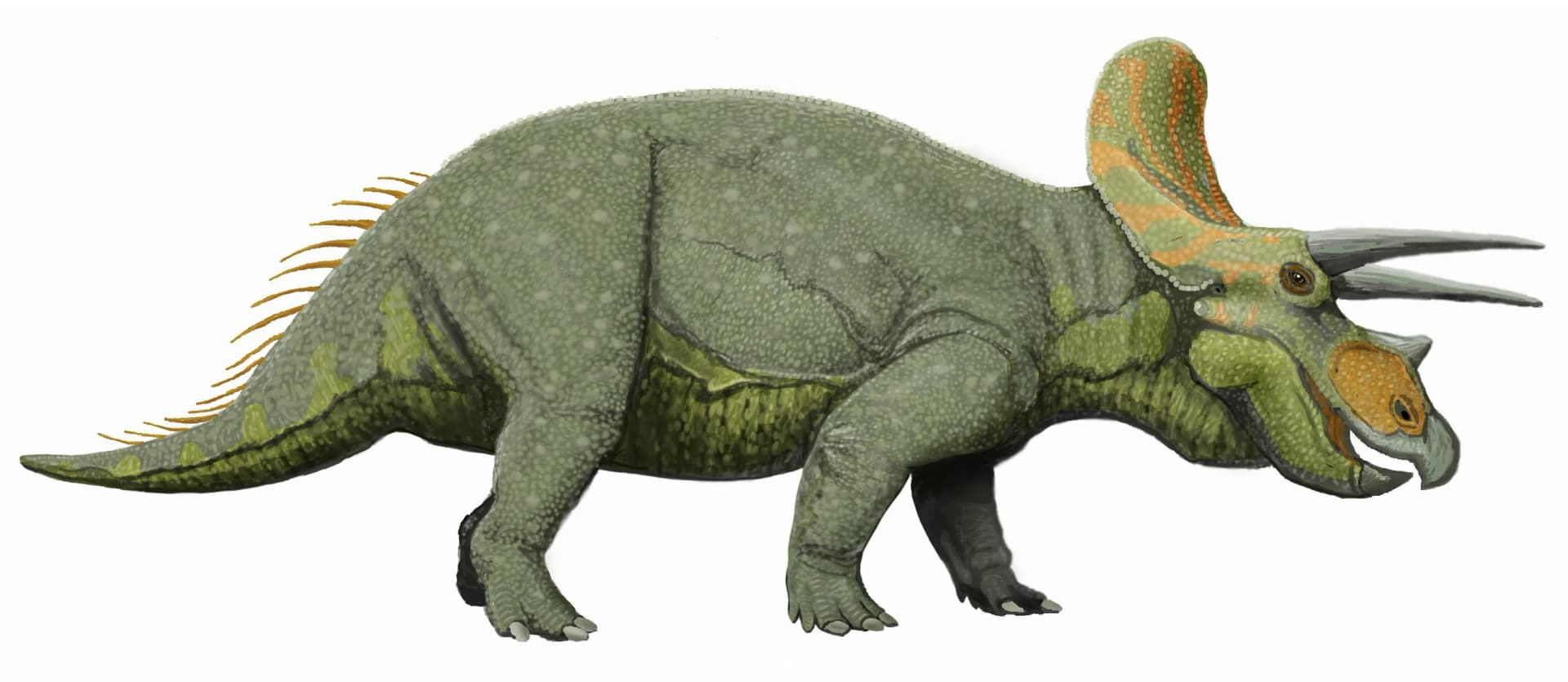
Triceratops horridus was a horned herbivorous dinosaur from North America, described in 1889 and a contemporary of Tyrannosaurus rex 68 to 66 million years ago. It reached 8 to 9 metres and 6 to 12 tonnes, carried brow horns close to 1.2 metres long, and held up to 800 teeth stacked in continuously replaced columns. The skull known as Big John, at 2.62 metres, is the largest dinosaur skull ever found.
The ultimate tank. Impenetrable from the front thanks to its Frontal Parry (Stun + Knockback). Slow and loud, but a well-positioned Trike is nearly invincible.
Playable in The Isle: Evrima
See Triceratops horridus's in-game stats, tier, strengths & weaknesses on our server.
Triceratops lived in the Late Cretaceous, 68 to 66 million years ago (Maastrichtian), contemporary with T. rex. Belonging to the Chasmosaurinae subfamily (family Ceratopsidae), its phylogenetic classification was long debated before being confirmed by cladistic studies. It is one of the last non-avian dinosaurs, lost in the Cretaceous-Paleogene extinction caused by the Chicxulub asteroid impact. Paleontologist John Scannella stated that 'it is difficult to walk in the Hell Creek Formation without tripping over Triceratops remains.' Two valid species are recognized: T. horridus and T. prorsus; the numerous other named species (about fifteen) remain unconfirmed.
Triceratops measured 7 to 10 meters (average 8-9 m), up to 3.5-4 meters at the withers, weighing 5 to 10 tons (average 7-8 tons). Its skull, among the largest of any terrestrial animal, could reach 2.5 meters wide on specimen BYU 12183 — nearly one-third of total body length. The record belongs to 'Big John': skull 2.62 m long and 2 m wide, horns 1.2 m long and over 30 cm wide at the base, discovered in 2014 in South Dakota by Walter Stein. The bony frill (parietal-squamosal), solid and unfenestrated unlike other ceratopsids, measured nearly 2 meters and supported powerful cervical muscles.
A strict and specialized herbivore, Triceratops grazed on low fibrous vegetation including ferns, cycads, conifers, and primitive angiosperms that dominated the Late Cretaceous landscape. Its powerful horny beak at the front sectioned tough stems with remarkable efficiency, while the rear dental batteries — comprising up to 800 teeth organized in columns of 36 to 40, continuously replaced throughout its lifetime — provided efficient vertical shearing of even the most resistant plant material. Its ecological niche closely resembles that of the modern rhinoceros: a robust browser capable of processing tough, woody plants that other contemporary herbivores simply could not handle or digest.
Triceratops occupied the coastal plains and wooded zones of western North America (Montana, South and North Dakota, Wyoming, Colorado, Saskatchewan). The Hell Creek Formation and Lance Formation are the main deposits. Barnum Brown reported observing over 500 skulls in Montana; Bruce Erickson of the Minnesota Science Museum counted 200 T. prorsus specimens in the Hell Creek Formation alone. Despite this exceptional fossil abundance, only ONE Triceratops-dominated bone bed is documented to date (three juveniles, Montana) — a surprising rarity for an animal assumed to be gregarious.
Triceratops anatomy is dominated by its monumental skull. Its solid frill (without fenestrae, unlike Torosaurus and Chasmosaurus) was vascularized, serving as both thermal regulator and display organ during courtship. Its posture — long debated — is now reconstructed in an intermediate position: elbows slightly bent and angled, neither fully upright nor sprawling, similar to a modern rhinoceros. Three-fingered functional hands (4th and 5th digits vestigial) and four-toed feet bore weight on the first three digits only. Some fossils suggest the possible presence of downy integumentary structures on certain body parts, similar to the primitive ceratopsid Psittacosaurus.
Evidence of gregarious behavior is surprisingly rare for such a common dinosaur: only one documented bone bed with 3 juveniles. Adult remains appear mainly solitary. However, trackway evidence indicates their primary defense against predators consisted of forming a circle — adults facing threats, juveniles at center — similar to modern musk ox defensive circles. Isolated individuals preferred charging the aggressor without making contact, to drive it away. Horns and frill served during ritualized intraspecific combat for dominance and mate access — numerous healed wounds on fossil skulls testify to this.
Named by O.C. Marsh in 1889 from a skull fragment in Colorado, Triceratops became one of the most abundant dinosaurs in the fossil record, with 47 skeletons (complete or partial) discovered between 2000 and 2010 alone. 'Big John', excavated in 2014 in South Dakota, holds the record for the largest skull (2.62 m × 2 m). In 2021, its 60%-complete skeleton was sold at Hôtel Drouot (Paris) for €6.6 million to a private American collector. The Torosaurus-Triceratops controversy (Scannella & Horner, 2010 — proposing Torosaurus is simply the adult Triceratops with a fenestrated frill) was vigorously contested by numerous subsequent studies. Triceratops's most distant known ancestor is Laquintasaura venezuelae from the Late Triassic of Venezuela — an herbivorous dinosaur no larger than a turkey.
| Period | Crétacé supérieur / Late Cretaceous |
| Era | Mésozoïque / Mesozoic |
| Age | 68-66 Ma |
| Location | Amérique du Nord / North America |
| Length | 7.9-9 m |
| Height | 3 m |
| Weight | 6-12 tonnes |
| Diet | Herbivore |
| Discovery | 1889 |
| Type (in-game) | Herbivore |
| Tier | Apex |
The Triceratops horridus skull ranks among the largest of any land animal. The specimen 'Big John', found in 2014 in South Dakota, holds the record with a skull 2.62 m long and 2 m wide — nearly one-third of the animal's total length. Its horns measured 1.2 m long and over 30 cm wide at the base.
The horns and frill of Triceratops horridus served multiple functions. The vascularized frill flushed red with blood flow for temperature regulation and social signaling. Healed wounds on fossil skulls, studied by Farlow and Dodson (1975), prove that horns were used in ritualized intraspecific combat between males competing for dominance and mates.
Despite the fossil abundance of Triceratops horridus in the Hell Creek Formation — over 500 skulls reported in Montana alone by Barnum Brown — evidence of gregarious behavior remains rare. Only one Triceratops-dominated bone bed is documented, containing three juveniles. Adult remains appear mostly solitary, though trackway evidence suggests circular defensive formations against predators.
Information on this page is based on peer-reviewed scientific publications.
Triceratops mount at LA Natural History Museum
Wikipedia Commons
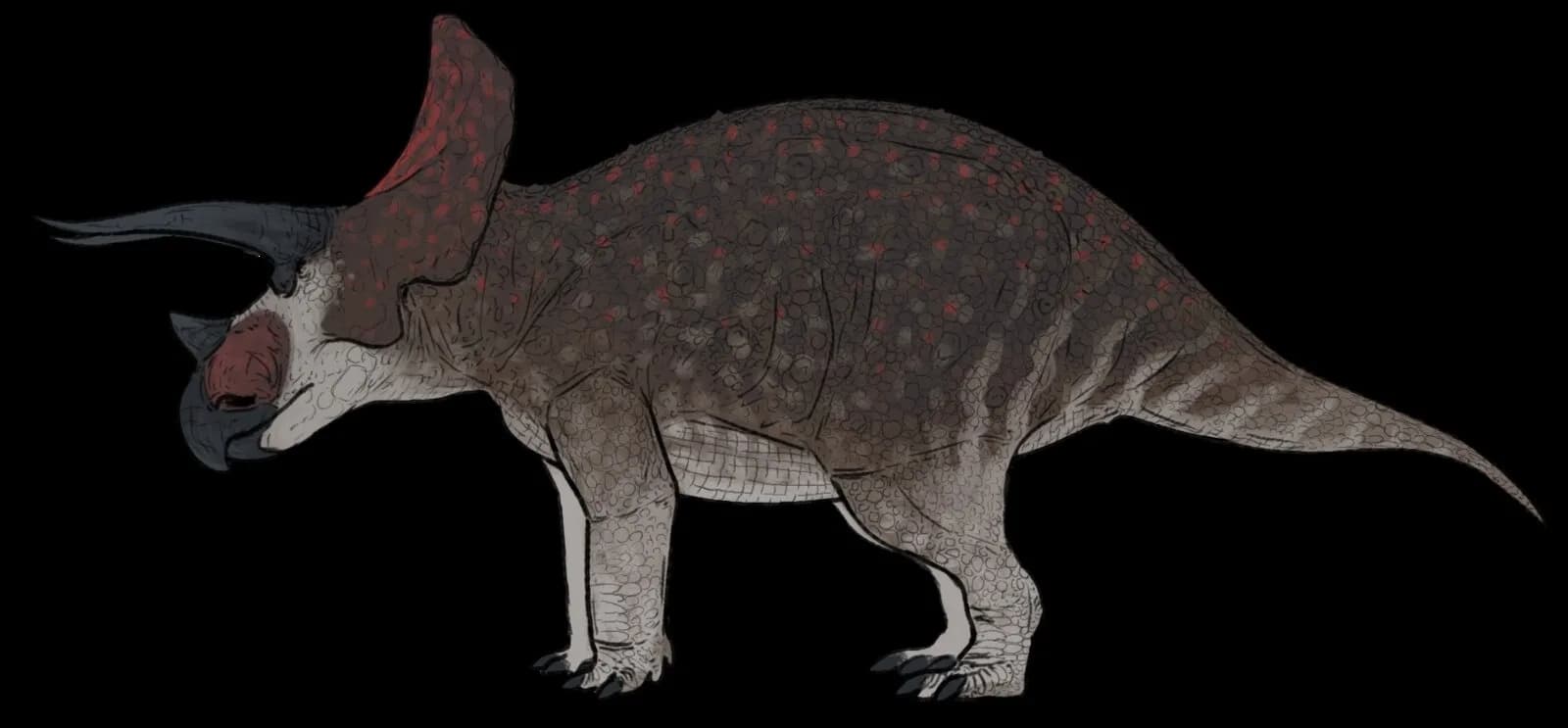
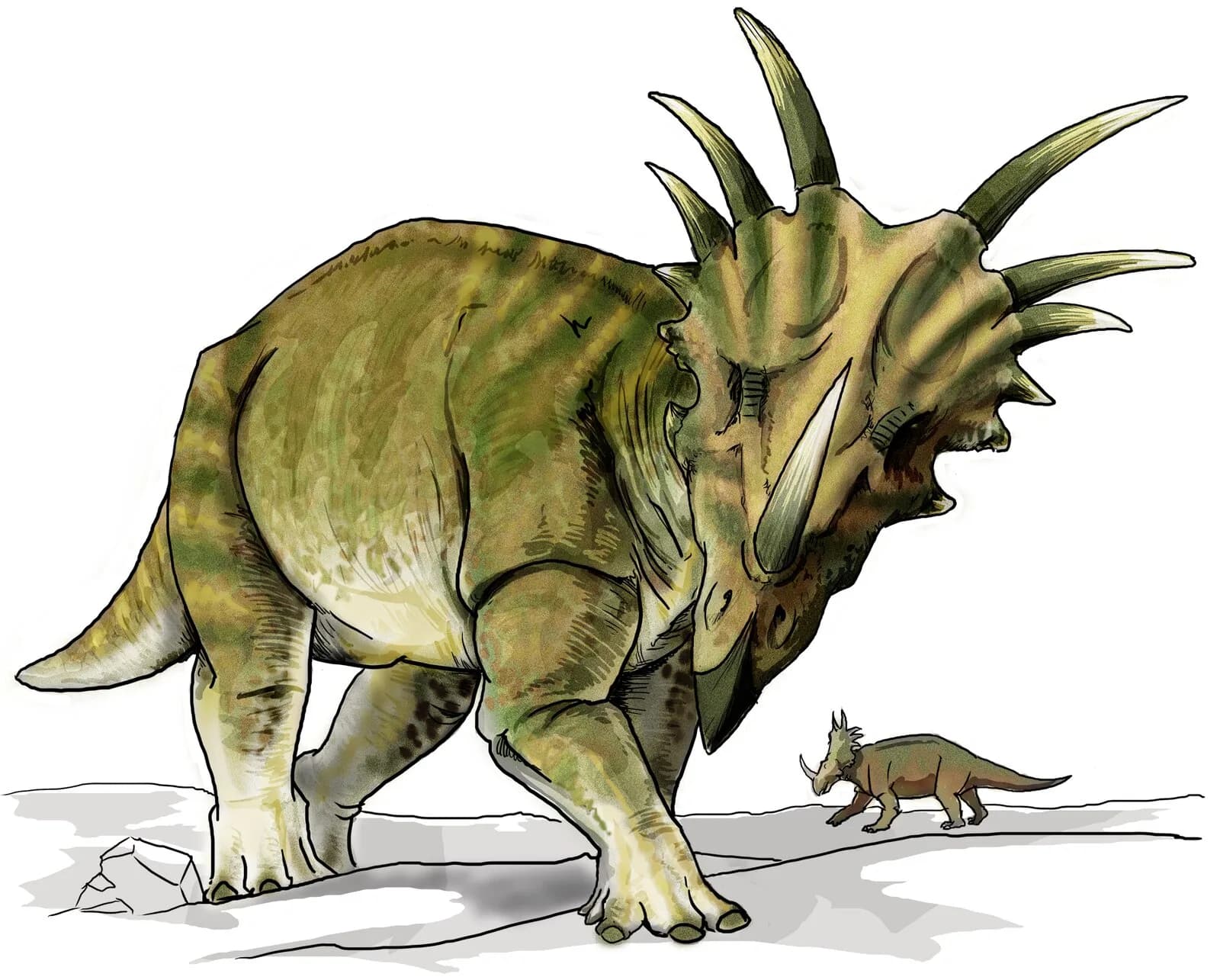
Triceratops horridus life reconstruction
Connor Ashbridge, CC BY-SA 4.0