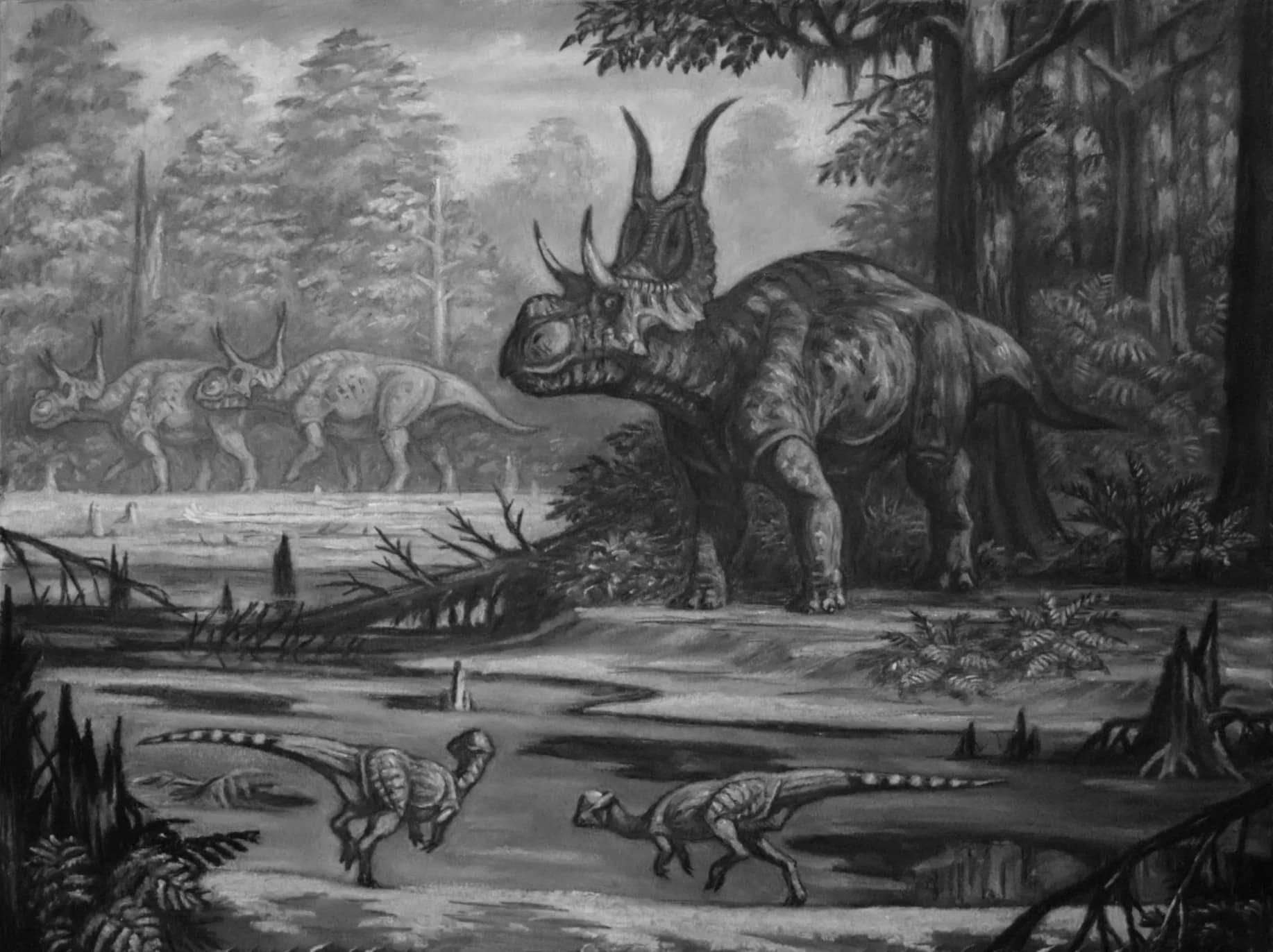
Face de diable à cornes
Diabloceratops eatoni was a herbivorous ceratopsian from Utah, described in 2010 and dated to 81.4 to 81 million years ago. At 4 to 4.5 metres and around 1.3 tonnes, it carried horns on its frill as well as on its face — a rare combination. It lived 10 million years before Triceratops, making it one of the earliest North American ceratopsians.
A compact and formidable tank in herds. Its horns bleed and its charges are devastating. Excellent sparring partner to speed up growth.
Playable in The Isle: Evrima
See Diabloceratops eatoni's in-game stats, tier, strengths & weaknesses on our server.
Diabloceratops eatoni lived during the Late Cretaceous, approximately 81.42 to 81.01 million years ago during the early Campanian stage, in present-day southern Utah within the Wahweap Formation. It is one of the oldest known frilled ceratopsians from North America, predating by several million years the famous Triceratops and Torosaurus of the Maastrichtian. Its unique morphology, combining prominent lateral horns on the frill and two small orbital horns, earned it its evocative name meaning devil horned face, formally described for the first time in 2010. At the time of its description, it was the first centrosaurine known from south of Montana, filling a significant geographic gap in the distribution of this group.
Diabloceratops measured approximately 4 to 4.5 meters in length with an estimated weight of about 1.3 metric tons. A remarkable characteristic of these primitive centrosaurines: it possessed two large upward-curving horns on the upper edge of its bony frill, evoking devil horns in popular imagery. Unlike later ceratopsians such as Triceratops, its orbital horns above the eyes were relatively small and oriented upward rather than forward. Its skull is deeper and shorter than that of any other known centrosaurine, and its bony frill bore a pair of very long spikes comparable to those of Einiosaurus and Styracosaurus. Its massive frill likely served both as protection against predators and as a visual signal for social communication.
A strict and specialized herbivore, Diabloceratops fed on low to medium vegetation: ferns, cycadophytes, conifers, and primitive angiosperms present in the floodplains and gallery forests of the Wahweap Formation. Its powerful horny beak effectively cut woody stems and fronds with great efficiency. The typical ceratopsian dental batteries allowed effective grinding of tough plant material into digestible pieces. Its quadrupedal posture and relatively low head positioned it to feed on vegetation at ground level and low shrubs, unlike contemporary hadrosaurs that could reach higher vegetation by rearing up on their hind legs.
Diabloceratops inhabited the floodplains, gallery forests, and lake shores of the Last Chance Creek Member of the Wahweap Formation, in present-day Kane County, Utah. This subtropical Campanian environment was remarkably rich in freshwater resources: lakes, streams, and wetlands harbored fish, turtles (Compsemys), crocodilians, and a lungfish (Myledaphus), creating a diverse aquatic community. Predators included various theropods of different sizes, with the apex predator of this ecosystem being Lythronax argestes, a primitive tyrannosaurid. The fauna also included hadrosaurs such as Acristavus gagslarsoni and Adelolophus hutchisoni, as well as small mammals that occupied nocturnal niches.
The most striking anatomical feature of Diabloceratops is its parieto-squamosal frill bearing a pair of very long curved spikes — comparable to those of Einiosaurus and Styracosaurus — evoking devil horns that inspired its dramatic name. Its skull, deeper and shorter than that of any other known centrosaurine, also possesses a primitive accessory opening in the parietal bone of the frill, a rare basal anatomical trait among ceratopsids that provides important evolutionary information. These distinctive characteristics make it a pivotal taxon in understanding centrosaurine evolution and the diversification of horned dinosaurs across the Late Cretaceous of western North America.
Like most ceratopsians, Diabloceratops likely lived in family groups or small herds, benefiting from collective vigilance against the theropod predators of its environment. The large, distinctive frill horns played a crucial role in social interactions: courtship displays, intraspecific recognition, and ritual combat between males for territory and mates. The variability of cranial ornaments between individuals suggests marked sexual dimorphism, with males likely sporting more developed horns than females. Facing Lythronax or other predators, the defensive strategy likely consisted of presenting the horned head toward the aggressor, with the possibility of charging to repel the threat effectively.
The holotype of Diabloceratops eatoni (UMNH VP 16699) is a partial skull collected in 2002 by Don DeBlieux from an intraclastic sandstone of the Last Chance Creek Member of the Wahweap Formation, Kane County, Utah. The species was formally described in 2010 by James Kirkland and Donald DeBlieux. The species name 'eatoni' honors Jeffrey Eaton, a paleontologist at Weber State University whose work contributed to understanding Utah's Cretaceous formations. At its discovery, Diabloceratops was the first centrosaurine known from so far south of Montana, revealing a far broader geographic distribution than previously assumed.
| Period | Crétacé supérieur / Late Cretaceous |
| Era | Mésozoïque / Mesozoic |
| Age | 81.42-81.01 Ma |
| Location | Amérique du Nord (Utah) / North America (Utah) |
| Length | 4-4.5 m |
| Height | 1.8 m |
| Weight | ~1.3 tonne |
| Diet | Herbivore |
| Discovery | 2010 |
| Type (in-game) | Herbivore |
| Tier | Tier 4 |
Diabloceratops eatoni gets its name ('devil horned face') from the two long upward-curving spikes on the edge of its bony frill, evoking devil horns. The partial holotype skull (UMNH VP 16699) was collected in 2002 by Don DeBlieux from the Wahweap Formation (Utah), and the species was formally described in 2010 by Kirkland and DeBlieux.
The frill of Diabloceratops eatoni features a primitive accessory opening in the parietal bone — a rare basal trait among ceratopsids. Its skull is deeper and shorter than any other known centrosaurine. These characteristics make it a pivotal taxon for understanding Late Cretaceous frilled ceratopsian evolution in North America.
Diabloceratops eatoni coexisted in the Wahweap Formation (Kane County, Utah) with the primitive tyrannosaurid Lythronax argestes, hadrosaurs Acristavus gagslarsoni and Adelolophus hutchisoni, turtles (Compsemys), crocodilians, and a lungfish (Myledaphus). The subtropical Campanian rivers and lakes formed a highly productive ecosystem.
Diabloceratops skull
Wikipedia Commons
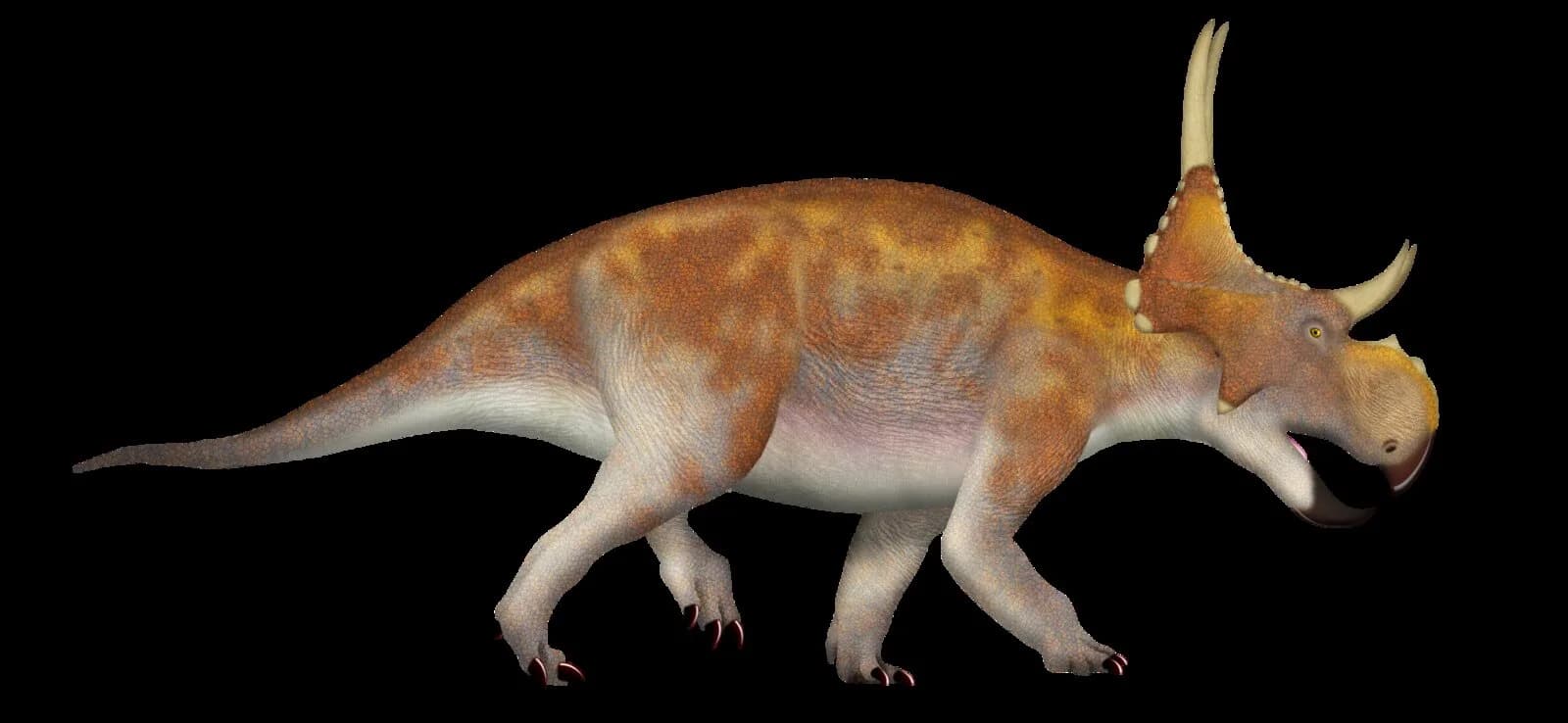
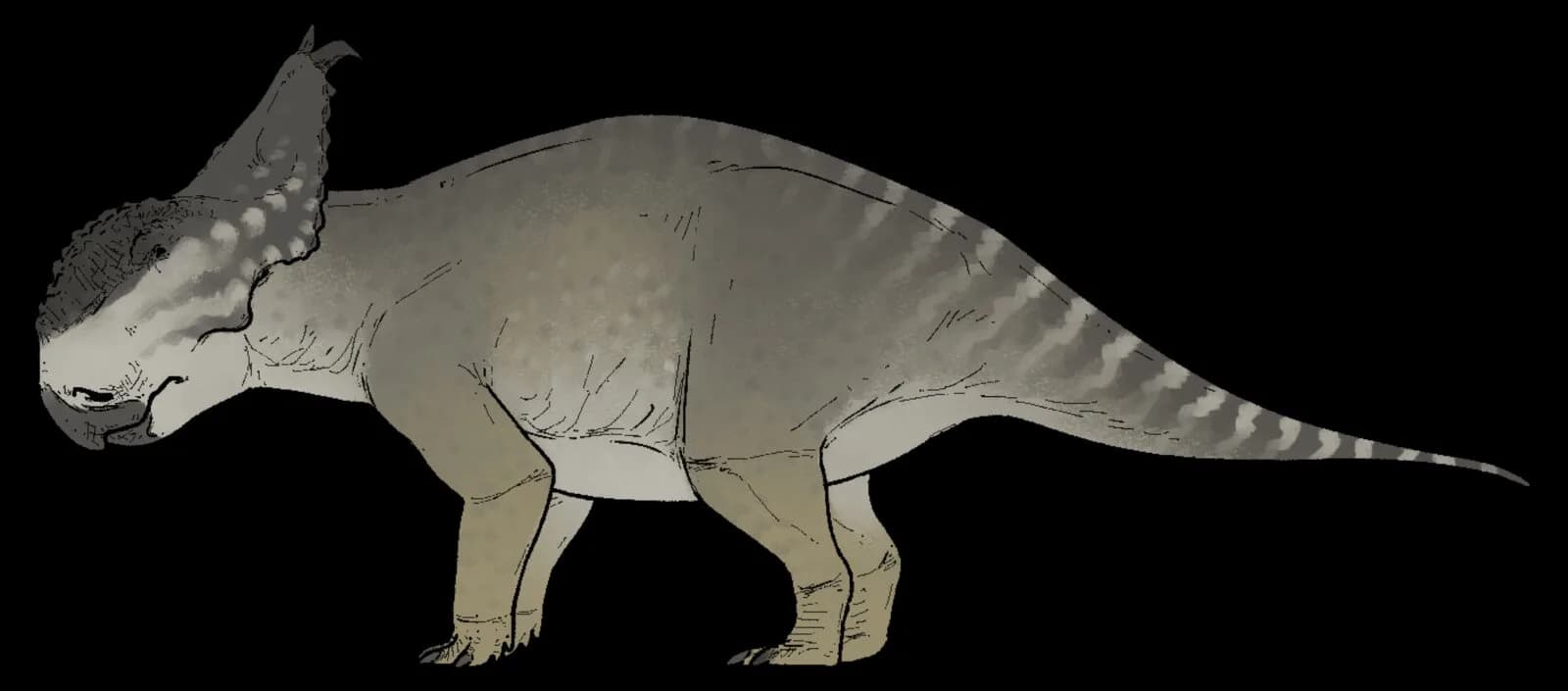
Diabloceratops eatoni life reconstruction
TotalDino, CC BY-SA 4.0