Styracosaure
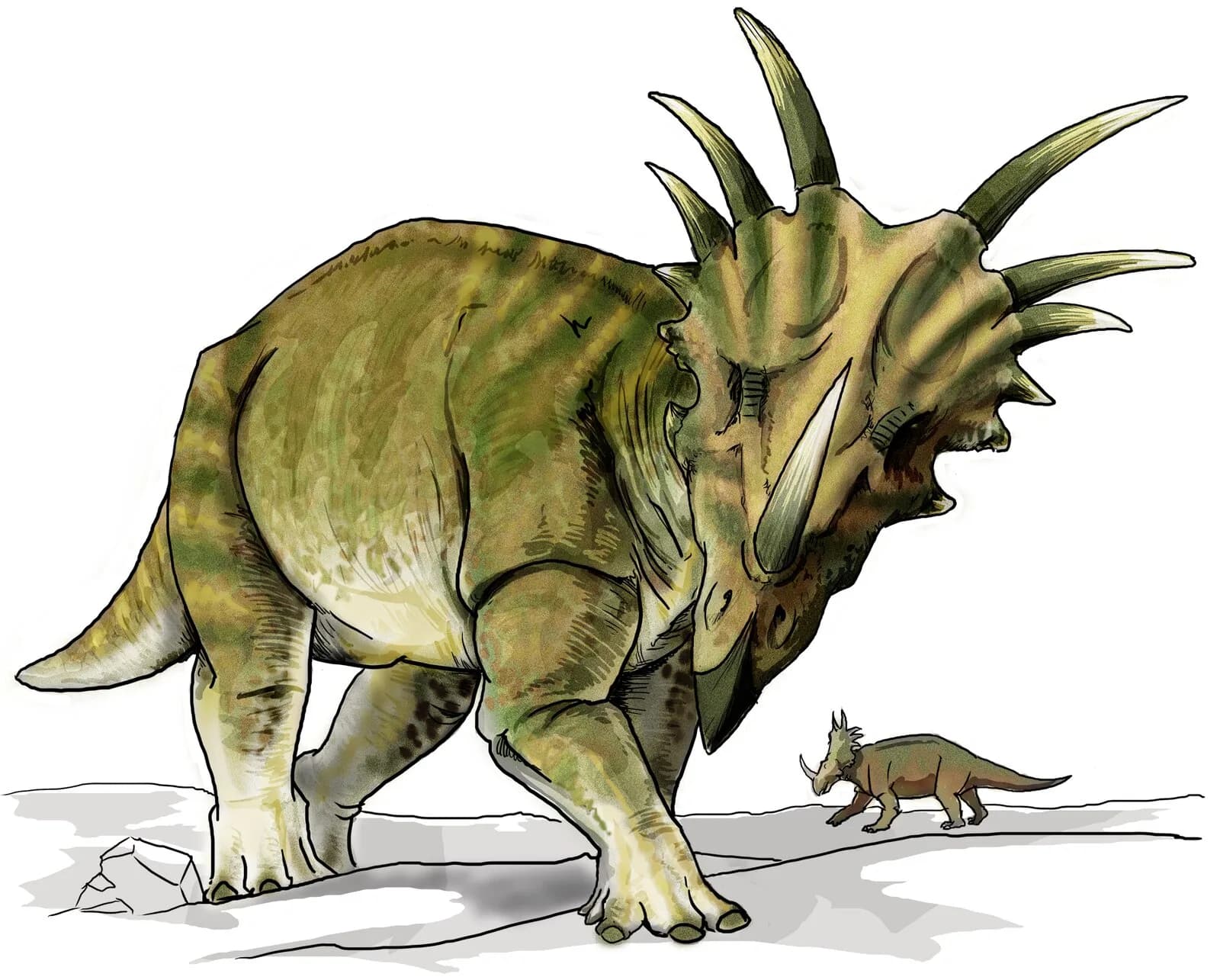
Styracosaurus albertensis carries a frill bristling with six long bony spikes, hence its name « spiked lizard ». Five to 5.8 metres long and 2.7 to 3.5 tonnes, described in 1913 in Alberta, it lived 75.5 to 75 million years ago. A Canadian bone bed gathering many individuals indicates it moved in large herds.
Styracosaurus lived during the Late Cretaceous, approximately 75.5 to 74.5 million years ago, during the Campanian stage. Western North America at this time was the landmass of Laramidia, bordered to the east by the Western Interior Seaway. The climate was warm and humid, with dense forests and coastal alluvial plains. This period saw remarkable diversity of ceratopsians in North America, each species developing its own spectacular cranial ornaments. Styracosaurus possessed one of the most impressive frills of all horned dinosaurs.
Styracosaurus measured approximately 5 to 5.5 meters long with an estimated weight of 2 to 3 tonnes. Its size was comparable to a large modern rhinoceros. Its most spectacular feature was its ornate skull, measuring about 1.8 meters long (including frill). It bore a large nasal horn that could reach 57 centimeters, plus four to six long bony spikes extending from the edge of its frill, the largest measuring up to 60 centimeters. Its body was stocky and powerful, supported by four robust limbs.
Styracosaurus was a dedicated herbivore that fed on the low vegetation of Cretaceous alluvial plains and forested environments. Its powerful, sharp parrot-like beak allowed it to cut the tough stems and leathery leaves of ferns, cycads, and low-growing flowering plants with great efficiency. Its shearing tooth batteries at the back of the jaw efficiently sliced and processed vegetation before swallowing, enabling it to handle even the most fibrous plant material. Its low posture and relatively short neck limited it to feeding at ground level and on the lowest shrubs, clearly differentiating its ecological niche from the taller hadrosaurs that could reach and feed at significantly higher levels in the canopy.
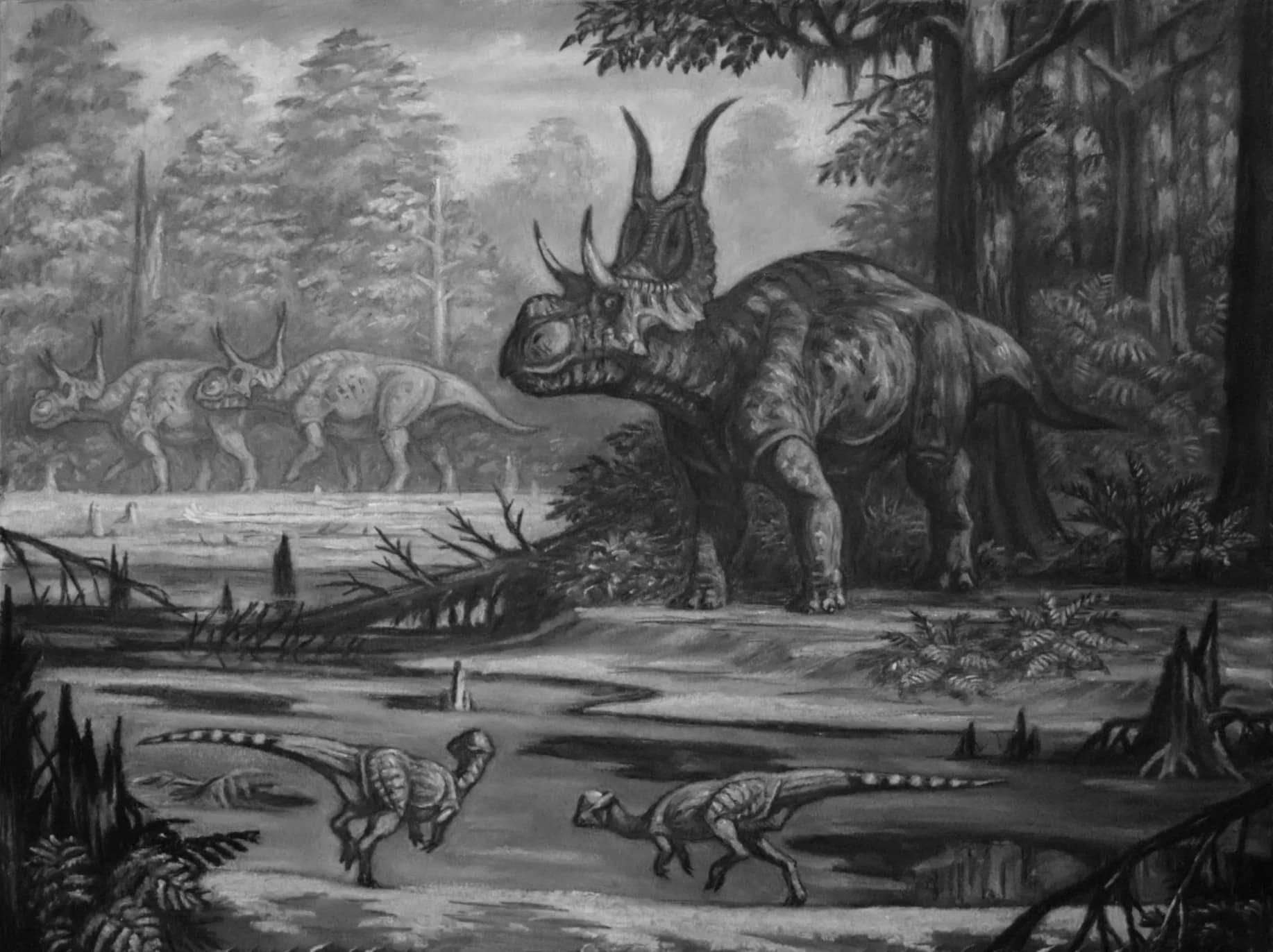
Styracosaurus inhabited the forested coastal plains of western Canada, specifically in the Dinosaur Park Formation of Alberta during the Campanian stage. This environment included meandering rivers, extensive swampy areas, and forests of conifers and flowering plants providing abundant food resources. The climate was subtropical and humid due to the proximity of the Western Interior Seaway, which moderated temperatures and provided consistent moisture. It shared its habitat with a remarkably rich dinosaur community including Centrosaurus, Corythosaurus, Lambeosaurus, and fearsome predators like the tyrannosaur Gorgosaurus. Massive bone beds containing thousands of Centrosaurus (a close relative) suggest seasonal gatherings of very large ceratopsian herds in this productive ecosystem.
Styracosaurus anatomy combines the classic characteristics of centrosaurines with unique cranial ornaments. Its large, straight, pointed nasal horn likely served as both a defensive weapon and a visual signal. The long spines of its frill (called epiparietals) were its most distinctive traits: these bony projections radiated outward and backward from the frill edge, creating an impressive silhouette when viewed from the front. The frill itself was relatively thin and pierced by fenestrae, suggesting a more visual than defensive role. Its stocky body rested on four robust legs, with the forelimbs slightly shorter.
Styracosaurus was probably a gregarious animal living in herds of varying size, as evidenced by associated fossil discoveries. Its spectacular cranial ornaments — the dramatic nasal horn and long frill spikes — played a crucial role in social communication: species recognition among coexisting ceratopsians, courtship display to attract mates, and establishing dominance hierarchies between competing males. Intraspecific combat probably involved frontal charges and horn-locking contests, similar to modern rhinoceros fights. When facing predators like the tyrannosaur Gorgosaurus, the herd could form a defensive circle, presenting an intimidating wall of horns and spikes. An isolated Styracosaurus could charge a predator with its formidable nasal horn as a last resort.
Styracosaurus was described in 1913 by Lawrence Lambe from a skull and partial skeleton (CMN 344) discovered in the Dinosaur Park Formation along the Red Deer River in Alberta, Canada. The name means 'spiked lizard,' referencing the impressive projections of its frill. Barnum Brown discovered a Styracosaurus bone bed in 1915, containing hundreds of bones from numerous individuals, evidence of gregarious behavior with possible mass mortality (drowning during a river crossing). Since its discovery, Styracosaurus has become one of the most iconic ceratopsians, with its spike-bristled profile recognizable among all others.
| Period | Crétacé supérieur / Late Cretaceous (Campanien) |
| Era | Mésozoïque / Mesozoic |
| Age | 75.5–75 Ma |
| Location | Amérique du Nord / North America (Alberta, Canada ; Montana, USA) |
| Length | 5–5.8 m |
| Height | ~1.8 m |
| Weight | 2 700–3 500 kg |
| Diet | Herbivore |
| Discovery | 1913 |
Styracosaurus albertensis bore four to six long bony spikes (epiparietals) radiating from the frill edge, the largest reaching up to 60 centimeters. Its nasal horn could measure up to 57 centimeters. The complete skull with frill measured about 1.8 meters. These ornaments served for social communication, courtship display, and likely deterrence of predators such as Gorgosaurus.
In 1915, Barnum Brown discovered a Styracosaurus albertensis bone bed containing hundreds of bones from numerous individuals in the Dinosaur Park Formation of Alberta. This massive accumulation is interpreted as a group mortality event — likely drowning during a river crossing — confirming seasonal gregarious behavior similar to modern deer or bovid migrations.
Styracosaurus albertensis was described in 1913 by Lawrence Lambe from a skull and partial skeleton (CMN 344 specimen) discovered in the Dinosaur Park Formation along the Red Deer River in Alberta, Canada. The name means 'spiked lizard.' The animal lived 75.5 to 74.5 million years ago during the Campanian (Late Cretaceous), on the paleo-landmass of Laramidia.
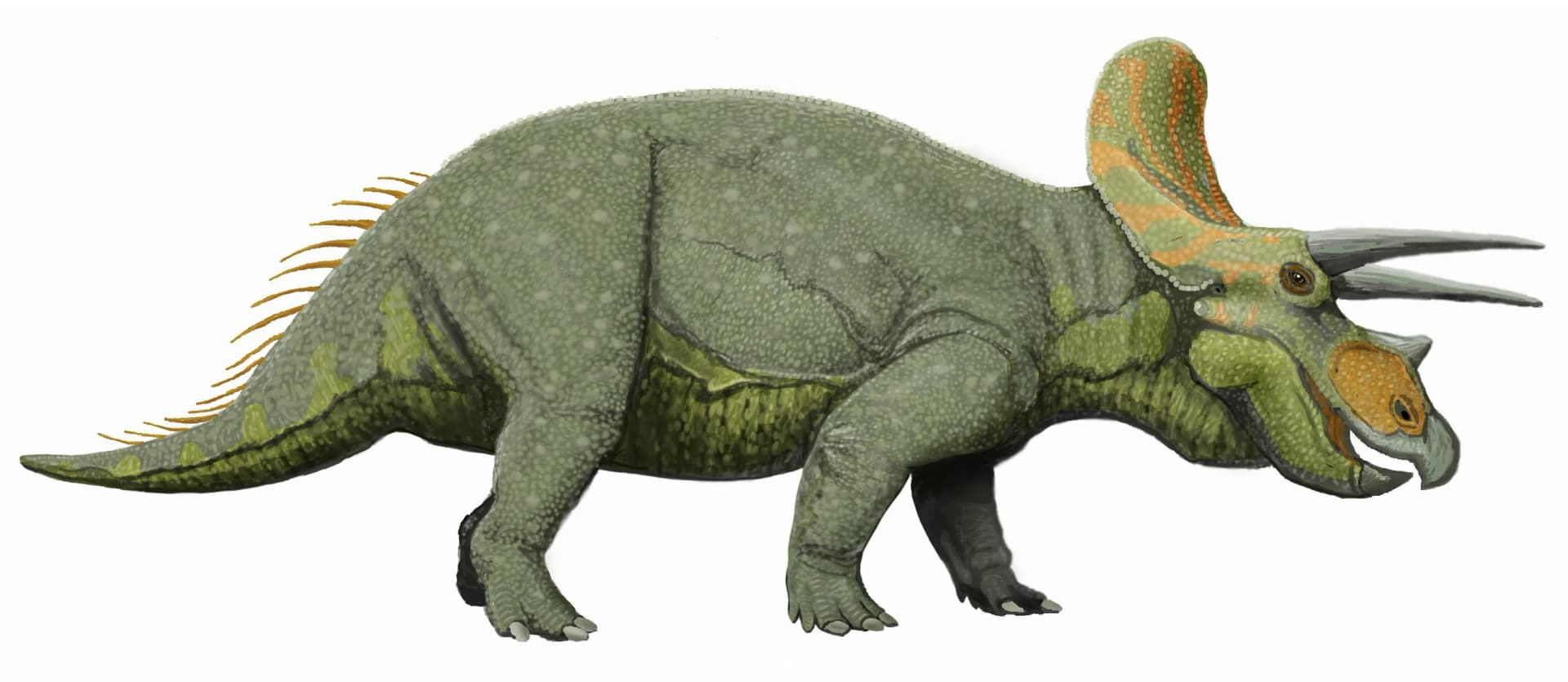
Life reconstruction of Styracosaurus albertensis
LadyofHats, domaine public, via Wikimedia Commons
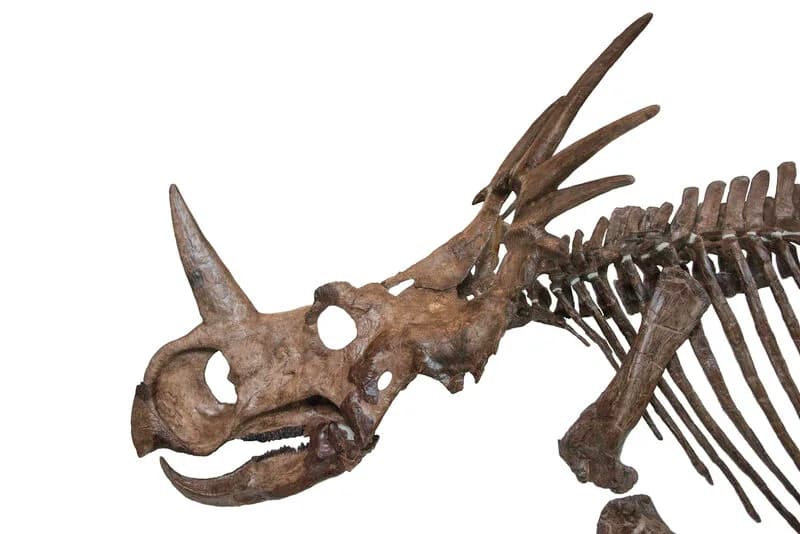
Styracosaurus albertensis skull (AMNH 5372)
WehaveaTrex, CC BY-SA 4.0