Protocératops
Protoceratops andrewsi is immortalised in the « fighting dinosaurs » fossil: one individual frozen mid-grapple with a Velociraptor, buried together by a dune. From 1.5 to 1.8 metres and 62 to 180 kilograms, described in 1923 in Mongolia, it lived 75 to 71 million years ago. Its skulls may have fed the griffin legend.
Protoceratops lived during the Late Cretaceous, approximately 75 to 71 million years ago, during the Campanian stage of the Mesozoic era. Present-day Mongolia, where all its fossils have been found, was then an arid environment characterized by sand dunes, scattered oases, and sparse vegetation adapted to dry conditions. The Cretaceous Gobi Desert was frequently swept by violent sandstorms that sometimes buried living animals alive, creating exceptional preservation conditions that have yielded some of the most complete dinosaur fossils known to science. Protoceratops was one of the most common dinosaurs in this harsh ecosystem and constituted a fundamental prey item in the Mongolian Cretaceous food chain.
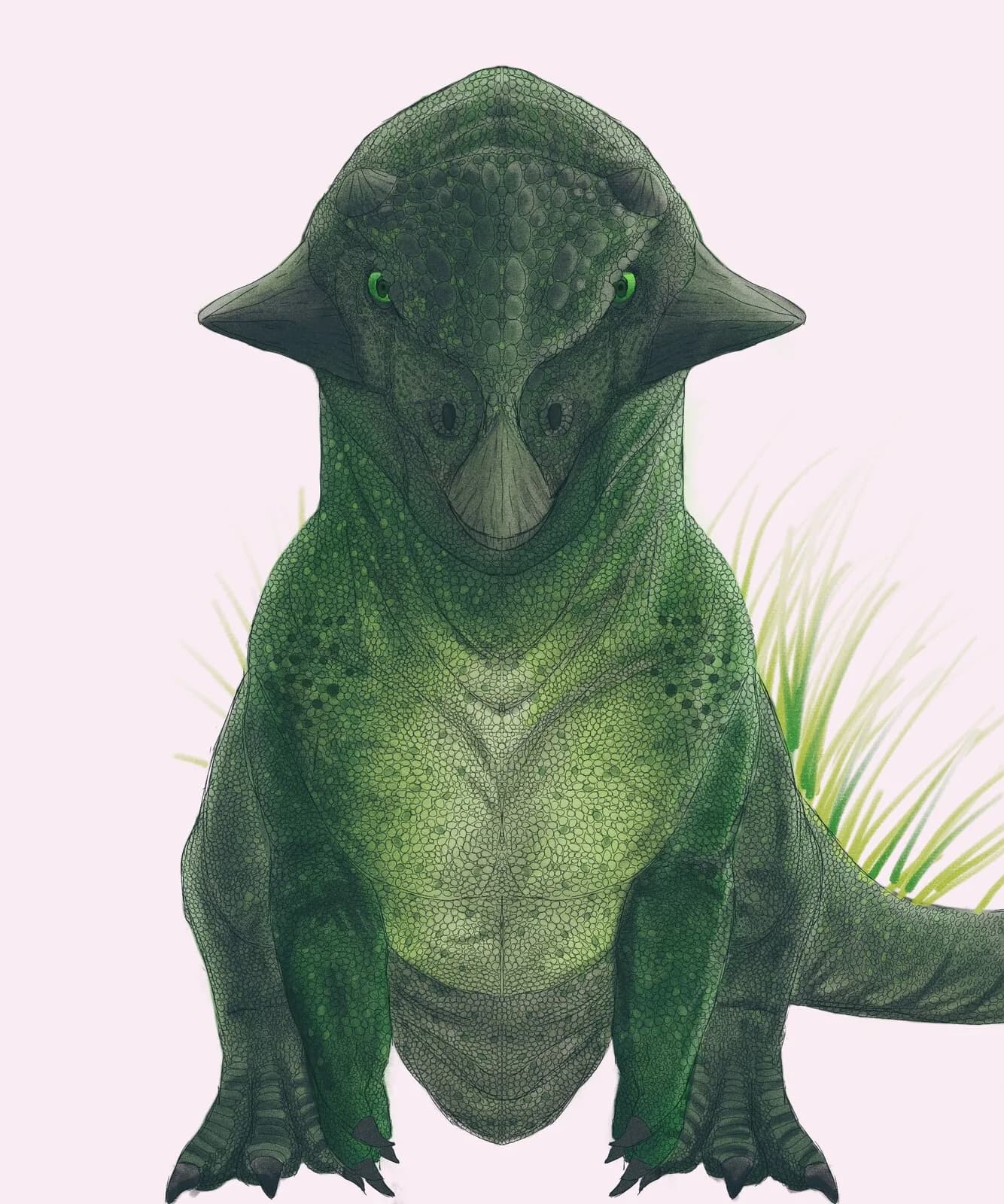
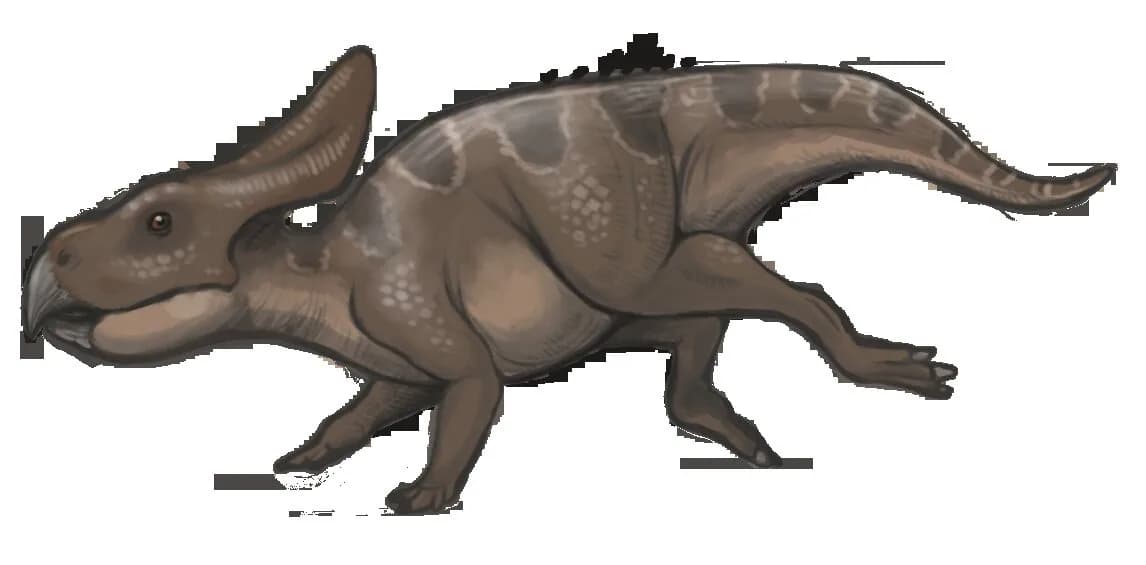
Protoceratops was a small ceratopsian measuring about 1.8 to 2 meters long with a weight of 60 to 180 kilograms, barely larger than a sheep. Its modest size contrasted with the giant ceratopsians of North America like Triceratops. Its skull was proportionally very large relative to its body, measuring about 50 centimeters long, dominated by a broad bony frill at the back. It did not possess true horns, but bore a small nasal bump. Sexual dimorphism was pronounced, with males presenting larger and wider frills than females.
Protoceratops was a dedicated herbivore equipped with a powerful, sharp parrot-like beak capable of cutting the toughest and most drought-resistant plants of the Gobi Desert environment. Its shearing teeth arranged in rows allowed it to effectively slice xerophytic vegetation, likely including low bushes, resistant ferns, and succulent plants well-adapted to the prevailing aridity. The force of its beak was considerable for its relatively modest size, enabling it to cut through thick stems and even dig up roots from the sandy substrate. Its diet had to be carefully adapted to the limited and seasonal resources of its challenging semi-desert environment, making it an efficient forager.
Protoceratops inhabited the semi-arid to arid environments of the Djadokhta Formation and Barun Goyot Formation in the Gobi Desert of Mongolia during the Late Cretaceous. This harsh landscape included extensive dune fields, interdune depressions with ephemeral water points, and sparse but vital vegetation clustered around oases and seasonal water sources. Despite the challenging conditions, the ecosystem supported a surprisingly diverse fauna including Velociraptor (its main predator and famous rival), various oviraptorosaurs, primitive mammals, and numerous species of lizards. Protoceratops was so remarkably abundant in this environment that it is sometimes affectionately nicknamed the sheep of the Cretaceous by paleontologists.
Protoceratops anatomy is that of a primitive ceratopsian, without the spectacular horns of more derived forms. Its bony frill, though broad, was relatively thin and pierced by large fenestrae (openings) that lightened the structure. Its toothless parrot beak at the front served to cut plants, while rows of shearing teeth at the back finely chopped them. Its legs were robust but short, with an obligatory quadrupedal posture. Its tail was relatively short and muscular. Ontogenetic studies show the frill grew considerably from birth to adulthood.
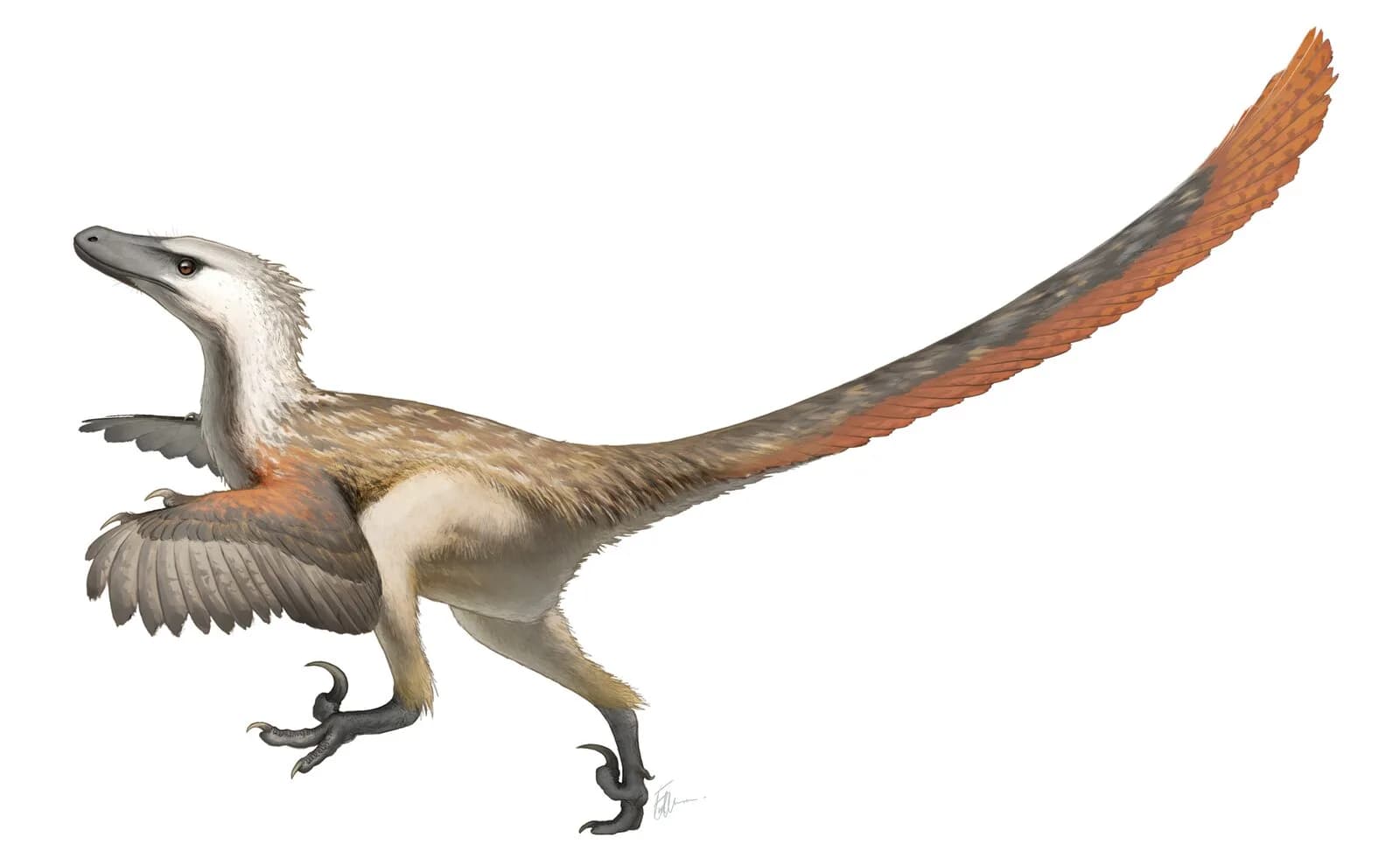
Protoceratops was a gregarious animal that lived in colonies, as demonstrated by numerous fossil sites containing groups of individuals of all ages. The discovery of nests containing dozens of eggs proves communal nesting behavior. An extraordinary specimen shows a group of 15 juveniles preserved together, probably a crèche. The most famous fossil in the dinosaur world — the 'fighting dinosaurs' — shows a Protoceratops and Velociraptor dead together, locked in mortal combat, buried by a sandstorm. This specimen proves that Protoceratops actively defended itself against predators.
Protoceratops was discovered during the legendary American Museum of Natural History expeditions to Mongolia, led by Roy Chapman Andrews in the 1920s. The first expeditions to the Gobi Desert in 1922-1923 brought back numerous skulls and skeletons, and Walter Granger and W.K. Gregory described the species Protoceratops andrewsi in 1923. The quantity of recovered fossils is impressive: hundreds of specimens ranging from embryos to adults have been found, allowing detailed study of growth and sexual dimorphism. The famous 'fighting dinosaurs' fossil (GI SPS 100/25) was discovered in 1971 by a Polish-Mongolian expedition.
| Period | Crétacé supérieur / Late Cretaceous (Campanien) |
| Era | Mésozoïque / Mesozoic |
| Age | 75–71 Ma |
| Location | Asie Centrale / Central Asia (Mongolie / Mongolia, Chine / China) |
| Length | 1.5–1.8 m |
| Height | ~0.6 m |
| Weight | 62–180 kg |
| Diet | Herbivore |
| Discovery | 1923 |
The fossil GI SPS 100/25, known as the 'fighting dinosaurs,' shows a Protoceratops andrewsi and a Velociraptor mongoliensis dying simultaneously, frozen in combat, buried by a sandstorm during the Campanian (75–71 Ma) in Mongolia. It is direct evidence of a fossilized predator-prey interaction. Discovered in 1971 during a Polish-Mongolian expedition, it is displayed at the Institute of Paleontology in Warsaw.
Protoceratops andrewsi measured 1.8 to 2 meters long with a weight of 60 to 180 kilograms — comparable to a sheep. Its skull reached 50 centimeters, dominated by a broad fenestrated bony frill. It had no true horns but a small nasal bump. Sexual dimorphism was pronounced, with males bearing wider frills than females.
An academic hypothesis formulated by Adrienne Mayor in 'The First Fossil Hunters' (2000) suggests that Scythian nomads crossing the Gobi Desert would have found Protoceratops andrewsi skulls — with their hooked beak and frill resembling wings — and transmitted them as descriptions of griffins. No direct evidence confirms this, but the geographic and morphological coincidence remains compelling.
Life reconstruction of Protoceratops andrewsi
Emily Willoughby, CC BY-SA 3.0, via Wikimedia Commons
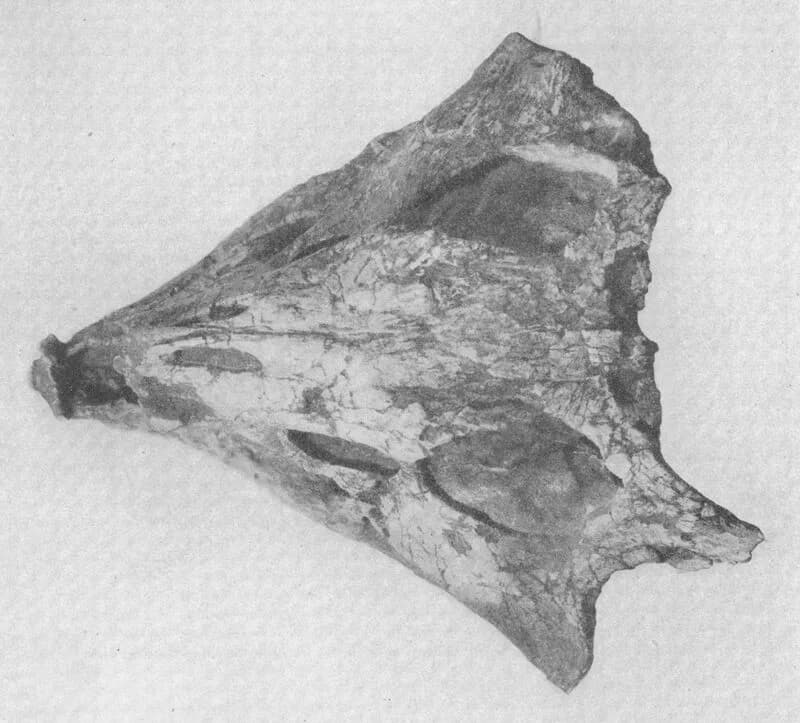
Protoceratops andrewsi holotype skull
Gregory & Granger, Public domain