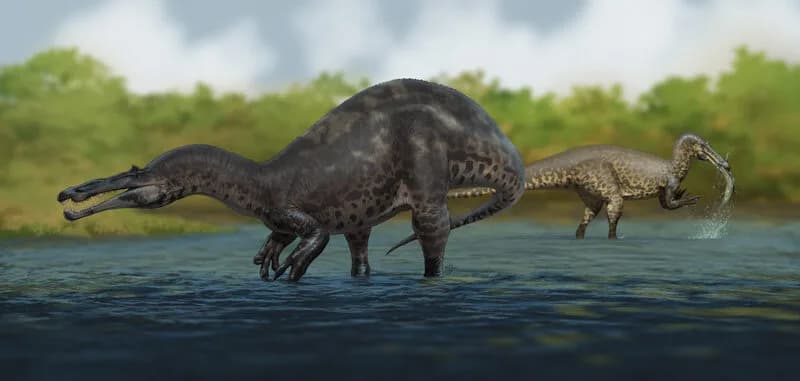
Suchomimus
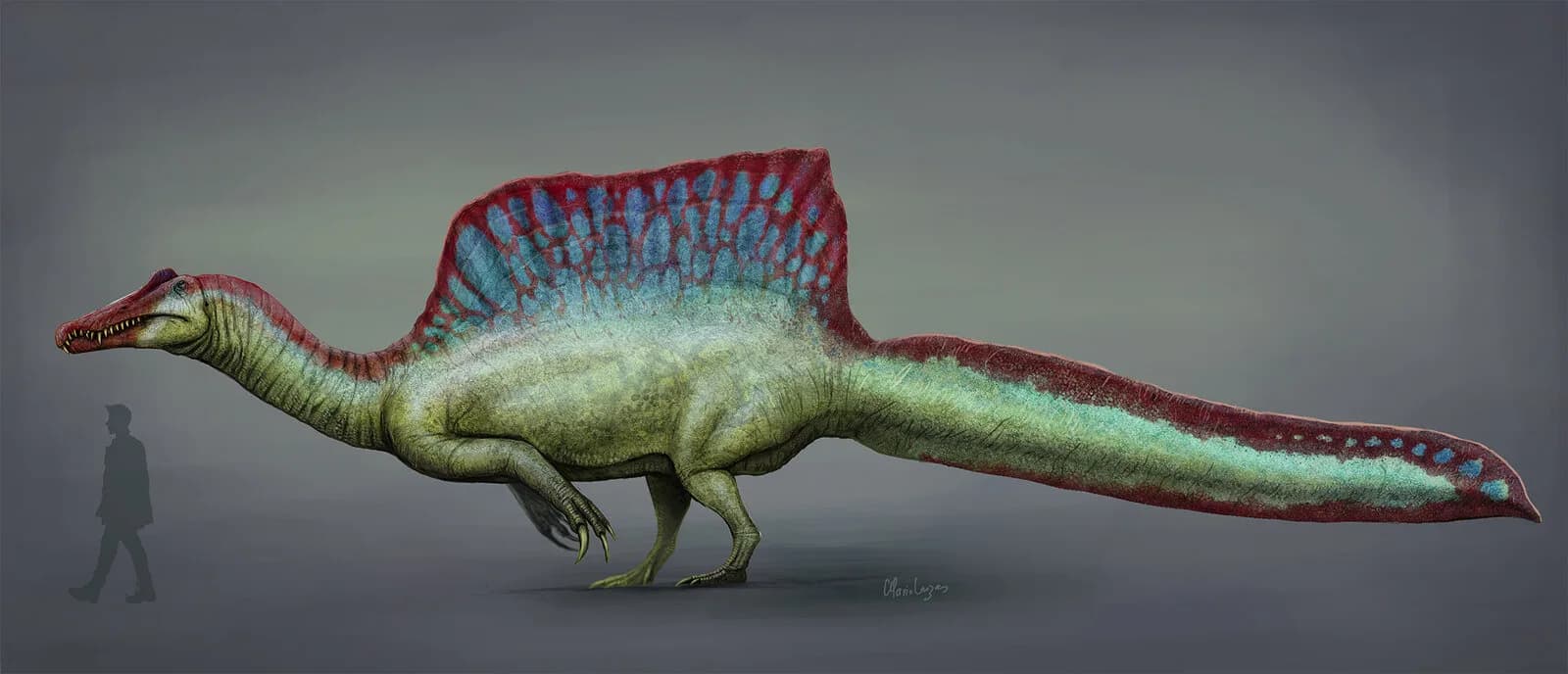
Suchomimus tenerensis means « crocodile mimic », after its long narrow snout recalling a gharial's. Its thumb claw exceeded 30 centimetres and most likely served to spear fish. Eleven metres long and 3.5 to 5 tonnes, described in 1997 in Niger, it fished 112 million years ago in Saharan rivers.
Playable in Path of Titans
See Suchomimus tenerensis's stats, abilities and role on our survival server.
Suchomimus lived during the Early Cretaceous period, approximately 121 to 113 million years ago, during the Aptian stage, in what is now the Elrhaz Formation of Niger, West Africa. This period saw the African continent still connected to South America as part of the southern supercontinent Gondwana, allowing faunal exchange between the two landmasses. The environment was a lush, river-dominated landscape very different from the Saharan desert that occupies this region today. Suchomimus was one of several large predators in this productive ecosystem, sharing its world with other theropods, large sauropods, and diverse aquatic fauna. The Elrhaz Formation preserves one of the best-sampled Early Cretaceous ecosystems from Africa.
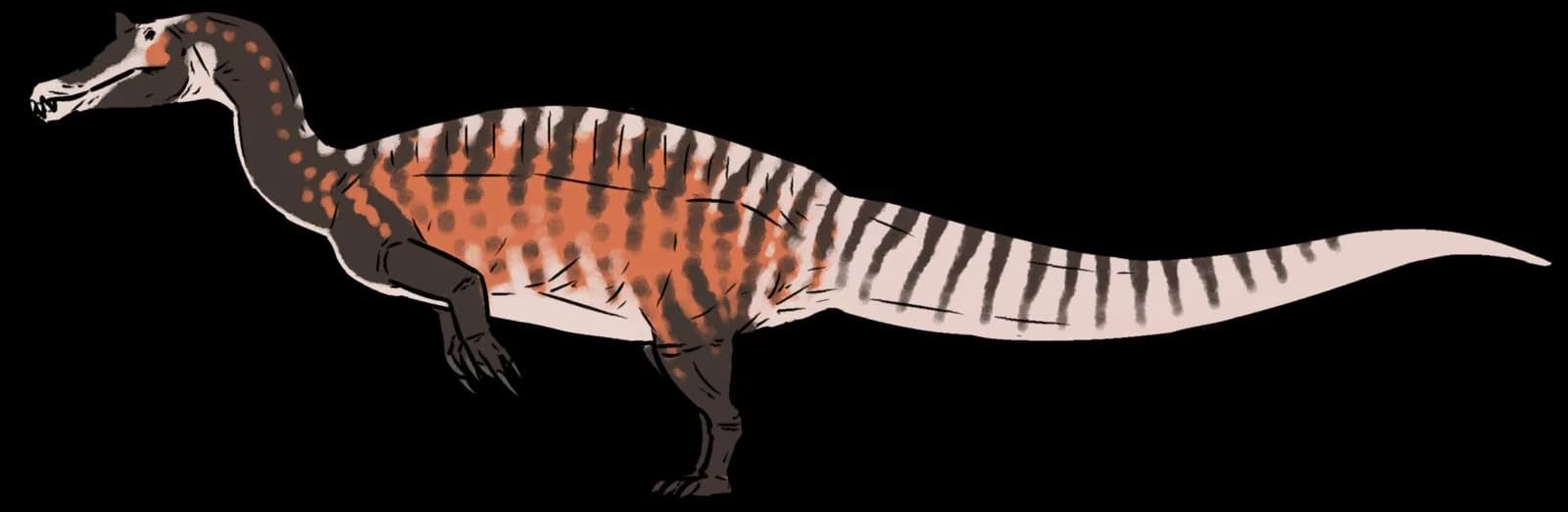
Suchomimus measured approximately 9.5 to 11 meters in length with an estimated weight of around 2.5 to 5 tons, making it one of the largest spinosaurid theropods known. Its skull was extremely elongated and narrow, measuring over one meter in length, resembling the snout of a modern crocodilian — hence its name meaning 'crocodile mimic.' The jaws contained over 120 conical teeth, far more than most theropods, adapted for catching slippery aquatic prey. A distinctive low neural sail ran along its back formed by elongated vertebral spines. The forelimbs were notably powerful with a large, curved thumb claw measuring approximately 30 centimeters, serving as its primary weapon for hooking fish from the water.
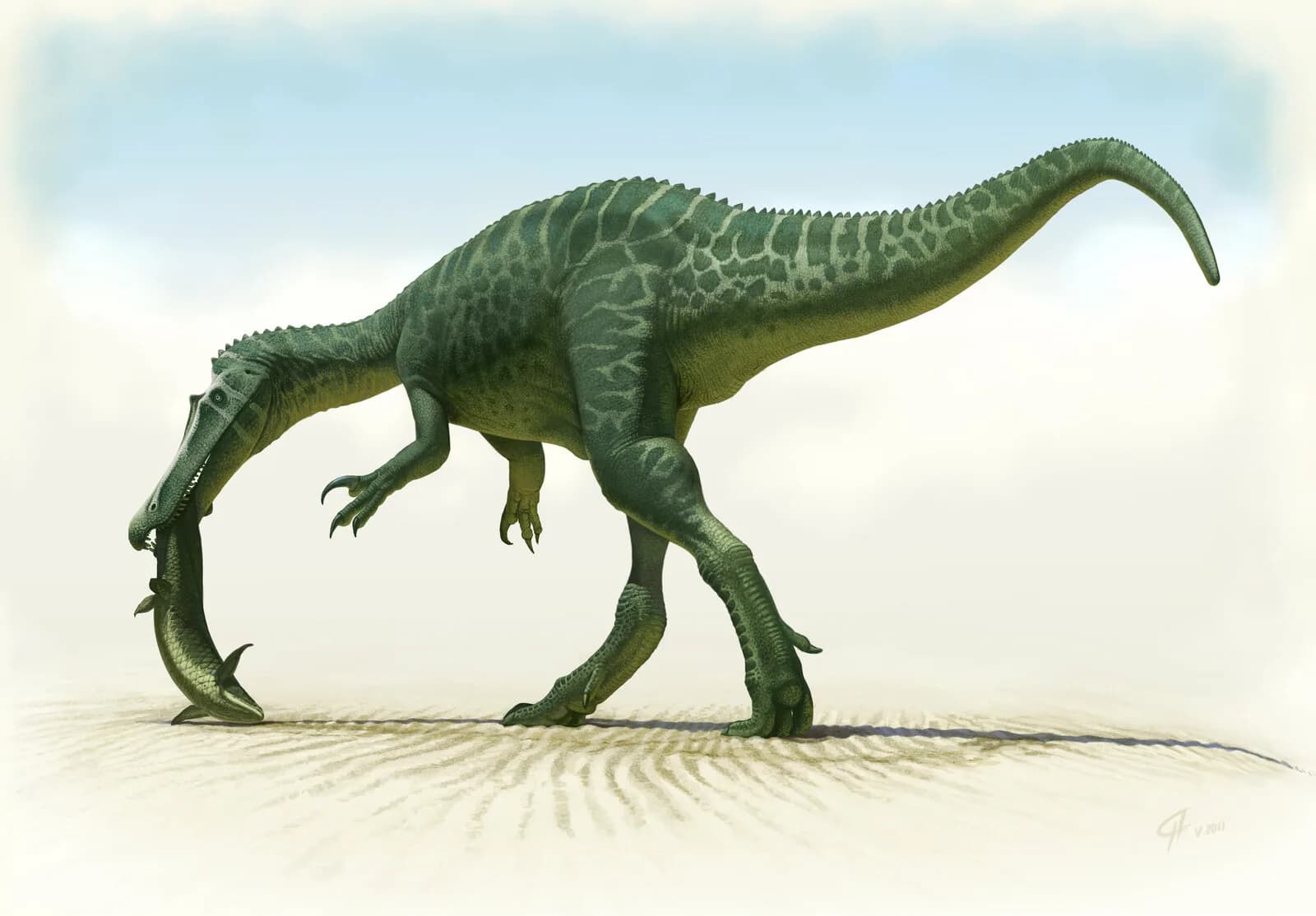
Suchomimus was primarily a piscivorous predator, as indicated by its elongated crocodilian-like snout and numerous conical teeth designed for gripping slippery fish rather than tearing flesh. The large thumb claw was likely used to hook fish from river waters, similar to the fishing technique used by modern bears. However, like other spinosaurids, Suchomimus was probably an opportunistic feeder that would also consume terrestrial prey when available, including small to medium-sized dinosaurs and carrion. The river-rich environment of the Elrhaz Formation would have provided abundant fish resources. Its semi-aquatic hunting lifestyle allowed Suchomimus to exploit food resources unavailable to purely terrestrial predators, reducing competition with other large theropods in the ecosystem.
Suchomimus inhabited a lush, river-dominated environment in the Elrhaz Formation of what is now the Ténéré Desert region of Niger. During the Early Cretaceous, this area was a vast coastal floodplain crossed by numerous rivers and dotted with lakes, supporting dense tropical and subtropical vegetation including ferns, conifers, and early angiosperms. The warm, humid climate created productive aquatic ecosystems teeming with diverse fish species, crocodilians, and other aquatic organisms. The landscape was remarkably different from the present-day Sahara, representing one of the most biodiverse environments in Cretaceous Africa. Suchomimus likely spent much of its time along riverbanks and in shallow waters, similar to modern gharials and fishing herons.
Suchomimus anatomy was highly specialized for a semi-aquatic piscivorous lifestyle, representing one of the most extreme dietary adaptations among theropod dinosaurs. The skull was remarkably elongated and narrow, with a distinctive rosette of teeth at the tip of the snout similar to modern gharials, creating an effective fish trap. The nostrils were positioned far back on the skull, an adaptation that allowed breathing while the snout was partially submerged. A low sail of elongated neural spines ran along the back, possibly serving thermoregulatory or display functions. The forelimbs were more robust than in most large theropods, with powerful muscles and a massive curved thumb claw used for hooking prey from the water.
Suchomimus was likely a semi-aquatic predator that spent much of its time wading in rivers and lakes, using its elongated snout and powerful claws to catch fish, much like modern grizzly bears fishing for salmon. Its hunting strategy probably involved standing motionless in shallow water, waiting for fish to come within striking range before making a rapid sideways snap of the jaws. On land, Suchomimus may have been an opportunistic scavenger or predator of smaller dinosaurs. The neural sail along its back may have served as a visual display structure for attracting mates or intimidating rivals. As a large predator, Suchomimus likely maintained territories along productive stretches of river, defending prime fishing spots from competitors.
Suchomimus tenerensis was described by Paul Sereno and colleagues in 1998 from a partial skeleton discovered in the Elrhaz Formation of the Ténéré Desert in Niger during the 1997 expedition. The holotype includes a substantial portion of the skeleton, including the distinctive skull, vertebrae with elongated neural spines, and the characteristic large thumb claw. The species name 'tenerensis' refers to the Ténéré Desert where it was found, one of the most remote and inhospitable regions on Earth today. Additional fragmentary spinosaurid material from the same formation may also belong to Suchomimus. The discovery significantly expanded understanding of spinosaurid diversity and distribution across Gondwanan continents during the Early Cretaceous period.
| Period | Crétacé inférieur / Early Cretaceous |
| Era | Mésozoïque / Mesozoic |
| Age | 112 Ma |
| Location | Niger / Niger |
| Length | 11 m |
| Height | 3 m |
| Weight | 3.5-5 tonnes |
| Diet | Piscivore |
| Discovery | 1997 |
Suchomimus tenerensis reached approximately 11 meters long and 3.5 to 5 tonnes — smaller than Spinosaurus aegyptiacus (14-15 m). The main difference: Suchomimus had only a low dorsal sail of moderately elongated neural spines, where Spinosaurus sported a spectacular 1.65-meter structure. Both spinosaurids shared a narrow gharial-like snout and giant thumb claws.
Suchomimus tenerensis lived in the Early Cretaceous, approximately 112 million years ago (Aptian), in the Ténéré region of Niger (Elrhaz Formation). What is today a hostile desert was then a lush floodplain crossed by immense waterways. It shared this habitat with Sarcosuchus, a giant 12-meter crocodilian nicknamed the 'SuperCroc,' creating fierce competition for aquatic resources.
The thumb claw of Suchomimus tenerensis measured over 30 centimeters. It likely served to harpoon fish from shallow waterways — a technique analogous to grizzly bears fishing for salmon. Its robust, powerful forelimbs combined with more than 120 slightly curved conical teeth in its jaws made it a formidable fisher in rivers rich in coelacanths and other large fish.
Information on this page is based on peer-reviewed scientific publications.
Reconstruction of Suchomimus tenerensis fishing in a river
Wikimedia Commons, CC BY-SA
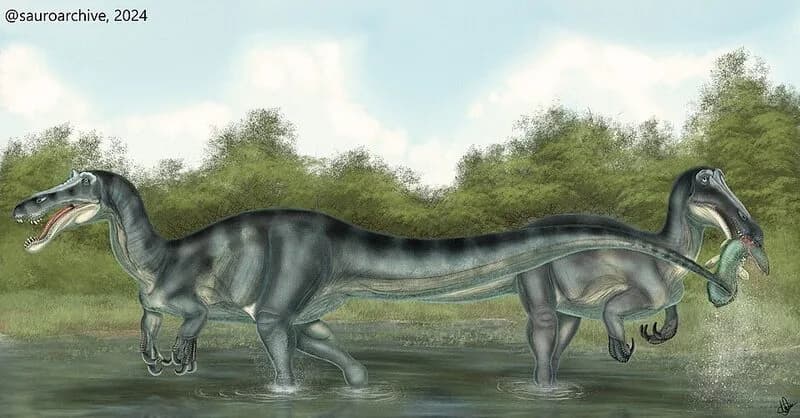
Mounted skeleton of Suchomimus showing the elongated snout and claws
Wikimedia Commons, CC BY-SA