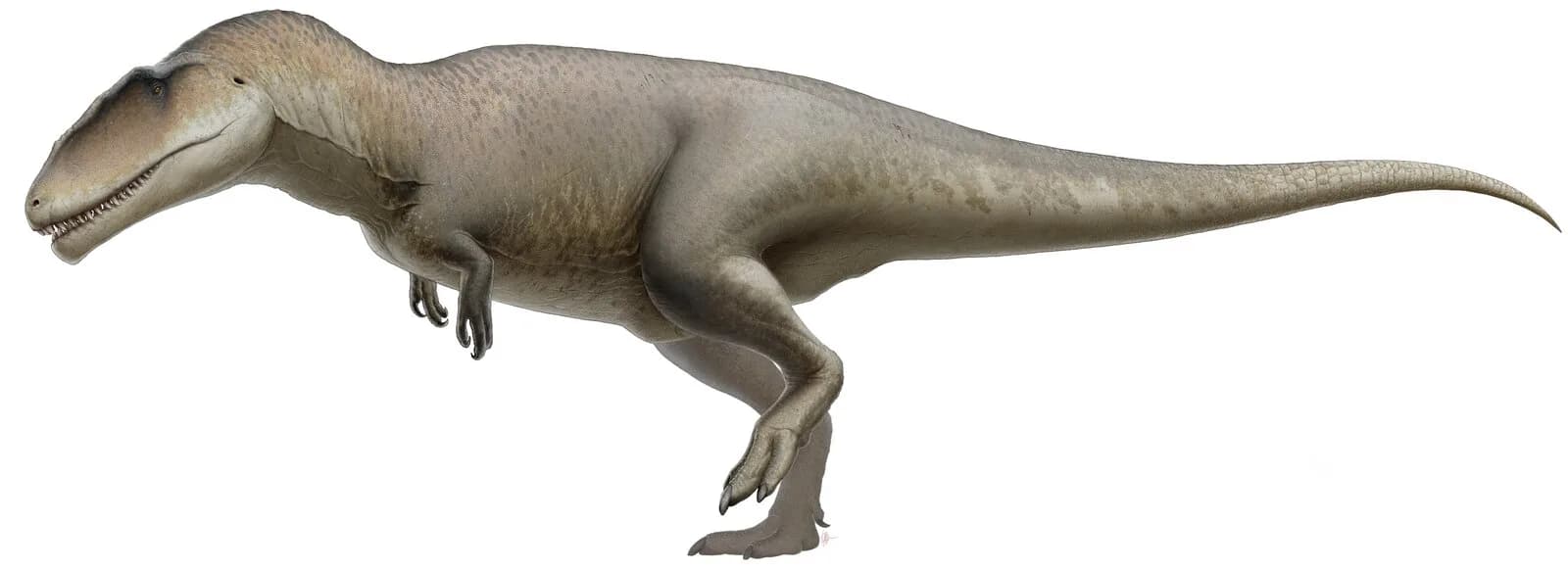
Carcharodontosaure
Carcharodontosaurus saharicus is a carnivore 12 to 14 metres long and 6 to 15 tonnes, which ruled North Africa 99 to 94 million years ago: Morocco, Algeria, Egypt and Niger. Its name means « shark-toothed lizard », after its blade-like dentition close to that of the great white shark. The fossils described in 1927 were destroyed in a bombing raid during the Second World War.
Carcharodontosaurus lived during the mid-Cretaceous period, approximately 100 to 94 million years ago, during the Cenomanian stage, in what is now North Africa. This was a time of extreme global warmth, with sea levels significantly higher than today and no polar ice caps. The Sahara region was a lush, well-watered landscape vastly different from the desert it is today, featuring large river systems and coastal environments. Carcharodontosaurus was the apex predator of this North African ecosystem, competing with other massive theropods like Spinosaurus and Deltadromeus. Its presence demonstrates the remarkable diversity of giant predatory dinosaurs that coexisted in Cretaceous North Africa.
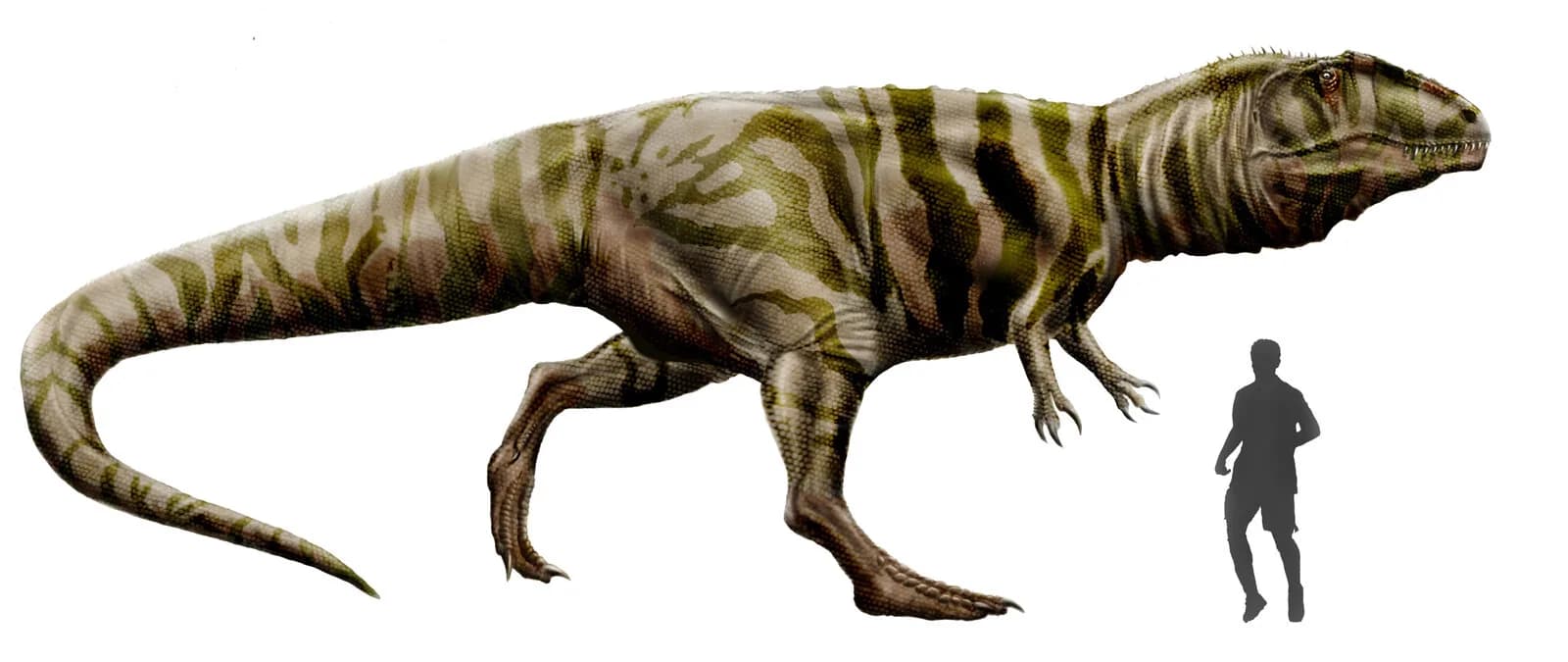
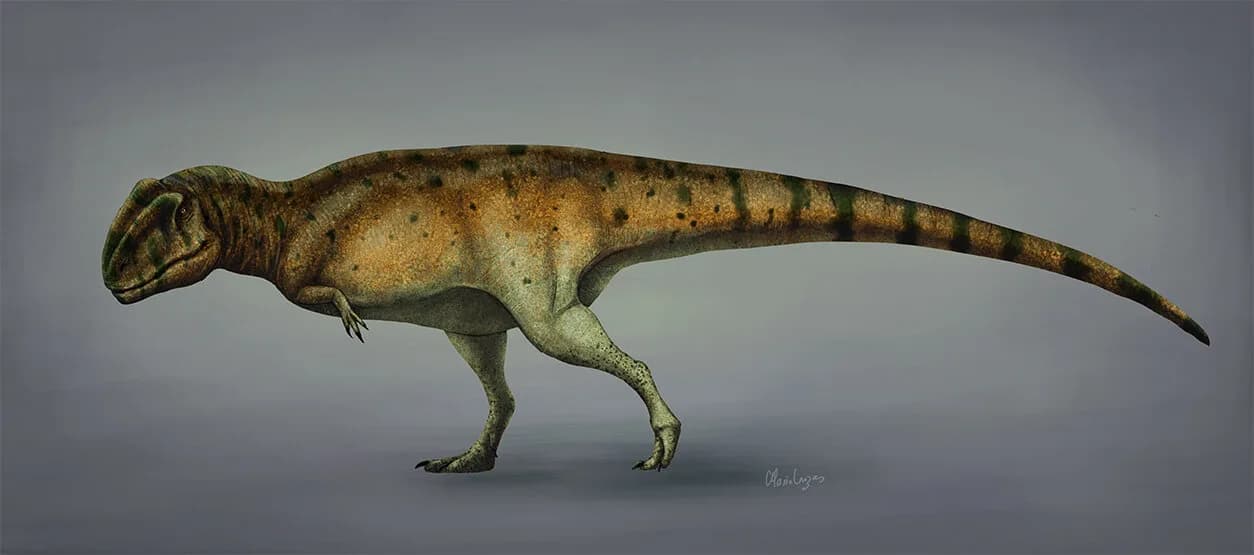
Carcharodontosaurus was one of the largest carnivorous dinosaurs ever to walk the Earth, rivaling and possibly exceeding Tyrannosaurus rex in length. Estimates suggest it reached 12 to 13 meters in length with a weight of approximately 6 to 8 tons. Its skull alone measured up to 1.6 meters in length, making it one of the largest theropod skulls known. The teeth were blade-like and serrated, resembling those of a great white shark — hence its name meaning 'shark-toothed lizard.' The body was powerfully built with strong hind limbs and relatively small but muscular forelimbs. The overall proportions suggest a predator built for delivering devastating biting attacks on large prey.
Carcharodontosaurus was an apex predator whose shark-like, serrated teeth were perfectly designed for slicing through flesh and inflicting massive bleeding wounds on prey. Unlike tyrannosaurs, which relied on bone-crushing bites, Carcharodontosaurus used a slashing bite technique that would have caused catastrophic tissue damage. Its primary prey likely included the large sauropods and ornithopods that were abundant in Cretaceous North Africa, particularly young or weakened individuals. The presence of other large predators in the same ecosystem, including Spinosaurus and Deltadromeus, suggests niche partitioning, with Carcharodontosaurus specializing in terrestrial prey while Spinosaurus focused on aquatic resources. Scavenging would have supplemented active hunting when opportunities arose.
Carcharodontosaurus inhabited the lush, well-watered environments of Cretaceous North Africa, a landscape dramatically different from today's Sahara Desert. The region featured extensive river systems, coastal floodplains, and mangrove-like environments bordering the Tethys Sea. The Kem Kem Formation and Bahariya Formation preserve evidence of dense forests, marshlands, and meandering rivers that supported an incredibly diverse fauna of giant dinosaurs, enormous fish, and massive crocodilians. The warm, humid climate with abundant water resources created one of the most productive terrestrial ecosystems of the Cretaceous period. Carcharodontosaurus likely patrolled the forests and river margins, using its size and power to dominate the terrestrial predator niche.
Carcharodontosaurus anatomy reflects a terrestrial predator optimized for hunting large herbivores. Its elongated, tall skull housed a relatively small brain, with a primitive shape compared to later tyrannosaurs. Its characteristic teeth — laterally compressed and finely serrated on both edges — functioned like saw blades, cutting flesh with formidable efficiency. Its arms were relatively short but longer than those of tyrannosaurs, equipped with three clawed fingers. Its powerful hindlimbs supported its considerable weight while allowing it to move with some speed.
Carcharodontosaurus was likely a solitary apex predator that used its massive size and powerful bite to dominate the terrestrial hunting grounds of Cretaceous North Africa. Its hunting strategy probably involved ambush attacks on large herbivores, using the element of surprise to deliver devastating slashing bites with its serrated teeth before withdrawing to let the prey weaken from blood loss. This strategy is analogous to the bite-and-wait technique used by modern Komodo dragons. The coexistence with other giant predators like Spinosaurus suggests ecological partitioning, with Carcharodontosaurus focusing primarily on terrestrial prey. Territorial behavior was likely important, as the high concentration of large predators would have created intense competition for prime hunting grounds.
The first Carcharodontosaurus fossils were discovered in the 1920s by Charles Depéret and Justin Savornin in the Algerian Sahara region, but the original material was destroyed during the bombing of Munich in 1944 during World War II. The species was not rediscovered until 1995, when Paul Sereno and his team found a spectacular partial skull in the Kem Kem of Morocco. This new specimen allowed Carcharodontosaurus saharicus to be recognized as one of the largest theropods of all time. A second species, C. iguidensis, was described in 2007 from Niger fossils, expanding the genus's geographic distribution.
| Period | Crétacé moyen / Middle Cretaceous (Cénomanien) |
| Era | Mésozoïque / Mesozoic |
| Age | 99–94 Ma |
| Location | Afrique du Nord / North Africa (Maroc, Algérie, Égypte, Niger) |
| Length | 12–14 m |
| Height | ~3.5–4 m |
| Weight | 6 000–15 000 kg |
| Diet | Carnivore |
| Discovery | 1927 |
The first Carcharodontosaurus saharicus fossils were discovered in the 1920s by Depéret and Savornin in the Algerian Sahara. Stored in the Munich museum, they were destroyed during an Allied bombing on April 24, 1944 — the same raid that destroyed the original Spinosaurus fossils. The species was not rediscovered until 1995, when Paul Sereno found a partial skull in the Kem Kem of Morocco.
Carcharodontosaurus saharicus and Spinosaurus aegyptiacus shared North African ecosystems 100-94 million years ago through strict ecological niche separation: Carcharodontosaurus, a terrestrial predator, hunted large sauropods on land, while Spinosaurus dominated aquatic environments as a semi-aquatic piscivore. This partitioning reduced direct competition between these two giants.
Carcharodontosaurus saharicus is one of the largest theropods ever discovered, measuring between 12 and 13.3 meters long with an estimated weight of 6 to 15 tonnes. Its massive skull reached approximately 1.6 meters — one of the largest theropod skulls known. Its teeth could reach up to 20 centimeters, compressed and finely serrated like those of a great white shark.
Information on this page is based on peer-reviewed scientific publications.
Life reconstruction of Carcharodontosaurus
Fred Wierum, CC BY-SA 4.0, via Wikimedia Commons
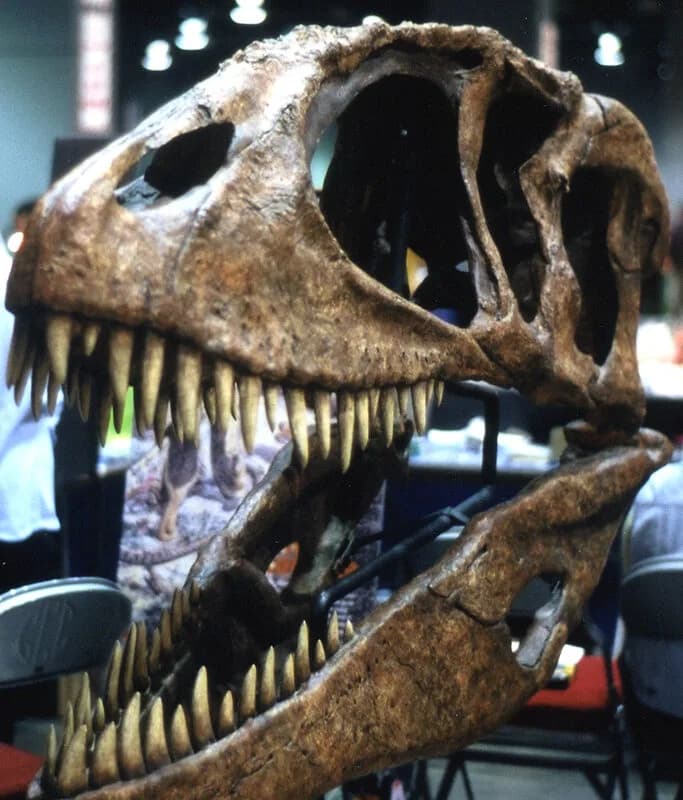
Carcharodontosaurus saharicus fossil tooth
James St. John, CC BY 2.0