Irritator
Irritator challengeri was a spinosaurid from Brazil, described in 1991 from a skull found in Ceará and dated to around 110 million years ago. At 6 to 8 metres and 1 to 2 tonnes, it fed mainly on fish, like its relative Spinosaurus. Its name comes from the irritation of palaeontologists: collectors had reshaped the skull with plaster before study.
Irritator lived during the Early Cretaceous period, approximately 110 million years ago, during the Albian stage, in what is now the Santana Formation of northeastern Brazil. This formation is world-famous for its exceptionally preserved fossils, particularly fish, preserved in limestone nodules that often retain three-dimensional detail. The name Irritator reflects the frustration of paleontologists who discovered that fossil dealers had artificially modified the holotype skull before it was studied scientifically. The Santana Formation preserves a tropical coastal lagoon environment that was home to diverse marine and terrestrial fauna. Irritator was one of the top predators in this unique Brazilian Cretaceous ecosystem.
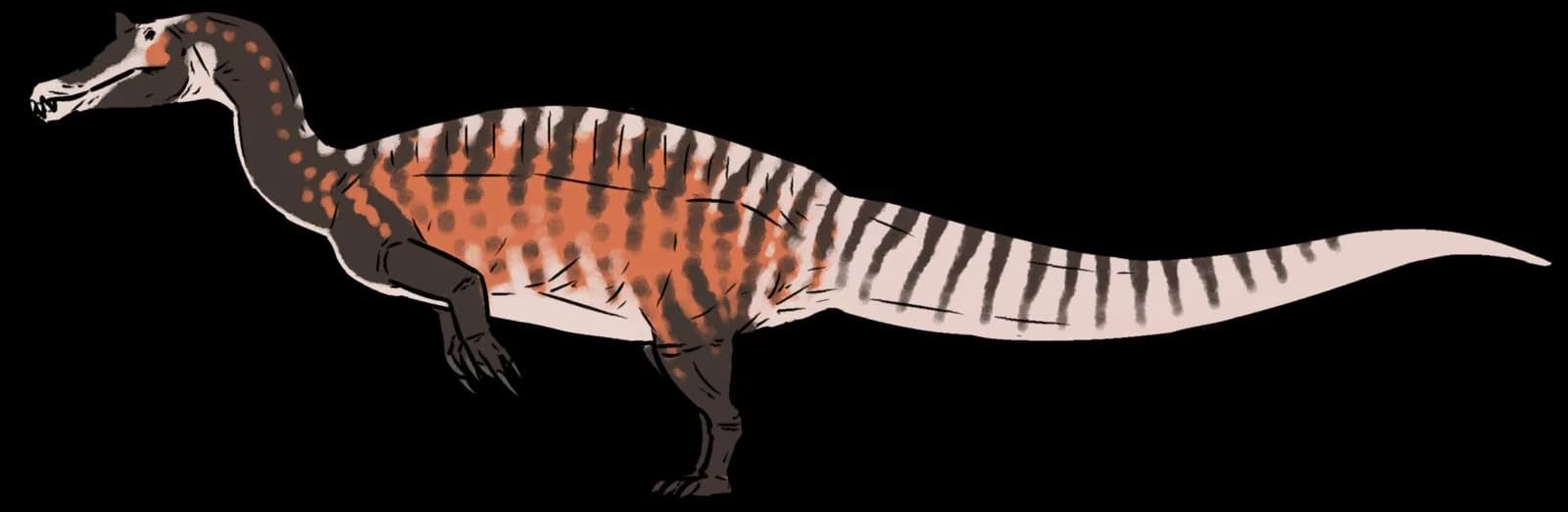
Irritator measured approximately 6 to 8 meters in length with an estimated weight of around 1 ton, making it a medium-sized spinosaurid theropod. Its skull was notably elongated and narrow, with a distinctive sagittal crest running along the top of the head, giving it a unique profile among spinosaurids. The snout was long and filled with conical, interlocking teeth well-adapted for catching slippery fish. The overall body plan was typical of spinosaurids, with relatively strong forelimbs bearing large curved claws and powerful hind limbs. Despite being smaller than its famous relative Spinosaurus, Irritator was still a formidable predator with specialized adaptations for a semi-aquatic piscivorous lifestyle.
Irritator was primarily a fish-eating predator, as evidenced by its elongated snout, conical teeth, and association with the fish-rich Santana Formation. A pterosaur bone found lodged in the throat region of one specimen demonstrates that its diet was not exclusively piscivorous and could include other small to medium-sized animals. The long, narrow snout with interlocking conical teeth functioned like a fish trap, similar to modern gharials, allowing Irritator to catch slippery prey with a rapid sideways snap of the jaws. Its semi-aquatic lifestyle would have given it access to abundant fish resources in the coastal lagoons and rivers of Cretaceous Brazil, supplemented by opportunistic predation on terrestrial and flying animals.
Irritator inhabited the tropical coastal lagoon environments of the Santana Formation in what is now northeastern Brazil. During the Early Cretaceous, this region was characterized by shallow marine lagoons, tidal flats, and river estuaries surrounded by lush tropical vegetation. The warm waters teemed with diverse fish species, providing abundant food resources for piscivorous predators like Irritator. The coastal environment also supported pterosaurs, marine reptiles, and various terrestrial dinosaurs. The exceptional preservation of the Santana Formation indicates periodic anoxic conditions in the lagoons that facilitated rapid fossilization. Irritator likely spent considerable time near water, wading in shallow lagoons and patrolling riverbanks in search of fish and other aquatic prey.
Irritator's anatomy is typical of spinosaurids, with marked adaptations for piscivory. Its elongated skull bore a prominent sagittal crest on the nasal and premaxillary bones, giving it a tall, narrow profile when viewed from the front. Its conical, smooth (unserrated) teeth were spaced and slightly curved backward, perfect for retaining fish. Its nostrils were positioned far from the snout tip, an adaptation for plunging the head into water without obstructing the airways. The mandible bore a rosette of teeth at the tip, similar to the modern gharial.
Irritator was probably a solitary fisher that frequented the banks of lagoons and tropical waterways of Cretaceous Brazil. Like modern herons and grizzly bears, it probably stood in shallow waters, watching for fish and seizing them with a rapid head movement. The discovery of a pterosaur in its stomach suggests it could also hunt flying prey, perhaps catching them on the ground near the water or intercepting those diving to fish. Its lifestyle was intimately linked to aquatic environments, though it remained fundamentally a terrestrial animal.
The Irritator holotype (SMNS 58022) is a nearly complete skull discovered in the Santana Formation of the Araripe Basin in Brazil. It was described in 1996 by David Martill, Arthur Cruickshank, Eberhard Frey, Peter Small, and Mick Clarke. The name 'Irritator' is unique in paleontological nomenclature: it references the scientists' irritation upon discovering that the specimen had been artificially modified by collectors before its sale — the snout had been lengthened with plaster to make it more impressive and increase its market value. The researchers had to laboriously remove the fraudulent additions to study the real skull. The species was named I. challengeri in tribute to Professor Challenger, a character by Conan Doyle.
| Period | Crétacé inférieur / Early Cretaceous (Albien) |
| Era | Mésozoïque / Mesozoic |
| Age | ~110 Ma |
| Location | Amérique du Sud / South America (Brésil / Brazil, Ceará) |
| Length | 6–8 m |
| Height | ~2 m |
| Weight | 1 000–2 000 kg |
| Diet | Piscivore |
| Discovery | 1991 |
Irritator challengeri gets its name from the irritation of paleontologists who discovered, when studying holotype skull SMNS 58022, that collectors had forged it before sale by extending the snout with plaster to increase market value. Researchers had to laboriously remove the fraudulent additions to analyze the real skull. The species name challengeri honors Professor Challenger from Conan Doyle.
Irritator challengeri measured between 6 and 8 meters long with an estimated weight of 1 to 2 tonnes. It was a medium-sized spinosaurid from the Early Cretaceous (about 110 million years ago, Albian stage) of the Santana Formation in the Araripe Basin of Brazil (present-day Ceará). It remains one of the few spinosaurids known from South America.
A specimen of Irritator challengeri was found with remains of the pterosaur Anhanguera in the stomach region — direct evidence that this spinosaurid consumed non-aquatic prey. While its conical, unserrated teeth were ideal for catching slippery fish, its diet was thus opportunistic, including pterosaurs and other vertebrates near water.
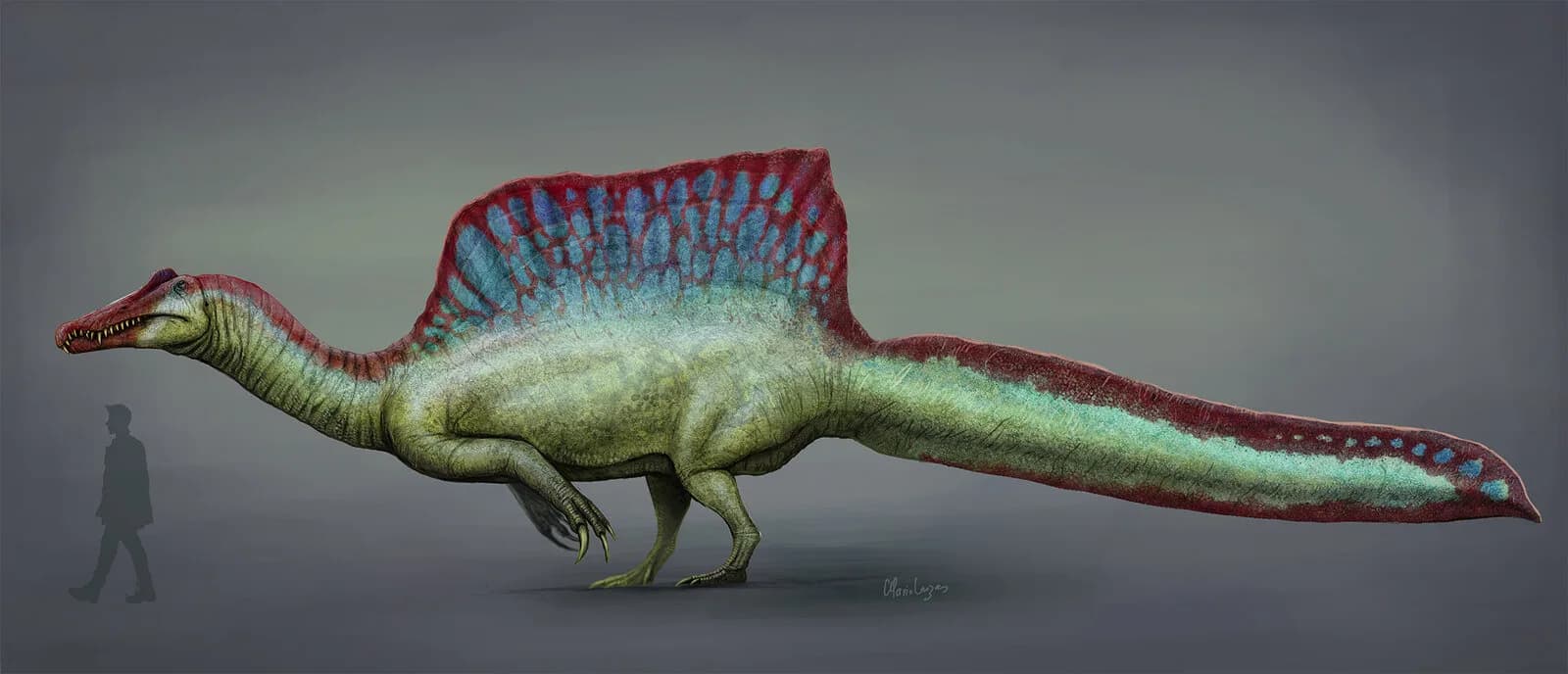
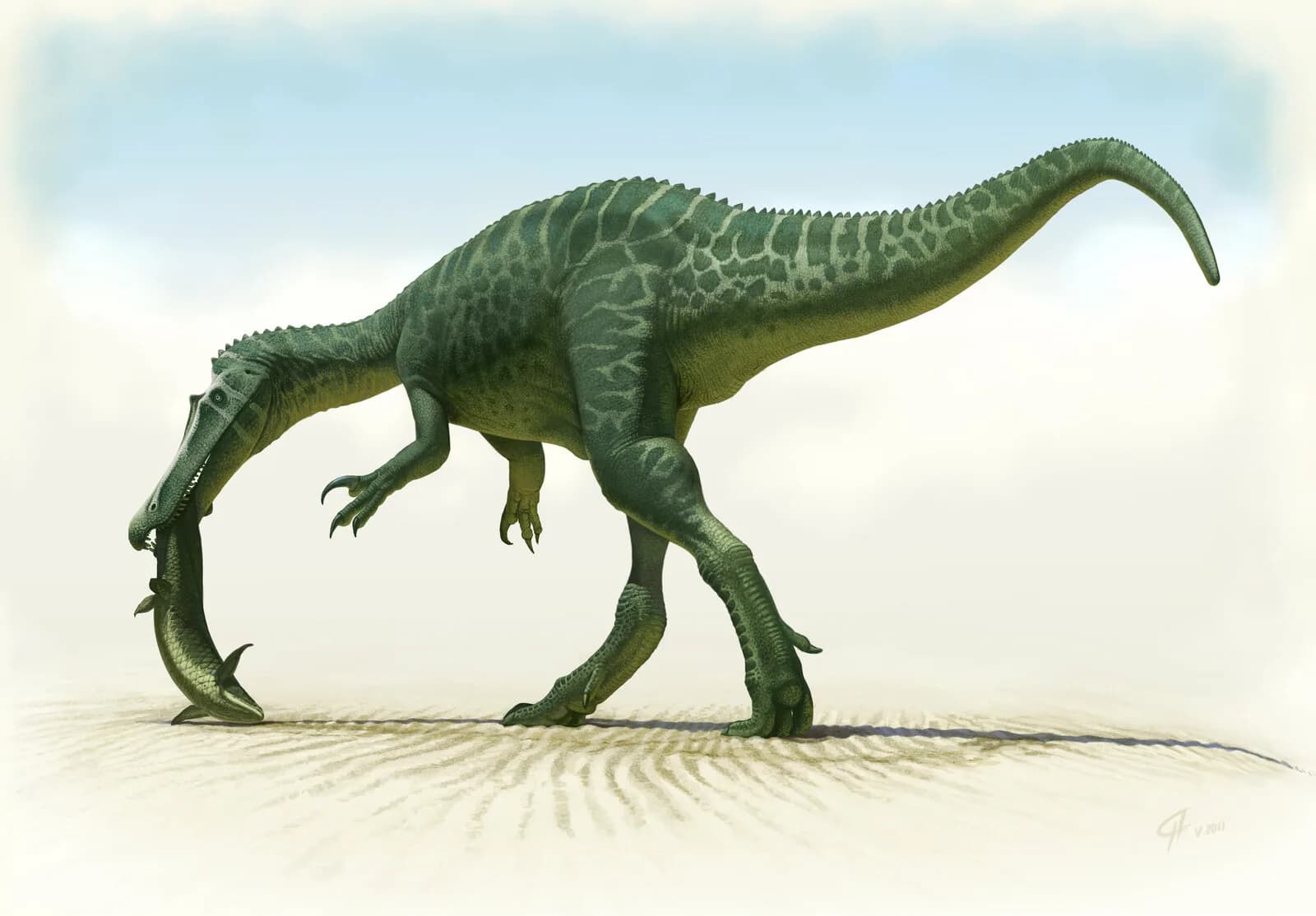
Life reconstruction of Irritator challengeri
Connor Ashbridge, CC BY-SA 4.0, via Wikimedia Commons
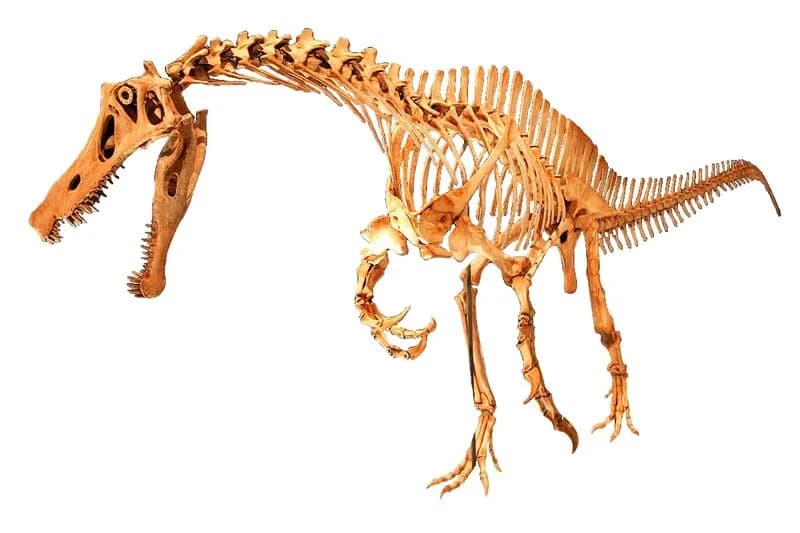
Mounted Irritator challengeri skeleton
Kabacchi, CC BY 2.0