Tigre à dents de sabre
Smilodon fatalis is not a tiger: it belongs to the Machairodontinae, an extinct subfamily of cats far removed from living tigers. Its 18-centimetre canines were brittle and could snap on bone, forcing it to aim for the throat rather than bite at random. It weighed 160 to 280 kilograms, up to 400 for S. populator.
Smilodon lived during the Pleistocene, approximately 2.5 million to 10,000 years ago, making it one of the last great predators of the American megafauna. This machairodont felid appeared in North America at the start of the Pleistocene and colonized South America during the Great American Biotic Interchange, after the formation of the Isthmus of Panama around 3 million years ago. Three species are recognized: S. gracilis (the oldest and smallest), S. fatalis (the most widespread in North America), and S. populator (the most massive, restricted to South America). Smilodon disappeared at the end of the Pleistocene, around 10,000 BCE, during the megafaunal extinction event that affected giant mammals on every continent. Probable causes include rapid climate changes at the end of the last ice age and hunting pressure from the first human populations arriving in the Americas.
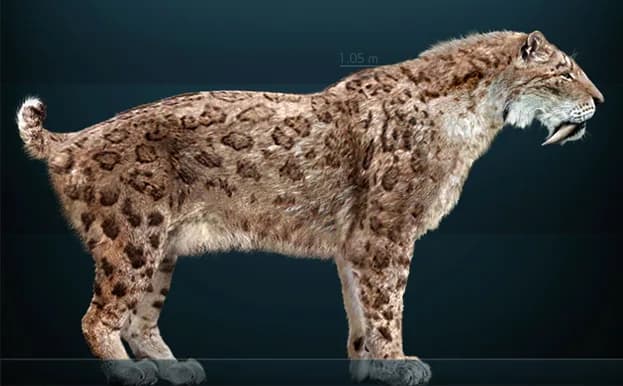
Smilodon fatalis, the best-documented species, measured approximately 1.75 meters long (excluding its short 35 cm tail) with a shoulder height of about 1 meter. Its weight ranged between 160 and 280 kg, comparable to a modern male lion but with a noticeably more robust and stocky build. S. populator, the largest South American species, could reach 400 kg, rivaling the mass of the largest modern bears. The smallest species, S. gracilis, weighed only 55 to 100 kg, roughly the size of a modern jaguar. Smilodon's musculature was concentrated in the shoulders and forelimbs, giving it formidable power to pin and immobilize prey much heavier than itself. Its hind legs were proportionally shorter than those of modern cats, suggesting a powerful animal but not a particularly fast runner.
Smilodon was a hypercarnivore specialized in hunting large Pleistocene herbivores. Its diet included bison, horses, American camels, giant ground sloths (Megatherium, Paramylodon), and likely juvenile mammoths or mastodons. Isotopic analysis of bone collagen from Rancho La Brea specimens indicates a diet rich in grazing herbivores of the plains. Unlike modern cats that kill by suffocation through throat-biting, Smilodon used its hypertrophied canines to deliver a fatal bite targeting the soft tissues of the neck — the trachea, major blood vessels, and possibly the spinal cord — causing massive and rapid hemorrhage. Biomechanical studies show its jaw opened to 120 degrees (versus 65 for a lion), but its actual bite force was relatively weak; the lethal power came from the neck muscles that drove the canines downward into prey.
Smilodon occupied a variety of habitats across the Americas, from temperate grasslands to open forests and semi-arid scrublands. In North America, S. fatalis primarily inhabited the plains and coastal valleys from present-day California to the southeastern United States and Mexico. In South America, S. populator dominated the Argentine pampas, Brazilian cerrados, and Venezuelan savannas. Unlike the cheetah or lion that hunt in open terrain, Smilodon's stocky anatomy suggests a preference for semi-enclosed environments offering ambush opportunities — forest edges, riverbanks, and the margins of watering holes. The Rancho La Brea site in Los Angeles, where over 2,000 individuals became trapped in natural asphalt seeps over millennia, indicates these predators were attracted to entrapped prey, becoming mired themselves in turn.
Smilodon's anatomy was radically different from any living felid. Its upper canines, true curved and finely serrated blades, measured up to 28 cm in S. populator (18 cm in S. fatalis) and were laterally flattened to penetrate flesh with minimal resistance. Its lower jaw possessed mentonian flanges (bony extensions) that protected the canines when the mouth was closed. The gape reached 120 degrees thanks to a specialized mandibular articulation. Its neck was exceptionally muscular, with massive muscle attachments on the skull, because canine bite force came more from cervical flexion than from jaw strength itself. The forelimbs were powerful, equipped with robust retractile claws and a supination range greater than modern cats, allowing it to firmly grasp and hold prey on the ground. Its spine, shorter and more rigid than a lion's, limited running speed but maximized close-quarters wrestling power.
Smilodon was very likely a social predator, living in family groups or small packs. This hypothesis rests on several lines of evidence: at Rancho La Brea, specimens showing severe healed injuries (fractures, severe arthritis, bone infections) survived long enough to recover, which would be improbable for a solitary predator unable to hunt. The high proportion of Smilodon trapped in the asphalt (more than any other carnivore) suggests group behavior attracted by the distress calls of a trapped companion. Its likely hunting technique consisted of a short ambush charge followed by a powerful takedown: the forelimbs pinned the prey while the canine bite targeted the throat with precision. The short tail, unusual among felids, indicates an animal that did not rely on high-speed turning. Males were slightly larger than females, a moderate sexual dimorphism consistent with a social lifestyle.
The genus Smilodon was first described in 1842 by Danish naturalist Peter Wilhelm Lund, based on fossils discovered in limestone caves at Lagoa Santa, Brazil. The name means 'knife tooth' (Greek: smilē 'scalpel' + odous 'tooth'). The most famous deposit is Rancho La Brea in Los Angeles, California, where over 2,000 S. fatalis individuals have been extracted from natural asphalt seeps since the first excavations in 1901. This exceptional site has yielded complete skeletons of all ages, enabling study of the species' growth, pathologies, and population structure. Other important sites include Última Esperanza cave in Chile (where mummified remains with skin fragments were found), Florida caves, and numerous sites in Argentina and Brazil. In 2018, a genomic study confirmed that Smilodon is only distantly related to modern cats, having diverged from the feline lineage approximately 20 million years ago.
| Period | Pléistocène / Pleistocene |
| Era | Cénozoïque / Cenozoic |
| Age | 2.5 Ma - 10 000 ans |
| Location | Amériques (Amérique du Nord et du Sud) / Americas (North & South America) |
| Length | 1.7-2.5 m |
| Height | 1.0-1.2 m (au garrot / at shoulder) |
| Weight | 160-280 kg (S. fatalis), jusqu'à 400 kg (S. populator) |
| Diet | Carnivore |
| Discovery | 1842 |
No, Smilodon fatalis was not a tiger. Despite its nickname 'saber-toothed tiger,' it belonged to the extinct subfamily Machairodontinae and diverged from the lineage of modern felids approximately 20 million years ago. It was therefore far more distantly related to modern tigers than a lion is to a cheetah. Its build was more comparable to a large bear, with massive forelimbs and a short tail.
Smilodon fatalis canines measured 18 cm, laterally flattened and finely serrated. They were not used to crush bones — too fragile for that — but to deliver a precisely targeted bite to the soft tissues of the neck (trachea, arteries), causing massive hemorrhage. The killing power came from the neck muscles, not the jaw. Its gape reached 120°, according to McHenry et al. (2007), versus 65° for a lion.
Fossil evidence from the Rancho La Brea site in Los Angeles suggests that Smilodon fatalis was likely social. Specimens with severe well-healed fractures — injuries that would have been fatal to a solitary predator — imply they were fed by companions during recovery. The disproportionately high number of Smilodon trapped in the asphalt, more than any other carnivore, also indicates group behavior responding to distress calls.
Information on this page is based on peer-reviewed scientific publications.
Smilodon fatalis skeleton at the George C. Page Museum, Rancho La Brea
Wikipedia Commons
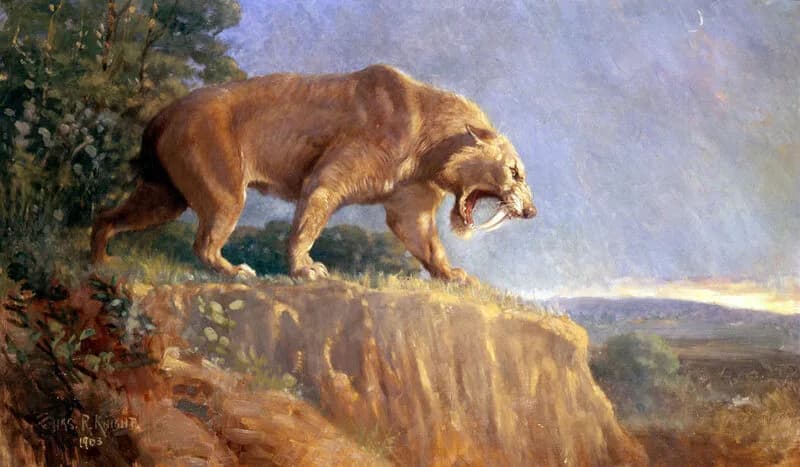
Artistic reconstruction of Smilodon fatalis in hunting posture
Sergiodlarosa, CC BY-SA 3.0