Mammouth laineux
Mammuthus primigenius, the woolly mammoth, stood 4 to 5 metres and weighed 4 to 6 tonnes, sometimes 8. The last individuals died out around 2000 BC on Wrangel Island, in the Russian Arctic: the Giza pyramids had already stood for over five centuries. « Lyuba », a 41,800-year-old calf unearthed in Siberia in 2007, still held milk in its stomach.
The woolly mammoth appeared approximately 400,000 years ago during the Middle Pleistocene, descending from Mammuthus trogontherii (the steppe mammoth). It thrived during the last glaciations, reaching its maximum distribution during the Last Glacial Maximum 26,000 to 19,000 years ago, when vast mammoth steppes covered the Northern Hemisphere from Spain to eastern Siberia and from the Yukon to the northeastern United States. Continental populations declined rapidly between 14,000 and 10,000 BCE, coinciding with postglacial warming and the expansion of human hunter-gatherer populations. A relict population survived on Wrangel Island in Arctic Siberia until approximately 2000 BCE — over a thousand years after the construction of the Giza pyramids. This last island colony likely went extinct due to inbreeding, loss of genetic diversity, and extreme weather events.
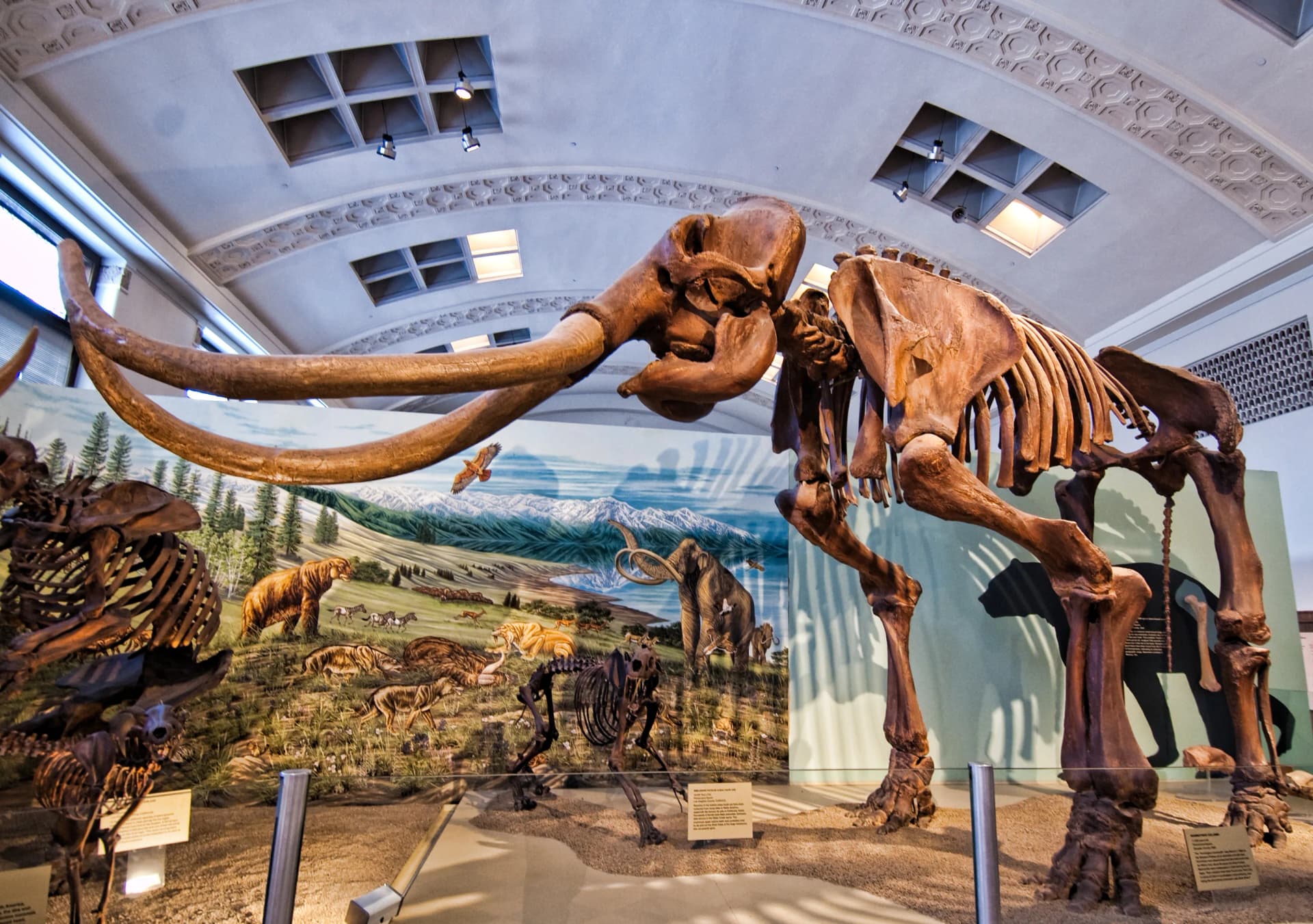
The woolly mammoth was comparable in size to the modern African elephant, though very different in appearance. Adult males stood between 2.7 and 3.4 meters at the shoulder, with exceptional specimens reaching 3.7 meters. Adult weight ranged from 4 to 6 tonnes, with large males approaching 8 tonnes. Females were significantly smaller, standing 2.6 to 2.9 meters and weighing 2.5 to 4 tonnes. Its spirally curved tusks were spectacular: in males, they could reach 4.2 meters in length along the curve and weigh up to 90 kg each. Female tusks were thinner and less curved. Unlike modern elephants, the woolly mammoth had a distinctive profile with a high domed skull, a prominent dorsal fat hump, and a back sloping downward toward the rear, giving it a very distinctive silhouette.
A strict herbivore, the woolly mammoth fed primarily on grasses, sedges, herbs, and low shrubs of the steppe-tundra. Analysis of stomach contents from frozen Siberian carcasses (notably the Beresovka mammoth, 1901, and baby Lyuba, 2007) reveals a diet dominated by grasses (60-90%), supplemented by mosses, willow bark, and dwarf birch. Its hypsodont molars, composed of compressed enamel and dentine plates, were perfectly adapted to grinding abrasive, silica-laden vegetation. Like modern elephants, it replaced its molars six times during its lifetime; loss of the final set condemned the animal to starvation. An adult probably consumed 180 to 200 kg of vegetation daily. The extent of the mammoth steppe — a now-vanished biome maintained in part by the trampling and grazing of the mammoths themselves — was critical for sustaining large populations.
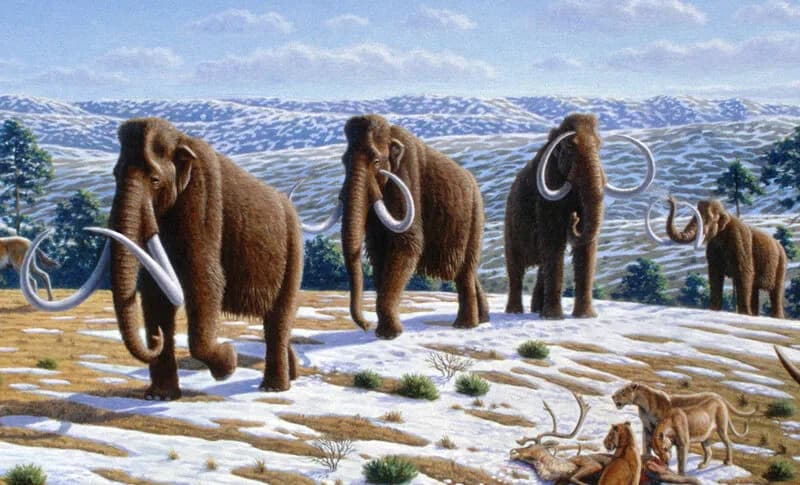
The woolly mammoth inhabited the mammoth steppe (or steppe-tundra), a now-vanished biome that combined elements of Arctic tundra and continental steppe. This ecosystem extended in a nearly continuous band across the Northern Hemisphere, from northern Spain and Britain through central Europe, Siberia, Beringia (the land bridge between Asia and America) to the Yukon and the North American Great Plains. Unlike modern tundra, the mammoth steppe was a productive landscape, dominated by nutritious grasses, herbs, and shrubs, maintained by intensive grazing from large herbivores. The mammoths themselves helped maintain this habitat by felling trees, compacting snow, and recycling nutrients, creating an 'ecosystem gardener' effect. Postglacial warming and the expansion of boreal forests fragmented and ultimately destroyed this biome.
The woolly mammoth's anatomy was superbly adapted to the extreme cold of the ice ages. Its coat consisted of two layers: a dense woolly undercoat of 8 cm and long outer guard hairs exceeding 90 cm, forming a protective 'skirt' over the belly and flanks. Color varied from dark brown to blonde, as revealed by frozen specimens and analysis of the MC1R gene DNA. Beneath the skin, a subcutaneous fat layer of 8 to 10 cm provided thermal insulation and energy reserves. Its ears were remarkably small (one-tenth those of the African elephant) to minimize heat loss, and its short tail (approximately 36 cm) served the same thermoregulatory function. Its trunk had two prehensile 'fingers' at the tip (like the African elephant) and dense sebaceous glands preventing mucous membrane freezing. Its broad feet acted as snowshoes, distributing weight over compacted snow.
Studies of modern elephant populations and analysis of fossil sites suggest the woolly mammoth lived in matriarchal herds, led by an older, experienced female. Adult males left the family herd at maturity and led a more solitary life or lived in small bachelor groups. Analysis of tusks — which record annual growth like tree rings — reveals seasonal cycles corresponding to migrations between wintering areas and summer pastures, potentially covering several hundred kilometers. Males used their imposing tusks for ritualized combat during the breeding season, as evidenced by the numerous broken tusks found at fossil sites. Mammoths likely communicated through infrasound like modern elephants. Paleolithic cave art (Rouffignac, Pech-Merle caves) often depicts mammoths in groups, confirming the gregarious behavior observed in the fossil record.
The woolly mammoth was scientifically described by Johann Friedrich Blumenbach in 1799 as Elephas primigenius, before being reclassified in the genus Mammuthus. The word 'mammoth' derives from Russian мамонт, possibly borrowed from a Uralic language (Mansi or Khanty) meaning 'earth horn.' The most spectacular discoveries include entire carcasses preserved in Siberian permafrost: the Beresovka mammoth (1901), baby Dima (1977), and especially baby Lyuba (2007), a naturally mummified 1-month-old calf from 41,800 years ago, considered the best-preserved mammoth specimen ever found. In 2015, complete genome sequencing of two mammoths (Wrangel and mainland Siberia) revealed that the Wrangel population had suffered a catastrophic genetic collapse. Controversial 'de-extinction' projects led by Colossal Biosciences aim to create an elephant-mammoth hybrid through CRISPR editing, inserting mammoth cold-resistance genes into the Asian elephant genome.
| Period | Pléistocène / Pleistocene |
| Era | Cénozoïque / Cenozoic |
| Age | 400 000 - 4 000 ans |
| Location | Hémisphère Nord (Eurasie, Amérique du Nord, île Wrangel) / Northern Hemisphere (Eurasia, North America, Wrangel Island) |
| Length | 4.0-5.0 m |
| Height | 2.7-3.7 m (au garrot / at shoulder) |
| Weight | 4-6 tonnes (jusqu'à 8 t / up to 8 t) |
| Diet | Herbivore |
| Discovery | 1799 |
Continental populations of Mammuthus primigenius went extinct around 10,000 years ago. A relict population survived on Wrangel Island in Arctic Siberia until approximately 2000 BCE — over a thousand years after the Giza pyramids were built. This last island colony likely died out from inbreeding, genetic diversity loss confirmed by 2015 genome sequencing, and extreme weather events.
In adult male Mammuthus primigenius, tusks could reach 4.2 meters along the spiral curve and weigh up to 90 kg each. Female tusks were thinner and less curved. Tusks, which record annual growth like tree rings, are now used by paleontologists to reconstruct seasonal migrations potentially covering several hundred kilometers.
Analysis of stomach contents from Mammuthus primigenius carcasses preserved in Siberian permafrost, notably baby mammoth Lyuba (41,800 years old, found in 2007) and the Beresovka mammoth (1901), reveals a diet dominated by grasses (60 to 90%). Coprolites also confirm consumption of mosses, willow bark, and dwarf birch. An adult likely ingested 180 to 200 kg of vegetation daily.
Information on this page is based on peer-reviewed scientific publications.
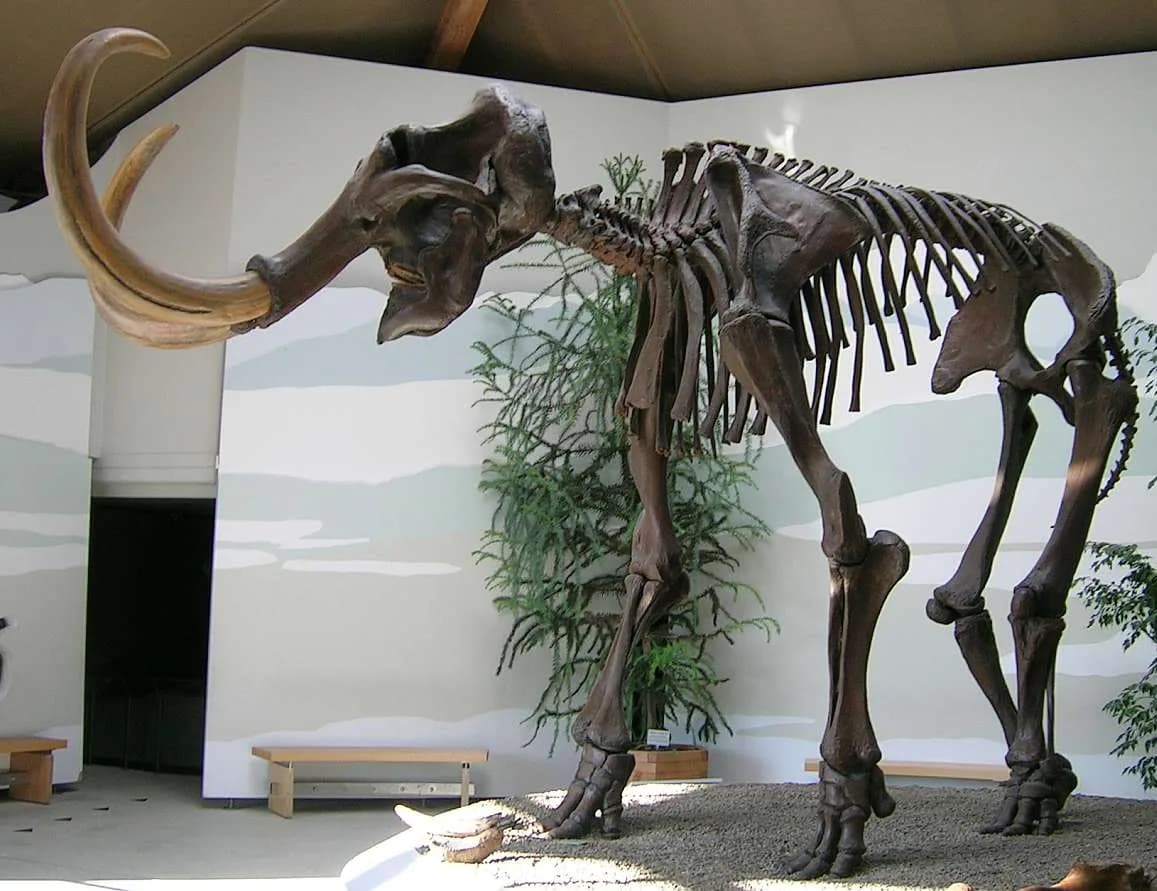
Woolly mammoth skeleton at the Royal Museum of Brussels
Wikipedia Commons
Reconstruction of a woolly mammoth in its glacial steppe environment
Mauricio Anton, CC BY-SA 4.0