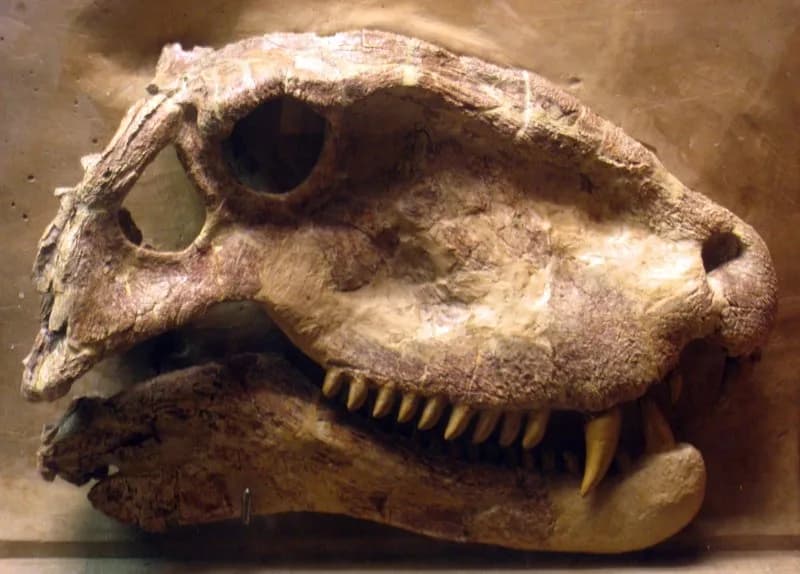
Dimétrodon
Dimetrodon grandis is not a dinosaur: it is a synapsid, the lineage leading to mammals, and therefore a closer relative of humans than of any dinosaur. It died out some 40 million years before the first dinosaurs appeared. At 1.7 to 4.6 metres and 28 to 250 kilograms, it hunted across Texas, Oklahoma and Germany 295 to 272 million years ago.
Dimetrodon lived during the Early Permian (Cisuralian), approximately 295 to 272 million years ago — some 40 to 60 million years BEFORE the first dinosaurs appeared in the Late Triassic. Despite its appearance as a 'prehistoric reptile,' Dimetrodon is absolutely not a dinosaur: it is a synapsid, a member of the great group that includes all ancestors of mammals. It is therefore more closely related to humans than to any dinosaur. Several species are recognized: D. grandis (the largest), D. limbatus, D. natalis, D. milleri, and others. Dimetrodon dominated Early Permian terrestrial ecosystems as an apex super-predator, tens of millions of years before dinosaurs filled that role. Its reign ended during the gradual decline of pelycosaur fauna in the Middle Permian, replaced by therapsids (more advanced synapsids, direct ancestors of mammals).
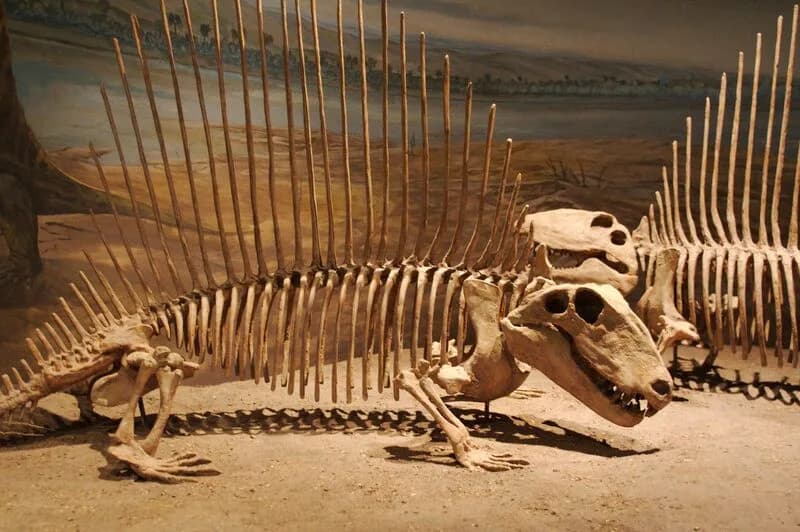
Dimetrodon size varied considerably by species. D. grandis, the most imposing, reached 4 to 4.6 meters in total length (including tail) with an estimated weight of 200 to 250 kg, making it the largest terrestrial predator of its time. D. limbatus, more common, measured about 3 meters at 100 to 150 kg. The smallest species, such as D. milleri, did not exceed 1.7 meters and weighed about 28 kg. The dorsal sail, its most recognizable feature, added up to 1 meter to the animal's profile: in a 4-meter D. grandis, the sail could reach 1.5 meters from the ground. The skull was proportionally large and massive, measuring 40 to 50 cm in large specimens, with a powerful, deep jaw. The body was elongated and stocky, carried on short, sprawling limbs in a semi-erect posture characteristic of primitive synapsids.
Dimetrodon was the apex super-predator of Early Permian ecosystems, ruling unchallenged over the floodplains and swamp forests of equatorial Pangaea. Its heterodont dentition — a major innovation absent in contemporary reptiles — included grasping incisors, prominent piercing canines, and shearing posterior teeth, allowing it to seize, kill, and dismember prey with formidable efficiency. Its diet primarily included smaller synapsids (Ophiacodon, Varanops), giant amphibians like Eryops and Diplocaulus, freshwater fish, and primitive reptiles. Analysis of coprolites attributed to Dimetrodon reveals fragments of bone and fish scales. Its position at the top of the food chain is confirmed by its relative fossil rarity compared to its herbivorous prey such as Edaphosaurus and Diadectes.
Dimetrodon inhabited the vast tropical and equatorial floodplains of western Pangaea, primarily in what is now the southwestern and south-central United States (Texas, Oklahoma, Ohio, New Mexico) as well as parts of Europe (Germany). During the Early Permian, these regions were situated near the equator and experienced a semi-arid to seasonal climate with pronounced monsoons, alternating dry seasons and floods. The richest geological formations — the Permian 'red beds' of the Clear Fork Group and Wichita Formation in Texas — represent floodplain environments crossed by meandering rivers, bordered by forests of primitive conifers, tree ferns, and giant horsetails. Dimetrodon shared these habitats with a complex ecological community including the sail-backed herbivore Edaphosaurus and the large amphibian Eryops.
Dimetrodon's most spectacular anatomical feature is its dorsal sail, formed by elongated neural spines of the thoracic and lumbar vertebrae, likely connected by a richly vascularized skin membrane. The exact function of this sail remains debated: the classic thermoregulation hypothesis (solar radiator to warm blood in the morning, heat dissipator during the day) is supplemented by hypotheses of sexual signaling (the sail may have been brightly colored) and intraspecific recognition. Recent studies (2012-2019) suggest the sail alone would not have been sufficient for effective thermoregulation of a 250 kg animal. The skull possessed a characteristic synapsid temporal fenestra — the lateral cranial opening that distinguishes the synapsid clade from all other amniotes. Its heterodont dentition (multiple tooth types) foreshadowed that of mammals and represents a major evolutionary advance over the uniform teeth of reptiles.
Dimetrodon was most likely a solitary and territorial predator, occupying hunting territories along waterways and marshy areas where its prey was abundant. Its mode of locomotion, with laterally sprawling limbs in a semi-erect posture, limited its speed and endurance compared to later dinosaurian predators, but it was probably the fastest animal of its time, outpacing contemporary amphibians and reptiles. The dorsal sail may have played a role in social interactions: during territorial confrontations or courtship displays, a Dimetrodon presenting itself in profile with its sail deployed must have been an intimidating sight. Sexual dimorphism of the sail (variable size and shape among individuals) suggests active sexual selection. Its likely hunting strategy was waterside ambush, targeting amphibians and smaller synapsids coming to drink.
Dimetrodon was first described in 1878 by American paleontologist Edward Drinker Cope, in the context of the fierce 'Bone Wars' pitting him against Othniel Charles Marsh. The name means 'two-measure tooth' (Greek: di 'two' + metron 'measure' + odous 'tooth'), referring to its differently sized teeth — a revolutionary characteristic at the time. Fossils come primarily from the Permian 'red beds' of northern Texas and Oklahoma (Clear Fork, Wichita, Hennessey formations), the world's richest deposits for Early Permian fauna. Over 14 species have been described, though some are considered dubious. In Germany, D. teutonis has been described from the Permian deposits of Thuringia. Dimetrodon is one of the most misidentified prehistoric animals by the general public, regularly included in 'dinosaur toy' sets despite having gone extinct 40 million years before the first dinosaur appeared and being more closely related to humans than to any dinosaur.
| Period | Permien inférieur / Early Permian (Cisuralien) |
| Era | Paléozoïque / Paleozoic |
| Age | 295-272 Ma |
| Location | Amérique du Nord (Texas, Oklahoma), Europe (Allemagne) / North America (Texas, Oklahoma), Europe (Germany) |
| Length | 1.7-4.6 m |
| Height | 1.5 m (avec voile / with sail) |
| Weight | 28-250 kg |
| Diet | Carnivore |
| Discovery | 1878 |
No. Dimetrodon was a synapsid of the Sphenacodontidae family — more closely related to mammals, and therefore to humans, than to any dinosaur. It lived 295 to 272 million years ago, some 40 to 60 million years BEFORE the first dinosaurs appeared in the Late Triassic. It is regularly and incorrectly included in dinosaur toy collections.
The function of Dimetrodon grandis's sail remains debated. The classic hypothesis is thermoregulation — a solar radiator in the morning and heat dissipator during the day — but studies from 2012-2019 show it alone would not have been sufficient for a 250 kg animal. Alternative hypotheses include sexual signaling (the sail may have been brightly colored) and intraspecific recognition.
The species D. grandis reached 4 to 4.6 meters long at 200 to 250 kg — the largest terrestrial predator of the Early Permian. It hunted smaller synapsids (Ophiacodon, Varanops), large amphibians like Eryops and Diplocaulus, and freshwater fish. Its heterodont dentition, with incisors, canines, and shearing teeth, was a major evolutionary advance for its era.
Mounted Dimetrodon grandis skeleton at the Field Museum in Chicago
Wikipedia Commons
Reconstruction of Dimetrodon grandis in its Permian environment
Dmitry Bogdanov, CC BY-SA 3.0