Pteranodon
Pteranodon longiceps was not a dinosaur but a pterosaur, a flying reptile that soared over North America 88 to 80 million years ago. Described in 1876, it weighed 15 to 35 kilograms with a wingspan reaching 7 metres. Entirely toothless, it swallowed fish whole like a pelican; males carried a far larger head crest than females.
The master of the skies. Untouchable in flight, it fishes mid-flight for independent feeding. On the ground, it's an easy target — stay airborne.
Playable in The Isle: Evrima
See Pteranodon longiceps's in-game stats, tier, strengths & weaknesses on our server.
Pteranodon lived during the Late Cretaceous, approximately 88 to 80 million years ago (Coniacian-Santonian), soaring above the warm waters of North America. This iconic pterosaur is one of the largest flying reptiles that ever existed in the history of life on Earth. Although not a dinosaur (pterosaurs are flying reptiles closely related to dinosaurs), Pteranodon is among the most famous prehistoric flyers. It soared above the Western Interior Seaway, a vast shallow sea that divided North America in two from the Gulf of Mexico to the Arctic. Over 1,100 fossil specimens have been discovered, making Pteranodon the best-documented pterosaur in the fossil record. It is often incorrectly depicted alongside dinosaurs like T. rex, but it predates most of them by approximately 15 million years.
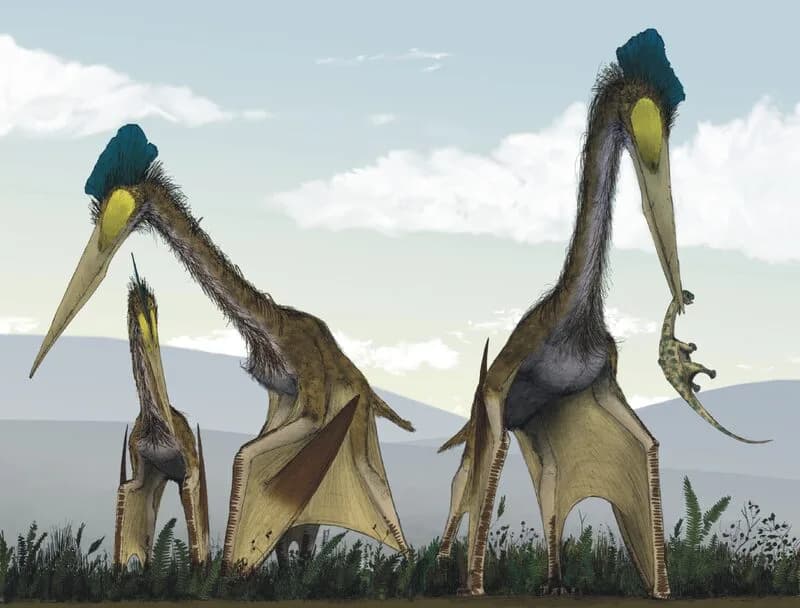
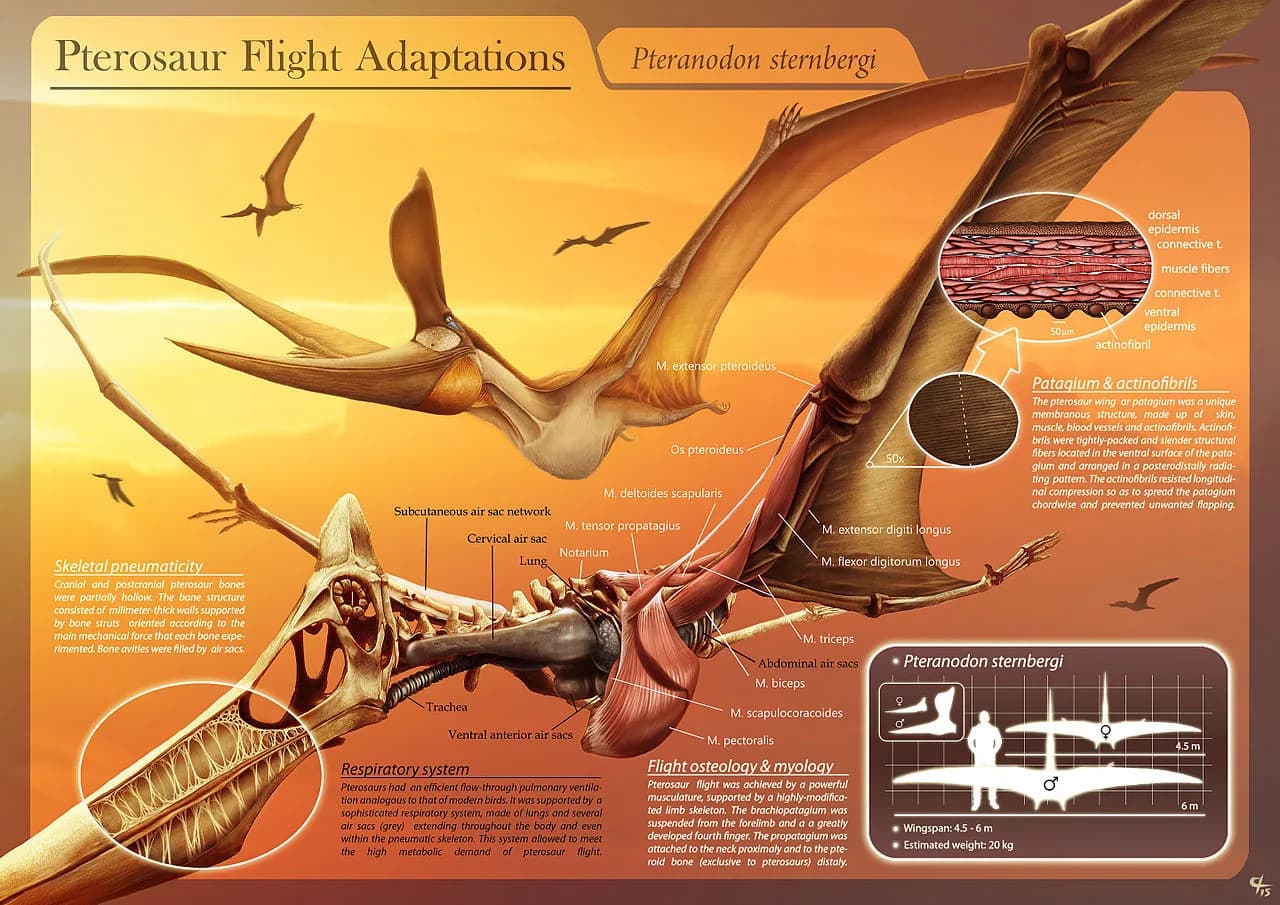
Pteranodon longiceps is remarkable for its impressive size. Males had wingspans reaching 5 to 7.5 meters, with some giant specimens approaching 9 meters. Despite this considerable wingspan, its weight remained surprisingly light (20 to 50 kg) thanks to hollow, pneumatized bones and a thin but resilient wing membrane. Its toothless, elongated beak measured over one meter in length. The prominent cranial crest of males — much larger than that of females — likely served as a rudder in flight and as a sexual display signal. Females were noticeably smaller, with a wingspan of about 3.8 meters and a greatly reduced or absent crest, indicating strong sexual dimorphism in this species.
A specialized piscivore, Pteranodon fed primarily on fish and squid caught at the water surface. Its long, toothless beak equipped with an extensible gular pouch (similar to that of a modern pelican) allowed it to dive and capture prey while skimming the water surface. Fossil fish remains have been found in the stomach region of certain specimens, confirming its fish-based diet. It likely fed by soaring above the water and plunging its beak downward to seize fish near the surface, much like modern gannets and pelicans. Its feeding strategy was highly specialized for life over the open waters of the Western Interior Seaway.
Pteranodon soared primarily above the Western Interior Seaway, an epicontinental sea covering central North America. The Niobrara Formation (Kansas, South Dakota, Nebraska) is the primary deposit. Its light hollow bones allowed soaring over vast distances above shallow, fish-rich waters. Cliffs and coastal areas likely served as nesting sites. The climate above the Seaway was warm and tropical, with surface water temperatures estimated around 25 to 30°C, sustaining large populations of fish including Xiphactinus and Cimolichthys. Marine co-inhabitants included mosasaurs, plesiosaurs, and large sharks, which may have competed with or predated upon Pteranodon near the water's surface. Coastal limestone cliffs and elevated shoreline formations provided sheltered nesting colonies away from terrestrial predators, a strategy similar to that of modern gannets and frigatebirds.
Pteranodon anatomy is optimized for long-distance soaring flight. Its hollow, lightweight bones, massive wing surface (a skin membrane connecting the elongated fourth finger to the body), and occipital crest (serving as a rudder by modifying head aerodynamics) make it an exceptional glider. On land, it likely moved quadrupedally by folding its wings. Contrary to popular depictions, it could not carry humans — its bone structure was far too fragile for such a task. The wing membrane, called the patagium, was reinforced by internal fibers called actinofibrils that provided structural strength while maintaining flexibility during flight.
Pteranodon was likely colonial, nesting in large noisy colonies on coastal cliffs much like modern seabirds. The pronounced sexual dimorphism (males with much larger and more spectacular crests) suggests courtship displays and competition between males for nesting sites and mates. Its flight mode combined active wing-beating and prolonged gliding exploiting thermal updrafts. Biomechanical studies estimate it could travel hundreds of kilometers without landing, soaring effortlessly over the Western Interior Seaway in search of fish schools. Aerodynamic analyses indicate it also exploited coastal updrafts to conserve energy during long foraging trips over open water.
Pteranodon was described by Othniel Charles Marsh in 1876, from fossils discovered in the Niobrara Formation of Kansas. Hundreds of specimens have been collected since, making Pteranodon one of the best-documented pterosaurs in the entire fossil record. The Natural History Museum in London, the Smithsonian Institution, and the Kansas Museum of Natural History house superb specimens. Several species have been described over the years, but P. longiceps and P. sternbergi remain the best supported by fossil evidence. The Kansas State Geological Survey and private collectors continue to enrich museum collections with new and important discoveries from the Niobrara chalk beds.
| Period | Crétacé supérieur / Late Cretaceous |
| Era | Mésozoïque / Mesozoic |
| Age | 88-80 Ma |
| Location | Amérique du Nord / North America |
| Length | 1.8 m (corps / body) |
| Height | N/A |
| Weight | 15-35 kg |
| Diet | Piscivore |
| Discovery | 1876 |
| Type (in-game) | Carnivore |
| Tier | Tier 2 |
No, Pteranodon longiceps was not a dinosaur. It was a pterosaur — a flying reptile closely related to dinosaurs but belonging to a separate group (Pterosauria). It lived 88 to 80 million years ago above the Western Interior Seaway of North America. With wingspans reaching 7.5 meters in males, it is one of the largest known flying reptiles.
Pteranodon longiceps was a specialized piscivore. Its long, toothless beak, equipped with an extensible gular pouch similar to that of a modern pelican, allowed it to catch fish and squid while skimming the surface of the Western Interior Seaway. Fossil fish remains have been found in the stomach region of some specimens, confirming this fish-based diet.
The cranial crest of Pteranodon longiceps, much larger in males than females, likely served two functions. It acted as an aerodynamic rudder in flight — modifying air resistance based on head angle — and as a sexual display signal during courtship. This pronounced sexual dimorphism, documented across hundreds of Niobrara Formation specimens from Kansas, is among the best established in any pterosaur.
Information on this page is based on peer-reviewed scientific publications.
Pteranodon at AMNH
Wikipedia Commons
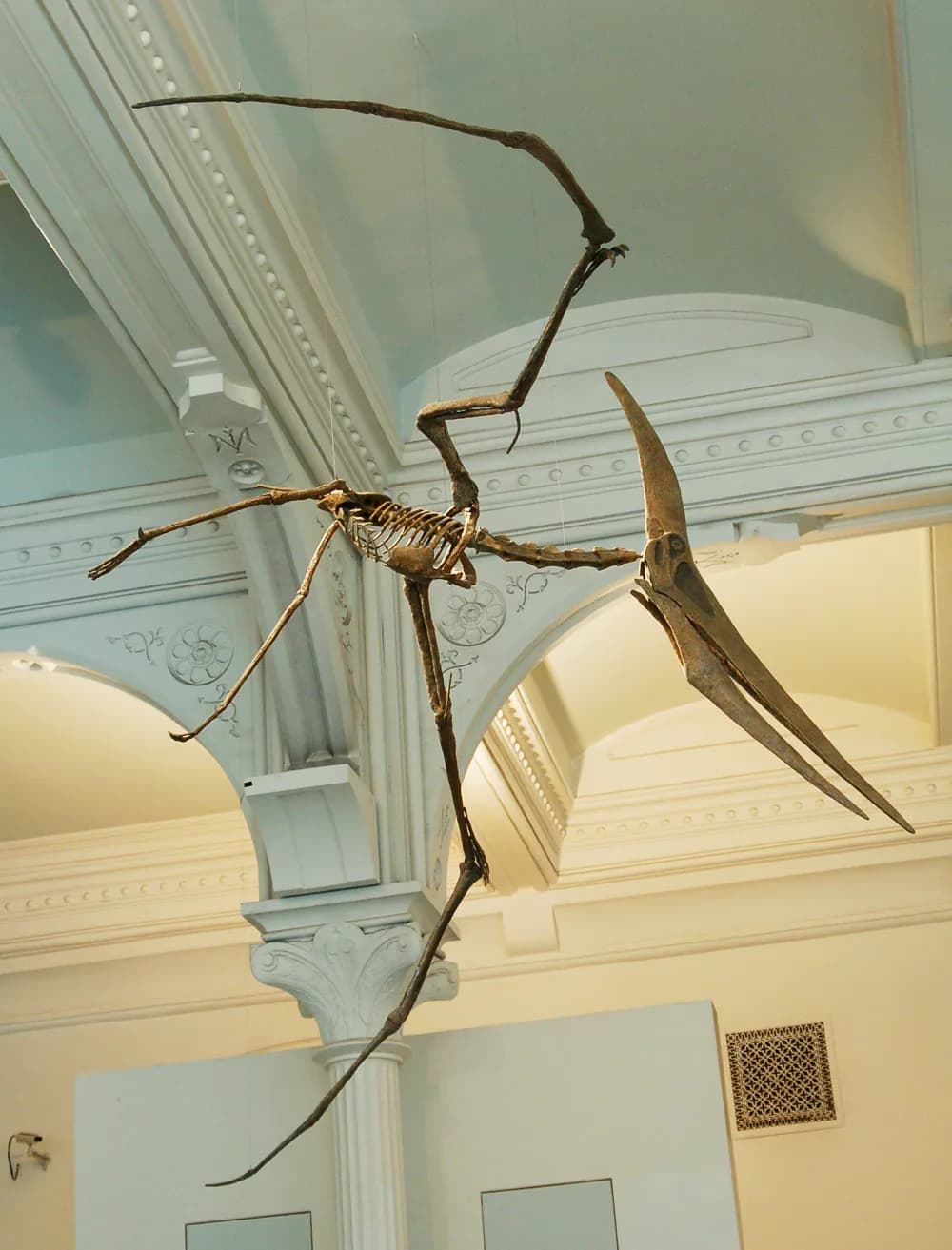
Male Pteranodon longiceps in flight reconstruction
Matt Martyniuk, CC BY 3.0