Archéoptéryx
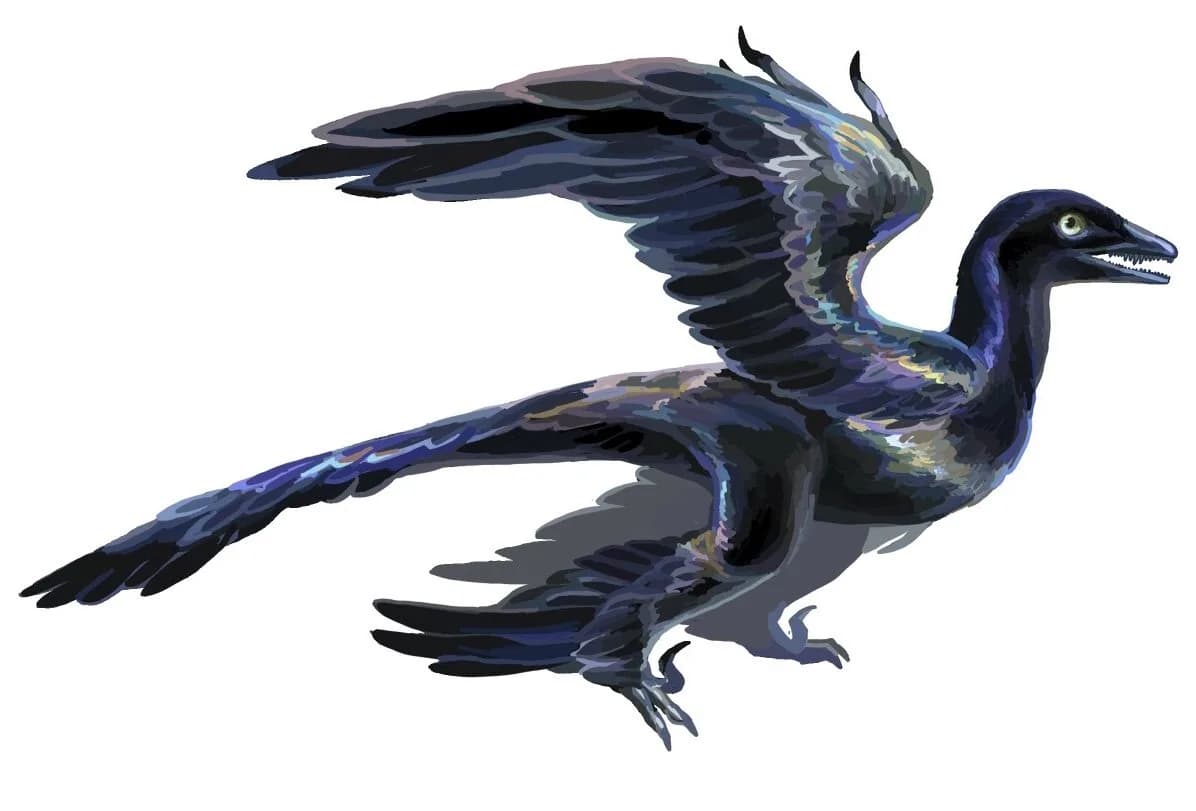
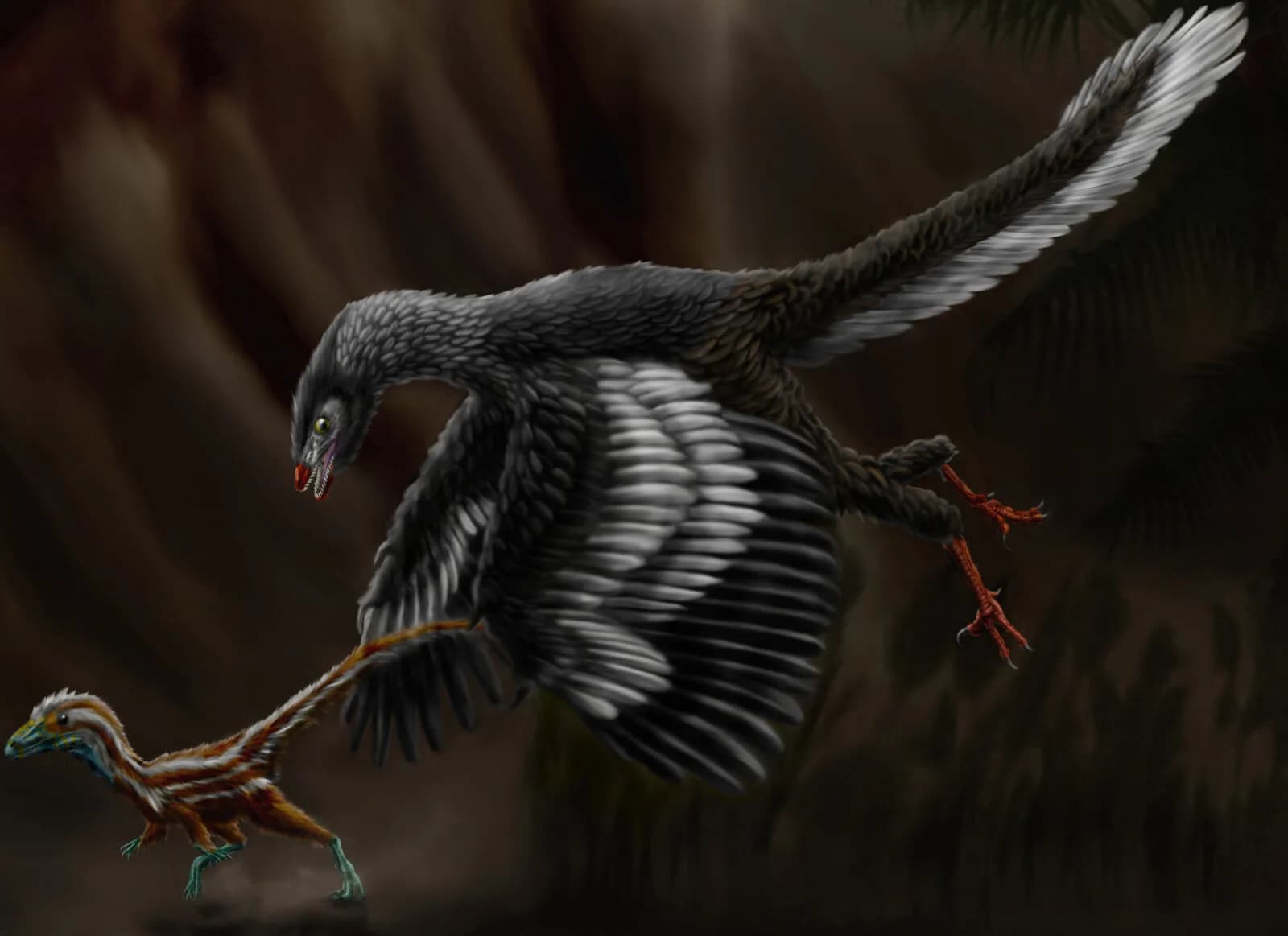
Archaeopteryx lithographica was a small feathered dinosaur about 50 centimetres long and 250 to 500 grams, roughly 150 million years old. All twelve known specimens come from Bavaria. Described in 1861, two years after On the Origin of Species, it combines teeth, wing claws and asymmetrical feathers; fossil melanin analysis showed in 2011 that some of those feathers were black.
Archaeopteryx lived in the Late Jurassic, approximately 150 million years ago, during the Tithonian stage. It is arguably the most famous and important fossil in the history of paleontology, as it represents the transitional link between theropod dinosaurs and modern birds. Its discovery in 1861, only two years after Darwin published 'On the Origin of Species,' provided spectacular evidence for the theory of evolution. It lived on a subtropical archipelago in the Tethys Sea, a series of low islands corresponding to present-day Bavaria. The climate was tropical, with calm-water limestone lagoons that allowed exceptional fossilization, preserving even feather impressions.
Archaeopteryx was roughly the size of a crow or magpie: about 50 cm long and weighing an estimated 0.8 to 1 kg. Its wingspan reached approximately 50 to 60 cm, comparable to that of a modern pigeon. Despite its small size, it is one of the most important animals in natural history due to its unique phylogenetic position. Its skeleton was lightweight but not as pneumatized as modern birds, implying less efficient flight. Its bony tail, much longer than that of any modern bird, added about 20 cm to its total length and likely served as a flight stabilizer.
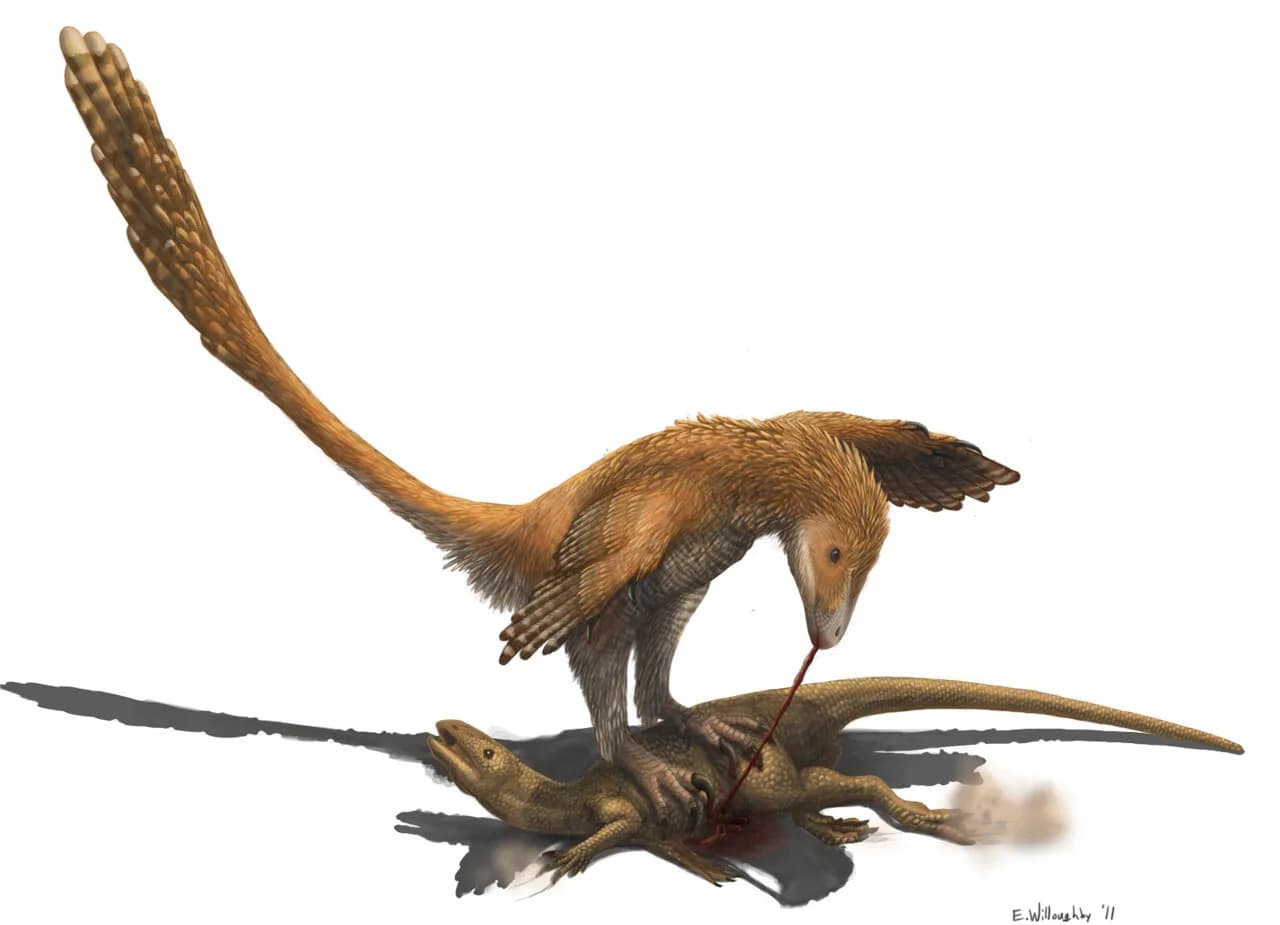
A carnivore and insectivore, Archaeopteryx likely fed on insects, small lizards, and invertebrates. Its small pointed teeth, absent in modern birds but typical of theropods, were adapted for capturing small live prey. The structure of its claws, on both feet and wings, suggests it could climb trees to hunt arboreal insects. Its rudimentary beak, still bearing teeth, was not adapted for seed crushing like later granivorous birds. Recent biomechanical analyses suggest it could catch prey in flight, although its active flying capabilities remain debated.
Archaeopteryx lived on a subtropical archipelago in the Tethys Sea, corresponding to present-day Bavaria in Germany. The environment resembled modern tropical lagoons, with coral reefs, low islands covered with conifers and cycads, and shallow waters rich in fish and crustaceans. The Solnhofen lithographic limestones, famous for their extremely fine grain, formed in these calm, anoxic lagoons, preserving organisms in extraordinary detail. This island environment offered a diversity of ecological niches — coastal forests, beaches, reefs — that Archaeopteryx could exploit through its flying and climbing abilities. The climate was warm and humid, with average temperatures well above those of present-day Germany.
Archaeopteryx uniquely combined reptilian and avian characteristics, making it the quintessential transitional fossil. Its reptilian features included teeth in the jaws, a long bony tail (20 caudal vertebrae), three clawed digits on each wing, abdominal ribs (gastralia), and the absence of a keeled sternum. Its avian features included asymmetric flight feathers on the wings and tail, a V-shaped furcula (wishbone), and feet adapted for perching. This unique mixture made it a decisive argument in favor of the dinosaurian origin of birds. Recent analyses of fossilized melanin in its feathers (2011) revealed that some feathers were black, thanks to preserved melanosomes. The structure of its inner ear suggests balance capabilities intermediate between those of terrestrial dinosaurs and flying birds.
Debates persist about Archaeopteryx's flight capability: could it fly actively or mainly glide? Its asymmetric feathers and shoulder girdle suggest limited powered flight, supplemented by tree-climbing and branch-to-branch gliding. Recent biomechanical studies (2018) showed that the internal structure of its wing bones more closely resembles that of flying birds than terrestrial dinosaurs, supporting the hypothesis of active flight, even if limited. It likely used its wing claws to climb trees and launched into gliding flight to hunt or escape predators. Its arboreal and island lifestyle probably protected it from large terrestrial predators. The presence of colored feathers also suggests a role in visual communication, perhaps for courtship display or species recognition.
Only 12 Archaeopteryx specimens are known, all found in the Solnhofen lithographic limestones of Bavaria. The Berlin specimen (1877) is the most complete and famous, displayed at the Natural History Museum of Berlin. The first isolated feather was found in 1860, followed by the first skeleton (the London specimen) in 1861, just two years after Darwin published 'On the Origin of Species.' Its discovery sparked intense scientific debate and became a symbol of evolutionary theory. The Thermopolis specimen (2005), with its remarkably preserved skull, revealed new anatomical details. Synchrotron analyses have uncovered details invisible to the naked eye, such as feather chemistry and bone microstructure. Archaeopteryx remains one of the most studied and discussed fossils in the history of paleontology.
| Period | Jurassique supérieur / Late Jurassic (Tithonien) |
| Era | Mésozoïque / Mesozoic |
| Age | ~150 Ma |
| Location | Europe (Allemagne / Germany) |
| Length | ~0.5 m |
| Height | ~0.2 m |
| Weight | ~250–500 g |
| Diet | Insectivore |
| Discovery | 1861 |
The question of flight in Archaeopteryx lithographica remains open. Its asymmetric feathers — characteristic of active flight surfaces in modern birds — and 2018 biomechanical studies of internal wing bone structure (resembling flying birds rather than terrestrial dinosaurs) support limited powered flight. But the absence of a keeled sternum and a less pneumatized skeleton than modern birds indicate less efficient flight, probably supplemented by climbing and gliding.
The discovery of the first Archaeopteryx lithographica skeleton (London specimen) in 1861 — only two years after Darwin published 'On the Origin of Species' — provided spectacular proof of a transitional fossil between theropod dinosaurs and birds. Combining reptilian features (teeth, 20-vertebra bony tail, wing claws) and avian features (asymmetric feathers, furcula), it confirmed evolutionary theory with a concrete, incontestable example, triggering intense worldwide scientific debate.
Only 12 Archaeopteryx lithographica specimens are known, all found in the Solnhofen lithographic limestones of Bavaria. The most complete and famous is the Berlin specimen (1877), displayed at Berlin's Natural History Museum. The Thermopolis specimen (2005) revealed new anatomical details through its remarkably preserved skull. Synchrotron analyses have uncovered details invisible to the naked eye, including the black coloration of some feathers through fossilized melanosomes (2011 analysis).
Information on this page is based on peer-reviewed scientific publications.
Reconstruction of Archaeopteryx lithographica chasing a Compsognathus
Durbed, CC BY-SA 3.0, via Wikimedia Commons
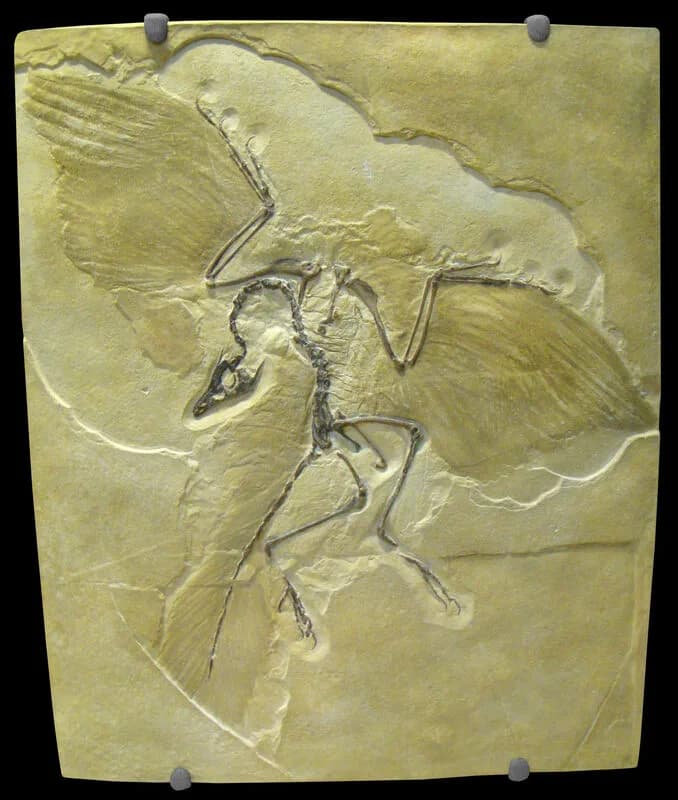
Archaeopteryx lithographica fossil
Daderot, Public domain