Microraptor
Microraptor zhaoianus is the smallest flying dinosaur known: 55 to 77 centimetres and around 1 kilogram. Described in 2000 from fossils in Liaoning, China, it lived close to 120 million years ago. It had four wings — flight feathers on both the front and hind limbs — and analysis of its fossilised melanosomes showed its plumage was iridescent.
Playable in Path of Titans
See Microraptor zhaoianus's stats, abilities and role on our survival server.
Microraptor lived during the Early Cretaceous period, approximately 120 million years ago, during the Aptian stage, in the Jiufotang Formation of Liaoning Province, China. This remarkable formation is famous for preserving exceptional fossils with soft tissue impressions, including feathers, in volcanic lake sediments. The Early Cretaceous in this region was characterized by a warm temperate climate with distinct seasons and frequent volcanic activity that created the conditions for extraordinary fossil preservation. Microraptor shared its ecosystem with numerous other feathered dinosaurs, early birds like Confuciusornis, diverse pterosaurs, and small mammals, making the Jehol Biota one of the most important fossil assemblages ever discovered.
Microraptor was one of the smallest known non-avian dinosaurs, measuring between 77 and 90 centimeters long (including tail) with a weight of approximately 1 kilogram only. Its size was comparable to that of a magpie or small modern raptor bird. Its skull measured barely 7 centimeters long, equipped with pointed, curved teeth. What made it unique was the presence of long asymmetric flight feathers not only on its arms but also on its hind legs, giving it the appearance of a four-winged biplane.
Microraptor was a carnivorous predator whose varied diet has been revealed through exceptional fossil preservation of gut contents. Specimens have been found with remains of fish, small mammals, and even a bird (Indrasaurus) preserved in their stomachs, indicating an opportunistic feeding strategy. Its sharp, serrated teeth and grasping claws were well-suited for catching small, quick-moving prey in forest canopies and along shorelines. The diversity of prey items suggests Microraptor was a versatile hunter that exploited multiple ecological niches, feeding both in trees and near water. This dietary flexibility may have contributed to its apparent abundance in the Jehol Biota, as evidenced by the numerous specimens discovered to date.
Microraptor inhabited the temperate forests surrounding volcanic lakes in what is now Liaoning Province, northeastern China. The Jiufotang Formation ecosystem was a lush, well-watered landscape dominated by conifer forests with an understory of ferns, ginkgoes, and early flowering plants. Volcanic lakes dotted the region, and their periodic toxic gas emissions or ash falls created the exceptional preservation conditions that make this fossil site world-famous. Microraptor was arboreal, spending considerable time in the forest canopy where its four-winged body plan was ideally suited for gliding between trees. The forest environment provided abundant prey in the form of insects, small mammals, lizards, and birds that shared this diverse Cretaceous ecosystem.
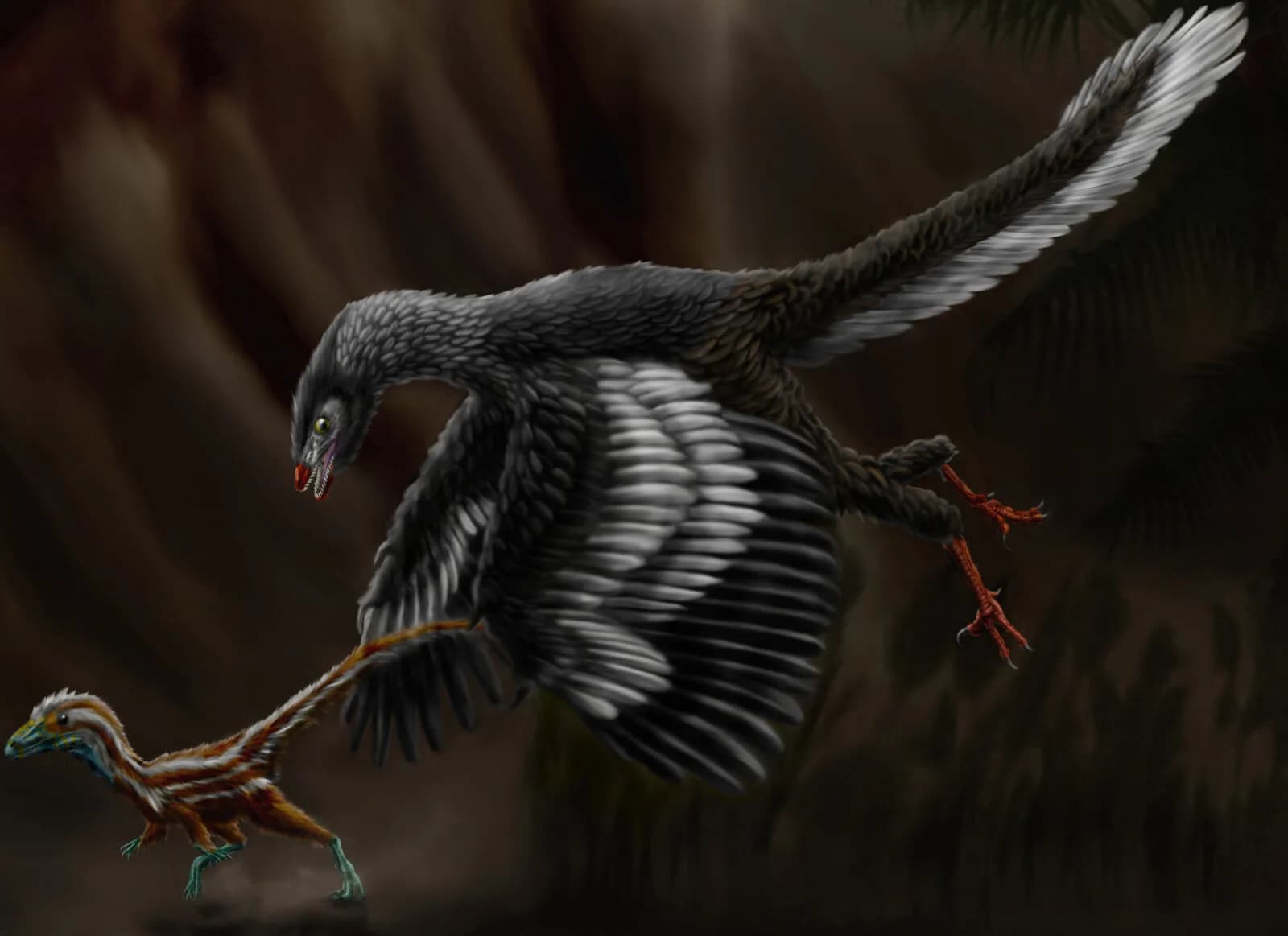
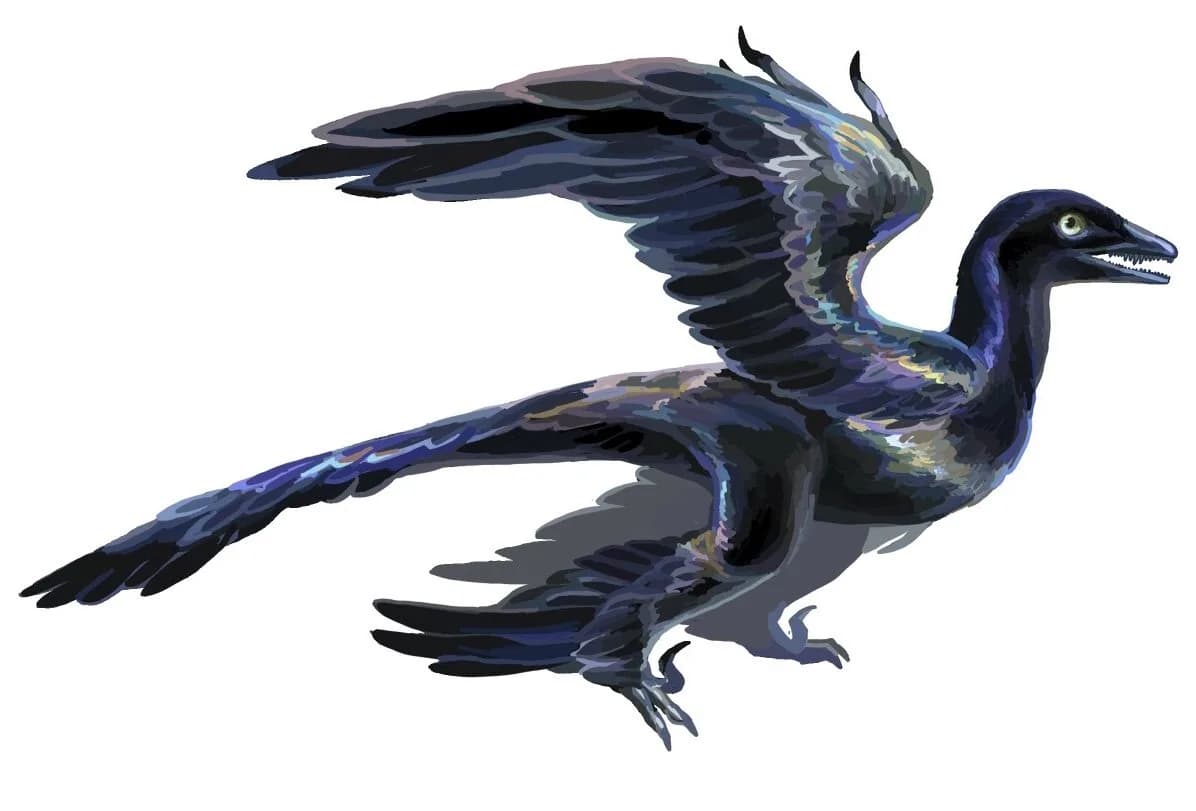
Microraptor's anatomy is striking for its flight adaptations. All four limbs bore long asymmetric flight feathers (pennaceous), similar to those of modern birds. The fore-wing feathers had a wingspan of about 60 centimeters, while the hind-leg feathers formed a second pair of functional wings. Its long tail was adorned with a pair of elongated diamond-shaped feathers at the tip, probably used as a stabilizer or for display. A 2012 study analyzing fossil melanosomes revealed that its plumage was iridescent black, with metallic blue-green reflections similar to those of a crow.
Microraptor was an agile arboreal hunter that spent most of its time in trees. It used its four wings to glide between branches and from tree to tree, in a flight mode that has no equivalent among living animals today. Aerodynamic studies have shown it could perform controlled gliding flights, but probably not sustained powered flight. It likely hunted by ambush from branches, gliding down on prey on the ground or catching birds and insects in flight. Its activity may have been crepuscular, using its dark plumage as camouflage in the dim forest light.
Microraptor was described in 2000 by Xu Xing, Zhou Zhonghe, and Wang Xiaolin from specimens discovered in the Jiufotang Formation in Liaoning, China. The exceptional preservation of these fossils in the finely laminated lacustrine sediments of Jehol preserved detailed feather impressions, including their microstructures. Over 300 specimens have been discovered, making Microraptor one of the most abundant non-avian dinosaurs in the fossil record. The most famous species, M. gui, described in 2003, revolutionized our understanding of avian flight evolution by demonstrating the existence of a 'four-wing' stage in the dinosaur-bird transition.
| Period | Crétacé inférieur / Early Cretaceous (Aptien) |
| Era | Mésozoïque / Mesozoic |
| Age | ~120 Ma |
| Location | Asie / Asia (Chine / China, Liaoning) |
| Length | 0.55–0.77 m |
| Height | ~0.2 m |
| Weight | ~1 kg |
| Diet | Piscivore |
| Discovery | 2000 |
Microraptor zhaoianus was a non-avian dinosaur of the family Dromaeosauridae (Microraptoria subclade), not a bird in the strict sense. Described in 2000 by Xu Xing from fossils in Liaoning (China, Early Cretaceous ~120 Ma), it was a key link in the dinosaur-to-bird transition. Its asymmetric feathers on all four limbs indicate gliding capabilities, but sustained powered flight remains uncertain.
Microraptor zhaoianus (species M. gui) bore long asymmetric feathers on both arms AND hind legs — a 'biplane' configuration with no equivalent in living animals. This aerodynamic architecture was adapted for gliding between trees. Its diet was diverse: stomach contents of different specimens revealed fish, an enantiornithine bird (Indrasaurus), and a small mammal — an opportunistic generalist of the Jehol biota.
A 2012 study published in Science analyzed fossilized melanosomes in Microraptor gui feathers. The shape, size, and arrangement of these pigment organelles correspond to those of an iridescent black plumage with metallic blue-green reflections, similar to that of a modern crow or starling. This was one of the first plumage color reconstructions based on direct microstructural data in a non-avian dinosaur.
Reconstruction of Microraptor gui with iridescent plumage
Entelognathus, CC BY-SA 4.0, via Wikimedia Commons
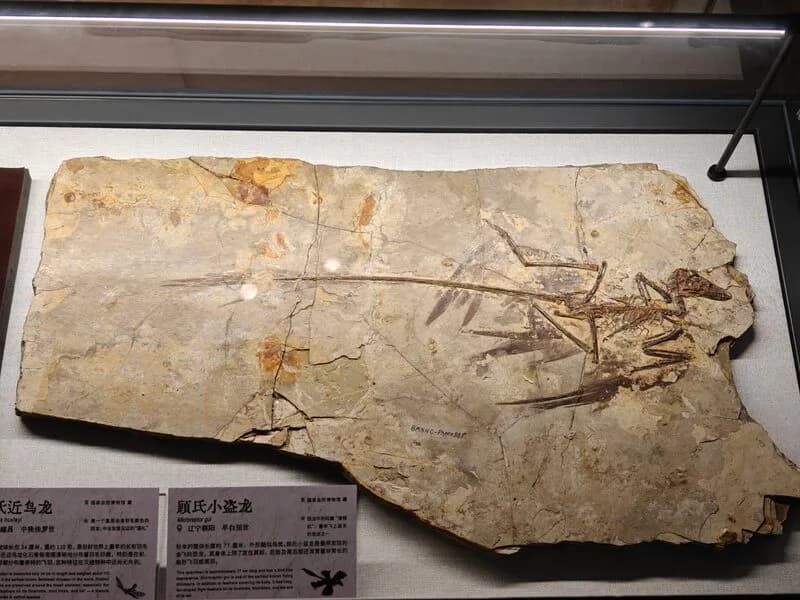
Microraptor gui fossil specimen (BMNHC-Ph000881)
CC BY-SA 4.0