Sinosauroptéryx
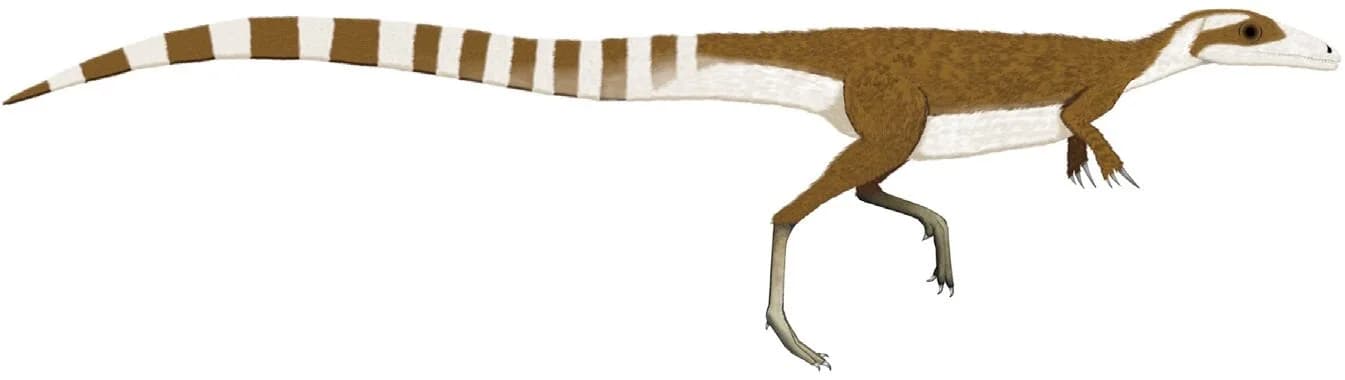
Sinosauropteryx prima is the first non-avian dinosaur found with preserved feathers, uncovered in China in 1996. Around 1 metre long and 55 to 280 grams, it lived 125 million years ago in Liaoning. Analysis of its melanosomes revealed its actual colouring: a russet-orange back and a striped tail.
Sinosauropteryx lived during the Early Cretaceous period, approximately 124.6 to 122 million years ago, in the Yixian Formation of Liaoning Province, China. This groundbreaking dinosaur was the first non-avian dinosaur confirmed to have possessed feather-like structures, forever changing our understanding of dinosaur integument and the evolutionary origin of feathers. The Yixian Formation preserves a remarkable Early Cretaceous ecosystem of volcanic lakes surrounded by temperate forests. Sinosauropteryx shared its environment with numerous other feathered dinosaurs, early birds, pterosaurs, and mammals, making this formation one of the most important paleontological sites in the world for understanding feather evolution.
Sinosauropteryx was a small theropod measuring about 1 meter long, more than half of which was its exceptionally long tail. It weighed approximately 500 grams to 1 kilogram. Its size was comparable to a small chicken or a large blackbird. Its thin, elongated skull measured about 7 centimeters, with small pointed teeth. Its arms were short (about 30% of hindlimb length), and its hands bore three clawed fingers. Its tail, containing more than 60 vertebrae, was proportionally the longest of any known theropod.
Sinosauropteryx was a small carnivorous dinosaur whose diet has been directly revealed through exceptional fossil preservation. Stomach contents found in specimens include the remains of small mammals and lizards, providing direct evidence of its predatory lifestyle. Its small, sharp teeth were well-suited for catching and processing small vertebrates and insects. The short arms with grasping hands suggest it captured prey through quick lunges rather than sustained pursuit. Sinosauropteryx was likely an opportunistic predator that hunted in the undergrowth of the temperate forests of the Yixian Formation, using its agility and speed to ambush small animals among the ferns and fallen logs of the forest floor.
Sinosauropteryx inhabited the temperate lakeland environments of the Yixian Formation in what is now Liaoning Province, northeastern China. The landscape was dominated by conifer forests surrounding volcanic lakes, with an understory of ferns, cycads, and early flowering plants. Periodic volcanic eruptions released toxic gases and ash that occasionally killed and rapidly buried animals, creating the exceptional preservation conditions for which this formation is famous. The climate was temperate with distinct seasons, supporting a highly diverse ecosystem that included dozens of species of feathered dinosaurs, birds, pterosaurs, fish, and mammals. Sinosauropteryx likely favored forested areas and forest margins where it could hunt small prey using cover and ambush tactics.
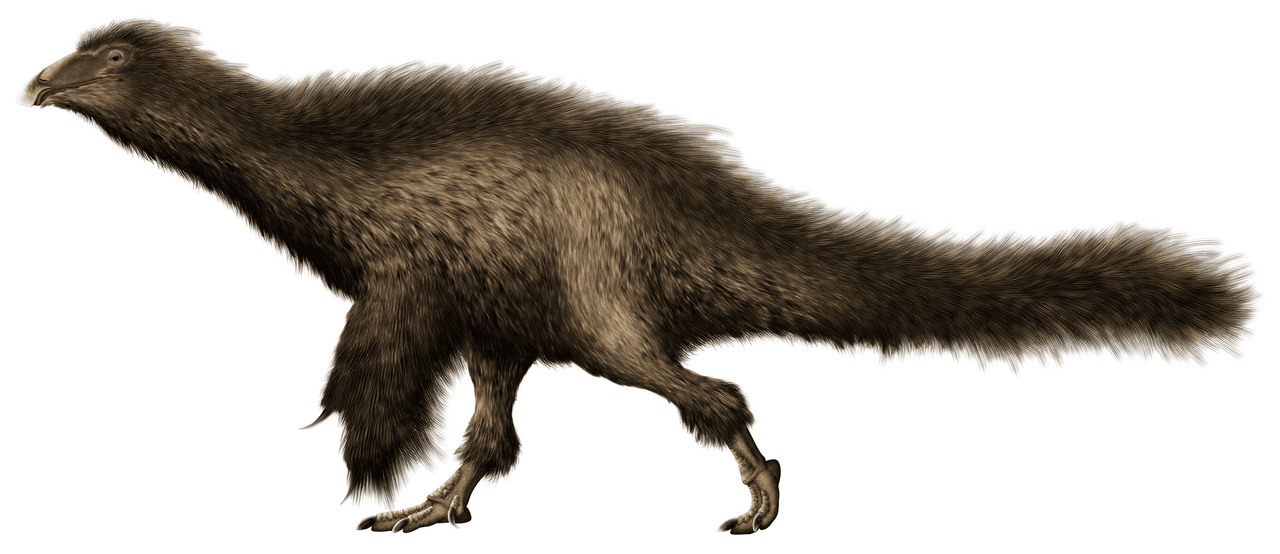
Sinosauropteryx is a compsognathid, a small coelurosaurian theropod with a gracile, elongated body. Its most revolutionary feature is the covering of simple, unbranched filaments that covered its body — the first proto-feathers ever documented on a non-avian dinosaur. These filaments, about 13 millimeters long, were hollow structures similar to the earliest developmental stages of modern avian feathers. They covered the head, neck, back, and tail, but were absent from the belly and undersides of the limbs. This distribution is consistent with a thermoregulatory role.
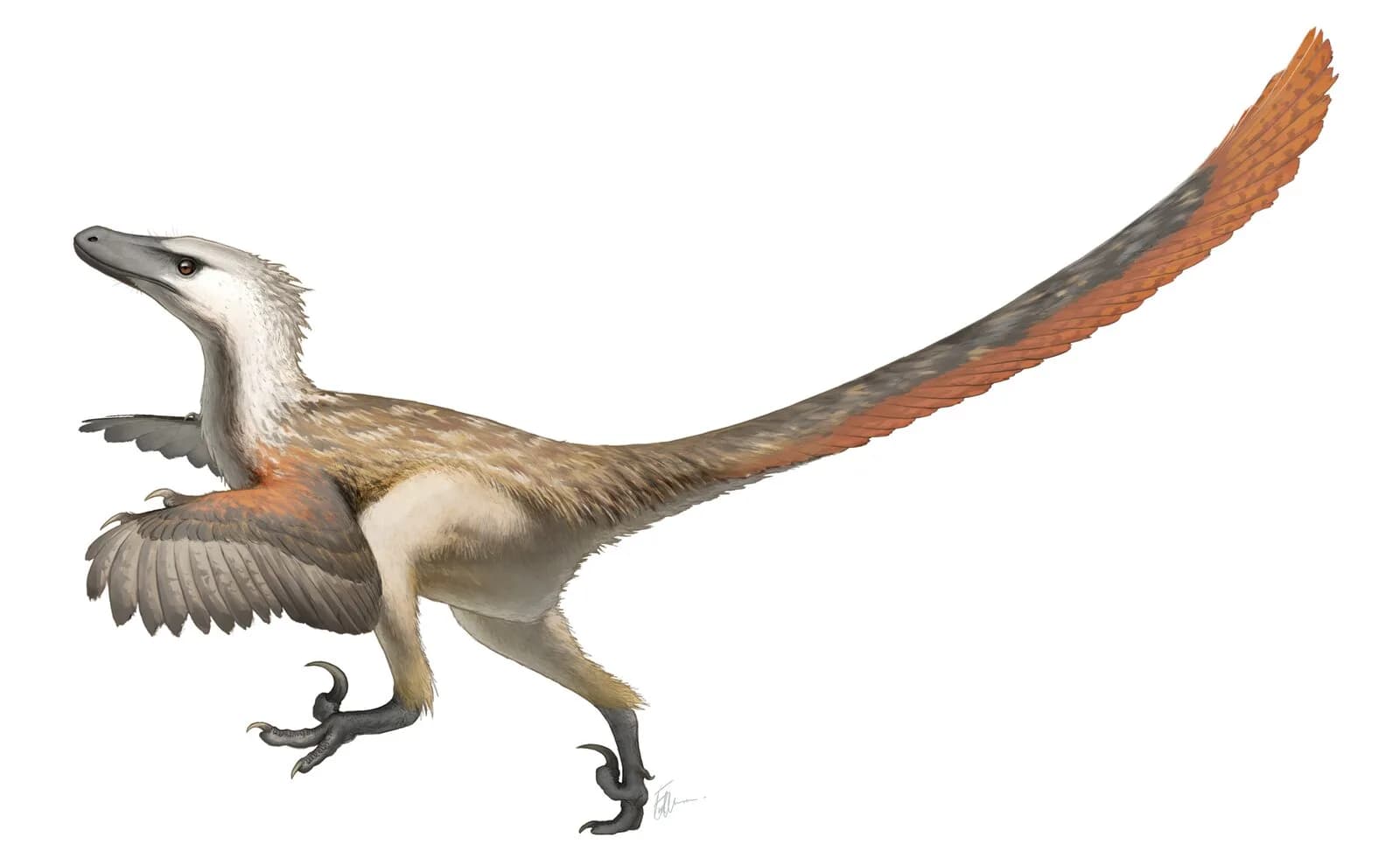
Sinosauropteryx was an agile terrestrial hunter that patrolled the undergrowth of Jehol forests in search of small prey. Its long hindlimbs and tail serving as a counterbalance gave it great agility for pursuing lizards and small mammals. Analysis of its fossil coloration revealed sophisticated camouflage: a dark back (reddish-brown) and light belly, a countershading pattern typical of small modern predators. Its tail bore alternating light and dark bands. This camouflage suggests a lifestyle in open or semi-open habitats where visual concealment was important for hunting and predator avoidance.
Sinosauropteryx was discovered in 1996 in the Yixian Formation at Liaoning, China, by farmer Li Yumin. Its description by Ji Qiang and Ji Shu'an the same year sent shockwaves through the paleontological world: it was the first non-avian dinosaur presenting indisputable evidence of proto-feathers. This discovery provided spectacular confirmation of the hypothesis of the dinosaurian origin of birds. In 2010, a pioneering study by Zhang et al. analyzed the fossil melanosomes of Sinosauropteryx, determining for the first time the color of a dinosaur: ginger with a striped tail. Over ten specimens are now known, all of remarkable preservation.
| Period | Crétacé inférieur / Early Cretaceous (Aptien) |
| Era | Mésozoïque / Mesozoic |
| Age | ~125 Ma |
| Location | Asie / Asia (Chine / China, Liaoning) |
| Length | ~1 m |
| Height | ~0.3 m |
| Weight | 55–280 g |
| Diet | Piscivore |
| Discovery | 1994 |
Sinosauropteryx prima is the first non-avian dinosaur whose color was scientifically determined. In 2010, Zhang et al. analyzed the fossil melanosomes of its proto-feather coat and established that it had a bright russet-orange back with a tail bearing alternating light and dark bands — a countershading camouflage comparable to small modern predators like the honey badger.
Several Sinosauropteryx prima specimens preserved fossilized stomach contents: one contained a small mammal (Sinobaatar), another a lizard, and a third fish remains. This prey diversity confirms an opportunistic hunter's diet targeting small vertebrates in the understory of the Jehol ecosystem, 125 million years ago in China.
Described in 1996 by Ji Qiang and Ji Shu'an, Sinosauropteryx prima was the first non-avian dinosaur presenting indisputable evidence of proto-feathers — fine hollow filaments of 13 mm covering its head, neck, and back. This discovery in the Yixian Formation (Liaoning, China) provided direct proof that birds descended from theropod dinosaurs.
Sinosauropteryx with scientifically reconstructed coloration
Smithwick et al., CC BY-SA 4.0, via Wikimedia Commons
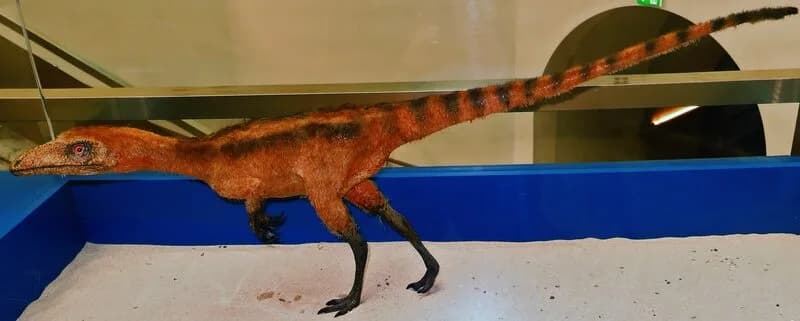
Sinosauropteryx prima model
Ghedoghedo, CC BY-SA 4.0