Leedsichthys
Leedsichthys problematicus is the largest bony fish that ever lived: 16 to 17 metres and 20 to 45 tonnes. Described in 1889 from English fossils, it swam 165 to 152 million years ago. It filtered plankton 100 million years before whales, and its name honours Alfred Leeds, the amateur collector who uncovered it.
Playable in Path of Titans
See Leedsichthys problematicus's stats, abilities and role on our survival server.
Leedsichthys lived during the Middle to Late Jurassic, approximately 165 to 152 million years ago (Callovian to Kimmeridgian). This colossal bony fish belongs to the extinct order Pachycormiformes, a group of ray-finned fishes that produced the largest bony fish of all time. It evolved in the warm epicontinental seas that covered much of present-day Europe, at a time when the North Atlantic was just beginning to open. Its extinction remains poorly understood but coincides with major oceanographic changes at the end of the Jurassic that altered the planktonic productivity on which it depended.
Leedsichthys is the largest bony fish that ever lived. Size estimates have varied considerably over the decades: early assessments of 27 meters have been revised downward, and the most recent analyses by Liston (2013) suggest a maximum length of 16 to 17 meters for the largest adult specimens. Its weight is estimated between 20 and 45 tonnes. Its pectoral fins alone measured over 2 meters long. Its mouth, lacking functional teeth, was equipped with over 40,000 small gill rakers forming an extremely efficient filter for capturing plankton and small suspended organisms.
Unlike the marine predators of its time, Leedsichthys was a giant filter feeder, the first known vertebrate to adopt this feeding strategy on a large scale. It fed on zooplankton, small crustaceans, and tiny marine organisms that it filtered by swimming open-mouthed through nutrient-rich waters. Its branchial arches bore thousands of finely spaced gill rakers forming a biological sieve comparable to that of modern baleen whales. This remarkable evolutionary convergence with mysticetes — which appeared 100 million years later — illustrates how the same ecological niche can be occupied by very different animals at distinct epochs.
Leedsichthys inhabited the warm, shallow epicontinental seas of the Middle to Late Jurassic, primarily in western Europe. Its fossils have been discovered in England (Oxford Clay Formation), France (Callovian formations of Normandy), Germany, and Chile. The Oxford Clay Formation, rich in organic matter and fossil plankton, represents a shallow tropical to subtropical marine environment — an ideal habitat for a giant filter feeder. These warm, productive seas, comparable to modern upwelling zones, offered an abundance of planktonic food sufficient to sustain an animal of this colossal size.
The skeleton of Leedsichthys poses unique challenges for paleontologists because its bones were largely composed of calcified cartilage rather than true bone, which explains the extreme fragmentation of its fossil remains. Its head measured approximately 1.5 meters long with an enormous terminal mouth capable of opening wide for filtration. Its pectoral fins, among the largest known in fish, were supported by robust bony rays. Its caudal fin was large and crescent-shaped, adapted for the slow, continuous swimming necessary for filter feeding. Its branchial apparatus, exceptionally well-developed, bore a dense network of gill rakers serving as a plankton filter.
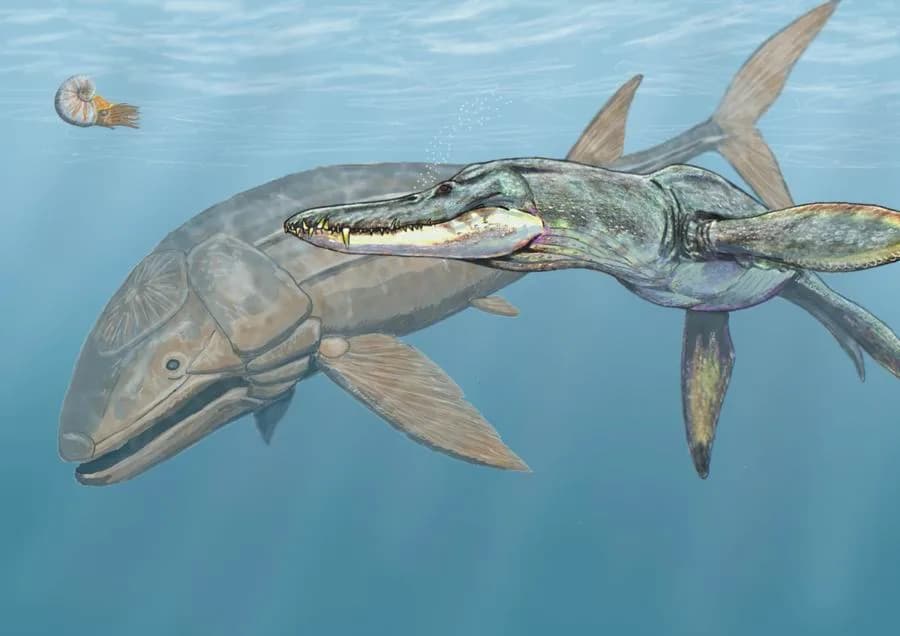
Leedsichthys was likely a slow, continuous swimmer, traversing the epicontinental seas while filtering enormous volumes of water through its gills to extract plankton and small organisms. Like modern whale sharks and baleen whales, it likely followed seasonal planktonic blooms and nutrient-rich currents. Its colossal size protected it from most predators, although bite marks on some specimens indicate attacks by large marine predators such as Liopleurodon or hybodont sharks. Its reproductive strategy remains unknown, but other pachycormids show evidence of viviparity.
The first specimen was discovered in 1886 near Peterborough, England, by amateur collector Alfred Nicholson Leeds, who gave his name to the genus. Arthur Smith Woodward of the British Museum formally described it in 1889 as Leedsichthys problematicus — the qualifier 'problematicus' reflecting the difficulty of interpreting its fragmentary remains. Most fossils come from the Oxford Clay Formation of the Middle Jurassic. The most complete specimen, discovered at Star Pit near Whittlesey in 2001-2003, allowed better size estimation. Remains have also been identified in France, Germany, and Chile, confirming a wider geographic distribution than initially supposed.
| Period | Jurassique moyen-supérieur / Middle-Late Jurassic |
| Era | Mésozoïque / Mesozoic |
| Age | 165-152 Ma |
| Location | Europe (Angleterre, France, Allemagne), Chili / Europe (England, France, Germany), Chile |
| Length | 16-17 m |
| Weight | 20-45 tonnes |
| Discovery | 1889 |
Early estimates of 27 metres were revised downward. According to Liston's (2013) analyses, Leedsichthys problematicus reached 16 to 17 metres at a weight of 20 to 45 tonnes — still making it the largest bony fish of all time, larger than the modern whale shark.
Leedsichthys problematicus was a giant filter feeder, the first known vertebrate to adopt this strategy on a large scale. It swam open-mouthed and filtered zooplankton through more than 40,000 gill rakers on its branchial arches — a remarkable convergent evolution with baleen whales, which appeared 100 million years later.
Leedsichthys problematicus lived 165 to 152 million years ago (Middle to Late Jurassic) in the warm, shallow epicontinental seas covering present-day Europe. Its main fossils come from the Oxford Clay Formation in England, formally described by Arthur Smith Woodward in 1889.
Leedsichthys reconstruction facing a Liopleurodon
Dmitry Bogdanov, CC BY 3.0
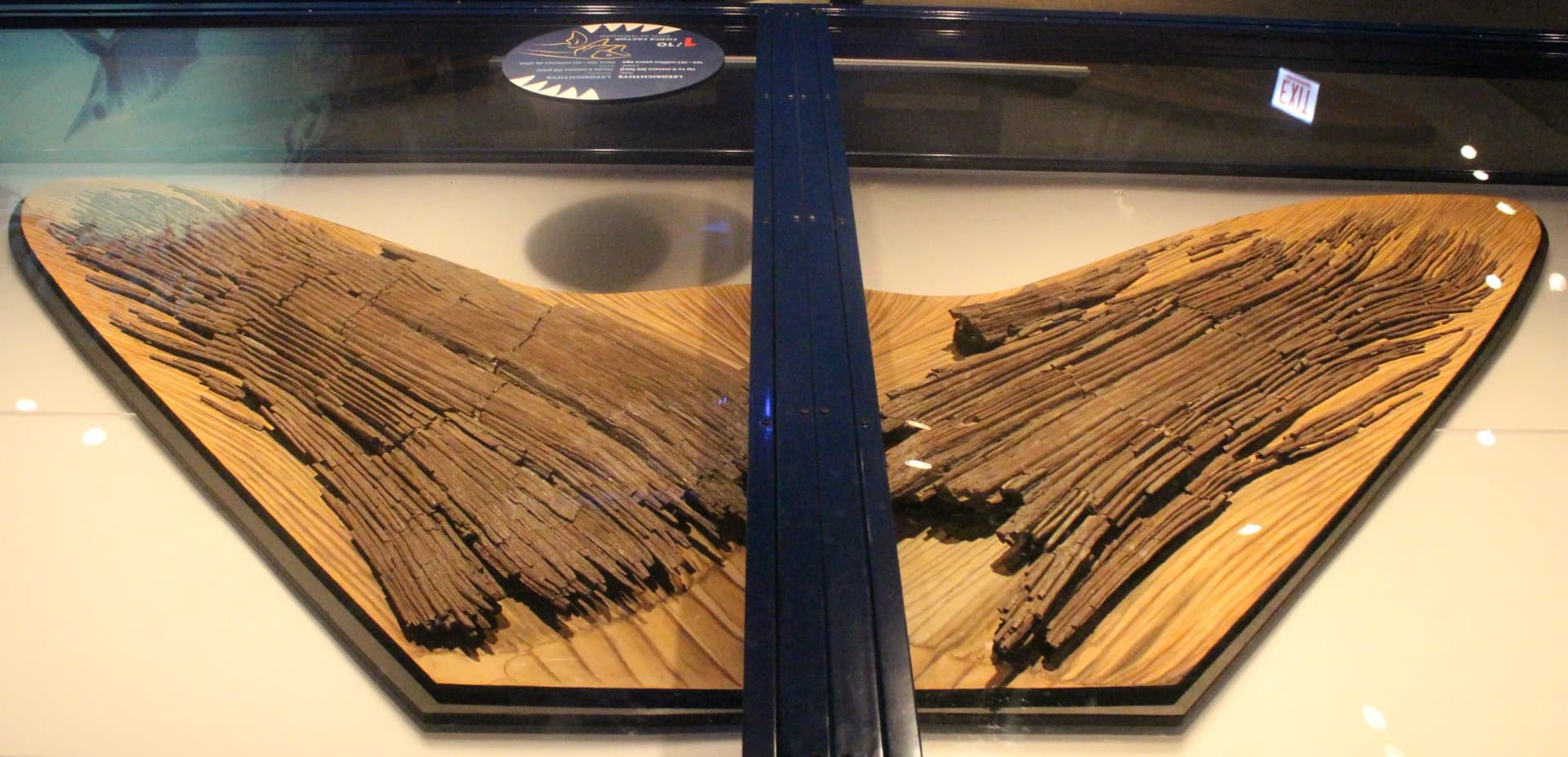
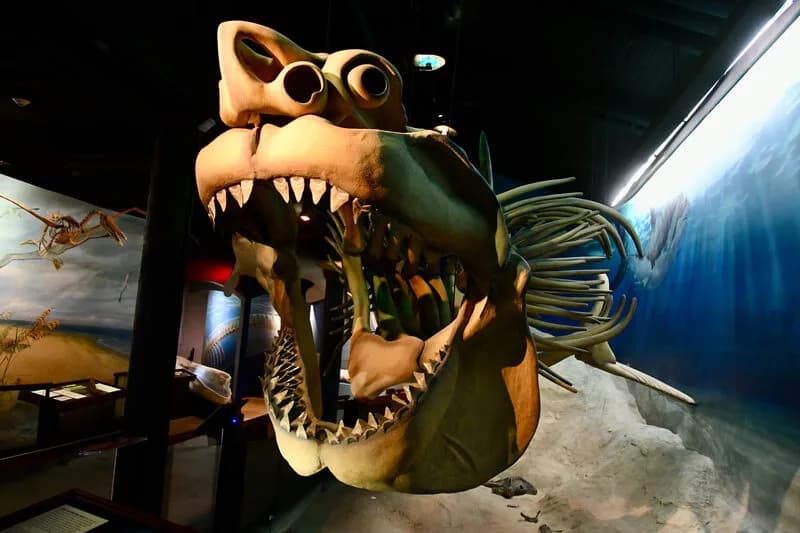
Leedsichthys fossil remains at the Field Museum
Wikipedia Commons