Mégalodon
Otodus megalodon was an extinct shark that ranged across the world's oceans 23 to 3.6 million years ago. It reached 15 to 18 metres and 50 to 60 tonnes, with jaws opening about 3 metres wide. Described in 1843, it is known almost entirely from its teeth; in medieval Europe those teeth were taken for petrified dragon tongues and worn as amulets.
The Megalodon ruled the world's oceans during the Miocene and Pliocene, approximately 23 to 3.6 million years ago — a reign of nearly 20 million years, making it one of the most enduring marine predators in history. Long classified in genus Carcharodon alongside the great white shark, it is now assigned to genus Otodus within the extinct family Otodontidae, a distinct lineage from modern Lamnidae. Its extinction coincides with the global Pliocene cooling, falling sea levels, and the diversification of baleen whales, which reduced its preferred prey populations. The decline of warm coastal waters — its preferred nursery habitats — likely dealt the final blow to this species.
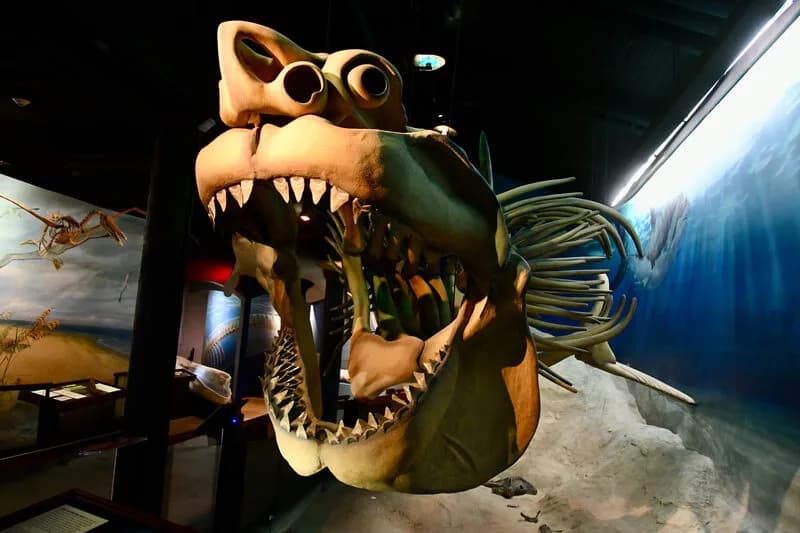
The Megalodon is the largest macropredatory shark that ever lived. Current estimates, based on allometric models derived from teeth and vertebrae, place its total length between 15 and 18 meters, with some specimens possibly larger. Its weight is estimated at 50 to 60 tonnes — ten times the mass of an adult great white shark. Its open jaws could measure nearly 3 meters in diameter, wide enough to swallow a small boat. Its serrated triangular teeth reached 17 to 18 centimeters in height, the largest of any known shark species. Its bite force, estimated between 108,000 and 182,000 Newtons, is the most powerful ever calculated for any animal.
An apex super-predator of the Neogene oceans, the Megalodon fed primarily on medium-sized whales, seals, dugongs, giant sea turtles, and large bony fish. Fossil whale bones bearing characteristic bite marks from its massive serrated teeth have been found on multiple continents, providing direct evidence of its predatory habits. Its hunting strategy appears to have targeted the pectoral fins and tails of large prey to immobilize them before delivering a fatal crushing blow to the body. Juveniles occupied a distinctly different ecological niche from adults, feeding on fish and small marine mammals in the shallow coastal waters that served as natural nurseries, thereby reducing competition with larger adults. The gradual disappearance of medium-sized cetaceans during the Pliocene, combined with increasing competition from newly evolved apex predators like great white sharks, contributed directly to its decline.
The Megalodon was a cosmopolitan shark that occupied all temperate and tropical ocean basins worldwide. Its fossils have been discovered on every continent except Antarctica, from the east coast of North America to Japan, across Europe, Africa, Australia, and South America. It preferred warm, shallow coastal waters for breeding and rearing juveniles, but also actively hunted in the open ocean and deeper subtropical waters where large cetaceans migrated. Nursery zones, identified by the abundance of small juvenile teeth concentrated in specific geological layers, were located in shallow tropical seas — notably in modern-day Panama, the southeastern United States, and the Canary Islands. The global climatic cooling of the Pliocene, which dramatically reduced these critical warm-water habitats and disrupted marine food webs, is considered a major factor in its extinction.
Like all sharks, the Megalodon's skeleton was composed of cartilage rather than bone, which explains the scarcity of body fossils — only its teeth and some vertebrae regularly fossilize. Its teeth, triangular and finely serrated on both edges, featured thick enamel and a V-shaped bourlette characteristic of genus Otodus. Its vertebral column likely contained more than 150 calcified vertebrae. Its fusiform body more closely resembled that of the salmon shark than the great white, according to recent phylogenetic analyses. It likely possessed five large gill slits and a counter-current heat exchange system allowing it to maintain a body temperature higher than the surrounding water, facilitating hunting across varied water temperatures.
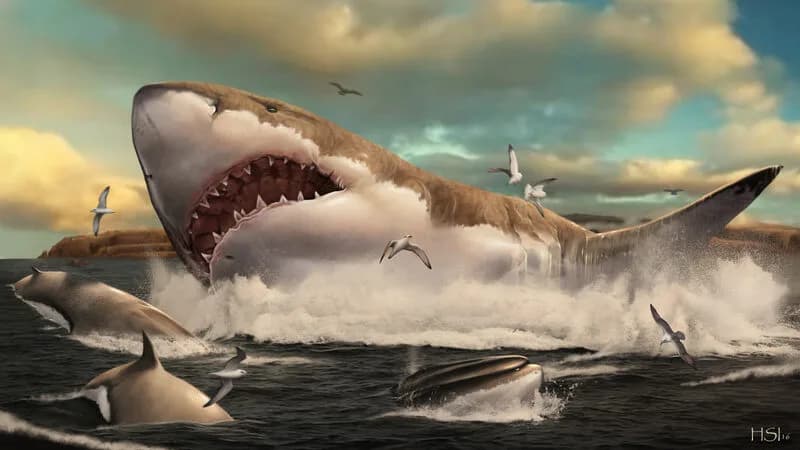
The Megalodon was likely an active and strategic hunter rather than a mere scavenger or opportunistic feeder. Bite traces on whale bones show precisely targeted attacks on pectoral and caudal fins — a deliberate strategy aimed at immobilizing large prey before consumption, similar to techniques used by modern orcas. Some paleontologists suggest it also practiced attacks from below at high speed, similar to the breaching behavior of the modern great white shark when hunting seals. Concentrations of small juvenile teeth in certain coastal formations strongly indicate the existence of dedicated nursery areas where females gave birth and young grew sheltered from open-ocean predators, including larger adults of their own species. This segregation of habitats by age class and apparent parental behavior suggests a level of ecological sophistication comparable to modern large sharks and marine mammals.
The first Megalodon teeth were collected long before their scientific identification — during the Middle Ages, they were called 'glossopetrae' (tongue stones) and believed to be petrified tongues of serpents or dragons. In 1667, Danish naturalist Nicolas Steno recognized their true nature as shark teeth. Swiss naturalist Louis Agassiz formally described the species in 1843 as Carcharodon megalodon. Thousands of fossil teeth have been discovered in marine deposits worldwide, making the Megalodon one of the most recognizable and collected fossils. Exceptional articulated vertebrae were discovered in Belgium (1860s) and Peru. A vertebral column of 141 vertebrae found in Peru in 2022 enabled new size and metabolic estimates.
| Period | Miocène-Pliocène / Miocene-Pliocene |
| Era | Cénozoïque / Cenozoic |
| Age | 23-3.6 Ma |
| Location | Océans mondiaux / Worldwide oceans |
| Length | 15-18 m |
| Height | 4-5 m |
| Weight | 50-60 tonnes |
| Discovery | 1843 |
No, Otodus megalodon was not a dinosaur. It was a shark — a cartilaginous fish of the extinct family Otodontidae. It lived from 23 to 3.6 million years ago, well after the extinction of non-avian dinosaurs 66 million years ago. Megalodon is therefore a Neogene predator with no direct phylogenetic link to dinosaurs or Mesozoic marine reptiles.
The teeth of Otodus megalodon are the largest ever documented in any shark: they reached 17 to 18 centimeters in height, triangular and finely serrated on both edges. By comparison, great white shark teeth rarely exceed 7 centimeters. These exceptional teeth make up nearly all known Megalodon fossils, since the cartilaginous skeleton fossilizes only rarely.
The extinction of Otodus megalodon approximately 3.6 million years ago coincides with Pliocene climate cooling, falling sea levels, and the progressive disappearance of medium-sized cetaceans that constituted its preferred prey. The reduction of warm coastal waters — its nursery zones — and increasing competition from other apex predators such as great white sharks are key factors cited by paleontologists.
Megalodon reconstruction hunting a whale
Wikipedia Commons
Reconstructed Megalodon jaw at the National Museum of Natural History
Wikipedia Commons