Dunkleostéus
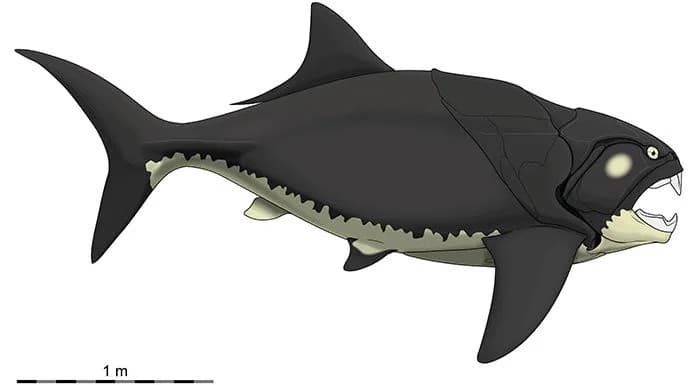
Dunkleosteus terrelli is an armoured fish 6 to 9 metres long and 1 to 4 tonnes, described in 1873 and dated to 382 to 358 million years ago. It had no teeth: its jaws were two bony blades that sharpened against each other with every bite. Its mouth opened in a fiftieth of a second, drawing prey in by suction alone.
Dunkleosteus dominated the oceans of the Late Devonian, approximately 382 to 358 million years ago — an era often called the 'Age of Fishes.' It was an arthrodire placoderm, member of an entirely extinct class of armored fish that dominated Paleozoic seas for over 50 million years. The Late Devonian saw the greatest fish diversity ever achieved, with placoderms at the top of the food chain. Its extinction coincides with the Late Devonian extinction event (Hangenberg event), one of the five great mass extinction episodes in Earth's history, which eliminated nearly all placoderms and paved the way for the dominance of sharks and bony fish.
Dunkleosteus terrelli is the largest known placoderm and one of the largest fish of the entire Paleozoic era. Length estimates vary considerably depending on the reconstruction method used: classic studies based on proportional scaling from the skull suggest approximately 6 meters, while more recent and comprehensive analyses (Engelman, 2023) suggest up to 8 to 9 meters for the largest specimens, incorporating new body proportion data. Its weight is estimated between 1 and 4 tonnes depending on the total length assumed. Its heavily armored skull alone measured over one meter long and weighed several hundred kilograms. Its bite force, estimated at 6,000 Newtons at the jaw tip and up to 7,400 Newtons at the posterior crushing region, was comparable to that of modern crocodilians — an absolute record for any fish, living or extinct.
Dunkleosteus was the undisputed apex predator of Devonian seas, sitting firmly at the top of a complex marine food web. Its diet included primitive sharks (such as Cladoselache, whose fossils are sometimes found with bite marks matching Dunkleosteus jaw plates), smaller placoderms, ammonites, nautiloids, and various bony fish. Fossilized stomach contents found in some specimens contained semi-digested fish fragments, directly confirming its position as an active predator rather than a filter feeder or scavenger. Remarkably, some of these stomach contents appear to have been regurgitated as compact boluses, suggesting that Dunkleosteus, like modern raptors and owls, regularly expelled the indigestible hard parts of its prey. Evidence of intraspecific predation — cannibalism — has even been found, with identifiable bone plate fragments of other Dunkleosteus individuals preserved in these food residues.
Dunkleosteus inhabited the warm, shallow epicontinental seas that covered much of North America during the Late Devonian, a period when global sea levels were significantly higher than today. The vast majority of fossils come from the Cleveland Shale formation in Ohio, a fine-grained sedimentary deposit laid down in a shallow marine basin that was notably oxygen-poor in its lower layers — anoxic conditions that inhibited decomposition and favored the exceptional preservation of armored skulls and associated remains. Specimens have also been found across the Atlantic in Europe (Belgium, Poland) and as far south as Morocco in North Africa, indicating a broad geographic range across the Devonian oceans. These warm, shallow seas teemed with diverse marine life and provided ideal hunting grounds for this heavily armored apex predator.
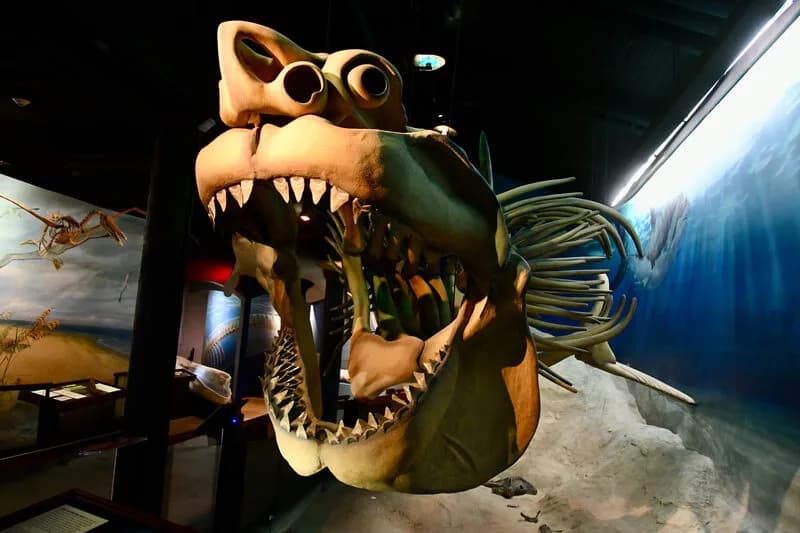
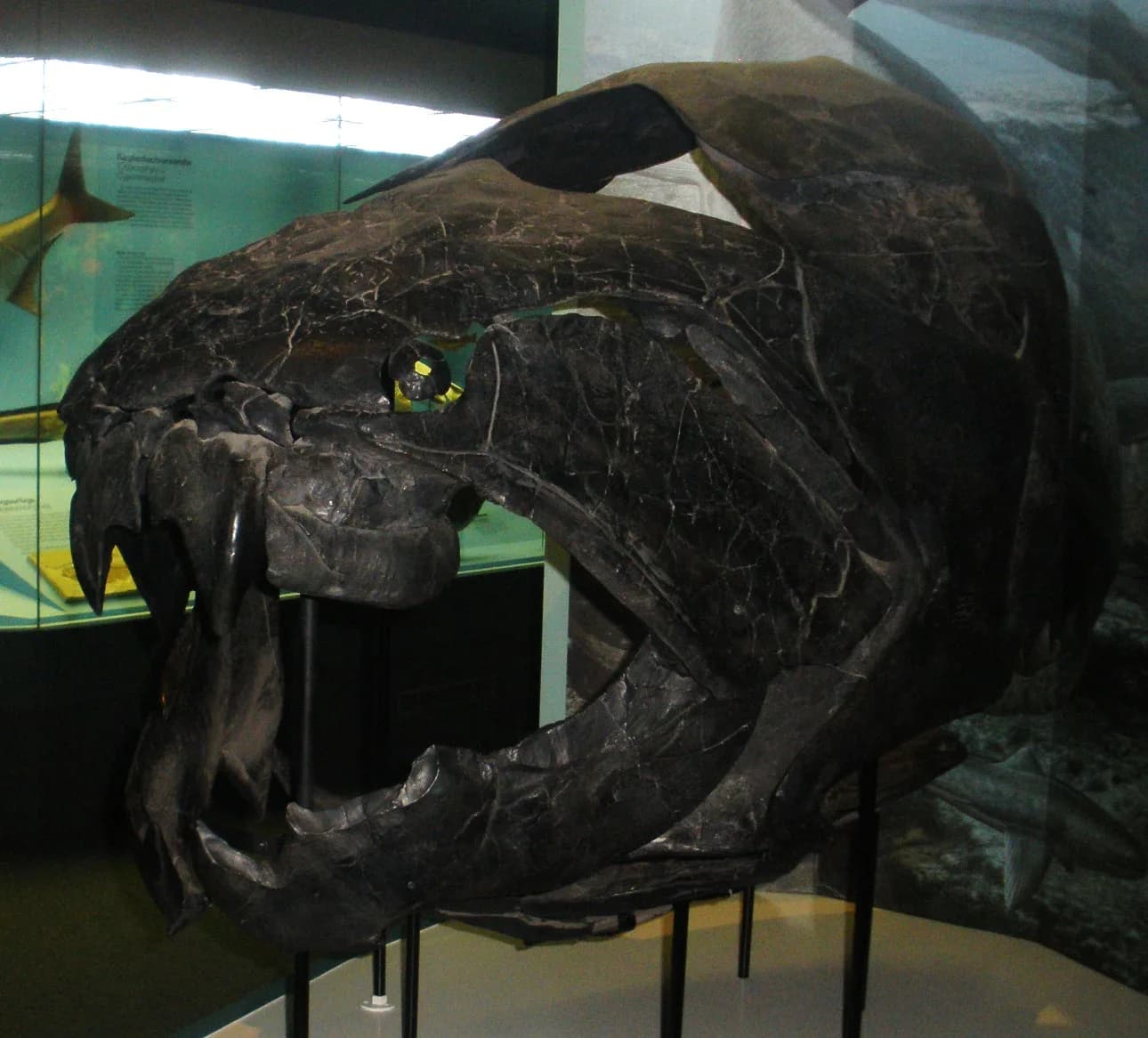
The most striking feature of Dunkleosteus is its cranial armor: a formidable cuirass of thick, interlocking dermal bone plates covering the entire head and anterior thorax, providing both protection from rival predators and structural support for its powerful jaw mechanism. Instead of true teeth, it possessed two pairs of razor-sharp bony blades (gnathals) that functioned as a self-sharpening beak — with each jaw closure, the upper and lower blades slid against each other in a shearing motion, maintaining a permanently sharp cutting edge capable of slicing through bone and armor. The sophisticated four-bar cranio-thoracic linkage enabled extraordinarily rapid jaw opening that simultaneously created powerful suction, drawing prey into its mouth in approximately one-fiftieth of a second. The posterior body, entirely lacking bony armor, is known only from rare and fragmentary fossils, making complete body reconstruction uncertain and the subject of ongoing scientific debate.
Dunkleosteus was an active open-water predator rather than a sedentary ambush hunter. Its ultra-rapid jaw opening mechanism (approximately 20 milliseconds from closed to fully open) created powerful suction that drew unsuspecting prey into its mouth before the razor-sharp bony blades slammed shut with devastating force. This suction feeding technique is comparable to that observed in some modern bony fish such as groupers, but operating at a truly gigantic and unprecedented scale. Fossilized regurgitalites — compact ejected food boluses containing indigestible bone fragments — found directly associated with Dunkleosteus specimens are among the oldest known examples of this feeding behavior in any vertebrate lineage. Despite carrying several hundred kilograms of cranial armor, its muscular heterocercal tail and streamlined posterior body made it a surprisingly fast and agile swimmer, fully capable of sustained pursuit of fleeing prey through the open Devonian seas.
The first Dunkleosteus fossils were discovered in the 1860s by Jay Terrell in the Cleveland Shale of Ohio. Paleontologist John Strong Newberry described the species in 1873 as Dinichthys terrelli. The genus was renamed Dunkleosteus in 1956 by Jean-Pierre Lehman in honor of David Dunkle, curator at the Cleveland Museum of Natural History. This museum today houses one of the finest collections of specimens, including remarkably complete armored skulls. Over 40 cranial specimens are known worldwide. Ten species have been described, including D. terrelli (the largest and best known), D. belgicus (Belgium), and D. marsaisi (Morocco), though the validity of some remains debated.
| Period | Dévonien supérieur / Late Devonian |
| Era | Paléozoïque / Paleozoic |
| Age | 382-358 Ma |
| Location | Amérique du Nord, Europe, Maroc / North America, Europe, Morocco |
| Length | 6-9 m |
| Height | 1.5-2 m |
| Weight | 1-4 tonnes |
| Discovery | 1873 |
No, Dunkleosteus terrelli did not have real teeth. Instead, it bore two pairs of razor-sharp bony blades (gnathals) that functioned as a self-sharpening beak: with each jaw closure, the upper and lower blades slid against each other, maintaining a permanently sharp cutting edge. Its bite force reached 6,000 to 7,400 Newtons — an absolute record for any fish, comparable to that of modern crocodilians.
Dunkleosteus terrelli lived during the Late Devonian, approximately 382 to 358 million years ago — a period nicknamed the 'Age of Fishes.' This is more than 130 million years before the dinosaurs. This arthrodire placoderm went extinct during the Hangenberg event, one of the five great mass extinctions in Earth's history, which eliminated nearly all placoderms and paved the way for sharks and bony fish.
Dunkleosteus terrelli is difficult to fully reconstruct because only its cranial armor — the dermal bone plates covering the head and anterior thorax — fossilizes regularly. The posterior body lacked armor and consisted of soft tissues that are only exceptionally preserved. More than 40 skulls are known, but very few complete body remains, making length estimates (6 to 9 meters according to Engelman, 2023) and mass estimates (1 to 4 tonnes) still subject to debate.
Armored skull of Dunkleosteus at the Cleveland Museum of Natural History
Wikipedia Commons
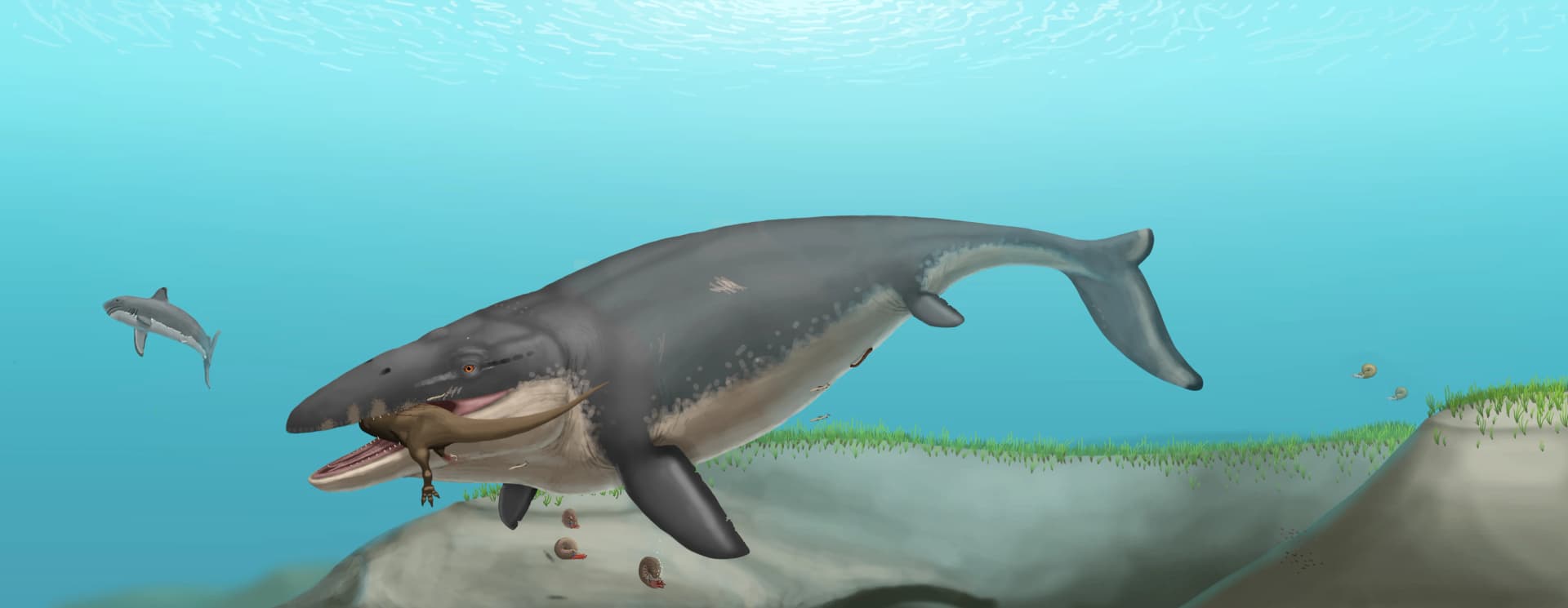
Life reconstruction of Dunkleosteus terrelli hunting
Wikipedia Commons