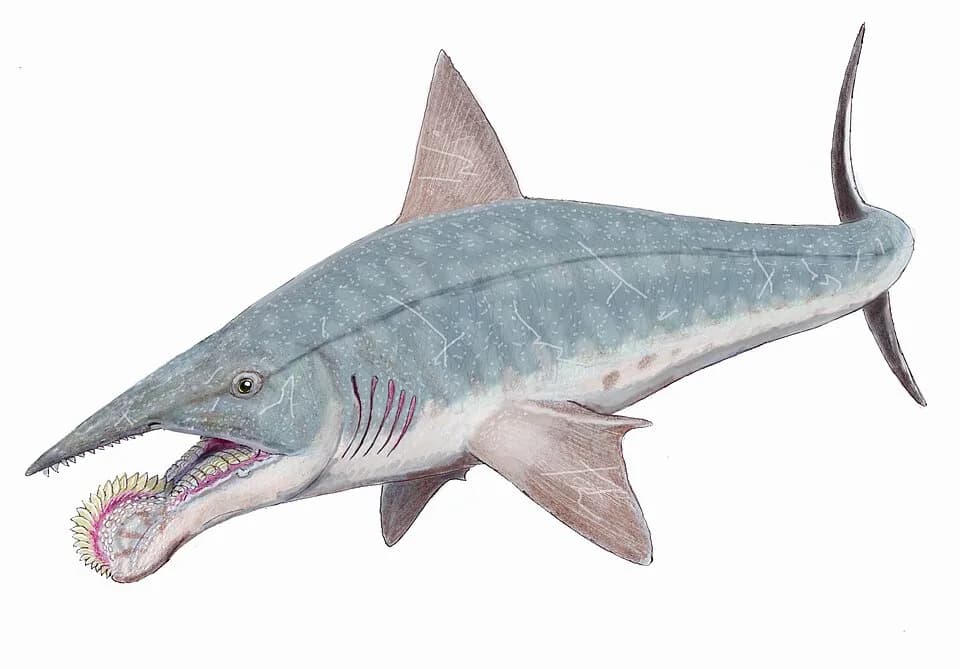
Hélicoprion
Helicoprion bessonowi was a cartilaginous fish described in 1899, found in Russia, the United States, Australia, Canada, China and Japan between 290 and 225 million years ago. At 5 to 12 metres and around 450 kilograms, it never shed a tooth: they built up in a continuous spiral whorl. It survived the Permian-Triassic Great Dying.
Helicoprion roamed the oceans from the Early Permian through the Early Triassic, approximately 290 to 225 million years ago — a reign spanning over 65 million years. It survived the Permian-Triassic extinction (the 'Great Dying,' 252 million years ago), which annihilated approximately 90% of marine species. Despite its shark-like appearance, Helicoprion is not a true shark: it belongs to the Holocephali, the same clade as modern chimaeras ('ghost sharks'). Its name, from Greek helikos (spiral) and prion (saw), perfectly describes its most distinctive feature: a tooth whorl spiral unique in the entire animal kingdom.
Helicoprion reached an impressive length of 3 to 12 meters depending on the specimen, with conservative estimates placing typical individuals at 5 to 7.5 meters. Its body mass is estimated at approximately 450 kilograms, though this remains highly speculative as its entirely cartilaginous skeleton never mineralized during the fossilization process. Only the teeth, composed of much harder and more resistant biological materials, fossilized properly over the course of millions of years, rendering any attempt at a complete body reconstruction partially hypothetical and subject to future revision as new discoveries emerge.
Helicoprion was a pelagic predator that fed primarily on soft-bodied cephalopods (ammonoids, nautiloids) and small fish. Its unique hunting mechanism relied on the tooth whorl in the lower jaw: when the jaws closed, the teeth performed a rotary 'circular saw' motion that lacerated soft prey and drew them toward the gullet. The minimal wear observed on fossil teeth confirms a soft-bodied prey diet rather than hard-shelled organisms. Its estimated swimming speed of 50 to 56 km/h made it a highly effective active open-water hunter capable of chasing down agile cephalopods across the Permian oceans.
Helicoprion had a remarkably cosmopolitan distribution, typical of a large open-ocean pelagic predator roaming the world's oceans for tens of millions of years. Its fossils have been found on virtually every continent: in Russia in the Ural Mountains (the site of the original discovery near Krasnoufimsk), in the United States across no fewer than seven different states (Idaho with the greatest number of specimens, California, Montana, Nevada, Texas, Utah, and Wyoming), in Western Australia along the Gascoyne River, as well as in Canada, China, Japan, Kazakhstan, and Mexico, testifying to a truly planetary range.
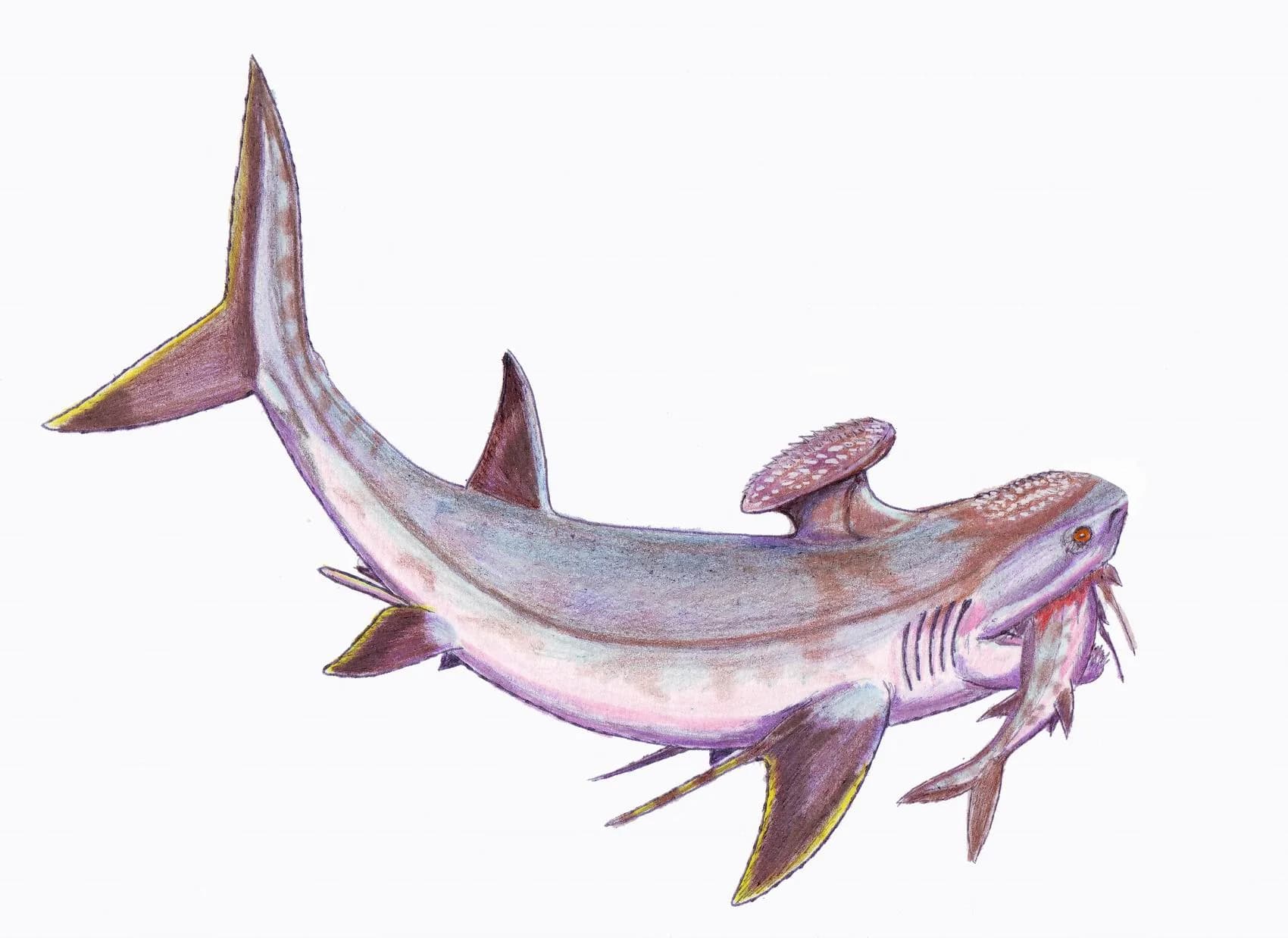
Helicoprion's most spectacular feature is its tooth whorl — a logarithmic spiral of fused teeth embedded in a single bony element spiraling within the lower jaw. Unlike modern sharks that lose and replace teeth individually, Helicoprion retained all its teeth throughout life: new ones grew at the base and pushed older ones toward the spiral's exterior. An aged individual could possess dozens of teeth coiled into a compact whorl. The upper jaw bore no teeth at all. Special lateral cartilage supported the whorl to withstand the mechanical stress of biting.
Helicoprion was probably an active open-water hunter capable of swimming speeds comparable to modern sharks, estimated at 50 to 56 km/h. Its pelagic lifestyle is confirmed by the worldwide distribution of its fossils across virtually every continent. The tooth whorl functioned like a biological rotary saw: with each bite, the teeth moved backward in a 'circular saw' motion, allowing it to slice and suction soft-bodied prey into its gullet. This unique feeding mechanism has no equivalent whatsoever in the animal kingdom, either past or present, making Helicoprion one of the most biomechanically unusual predators in evolutionary history.
The first Helicoprion whorls were discovered in the 1880s-1890s by Alexander G. Bessonov in a quarry near Krasnoufimsk, Russia, then sent to geologist Alexander Karpinsky who formally described them in 1899. For over a century, scientists proposed more than 20 different reconstructions to explain where the whorl was located on the animal: snout, dorsal fin, upper jaw, lower jaw... The mystery was only solved in 2013, when Leif Tapanila and colleagues published the first 3D CT scans of a rare specimen preserving jaw cartilage, definitively confirming that the whorl occupied the entire lower mandibular arch.
| Period | Permien précoce au Trias précoce / Early Permian to Early Triassic |
| Era | Paléozoïque-Mésozoïque / Paleozoic-Mesozoic |
| Age | 290-225 Ma |
| Location | Distribution mondiale : Russie, États-Unis, Australie, Canada, Chine, Japon / Worldwide: Russia, USA, Australia, Canada, China, Japan |
| Length | 5-12 m |
| Weight | ~450 kg (estimé / estimated) |
| Discovery | 1899 |
Helicoprion bessonowi was not a true shark: it belonged to the Holocephali, the same clade as modern chimaeras ('ghost sharks'). Its typical length was 5 to 7.5 meters, with maximum estimates reaching 12 meters. Its weight is estimated at approximately 450 kilograms, though this remains speculative as its entirely cartilaginous skeleton did not mineralize during fossilization.
Helicoprion bessonowi's tooth whorl was a logarithmic spiral of fused teeth lodged in the lower jaw. Unlike sharks that lose teeth individually, Helicoprion retained all of them — new ones grew at the base and pushed older ones toward the spiral's exterior. With each bite, the teeth performed a rotary 'circular saw' motion, slicing soft-bodied cephalopods. This unique mechanism was confirmed in 2013 through 3D CT scans published by Tapanila et al.
Helicoprion bessonowi lived from the Early Permian to the Early Triassic, approximately 290 to 225 million years ago. It was one of the few large predators to survive the Permian-Triassic extinction ('Great Dying,' 252 Ma), which annihilated approximately 90% of marine species. Its distribution was worldwide: fossils found in Russia (Ural Mountains), the United States (Idaho notably), Australia, China, Japan, and Kazakhstan.
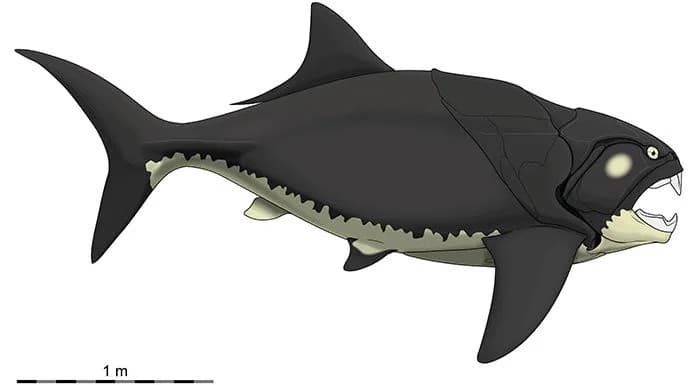
Reconstruction of Helicoprion bessonowi
Dmitry Bogdanov, CC BY-SA 3.0
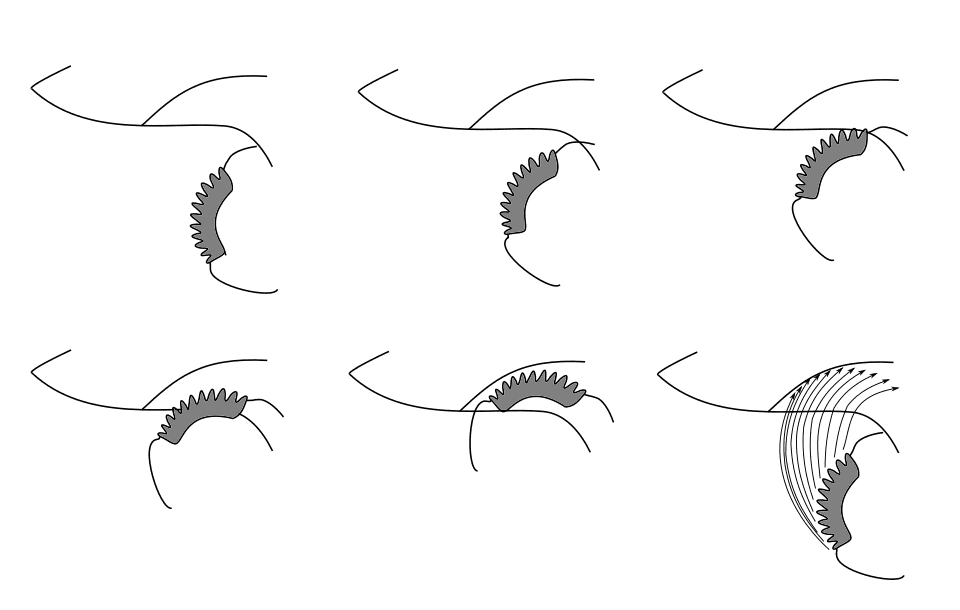
Diagram of the spiral jaw motion mechanism
Wikimedia Commons, CC BY-SA
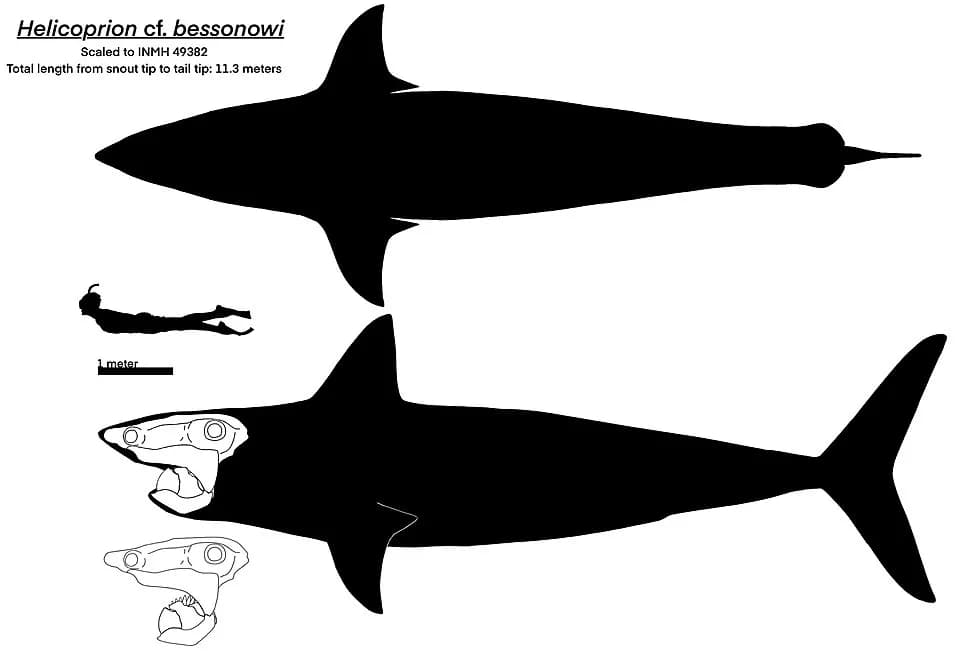
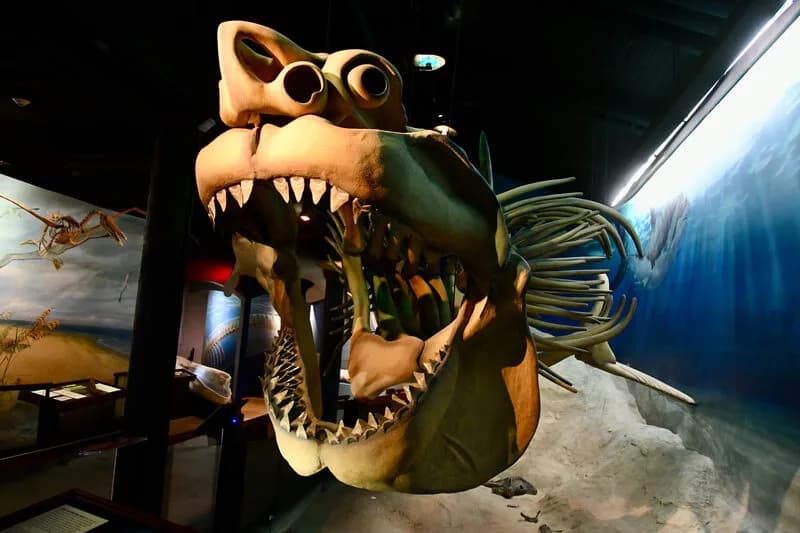
Skeletal reconstruction of Helicoprion
Wikimedia Commons, CC BY-SA