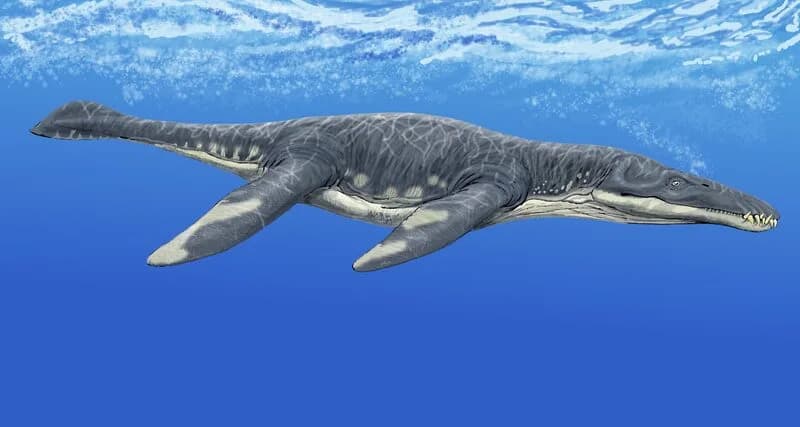
Liopleurodon
Liopleurodon ferox measured 5 to 7 metres and 1 to 2 tonnes, far from the 25 metres the BBC series Walking with Dinosaurs gave it. This pliosaur swam the seas of Europe 160 to 155 million years ago. Its name means « smooth-sided tooth ». Its directional nostrils let it pick up a scent in the water and track it to its source.
Liopleurodon lived during the Middle Jurassic, approximately 160 to 155 million years ago, during the Callovian stage. European seas at this time were warm and shallow, covering much of present-day Western Europe. Liopleurodon was one of the largest marine predators of its time, dominating the ocean ecosystems of the Middle Jurassic. This period preceded the appearance of mosasaurs and the large Cretaceous ichthyosaurs, making pliosaurs like Liopleurodon the undisputed masters of the Jurassic seas. It occupied the role of apex predator in these ancient marine environments, hunting a wide variety of prey across the shallow European seaways.
Liopleurodon measured between 5 and 7 meters long, far from the fanciful 25 meters depicted in the BBC's famous Walking with Dinosaurs series. Despite this more modest size than media exaggerations suggest, it remained a formidable marine predator. Its massive skull could reach 1.5 meters long, about a quarter of its total body length. Its weight is estimated between 1 and 2 tonnes, making it one of the largest pliosaurs of its time, comparable in size to a large modern orca. Its robust build and powerful jaws made it a dominant force in Jurassic marine ecosystems.
Liopleurodon was a carnivorous apex predator that actively hunted fish, squid, ammonites, and other smaller marine reptiles. Its massive, conical teeth, measuring up to 30 centimeters including the root, were designed to seize and hold slippery prey rather than to slice flesh. Its jaw exerted considerable bite force, sufficient to crush ammonite shells with ease. Biomechanical studies suggest it hunted by ambush, surging from the depths to surprise prey near the surface. This ambush strategy, combined with its powerful bite, made it one of the most effective marine predators of the entire Jurassic period.
Liopleurodon inhabited the warm, shallow seas that covered much of Europe during the Middle and Late Jurassic. Its fossils have been found primarily in England, France, and Germany, in marine deposits dating from the Callovian stage. Its environment was a tropical ocean populated by numerous fish species, ammonites, belemnites, and other marine reptiles. It shared these waters with other smaller pliosaurs, ichthyosaurs like Ophthalmosaurus, and marine crocodilians like Metriorhynchus. These warm epicontinental seas provided abundant prey and ideal conditions for large marine predators to thrive and diversify during the Jurassic period.
Liopleurodon possessed the typical pliosaur body plan: a massive, hydrodynamic body, a short powerful neck, and four large paddle-shaped flippers. Unlike long-necked plesiosaurs, pliosaurs had an enormous skull proportional to their body. Its four flippers operated on a unique propulsion system called 'underwater flight,' where the front and rear flippers beat alternately to generate continuous thrust. Its internal nostrils allowed it to detect scents underwater, a crucial advantage for hunting prey in murky waters. The robust skeleton and powerful musculature indicate an animal built for explosive bursts of speed during ambush attacks on unsuspecting prey.
Liopleurodon was probably a solitary, territorial hunter that patrolled vast stretches of ocean. Its ability to detect scents underwater through its directional nostrils gave it a considerable advantage in locating prey at a distance. Biomechanical studies suggest it was capable of brief powerful accelerations to capture prey, similar to the hunting strategy of modern great white sharks. Despite its imposing size, it was probably not an endurance swimmer, preferring an energy-efficient ambush approach. This sit-and-wait predation style allowed Liopleurodon to conserve energy between hunts while remaining a highly effective apex predator in the Jurassic seas.
Liopleurodon was first described in 1873 by French paleontologist Henri Émile Sauvage, from isolated teeth discovered near Boulogne-sur-Mer, France. Its name means 'smooth-sided tooth,' referring to the smooth surface of its teeth. Since then, more complete specimens have been discovered in England, particularly in the Oxford Clay Formation of the Middle Jurassic. Liopleurodon became world-famous through its appearance in the BBC's Walking with Dinosaurs (1999), although its size was considerably exaggerated to 25 meters in that documentary. Despite this inaccuracy, the program helped bring widespread public attention to pliosaurs and Jurassic marine ecosystems.
| Period | Jurassique moyen / Middle Jurassic (Callovien) |
| Era | Mésozoïque / Mesozoic |
| Age | 160–155 Ma |
| Location | Europe / Europe (Angleterre, France, Allemagne) |
| Length | 5–7 m |
| Height | ~1.5 m |
| Weight | 1–2 tonnes |
| Diet | Piscivore |
| Discovery | 1873 |
Liopleurodon ferox measured between 5 and 7 meters long, with a weight of 1 to 2 tonnes. The BBC documentary Walking with Dinosaurs (1999) portrayed it at 25 meters — a considerable exaggeration. Its massive skull reached 1.5 meters, roughly one quarter of its total body length — a proportion characteristic of pliosaurs. According to Andrews (1913), who described many British specimens, its actual size already made it one of the major marine predators of the Jurassic.
Liopleurodon ferox lived during the Middle Jurassic, approximately 160 to 155 million years ago (Callovian stage), in warm shallow epicontinental seas covering Western Europe. Its fossils have been found in England (Oxford Clay Formation), France, and Germany. Henri Émile Sauvage first described it in 1873 from isolated teeth found near Boulogne-sur-Mer. Its name means 'smooth-sided tooth.'
Liopleurodon ferox possessed internally directed nostrils that allowed it to 'smell in stereo' underwater, detecting odor gradients in the water column from two distinct points. This directional olfaction gave it an advantage in locating prey — fish, ammonites, other marine reptiles — at a distance in turbid waters. This sensory system was shared by many Jurassic pliosaurs and plesiosaurs.
Information on this page is based on peer-reviewed scientific publications.
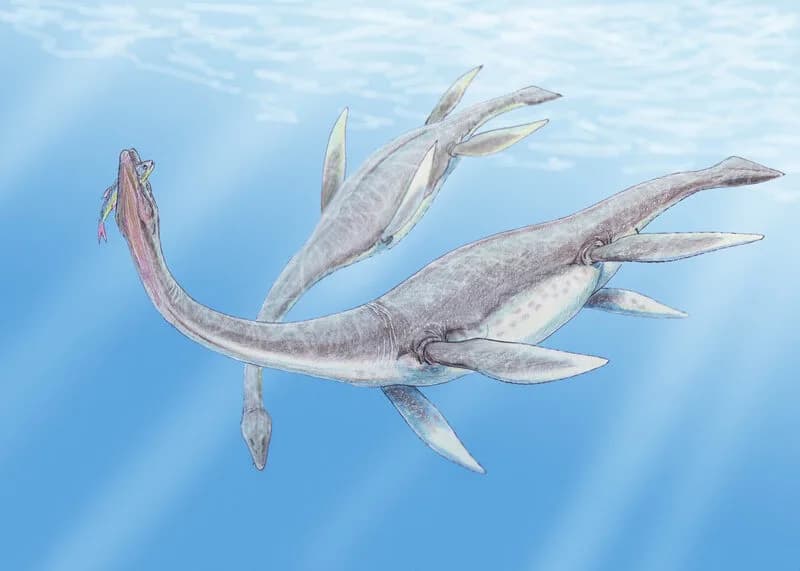
Life reconstruction of Liopleurodon ferox
Nobu Tamura, CC BY-SA 3.0, via Wikimedia Commons
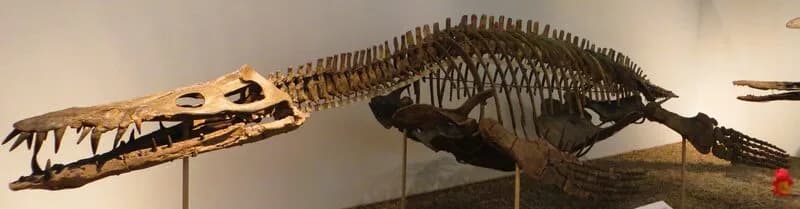
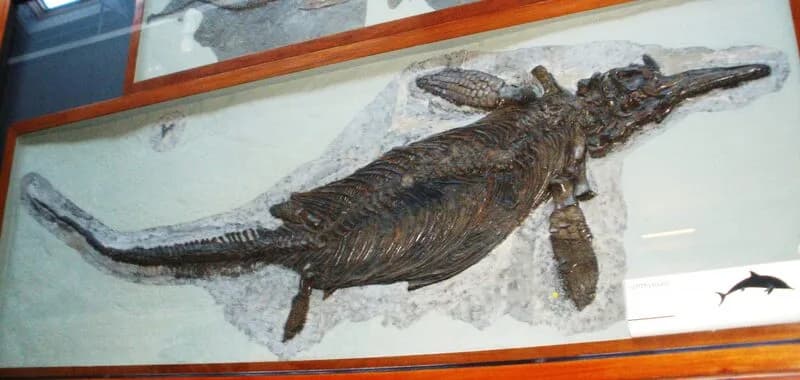
Fossil skull of Liopleurodon ferox
Ghedoghedo, CC BY-SA 3.0, via Wikimedia Commons