Eurhinosaure
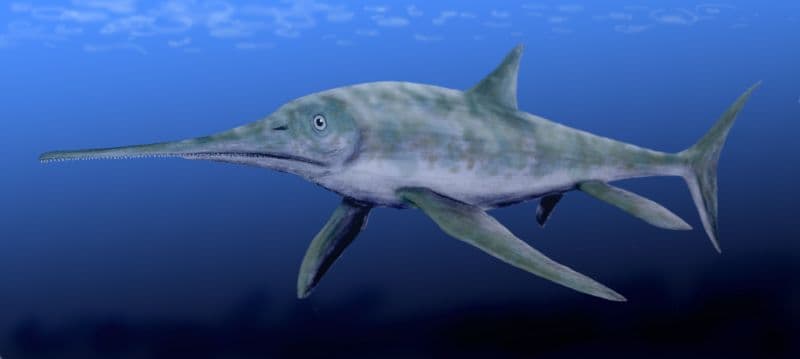
Eurhinosaurus longirostris is not a dinosaur but an ichthyosaur, a marine reptile from a separate lineage. Its upper snout runs about twice the length of its lower jaw, like a swordfish rostrum. Six metres long and some 450 kilograms, it swam the seas of western Europe 183 to 175 million years ago and gave birth to live young.
Playable in Path of Titans
See Eurhinosaurus longirostris's stats, abilities and role on our survival server.
Eurhinosaurus lived during the Early Jurassic, in the Toarcian stage, about 183 to 175 million years ago. At that time, much of present-day Western Europe was covered by a warm, shallow sea, fringed by lagoons and open to the deep. This ichthyosaur frequented the open sea, far from the coasts. The Toarcian was also marked by an episode of seafloor oxygen depletion, which favoured the exceptional preservation of dead animals that sank to the bottom. It was in these Jurassic seas, full of ammonites, belemnites and other marine reptiles, that Eurhinosaurus hunted. These waters teemed with spiral-shelled ammonites and squid-like belemnites, which formed the base of many marine food webs. The warming and oxygen drop characteristic of the Toarcian upended these ecosystems, yet without preventing ichthyosaurs from thriving.
The remains of Eurhinosaurus were first described as Ichthyosaurus longirostris by the English naturalist Gideon Mantell in 1851. It was only in 1909 that palaeontologist Othenio Abel erected the genus Eurhinosaurus for this peculiarly snouted form. The name means "well-nosed lizard", from the Greek eu ("good"), rhino ("nose") and sauros ("lizard"), referring to its elongated rostrum. Many specimens come from the famous bituminous shale deposits of Europe, notably the Posidonia Shale of Germany around Holzmaden, which has yielded ichthyosaur skeletons of remarkable quality.
Eurhinosaurus was a large ichthyosaur. The average adult was about 6 metres long and weighed an estimated 450 kilograms, with some individuals perhaps reaching more. Its long, streamlined body recalled that of a modern dolphin or swordfish, optimised for fast swimming in open water. Compared with stockier contemporary ichthyosaurs, Eurhinosaurus had a particularly slender silhouette. This respectable size placed it among the sizeable marine predators of its ecosystem, though without rivalling the largest Jurassic marine reptiles such as some pliosaurs. Its long two-lobed tail, supported by a vertebral column that bent downward into the lower lobe, provided most of the thrust, while the four flippers mainly served to steer and stabilise its swimming.
Eurhinosaurus was a marine carnivore that likely fed on fish and soft-bodied cephalopods such as belemnites and squid ancestors, abundant in Jurassic seas. Its very peculiar jaw, with an oversized upper snout, has fuelled many hypotheses about its hunting technique. It has been imagined probing the sediment, slashing through fish schools with a sideways sweep of the head, or stunning prey by striking — much as the modern swordfish does with its rostrum. Its many fine, pointed teeth suited the capture of slippery prey rather than crushing. In closely related ichthyosaurs, fossilised stomach contents have yielded belemnite hooks and fish remains, supporting a diet focused on cephalopods and fish. The elongated rostrum, lined with teeth along its sides, may have served to flush prey out of schools or to wound it before swallowing it whole, head first, as dolphins and ichthyosaurs generally do.
Eurhinosaurus inhabited the warm epicontinental seas that covered Western Europe during the Toarcian, relatively deep and open waters rather than coastal zones. Its fossils have been found in England, northern and southern Germany, the Benelux, France and Switzerland, outlining the extent of its range. It shared these waters with other ichthyosaurs such as Stenopterygius and Temnodontosaurus, as well as plesiosaurs, marine crocodiles and a rich fauna of ammonites and fish. In this diverse marine ecosystem, each predator exploited different prey and depths, reducing direct competition. This Europe-wide distribution makes it one of the best-represented ichthyosaurs of its time.
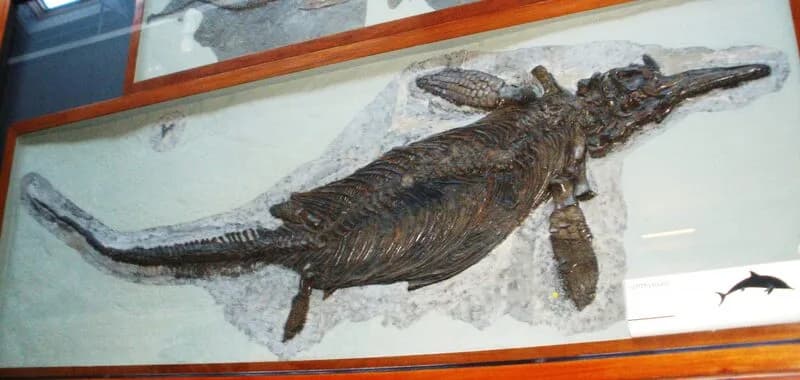
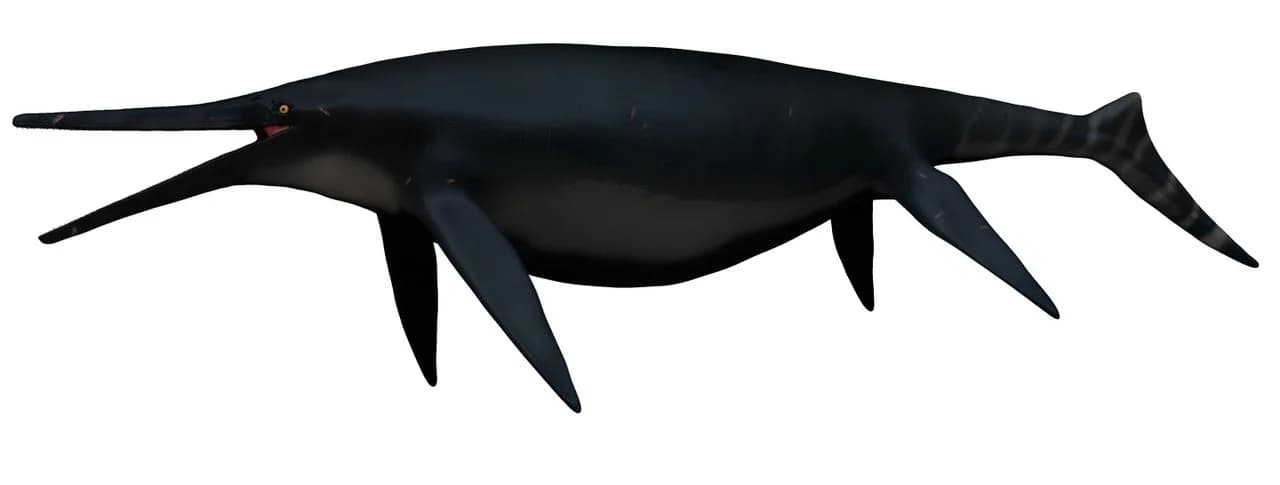
The most striking feature of Eurhinosaurus is its asymmetrical jaw: its upper snout is about twice as long as its lower jaw, with teeth set along the sides of the rostrum that project outward. This structure irresistibly recalls the rostrum of a swordfish or sawfish, and it is a unique trait among well-known ichthyosaurs. Otherwise, Eurhinosaurus had the typical anatomy of its group: a fusiform, dolphin-like body, four limbs turned into flattened flippers, a dorsal fin and a powerful two-lobed tail providing propulsion. Its forefins, long and slender, contributed to its stability and manoeuvrability in the water. Its eyes, as in many ichthyosaurs, were relatively large and reinforced by a ring of bone, the sclerotic ring, an asset for seeing in dimly lit waters. The bones of its limbs were multiplied and packed into a stiff paddle: what was originally a land reptile's leg had been transformed, over evolutionary time, into a swimming organ entirely dedicated to marine life.
Eurhinosaurus was an active, fast swimmer, built for open water. Like all ichthyosaurs, it was a fully marine reptile unable to return to land: it breathed air by surfacing and gave birth to live young in the water (viviparity), a mode of reproduction confirmed by fossils of females that died in mid-birth in closely related genera. The exact function of its long rostrum remains debated: a hunting weapon, a probing tool or a sensory organ — palaeontologists have not settled the question. Whatever the case, its morphology betrays an agile predator at ease in pursuing lively prey. Spectacular ichthyosaur fossils from Holzmaden, caught in the act of giving birth, show that the young were often born tail-first, as in whales, to avoid drowning before their first trip to the surface. Several studies further suggest these marine reptiles had a high metabolism, perhaps close to that of warm-blooded animals, which would have supported a lifestyle of enduring swimmers capable of long crossings in the open sea.
Eurhinosaurus belongs to the family Leptonectidae, a group of ichthyosaurs characterised by an elongated snout, within the large clade Neoichthyosauria. Ichthyosaurs, despite their resemblance to fish and dolphins, were neither fish nor mammals, but marine reptiles that adopted an aquatic lifestyle through convergent evolution. Within the leptonectids, Eurhinosaurus represents an extreme form, taking the elongation of the upper rostrum further than relatives such as Leptonectes. This specialisation makes it a textbook case of the morphological diversity reached by Jurassic marine reptiles. Successive analyses have refined its place among the leptonectids, but its anatomical originality has never been in doubt and still makes it a genus apart.
Compared with more "classic" ichthyosaurs such as Ichthyosaurus or Stenopterygius, with symmetrical snouts, Eurhinosaurus immediately stands out for its overdeveloped upper rostrum. This peculiarity creates a striking parallel with an unrelated modern fish, the swordfish, which evolved a comparable rostrum for likely similar reasons: a classic case of convergent evolution, where very distant animals arrive at similar solutions to similar challenges. Among Jurassic marine reptiles, Eurhinosaurus thus occupies a niche distinct from that of the massive pliosaurs or the long-necked plesiosaurs, illustrating the variety of predation strategies explored by the marine life of the time. Through the Jurassic and then the Cretaceous, other marine reptiles would push specialisation even further, from giant ichthyosaurs to mosasaurs, but Eurhinosaurus's long-beaked hunter profile remains one of the most memorable of this long evolutionary story at sea.
Eurhinosaurus is relatively well known thanks to the exceptional Toarcian deposits of Europe, especially the Posidonia Shale of Germany. These deposits, formed at the bottom of an oxygen-poor sea, preserved complete, articulated skeletons, sometimes accompanied by the imprint of soft tissues that reveals the true outline of the body and fins. This level of preservation, rare in the fossil record, has allowed scientists to reconstruct Eurhinosaurus with great confidence. Specimens come from several Western European countries, attesting to a wide distribution. Every well-preserved fossil continues to shed light on the lifestyle of these vanished marine reptiles.
Little known to the general public, Eurhinosaurus remains a familiar figure to marine-reptile enthusiasts, partly thanks to the superb specimens displayed in European museums. It has also gained visibility through video games: it features among the playable creatures of Path of Titans, where it was added as one of the first fully aquatic creatures after reaching a crowdfunding goal. One important distinction, however, must be recalled: Eurhinosaurus was not a dinosaur, but an ichthyosaur, a marine reptile of a completely separate lineage. Its presence alongside dinosaurs in popular culture is a good excuse to explain the often-overlooked richness of Mesozoic marine life.
| Period | Jurassique inférieur / Early Jurassic (Toarcien) |
| Era | Mésozoïque / Mesozoic |
| Age | 183–175 Ma |
| Location | Europe de l'Ouest / Western Europe |
| Length | ~6 m |
| Height | — |
| Weight | ~450 kg |
| Diet | Carnivore (piscivore) |
| Discovery | 1851 (décrit comme Ichthyosaurus longirostris) |
Eurhinosaurus longirostris measured about 6 meters long, weighing an estimated ~450 kilograms. This Early Jurassic ichthyosaur (Toarcian, ~183 Ma) inhabited the seas of Western Europe. It was first described in 1851 as Ichthyosaurus longirostris before being reclassified in its own genus.
The upper jaw of Eurhinosaurus longirostris extended far beyond the lower jaw, forming a long asymmetric rostrum unlike any other ichthyosaur. This morphology resembles the modern swordfish, leading paleontologists to propose that Eurhinosaurus slashed laterally through fish schools with this rostrum to stun prey before swallowing.
Eurhinosaurus longirostris was adapted for fast, agile swimming through its crescent-shaped (hypocercal) tail fin, paddle-like pectoral flippers, and streamlined fusiform body. Despite measuring 6 meters, it was likely capable of rapid pursuits in the shallow epicontinental seas of the Early Jurassic in Europe.
Information on this page is based on peer-reviewed scientific publications.
Life reconstruction of Eurhinosaurus longirostris, an Early Jurassic ichthyosaur with an elongated upper snout.
Nobu Tamura, CC BY 2.5, via Wikimedia Commons
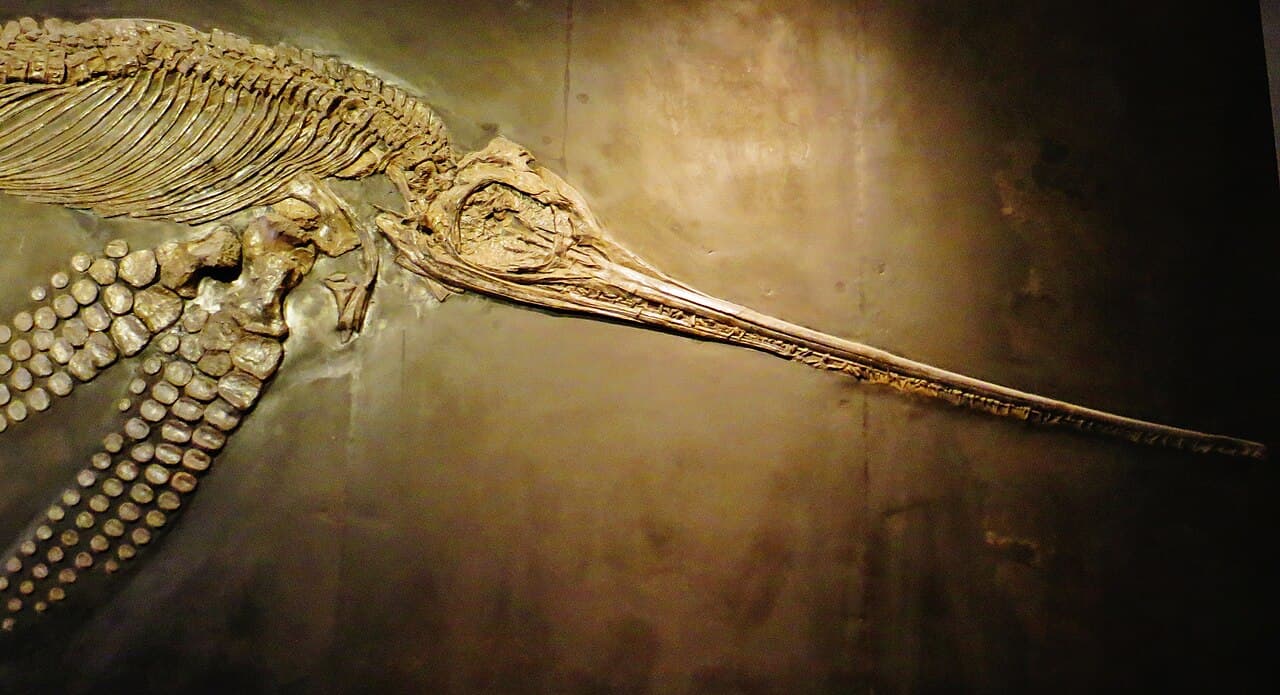
Fossil of Eurhinosaurus longirostris, showing the articulated skeleton and characteristic rostrum.
Ghedoghedo, CC BY-SA 4.0, via Wikimedia Commons