Shonisaure
Shonisaurus popularis was a giant ichthyosaur of the Late Triassic, found in Nevada in 1920 and dated to 237 to 227 million years ago. At 15 metres and roughly 30 tonnes, it ranks among the largest marine reptiles known. At least 37 individuals were recovered from a single site; adults lost their teeth, which suggests they fed by suction.
Shonisaurus popularis lived during the Late Triassic, approximately 237 to 227 million years ago, during the Carnian age. This giant ichthyosaur is one of the largest marine reptiles that ever existed, rivaling the size of the largest modern cetaceans. Discovered in the Shoshone Mountains of Nevada, United States, Shonisaurus belongs to the shastasaurid family, a group of giant ichthyosaurs that reached their peak during the Triassic. It lived in the ancient Panthalassic Ocean, the immense ocean that surrounded the supercontinent Pangaea. The Late Triassic was a period of explosive diversification of marine reptiles, after the Permian-Triassic mass extinction that had emptied the oceans of most of their fauna. Shonisaurus represents one of the first large-scale marine superpredators to evolve after this biological catastrophe.
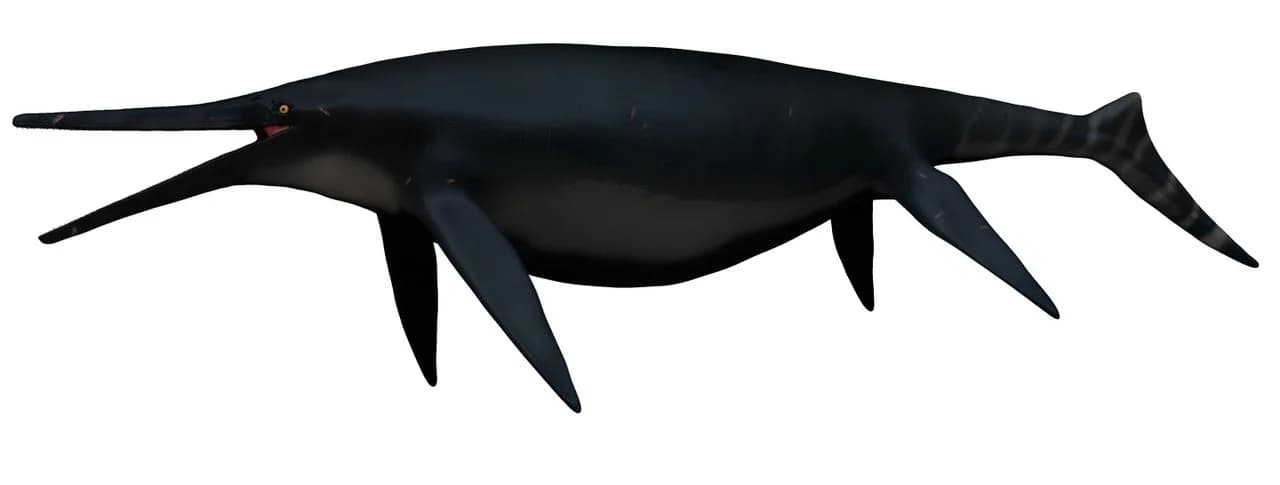
Shonisaurus popularis ranked among the largest marine animals of its time and in the history of life. Size estimates vary by specimen, but the largest individuals reached approximately 15 meters in length, comparable to a modern fin whale. Its estimated weight ranged between 20 and 30 tonnes. Its close relative Shastasaurus sikanniensis, sometimes considered a shonisaurid, possibly reached 21 meters, which would make it the largest known marine reptile. Shonisaurus's body was massive and fusiform, with a hydrodynamic profile more reminiscent of whales than dolphins. The flippers were unusually long and narrow for an ichthyosaur, suggesting a different swimming mode from later ichthyosaurs. The skull measured about 2 meters long with an elongated rostrum. Adults were probably toothless, although juveniles possessed teeth.
Shonisaurus's diet is debated, primarily due to the apparent absence of teeth in adults. Juvenile specimens possessed conical teeth located only at the front of the jaws, but adults appeared edentulous or retained only vestigial teeth. This tooth loss during growth is remarkable and suggests a dietary change with age. Several hypotheses have been proposed: toothless adults may have been cephalopod suckers, aspirating squid and ammonites from their shells similarly to modern sperm whales that use suction to capture giant squid. Filter feeding, similar to baleen whales, has also been suggested but remains poorly supported by skull morphology. Toothed juveniles probably hunted fish and small cephalopods. The colossal size of adults allowed them to target large cephalopods in the deep waters of Panthalassa.
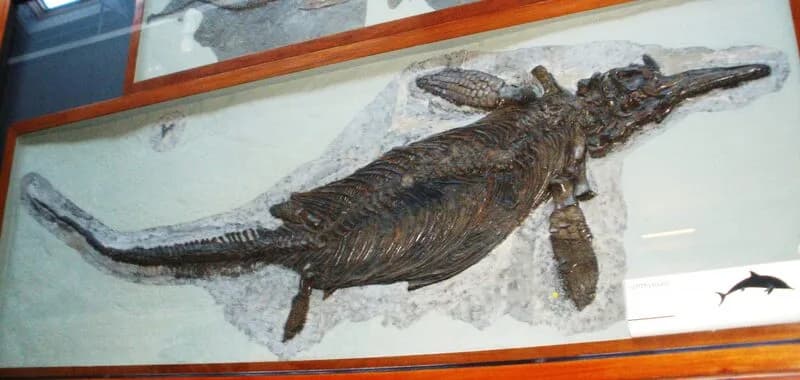
Shonisaurus lived in the waters of the Panthalassic Ocean, the immense world ocean that surrounded the supercontinent Pangaea during the Triassic. The region where its fossils were discovered, now the arid mountains of Nevada, was then covered by a shallow tropical sea bordering the North American continent. The Berlin-Ichthyosaur State Park fossil site in Nevada preserves a remarkable assemblage of at least 37 Shonisaurus individuals, suggesting either a mass stranding or a gregarious gathering site. The Late Triassic climate was globally warm and arid, with high ocean temperatures and an absence of polar ice caps.
Shonisaurus anatomy combined primitive ichthyosaur characters with unique specializations related to its gigantic size. Its body was fusiform but wider and less hydrodynamic than later ichthyosaurs like Ichthyosaurus. The spine comprised over 80 vertebrae, each measuring approximately 10 centimeters in diameter. All four flippers were unusually long and narrow, with elongated phalanges forming paddle-like underwater wings. This morphology suggests a swimming mode using all four flippers simultaneously, unlike later ichthyosaurs that propelled primarily with the tail. The presence or absence of a crescent-shaped tail fin remains debated. The skull was elongated with large orbits, indicating good vision adapted for deep-water hunting. The bones were partially spongy, an adaptation for deep diving.
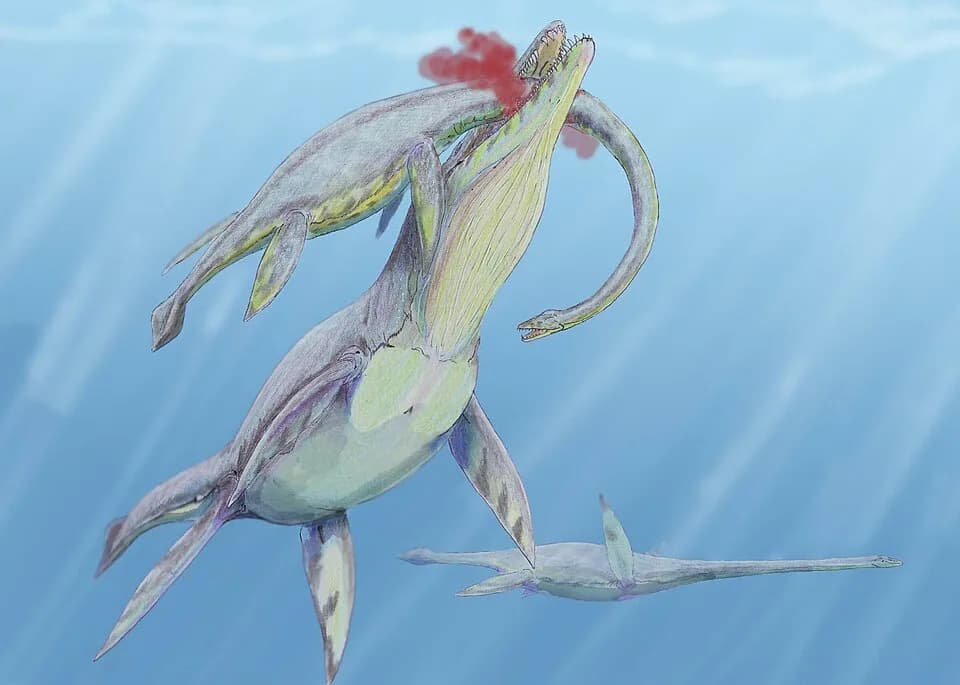
Shonisaurus behavior can be partially reconstructed from the extraordinary Berlin-Ichthyosaur State Park site in Nevada, where at least 37 individuals were found together. This massive accumulation has sparked numerous hypotheses. The most accepted explanation is a mass stranding event, similar to modern whale strandings, possibly caused by trapping coastal topography, disease, or disorientation. An alternative spectacular hypothesis proposed by Mark McMenamin in 2011 suggested the bones were arranged by a giant kraken — a hypothetical predatory cephalopod that hunted Shonisaurus — but this idea remains highly controversial and largely rejected. The grouping of many similarly-sized individuals suggests gregarious behavior, with Shonisaurus possibly moving in social groups like modern cetaceans.
Shonisaurus was first described in 1976 by paleontologist Charles Camp from fossils discovered in Nevada's Shoshone Mountains, hence the genus name. The main site, now Berlin-Ichthyosaur State Park, is one of the world's most spectacular ichthyosaur deposits, preserving at least 37 skeletons in a single outcrop of the Luning Formation. The fossils were initially discovered by miners in the 1920s, but the first scientific excavations didn't begin until 1954 under Camp's direction. The state park today protects several skeletons exposed in situ, partially freed from the rock, offering a striking view of these marine giants.
| Period | Trias supérieur / Late Triassic |
| Era | Mésozoïque / Mesozoic |
| Age | 237 - 227 Ma |
| Location | Amérique du Nord (Nevada, USA) / North America (Nevada, USA) |
| Length | 15 m |
| Height | ~3 m |
| Weight | ~30 tonnes |
| Diet | Carnivore |
| Discovery | 1920 |
No. Shonisaurus popularis was an ichthyosaur — a fully aquatic marine reptile of the Ichthyosauria group, living during the Late Triassic (237–227 Ma). Ichthyosaurs are neither dinosaurs nor ancestors of modern cetaceans; they represent an independent reptile lineage that converged toward a dolphin-like morphology. Shonisaurus reached approximately 15 meters long weighing 20 to 30 tonnes.
The Berlin-Ichthyosaur State Park site in Nevada preserves the remains of at least 37 Shonisaurus popularis individuals in a single outcrop of the Luning Formation. The most accepted hypothesis is a mass stranding, similar to modern cetacean strandings, possibly caused by trapping coastal topography or disease. A controversial 2011 theory proposed a giant kraken as responsible, but this idea remains widely rejected.
Juvenile Shonisaurus popularis specimens possessed conical teeth at the front of the jaws, but adults appeared edentulous or retained only vestigial teeth. This tooth loss during growth suggests a dietary shift with age. Adults may have sucked in prey — squid and ammonites — as modern sperm whales do with giant cephalopods, or used other capture methods not requiring dentition.
Shonisaurus popularis, a giant ichthyosaur
Wikimedia Commons
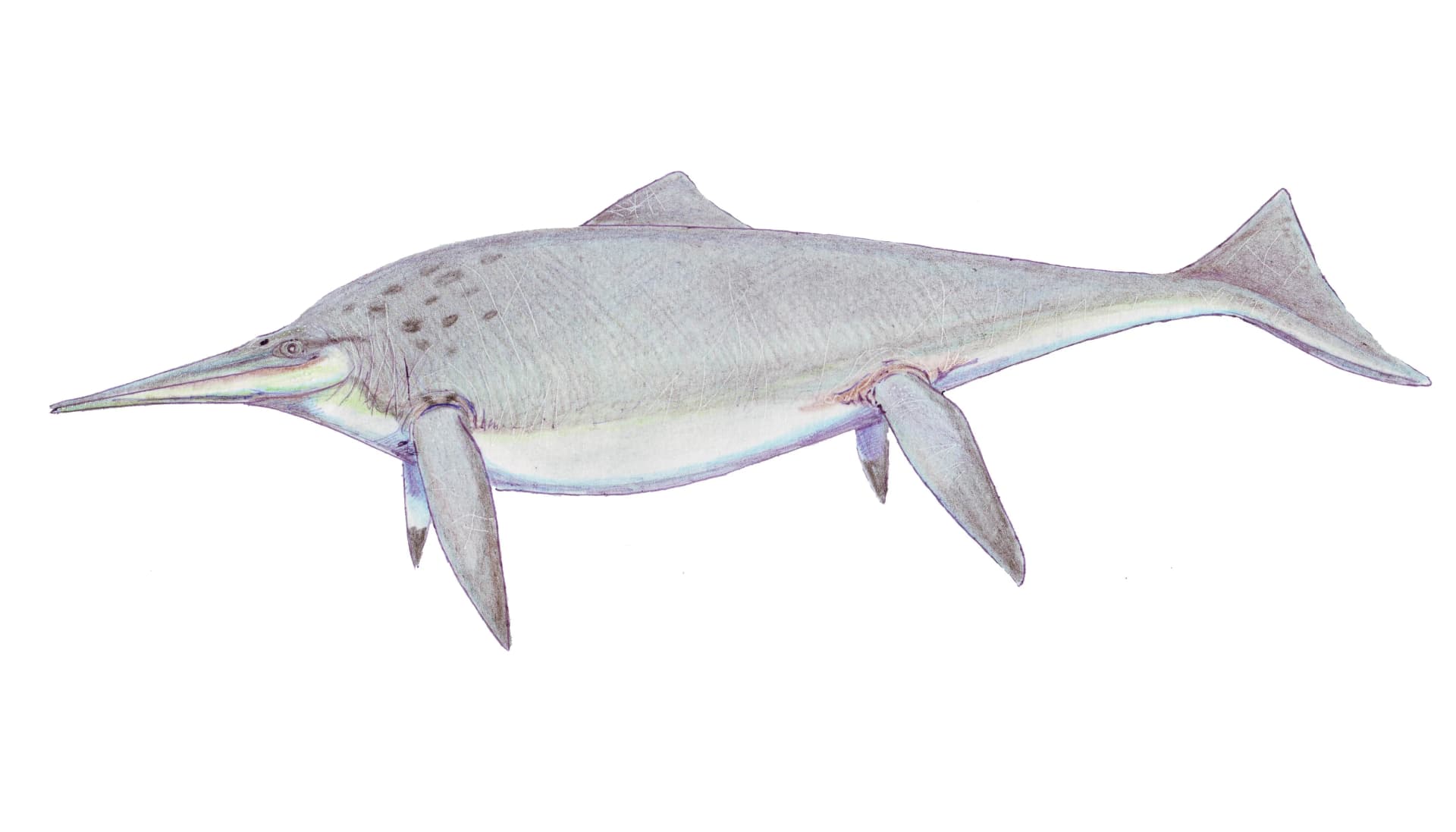
Shonisaurus popularis, the largest Triassic ichthyosaur
Dmitry Bogdanov / Wikimedia Commons