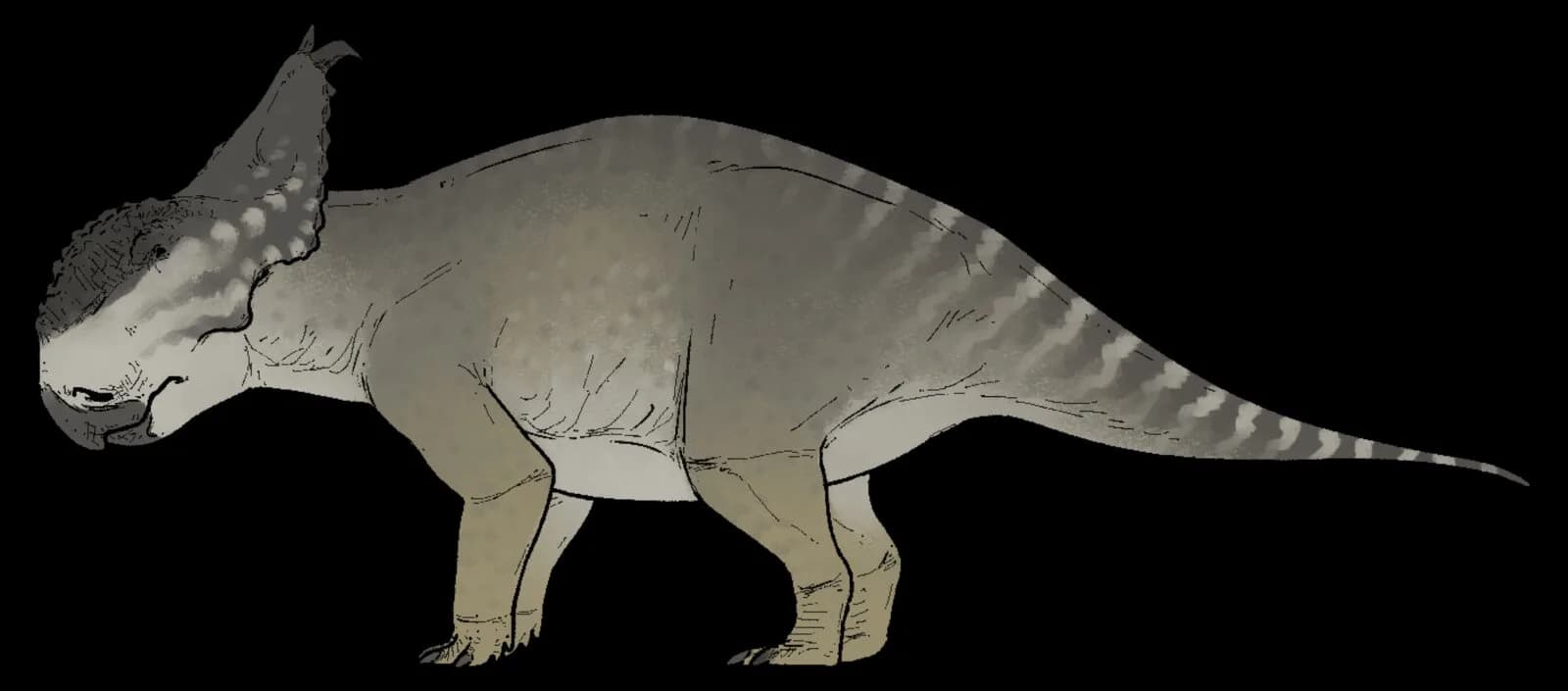
Pachyrhinosaure
Pachyrhinosaurus canadensis was a herbivorous ceratopsian from Alberta and Alaska, described in 1950 and dated to 73 to 68 million years ago. At 6 to 8 metres and 2.5 to 4 tonnes, it carried massive bony bosses instead of horns — unique among ceratopsians. It lived in the Cretaceous Arctic, in herds of thousands.
Pachyrhinosaurus lived during the Late Cretaceous, approximately 73 to 69 million years ago, during the late Campanian to early Maastrichtian stages of the Mesozoic era. It inhabited the landmass of Laramidia in western North America, with a remarkably wide geographic range extending from Alberta, Canada all the way to Alaska. It is one of the few dinosaur genera whose fossils have been found at high Arctic latitudes, strongly suggesting it was well-adapted to cooler climatic conditions than most contemporary dinosaurs experienced. Pachyrhinosaurus was the dominant ceratopsian of the late Campanian in western Canada, and its abundance in bone beds indicates very large population sizes.
Pachyrhinosaurus measured between 5 and 8 meters long depending on species, with an estimated weight of 2 to 4 tonnes. It was a large ceratopsian, comparable to Triceratops in mass. Its skull was massive and measured about 1.5 meters long (including frill). What immediately distinguished it from other ceratopsians was the absence of prominent nasal and orbital horns, replaced by thick, rough bony bosses called 'nasal boss' and 'supraorbital boss.' Its frill bore various ornaments depending on the species, including curved horns.
Pachyrhinosaurus was a dedicated herbivore that fed on the low vegetation of Late Cretaceous forests and open plains across its wide range. Its massive, sharp parrot-like beak was capable of cutting the toughest stems and leathery leaves, including ferns, cycads, and the early flowering plants that were rapidly diversifying during this period. Its shearing tooth batteries at the back of the jaw enabled efficient mastication of even the most fibrous plant material. The remarkable presence of fossils in Alaska suggests it could successfully feed on vegetation adapted to significantly cooler conditions than those found further south, including understory plants and the specialized vegetation of subarctic zones with limited sunlight during winter months.
Pachyrhinosaurus had a remarkable geographic distribution extending from Alberta in southern Canada to Alaska at high Arctic latitudes, one of the widest ranges of any ceratopsian. In Alberta, it inhabited forested coastal plains near the Western Interior Seaway in a warm subtropical climate with abundant vegetation. In Alaska, the species P. perotorum lived in much cooler and more challenging conditions, with dark, cold winters lasting several months, though temperatures were still milder than today at the same latitudes. This vast north-south distribution strongly suggests seasonal migrations between feeding grounds or an exceptional degree of climatic adaptability. Massive bone beds discovered in Alberta indicate seasonal gatherings of thousands of individuals, comparable to modern caribou migrations.
The most distinctive anatomical feature of Pachyrhinosaurus is the absence of horns replaced by bosses (massive bony outgrowths). The nasal boss, located above the nose, was a thick, rough bony plate that could measure 20 centimeters thick. The supraorbital bosses above the eyes were also pronounced. The shape and size of these bosses varied considerably among the three known species (P. canadensis, P. lakustai, P. perotorum) and between individuals, probably serving as individual and species identity markers. Its frill bore various ornaments, including in some species spectacular curved horns (unicorns) at the center.
Pachyrhinosaurus was a highly gregarious animal that lived in immense herds, as demonstrated by massive bone beds containing thousands of individuals. The Pipestone Creek bone bed in Alberta, containing the remains of over 3,000 P. lakustai individuals, is one of the most impressive dinosaur accumulations in the world. This mass mortality is interpreted as resulting from the drowning of an immense herd during a flooded river crossing. Its cranial bosses probably served during head-to-head combat between rival males, with individuals pushing and butting like modern bison.
Pachyrhinosaurus was described in 1950 by Charles M. Sternberg from fossils found along the St. Mary River in Alberta. Three species are recognized: P. canadensis (1950, Alberta), P. lakustai (2008, Alberta, from the Pipestone Creek bone bed), and P. perotorum (2012, Alaska, North Slope Borough). The Pipestone Creek bone bed, discovered in 1974 by teacher Al Lakusta, is the richest Pachyrhinosaurus site in the world, with thousands of bones representing at least 3,000 to 4,000 individuals of all ages. The Alaska specimens of P. perotorum extended the genus's distribution to Arctic latitudes, raising notable questions about dinosaur adaptations to cold and darkness.
| Period | Crétacé supérieur / Late Cretaceous (Campanien–Maastrichtien) |
| Era | Mésozoïque / Mesozoic |
| Age | 73–68 Ma |
| Location | Amérique du Nord / North America (Alberta, Canada ; Alaska, USA) |
| Length | 6–8 m |
| Height | ~2 m |
| Weight | 2 500–4 000 kg |
| Diet | Herbivore |
| Discovery | 1950 |
Pachyrhinosaurus canadensis replaced the typical ceratopsid nasal and brow horns with thick, rough bony outgrowths called bosses. The nasal boss could reach 20 cm thick. These structures likely served for intraspecific head-to-head combat, individual recognition, and possibly sexual selection, similar to modern bison.
The Pipestone Creek bone bed in Alberta, discovered in 1974 by Al Lakusta and formally excavated since, contains the remains of at least 3,000 to 4,000 Pachyrhinosaurus lakustai individuals of all ages. This mass accumulation is interpreted as resulting from drowning during a flooded river crossing by an immense migrating herd.
Pachyrhinosaurus perotorum, discovered in Alaska (North Slope), lived at Arctic latitudes. Although Cretaceous temperatures were milder than today, polar winters meant months of darkness and reduced vegetation. Seasonal migrations to lower latitudes, or great dietary adaptability, are the main hypotheses explaining its presence at these extreme northern latitudes.
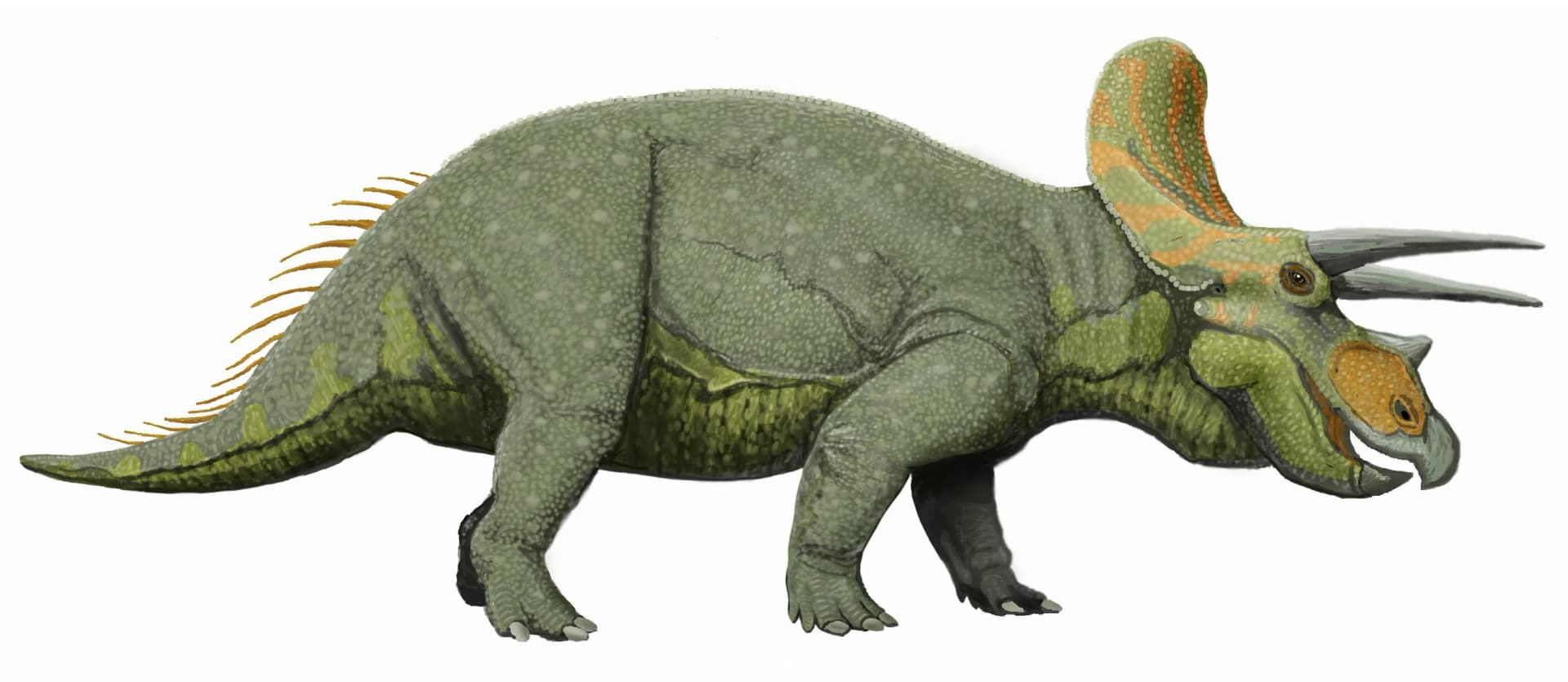
Life reconstruction of Pachyrhinosaurus canadensis
Connor Ashbridge, CC BY 4.0, via Wikimedia Commons
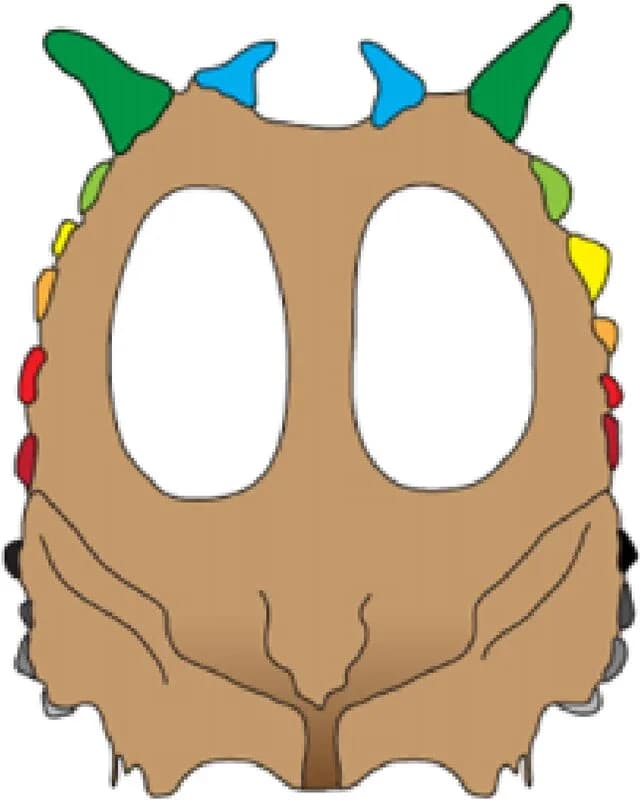
Pachyrhinosaurus canadensis fossil frill
Loewen et al., CC BY 4.0