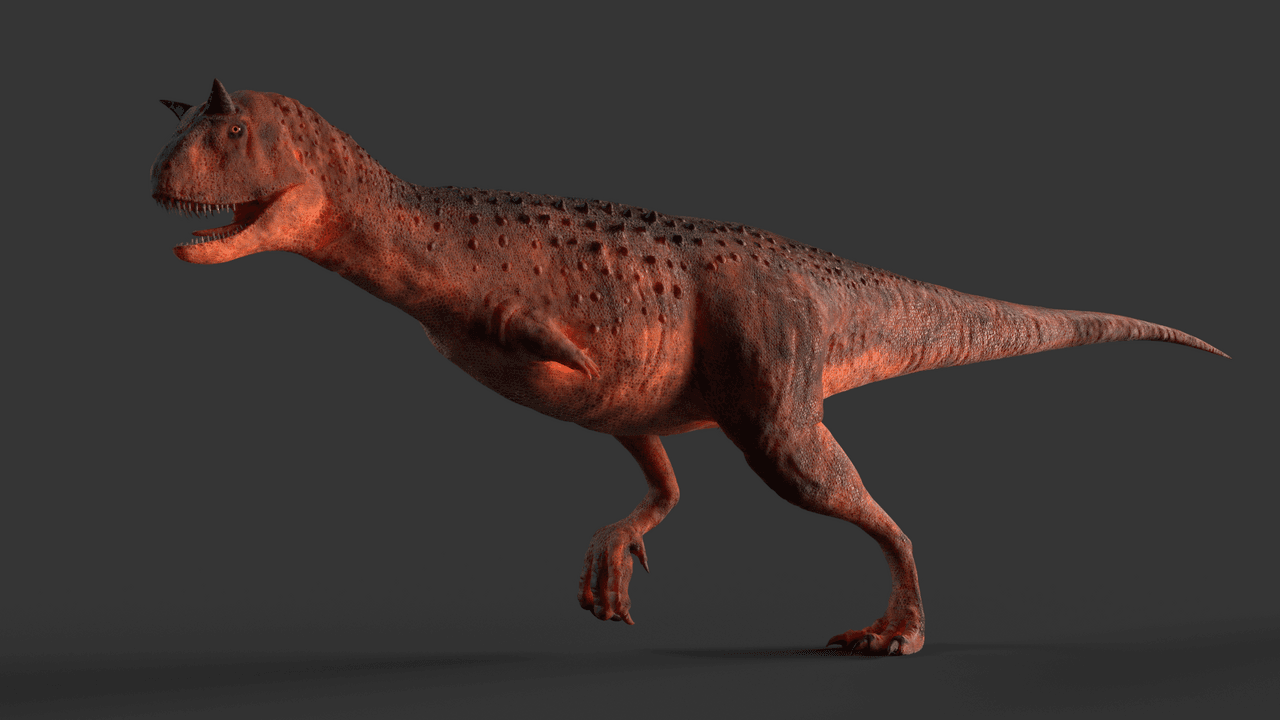
Taureau carnivore
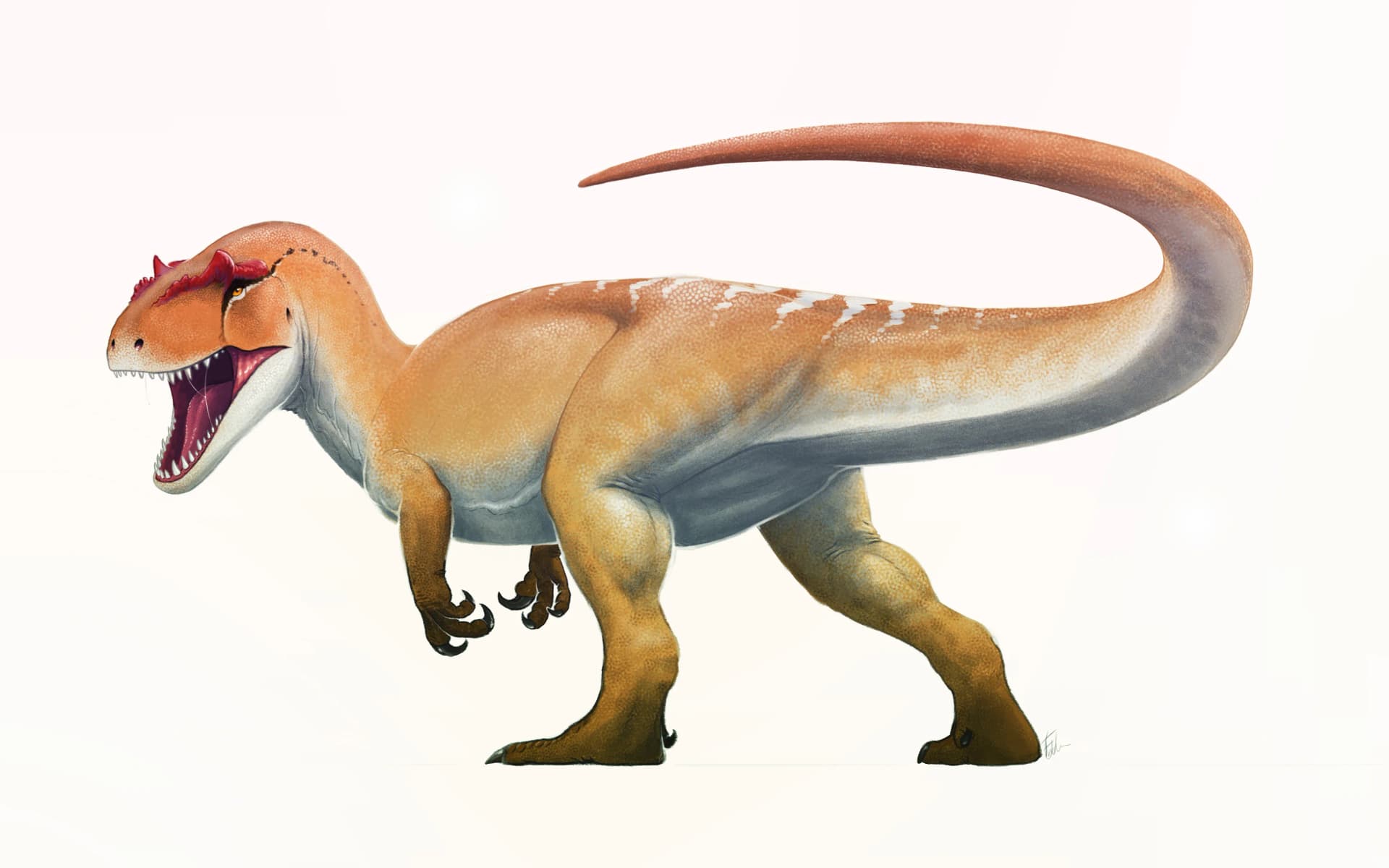
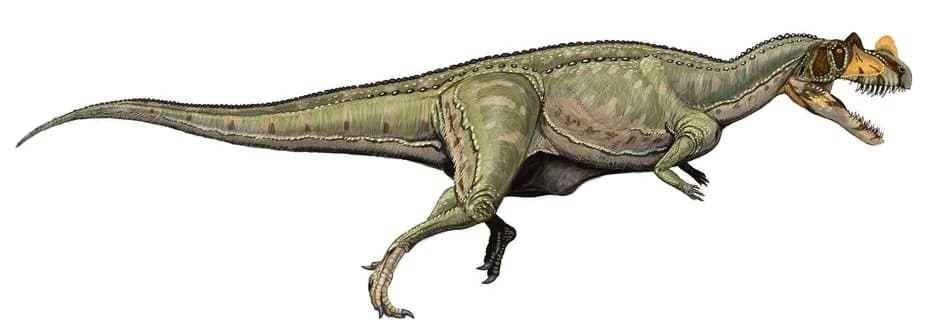
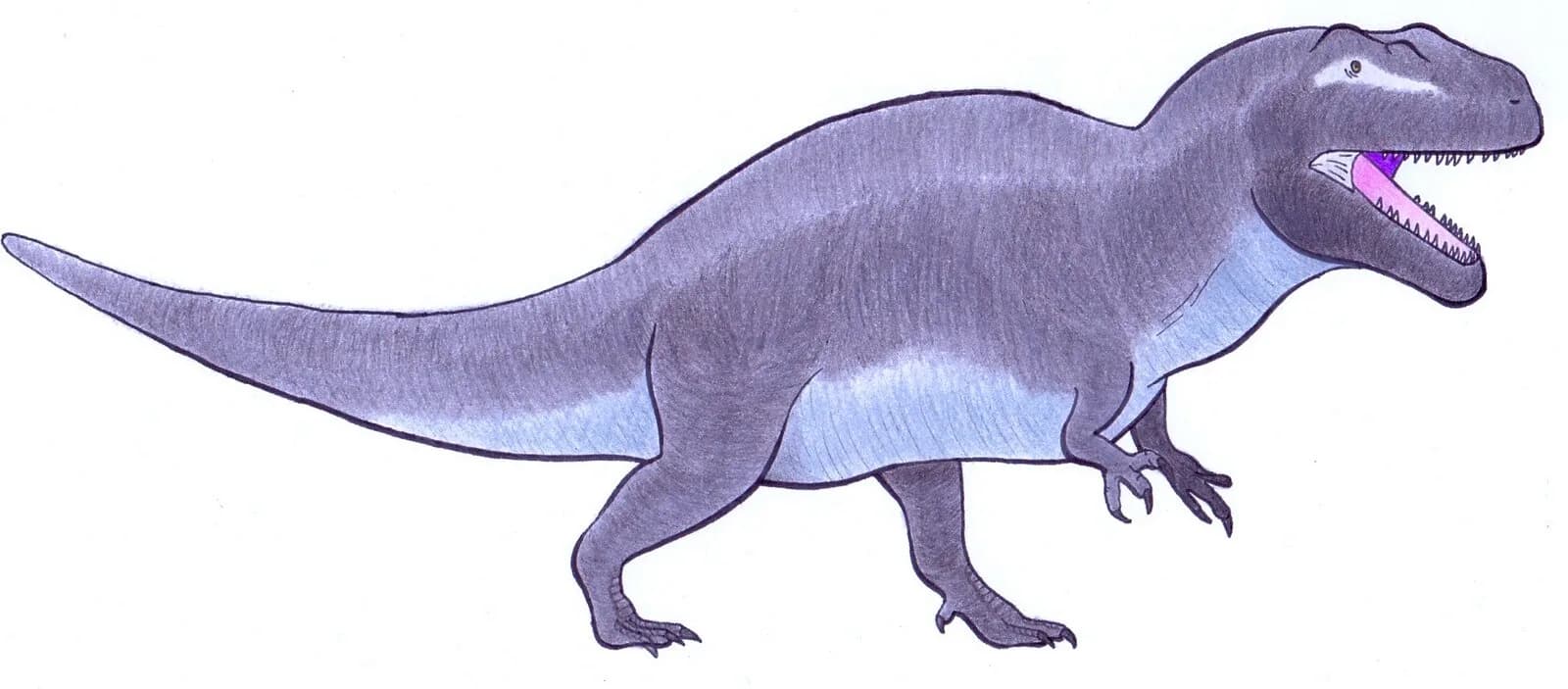
Carnotaurus sastrei was a carnivorous theropod from Argentina, described in 1984 and dated to 72 to 70 million years ago. It measured 7.5 to 9 metres and weighed 1.35 to 2.1 tonnes, could reach 62 km/h, and carried two horns above its eyes. Its holotype MACN-CH 894 is 75% complete and preserves skin impressions, which remains rare for a large theropod.
Speed demon. Its charge knocks down everything in its path with guaranteed knockdown. Fragile, but its innate bleed resistance compensates.
Playable in The Isle: Evrima
See Carnotaurus sastrei's in-game stats, tier, strengths & weaknesses on our server.
Carnotaurus lived during the Late Cretaceous period, approximately 72 to 69.9 million years ago, during the Campanian-Maastrichtian stage. Unlike the North American T. rex, Carnotaurus reigned over the lands of present-day Argentina in South America. This period corresponds to a time when continents continued their drift, progressively isolating South American faunas. The climate was hot and humid, favoring luxuriant vegetation and significant biodiversity. Carnotaurus shared its ecosystem with titanosaur sauropods, ankylosaurs, and other medium-sized theropods. The geological formations where its remains were found indicate a semi-arid environment with seasonal variations, providing a unique ecological context for this distinctive predator.
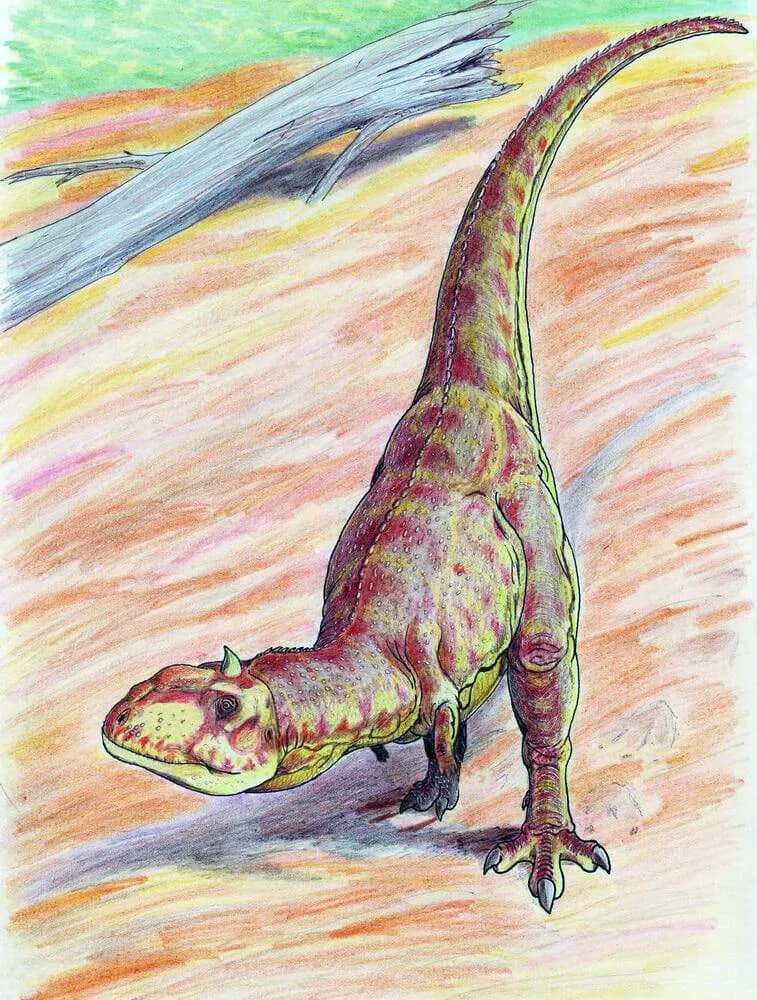
Carnotaurus measured approximately 7.5 to 9 meters in length, 3 to 3.5 meters in height, and weighed between 1.35 and 2.1 tons, making it a medium-sized but extremely specialized predator. Its skull was remarkably short and deep, measuring about 60 centimeters, with powerful but relatively weak jaws compared to other large theropods. The most distinctive characteristic of Carnotaurus lay in its two thick, conical horns located above the eyes, unique among known theropods. The forelimbs were ridiculously reduced, even more so than those of T. rex, with tiny forearms and four vestigial digits. The hindlimbs, on the other hand, were extremely powerful and adapted for rapid running.
An agile carnivore, Carnotaurus probably hunted medium to large-sized prey, including juvenile sauropods, ornithopods, and potentially smaller prey depending on opportunities. Its teeth, relatively small and blade-shaped, were designed to slice flesh rather than crush bones like those of T. rex. The jaw, while powerful in terms of closing speed, did not exert exceptional bite force, suggesting a hunting strategy based on rapid, repeated attacks rather than a single crushing bite. Biomechanical studies suggest Carnotaurus could open its mouth exceptionally wide, possibly to seize large-sized prey.
Carnotaurus inhabited the floodplains and wooded areas of Patagonia, in the present-day province of Chubut in Argentina. The Late Cretaceous South American environment was characterized by a subtropical to warm temperate climate, with winding rivers, lakes, and vegetation dominated by conifers, ferns, and primitive angiosperms. The La Colonia Formation, where the holotype specimen was discovered, represents an ancient fluvial environment with sandstone and clay deposits. This ecosystem harbored unique fauna, different from that of North America due to the increasing continental isolation of the time.
Carnotaurus anatomy is exceptionally well documented thanks to the discovery of an almost complete skeleton with fossilized skin impressions, a rarity in paleontology. The short, deep skull, with its reduced temporal fenestrae, suggests compact but powerful mandibular musculature. The horns, formed from extensions of the frontal bone, were probably covered in keratin, increasing their apparent size. The exact function of these horns remains debated: intraspecific combat, visual display, or perhaps even weapons during charges against prey. The hindlimbs presented unusual proportions: short but robust femurs, elongated tibiae and metatarsals, typical characteristics of fast runners. Skin impressions reveal skin covered with non-overlapping scales of different sizes, with no trace of plumage, as well as strange rounded structures along the back and flanks whose function remains mysterious.
Carnotaurus was probably a solitary predator, though some hypotheses suggest group hunting behaviors during specific periods. Its morphology suggests a speed-based hunting strategy: the long hindlimbs and stiff tail serving as a balancer indicate a capacity to reach high speeds, potentially up to 50-55 km/h according to some biomechanical estimates. The horns could have served during territorial combat between males, similar to modern bovine confrontations, hence the name 'meat-eating bull'. The extraordinary stiffness of the tail, reinforced by elongated chevron bones, limited its lateral flexibility but increased its counterbalance function during running. Carnotaurus represents a striking example of unique adaptation: a theropod optimized for speed rather than brute power.
Carnotaurus sastrei was discovered in 1984 by José F. Bonaparte in the La Colonia Formation, Chubut province, Argentina. The holotype specimen (MACN-CH 894) is one of the most complete theropods ever discovered in the southern hemisphere, preserving about 75% of the skeleton, including an almost complete skull and, exceptionally, vast areas of fossilized skin impressions. This unique discovery allowed detailed studies of external anatomy, revealing its skin texture and the presence of unusual dermal structures. Named in honor of Ángel Sastre, owner of the land where the fossil was discovered, Carnotaurus sastrei has since captured scientific and popular imagination. Unfortunately, it remains the only known specimen of the species, making assessment of individual variability difficult. This exceptional fossil is exhibited at the Museo Argentino de Ciencias Naturales in Buenos Aires and continues to be the subject of in-depth studies using modern scanning and 3D modeling technologies.
| Period | Crétacé supérieur / Late Cretaceous |
| Era | Mésozoïque / Mesozoic |
| Age | 72-69.9 Ma |
| Location | Amérique du Sud (Argentine) / South America (Argentina) |
| Length | 7.5-9 m |
| Height | 3-3.5 m |
| Weight | 1.35-2.1 tonnes |
| Diet | Carnivore |
| Discovery | 1984 |
| Type (in-game) | Carnivore |
| Tier | Tier 4 |
The function of Carnotaurus sastrei's two thick conical horns above the eyes remains debated. Hypotheses include intraspecific combat between males (similar to modern bovines, hence the name 'meat-eating bull'), visual display for recognition or mate attraction, or even weaponry during charges against prey. Their robust shape distinguishes them from the fragile decorative crests of other theropods.
Carnotaurus sastrei is one of the large theropods most adapted for speed. Its short but robust femurs combined with elongated tibiae and metatarsals — typical fast-runner characteristics — and its extremely stiff tail serving as a counterbalance indicate a potential top speed of 50-55 km/h according to some biomechanical estimates, compensating for a weaker bite force than T. rex.
The holotype specimen MACN-CH 894 of Carnotaurus sastrei, discovered in 1984 by José F. Bonaparte in Patagonia, is one of the most complete theropods from the southern hemisphere (~75%). Its unique feature: extensive fossilized skin impressions were preserved, revealing skin covered with non-overlapping scales and strange rounded structures along the back and flanks whose function remains mysterious.
Information on this page is based on peer-reviewed scientific publications.
Carnotaurus skeleton
Wikipedia Commons
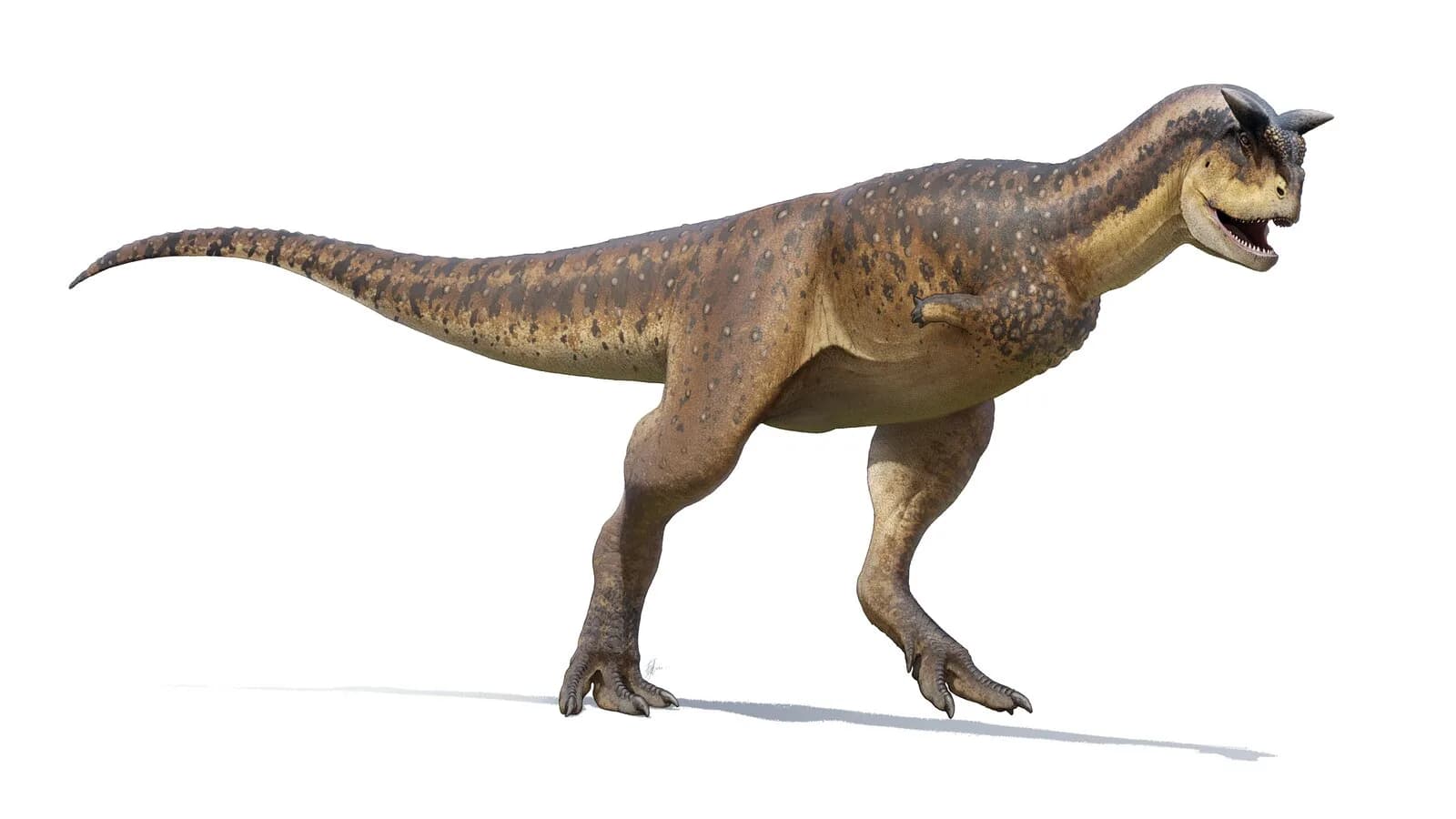
Carnotaurus sastrei life reconstruction (based on 2021 skin impression study)
Fred Wierum, CC BY-SA 4.0