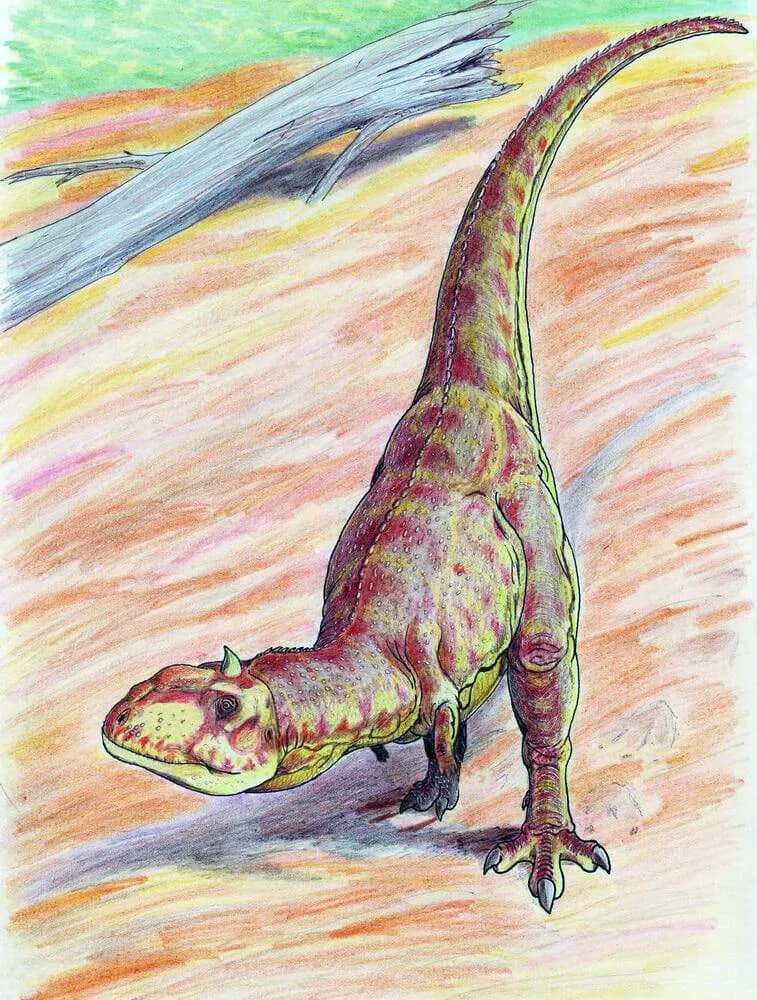
Majungasaurus
Majungasaurus crenatissimus was a carnivorous theropod from Madagascar, described in 1895 and dated to 70 to 66 million years ago. At 6 to 7 metres and 700 to 1,100 kilograms, it ruled its island unchallenged at the end of the Cretaceous. It is the only dinosaur with scientifically proven cannibalism: tooth marks from its own species were found on its bones.
Majungasaurus lived during the Late Cretaceous period, approximately 70 to 66 million years ago, during the Maastrichtian stage, on the island of Madagascar. At this time, Madagascar had already separated from the Indian subcontinent and was an isolated landmass, creating unique evolutionary conditions for its fauna. This isolation led to the development of distinctive species found nowhere else in the world, a pattern that continues in Madagascar today. Majungasaurus was the apex predator of this island ecosystem, preying on the sauropods and other herbivores that shared its isolated world. The Maevarano Formation preserves a semi-arid environment of seasonal floodplains and river channels.
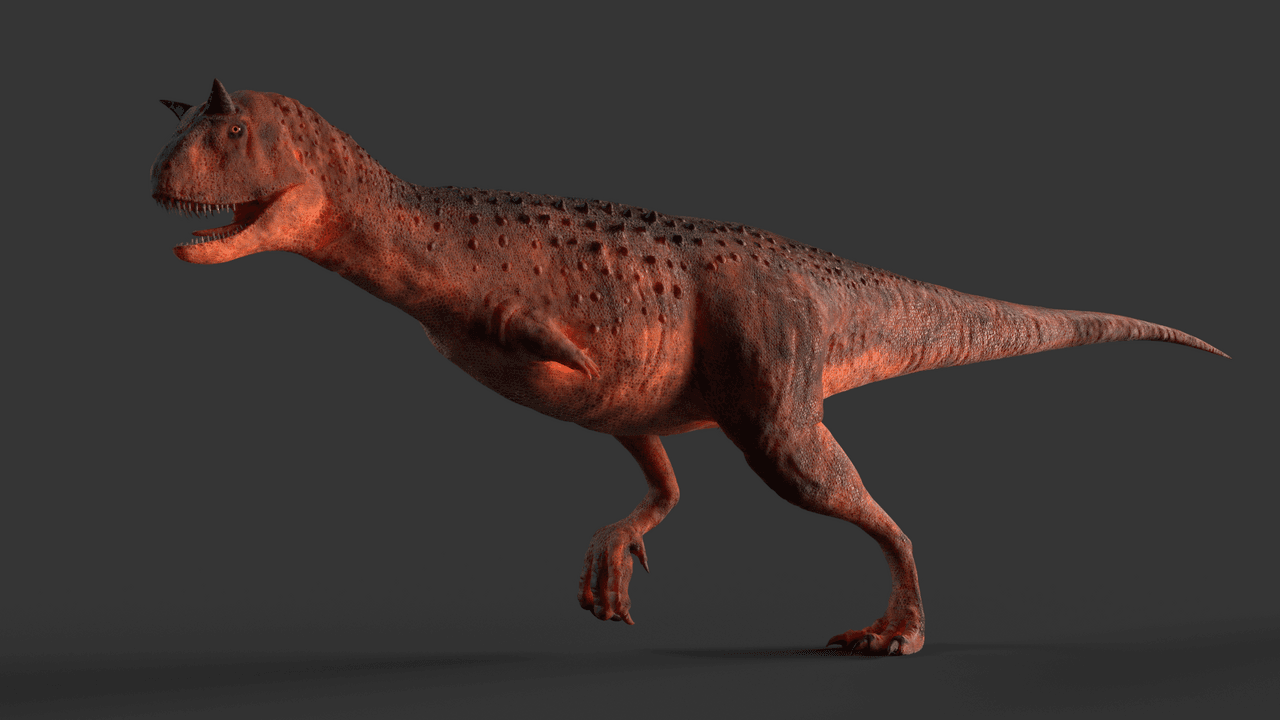
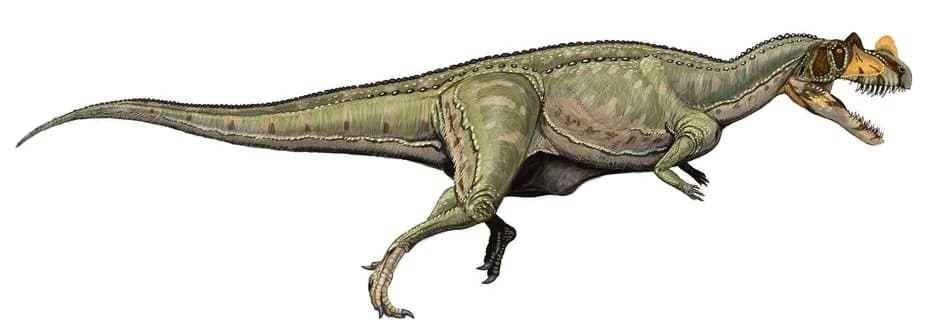
Majungasaurus measured between 6 and 7 meters long with an estimated weight of 1 to 1.5 tonnes. Although modest compared to the largest theropods, it was by far the largest predator on its island. Its skull measured about 60 to 70 centimeters long, with a short, wide snout typical of abelisaurids. Its most distinctive feature was a rounded bony protuberance atop the skull, often described as a single 'horn,' that differentiated it from all other theropods. Its body was massive and muscular for its size.
Majungasaurus was a carnivore notable for being one of the few dinosaurs with direct fossil evidence of cannibalism. Tooth marks matching Majungasaurus dentition have been found on Majungasaurus bones themselves, indicating that these animals consumed members of their own species, whether through active predation or scavenging of deceased conspecifics. Its primary prey was likely the titanosaur sauropod Rapetosaurus, which was the dominant large herbivore in its ecosystem. The robust skull and powerful jaw muscles suggest Majungasaurus employed a strong bite, possibly holding and crushing prey rather than using the slashing techniques of other abelisaurids. This dietary flexibility, including cannibalism, may have been an adaptation to the limited prey diversity on island Madagascar.
Majungasaurus inhabited the semi-arid environments of the Maevarano Formation in what is now northwestern Madagascar. During the Late Cretaceous, this region featured seasonal rivers, broad floodplains, and scattered forests adapted to pronounced dry and wet seasons. The island setting created a unique ecosystem with limited species diversity compared to continental environments but with high abundance of the species present. The landscape was periodically flooded during wet seasons, creating temporary water bodies that attracted prey animals. The isolated nature of Madagascar meant that Majungasaurus faced no competition from other large theropods, allowing it to dominate unchallenged as the sole apex predator across the entire island ecosystem.
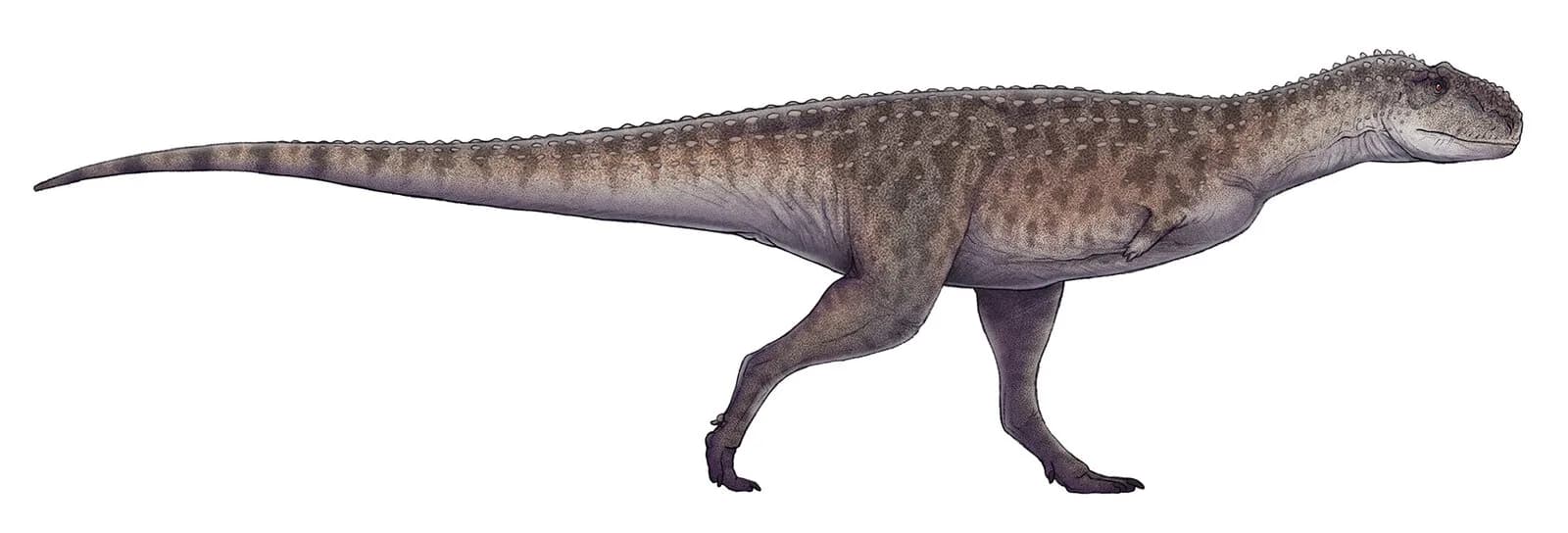
Majungasaurus anatomy is typical of abelisaurids, with characteristics pushed to the extreme. Its short, tall skull bore thickened frontal bones forming a rough dome at the top, probably covered in keratin in life. Its arms were extremely reduced, even shorter proportionally than those of T. rex, with four tiny fingers without functional claws — truly vestigial arms. In compensation, its hindlimbs were short but very powerful, and its muscular tail formed a solid base. Its teeth were more adapted for tearing and ripping than slicing, suggesting a different biting style from carcharodontosaurids.
Majungasaurus was the supreme predator of its island, probably solitary and territorial. Its massive build suggests a power hunter rather than a speed hunter, using ambushes to surprise prey. Evidence of cannibalism indicates aggressive behavior, possibly linked to territorial combat or food stress. Its frontal horn probably played a role in intraspecific combat, with individuals confronting each other head to head as some modern horned animals do. The marked seasonality of its environment may have influenced its activity periods and reproductive cycles.
The first fossils attributed to Majungasaurus were discovered in 1896 by French paleontologist Charles Depéret in Madagascar, but he incorrectly interpreted them as belonging to a pachycephalosaur due to the cranial dome. It was not until 1998, thanks to the discovery of a nearly complete skull by the team of Scott Sampson and David Krause, that the true abelisaurid nature of the animal was recognized. The species was renamed Majungasaurus crenatissimus. Since then, numerous skeletons have been found, making Majungasaurus one of the best-known theropods from the southern hemisphere. The bones bearing cannibalism marks, described in 2007 by Rogers et al., caused a sensation in the scientific community.
| Period | Crétacé supérieur / Late Cretaceous (Maastrichtien) |
| Era | Mésozoïque / Mesozoic |
| Age | 70–66 Ma |
| Location | Afrique / Africa (Madagascar) |
| Length | 6–7 m |
| Height | ~2 m |
| Weight | 700–1 100 kg |
| Diet | Carnivore |
| Discovery | 1895 |
Majungasaurus crenatissimus bones bearing characteristic butchery striations were found in the Maevarano Formation (Madagascar). The tooth imprints on these bones match exactly the dentition of Majungasaurus itself, according to analyses published in 2007 by Rogers et al. in the journal Nature. This evidence makes Majungasaurus crenatissimus the only dinosaur for which cannibalism is scientifically proven.
Majungasaurus crenatissimus forelimbs were even shorter proportionally than Tyrannosaurus rex, with four vestigial fingers lacking functional claws. This extreme reduction, typical of abelisaurids, resulted from evolutionary specialization where the massive head and powerful hind limbs compensated for the loss of frontal grasping ability. Its 60 to 70 cm skull concentrated all offensive power.
Majungasaurus crenatissimus was the exclusive apex predator of Madagascar during the Maastrichtian (70 to 66 Ma), without rival on this isolated island. Its main prey was Rapetosaurus krausei, a titanosaur sauropod whose fossils are abundant in the same Maevarano Formation. It also coexisted with the crocodilian Mahajangasuchus and the giant snake Madtsoia, but only Majungasaurus actively hunted large vertebrates.
Life reconstruction of Majungasaurus crenatissimus
Dmitry Bogdanov, CC BY-SA 3.0, via Wikimedia Commons
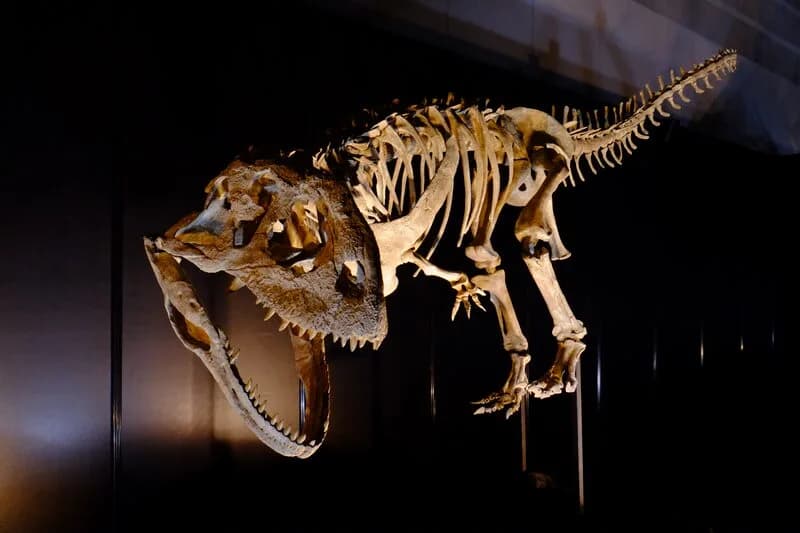
Mounted Majungasaurus crenatissimus skeleton
Kumiko, CC BY-SA 2.0