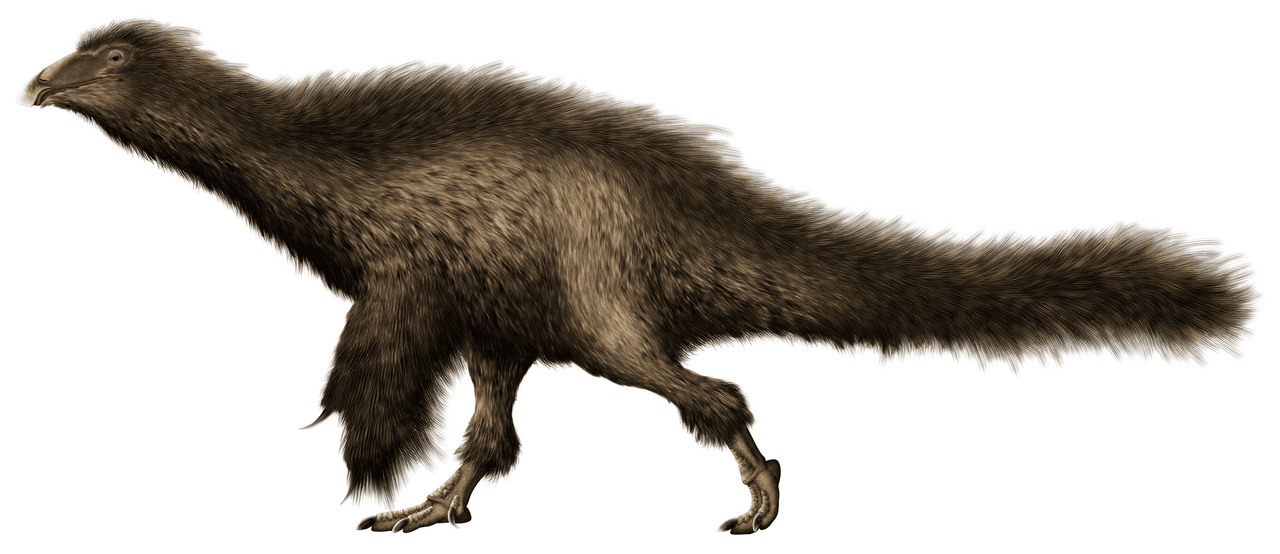
Lézard de Beipiao
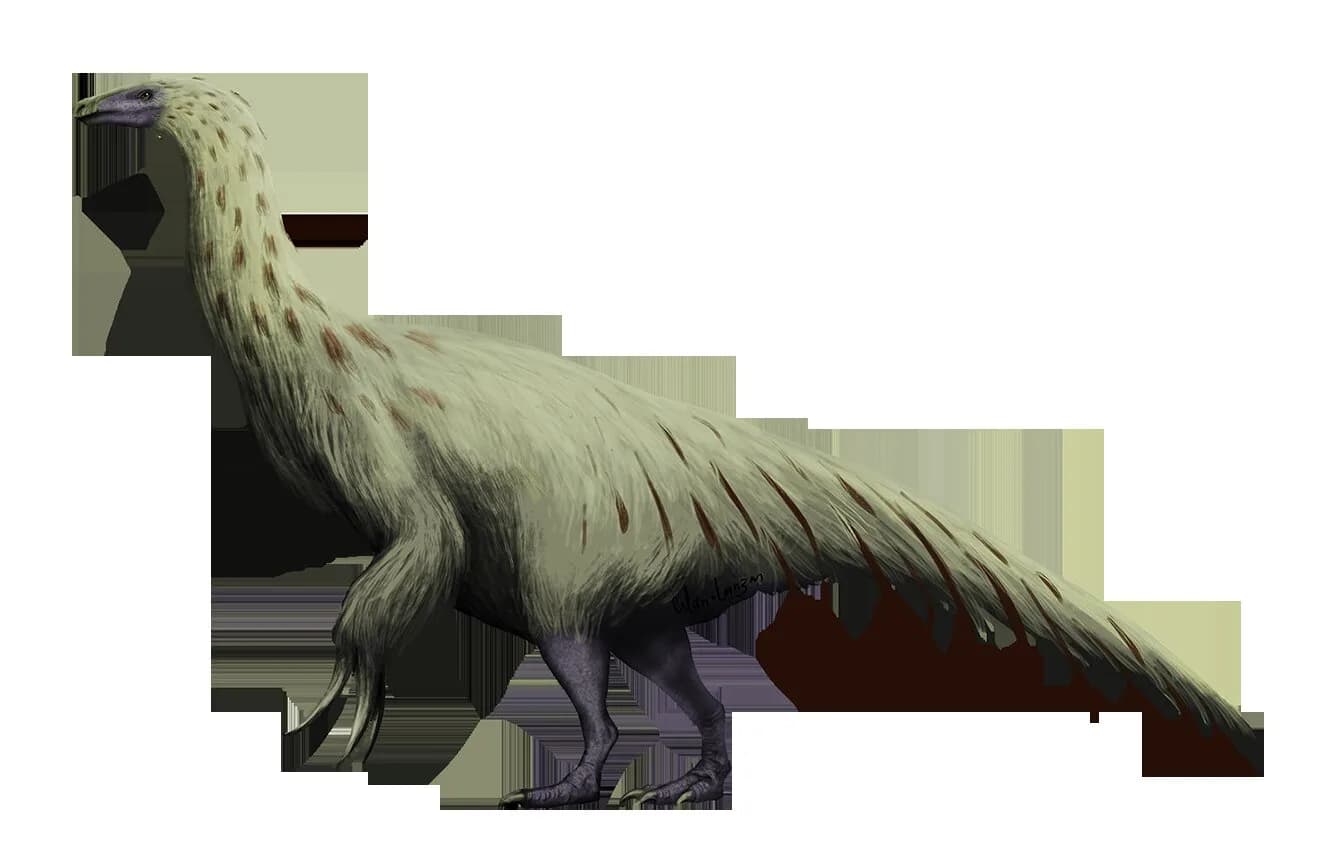
Beipiaosaurus inexpectus is a Chinese therizinosaurid 2.2 to 2.4 metres long and 75 to 90 kilograms, described in 1999. It lived 125 to 122 million years ago. It is one of the first dinosaurs to have yielded direct evidence of feathers: simple filaments, a long way from the structured feathers of birds. It is related to Therizinosaurus, five times its size.
Small feathered therizinosaur. Agile omnivore with defensive claws that deter small predators. Good solo survivor thanks to its dietary versatility.
Playable in The Isle: Evrima
See Beipiaosaurus inexpectus's in-game stats, tier, strengths & weaknesses on our server.
Beipiaosaurus lived during the Early Cretaceous, approximately 124.6 million years ago, during the Aptian stage, in what is now the Yixian Formation of Liaoning Province, China. This famous geological formation is renowned for its exceptional fossil preservation, including soft tissues like feathers, skin impressions, and even stomach contents. The Yixian Formation ecosystem was a temperate lakeland environment periodically disrupted by volcanic activity. Beipiaosaurus coexisted with numerous other feathered dinosaurs, early birds, and diverse invertebrates, making this one of the most important fossil sites in the world for understanding the evolution of feathers and the relationship between dinosaurs and birds.
Beipiaosaurus measured approximately 2.2 meters in length, making it one of the largest feathered dinosaurs known from the Yixian Formation at the time of its discovery. Despite being a therizinosaurid — a group that includes some of the largest theropods — Beipiaosaurus was relatively small compared to its later relatives like Therizinosaurus. Its body was robustly built with a broad torso and relatively short tail. The head was small with a narrow beak, and the forelimbs bore three large, curved claws characteristic of the therizinosaurid family. Its overall proportions suggest a slow-moving animal quite different from the agile predatory theropods that were its distant cousins.
As a therizinosaurid, Beipiaosaurus was almost certainly herbivorous, representing one of the most dramatic dietary shifts in theropod evolution — from carnivory to plant-eating. Its small head with a keratinous beak and leaf-shaped teeth was well-adapted for cropping vegetation including ferns, cycads, and early flowering plants. The large, curved claws on its hands, while formidable in appearance, were likely used for pulling down branches rather than capturing prey. Gastroliths found associated with some therizinosaurid specimens suggest these animals may have used swallowed stones to aid in grinding plant material in their digestive systems, similar to modern herbivorous birds.
Beipiaosaurus inhabited a temperate lakeland environment in the Yixian Formation of Liaoning, characterized by dense conifer forests surrounding volcanic lakes. The landscape was periodically disrupted by volcanic eruptions that, while catastrophic for the local fauna, created the exceptional conditions for fossil preservation that make this site so scientifically valuable. The climate was temperate with distinct seasons, supporting a diverse ecosystem of dinosaurs, early birds, pterosaurs, mammals, and abundant invertebrates. Rivers and streams fed the lakes, creating marshy margins rich in vegetation where herbivores like Beipiaosaurus would have found abundant food resources among the ferns, cycads, and early angiosperms.
Beipiaosaurus is notable for possessing two types of feathery integument: shorter, downy filaments covering much of the body, and longer, simpler structures called EBFFs (elongated broad filamentous feathers) on the head, neck, and tail. These EBFFs represent a unique feather type not found in any other known dinosaur and may have served primarily for display purposes. The skull was small with a toothless beak at the front and small teeth further back in the jaw. The forelimbs bore three large, curved claws typical of therizinosaurids. The pelvis was opisthopubic, meaning the pubic bone pointed backward as in ornithischian dinosaurs, an adaptation related to the enlarged gut needed for processing plant material.
Beipiaosaurus was likely a slow-moving, ground-dwelling herbivore that spent much of its time foraging among the dense vegetation of its forest habitat. Its feathered covering, particularly the elongated display feathers on the head and tail, suggests visual communication played an important role in social interactions, possibly including courtship displays and species recognition. The large claws may have been used defensively against predators as well as for foraging. As a relatively large animal in the Yixian ecosystem, adult Beipiaosaurus likely had few natural predators, though juveniles would have been vulnerable to the numerous small to medium-sized theropods that shared their environment.
Beipiaosaurus inexpectus was described by Xu Xing, Tang Zhilu, and Wang Xiaolin in 1999 from a remarkably well-preserved specimen found in the Yixian Formation near Beipiao City in Liaoning Province, China. The holotype preserves not only the skeleton but also impressions of feathery integument, providing crucial evidence for feather evolution in non-avian dinosaurs. A second specimen described in 2009 revealed the unique elongated broad filamentous feathers (EBFFs), expanding our understanding of the diversity of integumentary structures in theropod dinosaurs. Beipiaosaurus remains one of the most significant discoveries from the Yixian Formation, bridging the gap between small feathered dinosaurs and the larger therizinosaurids.
| Period | Crétacé inférieur / Early Cretaceous |
| Era | Mésozoïque / Mesozoic |
| Age | 122-125 Ma |
| Location | Asie (Chine) / Asia (China) |
| Length | 2.2-2.4 m |
| Height | 1 m |
| Weight | 75-90 kg |
| Diet | Herbivore |
| Discovery | 1999 |
| Type (in-game) | Omnivore |
| Tier | Tier 2 |
Beipiaosaurus inexpectus bore two types of integumentary covering: downy filaments over the body, and flat, rigid, broad structures on the back and neck called EBFFs (Elongated Broad Filamentous Feathers). Described in 2009 from a second specimen, these structures are unique among non-avian dinosaurs and their function — display, thermoregulation, or camouflage — remains debated.
Beipiaosaurus inexpectus had long, robust, curved claws inherited from its carnivorous theropod ancestors, but it was a strict herbivore. These claws mainly served to pull branches down to reach high vegetation, like modern sloths, and possibly for defense against predators in the Yixian Formation. Its lancet-leaf-shaped teeth ground plant matter, not prey.
Beipiaosaurus inexpectus measured about 2.2 to 2.4 meters in length and weighed 75 to 90 kg, making it one of the largest known feathered dinosaurs of the Early Cretaceous of China (122-125 Ma). It is one of the most primitive known therizinosaurs, representing a close ancestor to Therizinosaurus cheloniformis, a Late Cretaceous giant exceeding 10 meters and 5 tonnes.
Beipiaosaurus holotype fossil
Wikipedia Commons
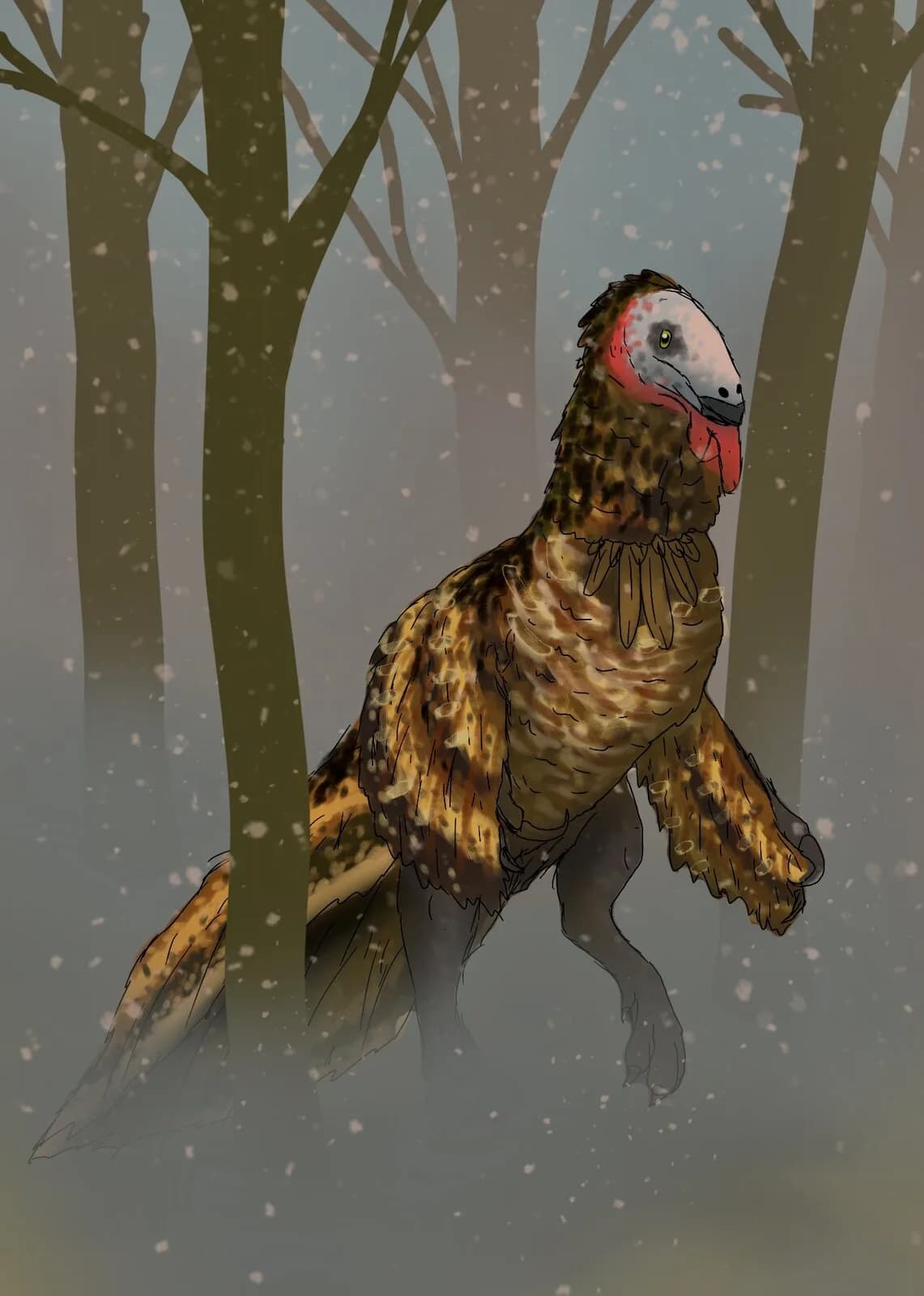
Beipiaosaurus inexpectus reconstruction in a snowy forest
PaleoEquii, CC BY-SA 4.0