Amargasaure
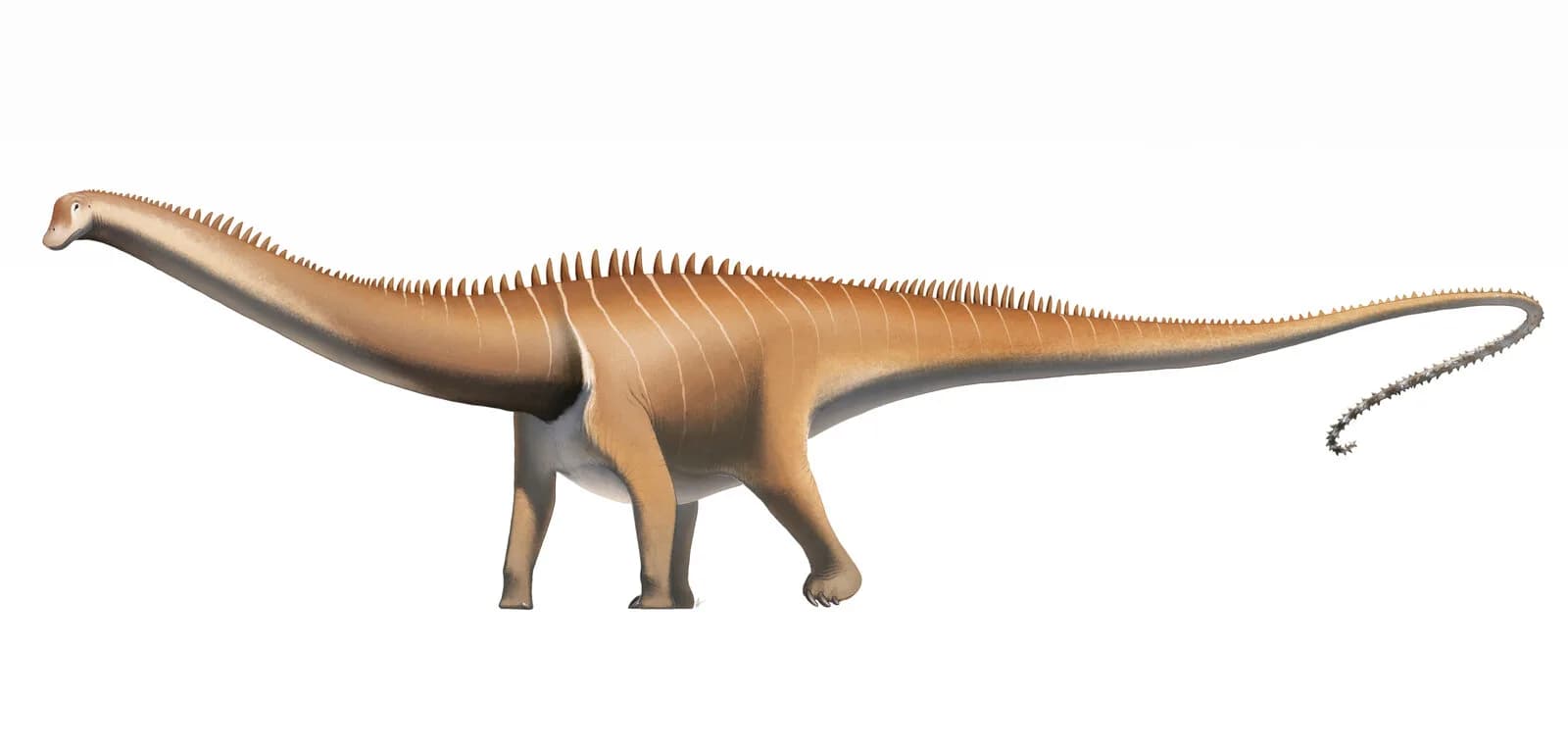
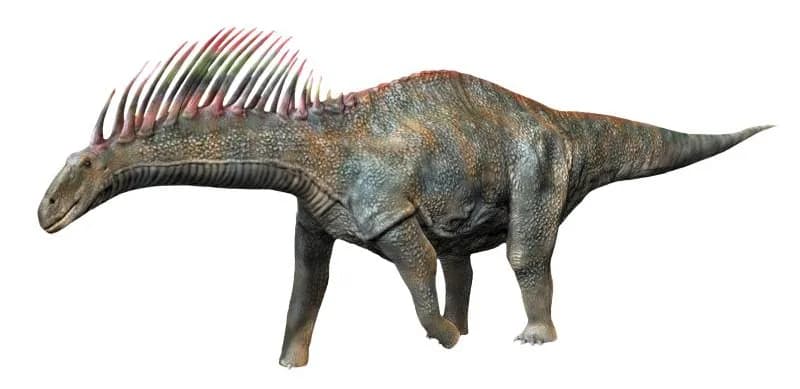
Amargasaurus cazaui was a herbivorous sauropod from Argentina, described in 1984 and dated to 129 to 122 million years ago. At 9 to 10 metres, it ranks among the smallest sauropods known. The two rows of spines along its neck are unique among all dinosaurs: they may have supported a skin sail used for thermoregulation or display.
Playable in Path of Titans
See Amargasaurus cazaui's stats, abilities and role on our survival server.
Amargasaurus lived during the Early Cretaceous, approximately 129 to 122 million years ago, during the Barremian to Aptian stages. At this time, South America was beginning to separate from Africa with the progressive opening of the South Atlantic. Argentine Patagonia, where it was discovered, enjoyed a temperate to subtropical climate with marked seasons. The dicraeosaurid sauropods, to which Amargasaurus belongs, represented a distinct evolutionary lineage characterized by shorter necks than other sauropods and remarkably elongated neural spines, setting them apart from the more typical long-necked sauropod body plan.
Amargasaurus was a relatively modest-sized sauropod, measuring about 9 to 10 meters long with an estimated weight of 2 to 3 tonnes. This is considerably smaller than the giant titanosaurs that would dominate South America later in the Cretaceous. Its head was small and elongated, typical of diplodocimorphs, with a narrow snout adapted for selective feeding. What immediately distinguished it from other sauropods was the spectacular row of long dorsal spines along its neck and back, reaching up to 60 centimeters in height, making it one of the most visually striking sauropods ever discovered.
Amargasaurus was a herbivore that fed primarily on ferns, horsetails, and low vegetation available in its Patagonian habitat. Its relatively short neck compared to other sauropods suggests it fed at low to medium heights, rather than in the tree canopy. Its teeth were peg-shaped, adapted for stripping leaves from branches rather than chewing them. Like other diplodocimorphs, it compensated for its inability to chew through prolonged fermentative digestion in a vast gastrointestinal system, and perhaps used gastroliths to help grind tough plant material in its stomach.
Amargasaurus inhabited the La Amarga Formation in Neuquén Province, Argentine Patagonia. This environment was an alluvial plain with rivers, wooded areas, and fern meadows that provided ample feeding grounds. The climate was temperate with marked seasons, offering sufficient vegetation to support herds of sauropods throughout the year. The associated fauna included other herbivorous dinosaurs and predatory theropods that shared this diverse ecosystem. Amargasaurus occupied an ecological niche as a medium-sized browser, feeding at different heights from the larger sauropods with which it coexisted, reducing direct competition for food.
The most striking anatomical feature of Amargasaurus is its double row of long bifurcated neural spines extending along the neck and front portion of the back. These spines, among the most developed of all sauropods, have sparked scientific debate: were they covered by a skin sail or did they stand freely like spikes? Recent studies favor the hypothesis of horn-like or keratin-covered spike structures rather than a sail. Its elongated skull bore elongated nostrils and peg-shaped teeth restricted to the front of the jaw.
Amargasaurus was probably a gregarious animal that moved in small herds across the Patagonian plains during the Early Cretaceous. Its spectacular dorsal spines likely played a significant role in visual communication between individuals, whether for species recognition, courtship display, or establishing social hierarchies within the group. If they were indeed spike-like structures, they could also serve as an effective defense against predators, making the neck and back difficult to bite. Its locomotion was quadrupedal and relatively slow, typical of sauropods of its modest size.
The only known Amargasaurus specimen (MACN-N 15) was discovered in 1984 by Argentine paleontologist Leonardo Salgado and his team in the La Amarga Formation, near the town of Zapala, in Neuquén Province, Argentina. The skeleton is remarkably complete for a sauropod, comprising the skull, most of the vertebral column with its spectacular neural spines, the pectoral and pelvic girdles, and portions of the limbs. Leonardo Salgado and José Bonaparte described it in 1991 as Amargasaurus cazaui, the genus name referring to the Amarga locality and the species honoring Dr. Luis Cazau.
| Period | Crétacé inférieur / Early Cretaceous (Barremien–Aptien) |
| Era | Mésozoïque / Mesozoic |
| Age | 129–122 Ma |
| Location | Amérique du Sud / South America (Argentine / Argentina) |
| Length | 9–10 m |
| Height | ~4 m (avec épines) |
| Weight | 2 600–8 000 kg |
| Diet | Herbivore |
| Discovery | 1984 |
The bifurcated neural spines of Amargasaurus cazaui, reaching up to 60 centimeters, are the most developed of any sauropod. Scientific debate opposes two hypotheses: a skin sail for thermoregulation, or keratin-covered spike-like structures. Recent studies favor rigid spikes serving for visual communication or defense — a structure with no equivalent in any other dinosaur.
Amargasaurus cazaui measured 9 to 10 meters and weighed 2.6 to 8 tonnes — modest compared to South America's giant titanosaurs. This Barremian-Aptian dicraeosaurid (129-122 Ma) from Neuquén Province, Argentina, ranks among the smallest sauropods. Its single specimen (MACN-N 15), remarkably complete, was discovered in 1984 by Leonardo Salgado and described in 1991 by Salgado and Bonaparte.
An herbivore, Amargasaurus cazaui fed mainly on ferns and low vegetation rather than the canopy. Its neck, shorter than typical diplodocids, limited access to high branches. Its peg teeth stripped leaves without chewing; fermentative digestion in a large gut compensated. It likely grazed at the same sites as larger sauropods but at different heights, avoiding direct competition.
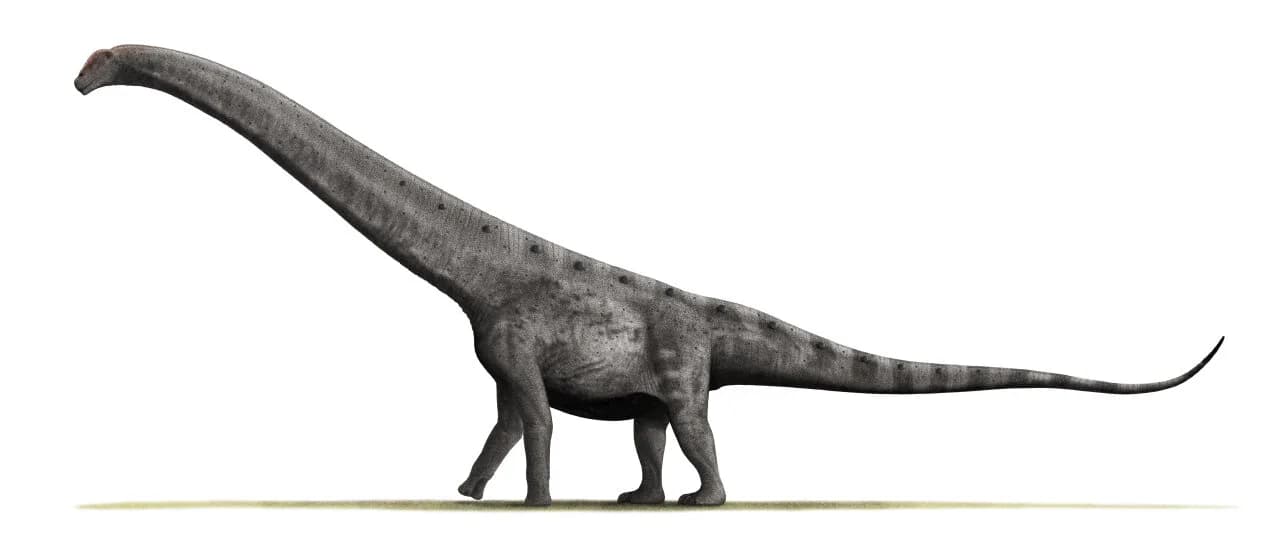
Life reconstruction of Amargasaurus cazaui
Nobu Tamura, CC BY-SA 4.0, via Wikimedia Commons
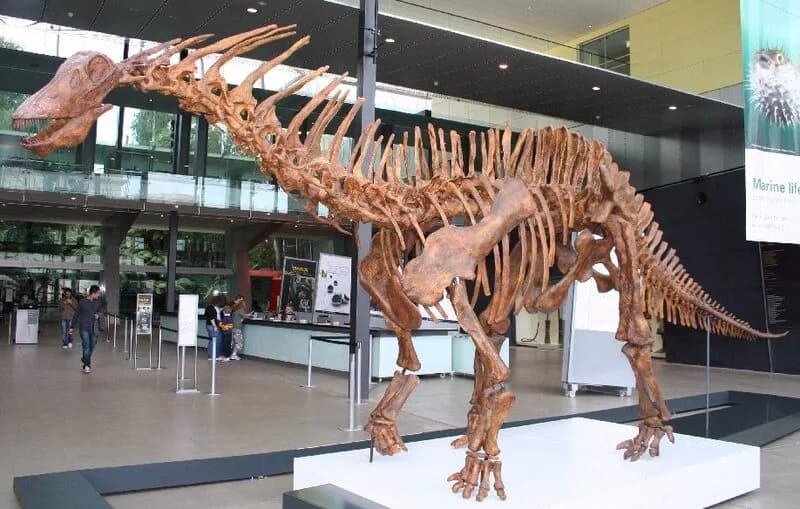
Mounted Amargasaurus cazaui skeleton, Melbourne Museum
Casliber, Public domain