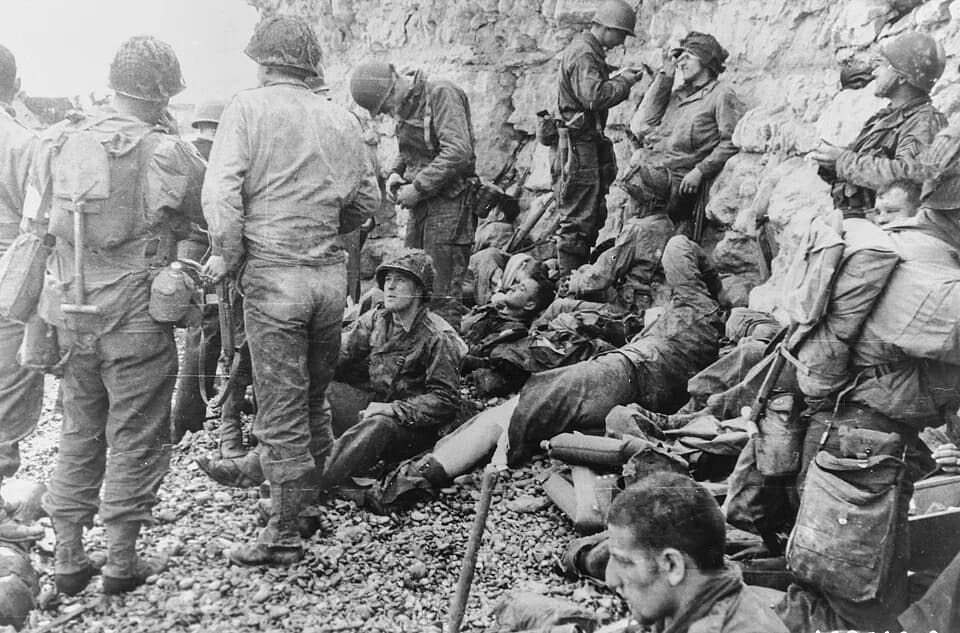
On June 6, 1944, the largest amphibious operation in history landed 156,000 Allied soldiers on the beaches of Normandy. D-Day opened a second front in Western Europe and marked the beginning of the liberation of France and Western Europe from Nazi rule.
Since 1942, Stalin had been insistently demanding the opening of a second front in Western Europe to relieve the Red Army, which bore the brunt of the ground war against Germany. After the landings in North Africa in 1942 and Italy in 1943, the Anglo-American Allies finally planned the invasion of France. Operation Overlord, under the supreme command of General Eisenhower, was the most complex military operation ever conceived. Preparations took over a year, as England was transformed into a gigantic military base housing three million soldiers. The Allies mounted a massive deception operation codenamed Fortitude to convince the Germans that the landing would take place at Pas-de-Calais rather than Normandy. A fictitious army group supposedly commanded by Patton, equipped with inflatable tanks and fake radio signals, effectively deceived the Germans. Hitler and his general staff remained convinced that Normandy was merely a diversion, even after June 6. The Atlantic Wall, a system of coastal fortifications designed by Rommel, defended the shoreline but was not completed everywhere along its vast length.
On June 6, 1944, after a 24-hour postponement due to bad weather, Eisenhower launched the operation. Starting at midnight, 24,000 paratroopers from the American 82nd and 101st Airborne Divisions and the British 6th Airborne Division jumped behind enemy lines to secure key bridges and crossroads. At dawn, an armada of 6,939 ships crossed the English Channel. Naval and aerial bombardment pounded the coastal defenses. At 6:30 AM, the first assault waves hit five beaches: Utah and Omaha in the American sectors, Gold and Sword in the British sectors, and Juno in the Canadian sector. On Omaha Beach, the situation was critical as the American 1st Division faced the formidable German 352nd Division on fortified cliffs. Casualties were terrible, approximately 2,000 killed and wounded, and the landing nearly failed. On the other beaches, progress was better. By the end of June 6, 156,000 men had landed, but the day's objectives, including the capture of Caen, were not achieved. The Allies suffered approximately 10,000 casualties including 4,414 confirmed dead.
D-Day opened the long-awaited second front demanded by Stalin and trapped Germany in a two-front war in Europe. In the following weeks, the Allies landed massive quantities of men and materiel through the artificial Mulberry harbors, one of which was destroyed by a storm on June 19. The Battle of Normandy proved far longer and bloodier than expected: Caen did not fall until July 21, and the Norman hedgerow country, known as the bocage, favored the German defense. The decisive breakthrough came in late July with Operation Cobra, which allowed Patton's armor to sweep through Brittany and outflank the German forces. In August, the Falaise pocket trapped 100,000 German soldiers. On August 15, a second landing in Provence under Operation Dragoon opened a southern front. Paris was liberated on August 25, 1944. Within months, France, Belgium, and Luxembourg were freed from occupation. D-Day dramatically accelerated the end of the war in Europe: less than a year later, on May 8, 1945, Germany surrendered unconditionally.
D-Day was a triumph of planning, logistics, and individual courage. Allied air superiority, with 11,000 sorties on June 6 compared to just 319 by the Germans, was the decisive factor: it prevented German reinforcements from reaching the beaches and blinded the enemy command structure. Operation Fortitude stands as one of the greatest military deception successes in history: even two months after D-Day, Hitler kept elite divisions stationed at Pas-de-Calais awaiting a supposedly real landing. German errors were numerous: Rommel was absent on June 6, having traveled to Germany for his wife's birthday; the Panzer divisions could not move without Hitler's personal authorization, and he slept until noon that day; and the command structure was paralyzed by disputes between Rommel and von Rundstedt over defensive strategy. The courage of the soldiers, particularly at Omaha Beach, remains a universal symbol of sacrifice and determination. The international cooperation among Americans, British, Canadians, Free French, Poles, and Norwegians foreshadowed the postwar alliances that would shape the decades to come.
The documentation on D-Day is monumental in scope. The SHAEF (Supreme Headquarters Allied Expeditionary Force) archives at the National Archives in Washington and the Public Record Office in London constitute the primary source material. The foundational work is The Longest Day by Cornelius Ryan, published in 1959, based on more than 3,000 individual testimonies. D-Day by Antony Beevor, published in 2009, offers the most complete and recent analysis, integrating German and French sources alongside the Anglo-American perspective. Overlord by Max Hastings, published in 1984, remains essential for military analysis. The American cemetery at Colleville-sur-Mer with its 9,387 graves, the British cemetery at Bayeux, and the Canadian cemetery at Beny-sur-Mer bear witness to the human cost. The Caen Memorial and the D-Day museums at Utah Beach and Arromanches hold exceptional collections. The oral archives at the Eisenhower Center in New Orleans and the Imperial War Museum in London preserve veterans' testimonies for future generations.
On June 6, 1944, after a 24-hour weather delay, 156,000 Allied soldiers landed on five Norman beaches: Utah and Omaha (American sectors), Gold and Sword (British sectors), and Juno (Canadian sector). From midnight, 24,000 paratroopers had already jumped behind enemy lines. An armada of 6,939 ships crossed the English Channel. The Allies suffered approximately 10,000 casualties including 4,414 confirmed dead on that single day.
At Omaha Beach, the 1st American Division faced the formidable German 352nd Division entrenched on fortified cliffs. Unlike other beaches, the amphibious armor sank almost entirely before reaching shore. Casualties were terrible — approximately 2,000 killed and wounded — and the landing nearly failed. This was the most critical point of D-Day; the individual courage of American soldiers ultimately allowed overcoming the defenses.
Operation Fortitude deceived the Germans into believing the landing would occur at Pas-de-Calais. A fictitious army group supposedly commanded by Patton, equipped with inflatable tanks and fake radio signals, convinced Hitler and his general staff. Even two months after D-Day, German elite divisions were still waiting for a 'real' landing at Pas-de-Calais, allowing the Allies to reinforce the Norman beachhead without concentrated opposition.
Information cross-checked against Wikipedia and reference historical works.
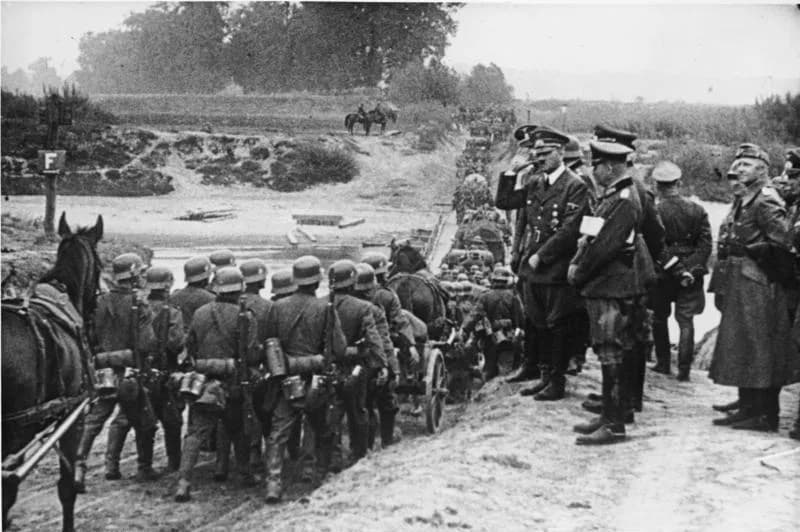
Invasion of Poland
The invasion of Poland by Nazi Germany on 1 September 1939 triggered World War II. In barely five weeks, German and then Soviet forces crushed the Polish army, applying the Blitzkrieg doctrine on a large scale for the first time. Britain and France declared war on 3 September.
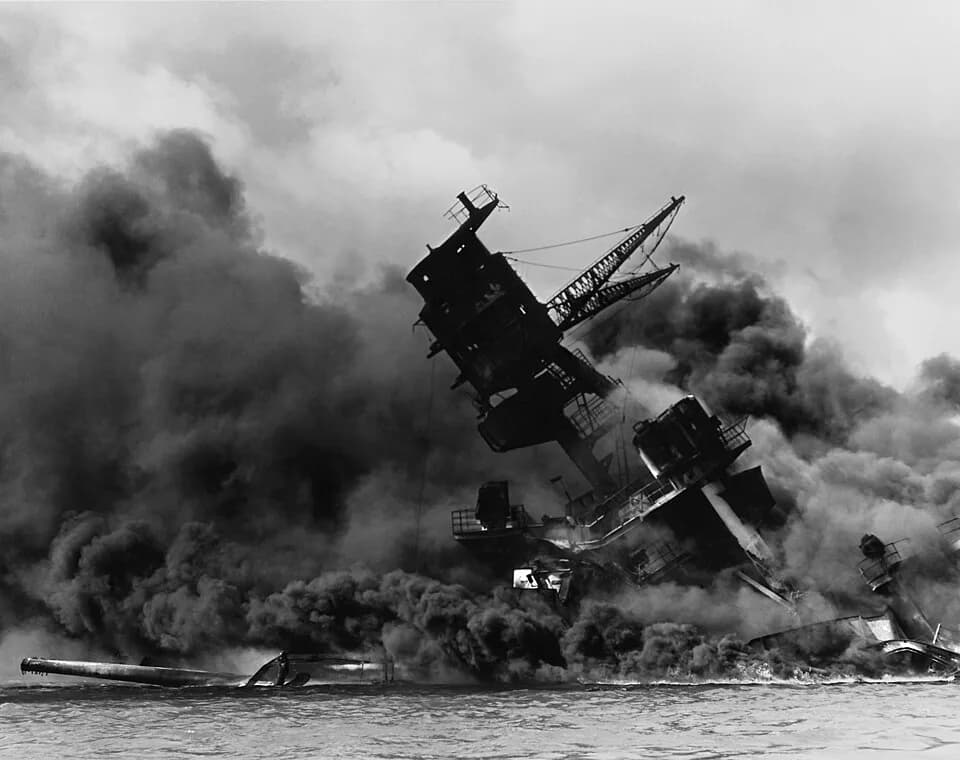
Attack on Pearl Harbor
The surprise Japanese attack on the American naval base at Pearl Harbor on December 7, 1941 triggered the United States' entry into the war. This event transformed an essentially European conflict into a true world war and ultimately sealed the fate of the Axis powers.
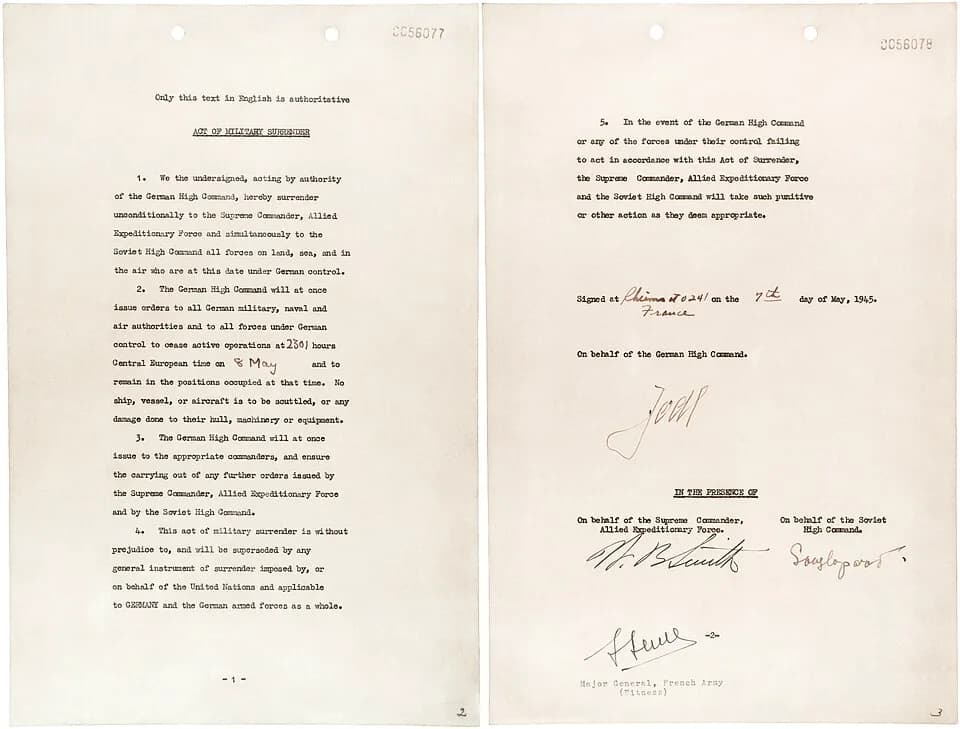
Surrender of Germany
On May 8, 1945, Nazi Germany surrendered unconditionally, ending the war in Europe after nearly six years of conflict. This event, celebrated as Victory in Europe Day (V-E Day), marked the fall of the Third Reich and the beginning of a new geopolitical era.
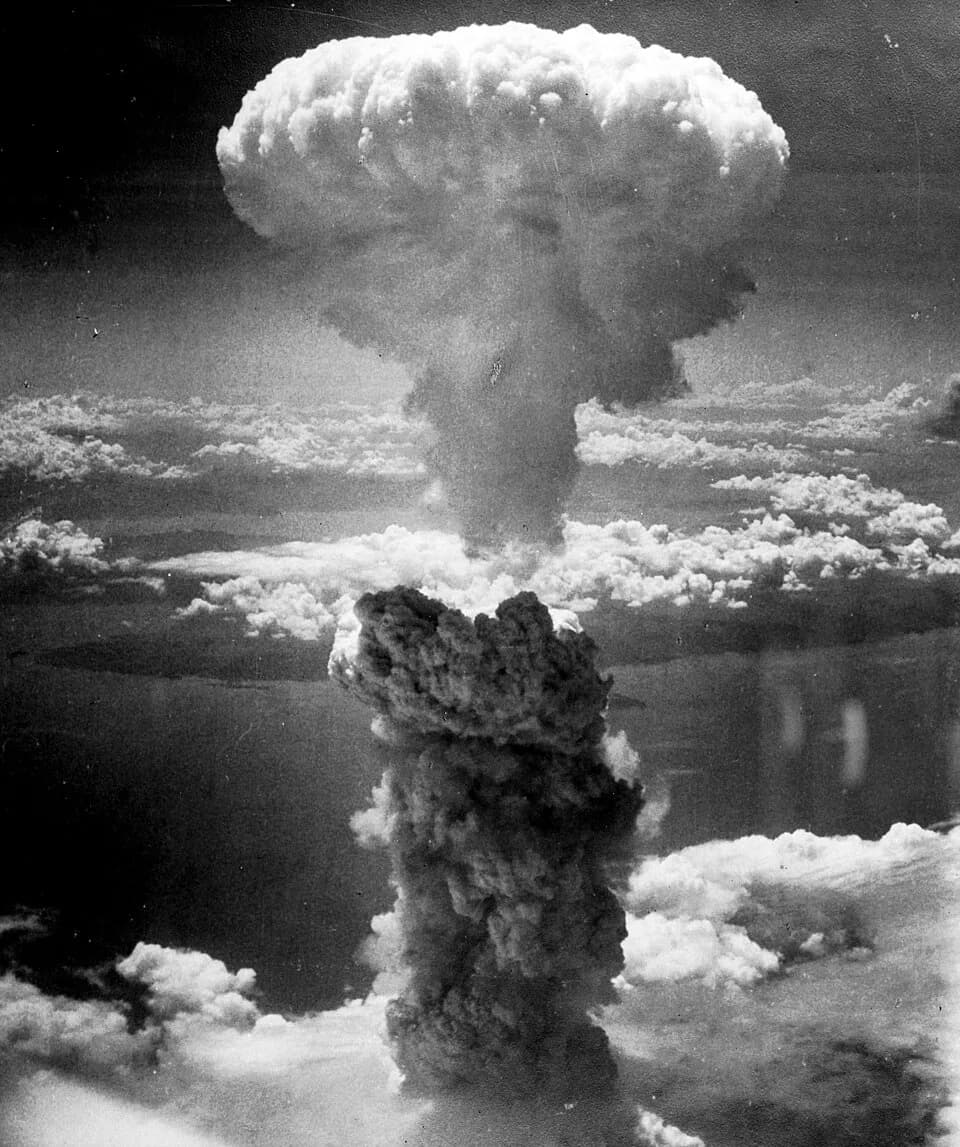
Atomic Bombings of Hiroshima and Nagasaki
The atomic bombings of Hiroshima (August 6) and Nagasaki (August 9, 1945) are the only uses of nuclear weapons in warfare. These attacks killed between 150,000 and 226,000 people and led to Japan's surrender, ending World War II while ushering in the nuclear age.
