Zuul
Zuul crurivastator owes its name to the hound demon in Ghostbusters, so closely does its horned skull recall the film's creature. Its epithet, « destroyer of shins », points to its tail club. About 6 metres long and 2.5 tonnes, found in Montana in 2014, it lived 76 to 75 million years ago. Its type specimen preserves skin and osteoderms in place.
Zuul crurivastator lived during the Late Cretaceous, approximately 76 to 75 million years ago (Campanian stage), in what is now Montana, United States. This dinosaur belongs to the family Ankylosauridae, specifically the subfamily Ankylosaurinae, making it a close relative of Ankylosaurus itself. It was described in 2017 by paleontologists Victoria Arbour and David Evans, based on a remarkably complete specimen discovered in 2014 in the Judith River Formation. The generic name 'Zuul' references the demonic dog creature from the 1984 film Ghostbusters, due to the striking resemblance between the dinosaur's skull and the fictional creature.
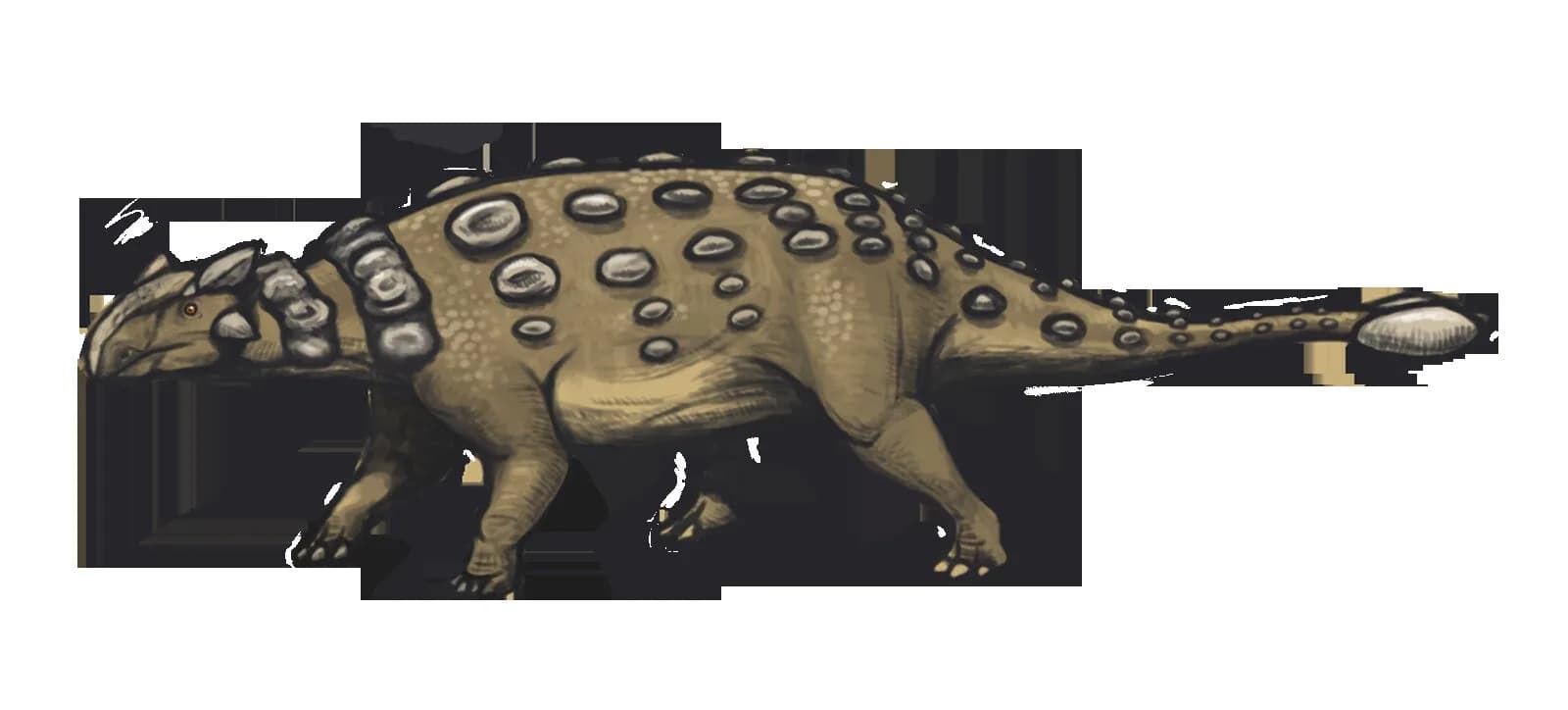
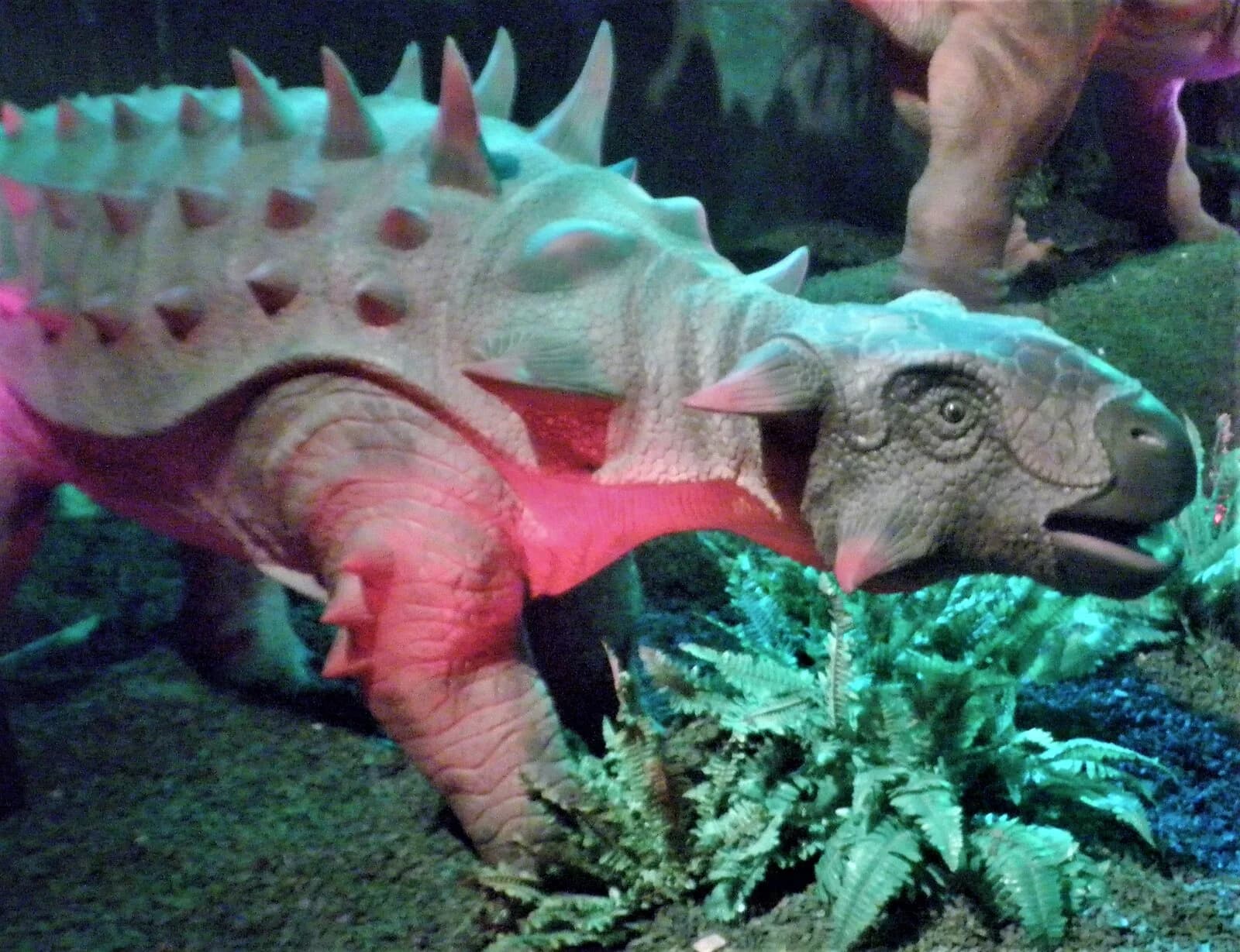
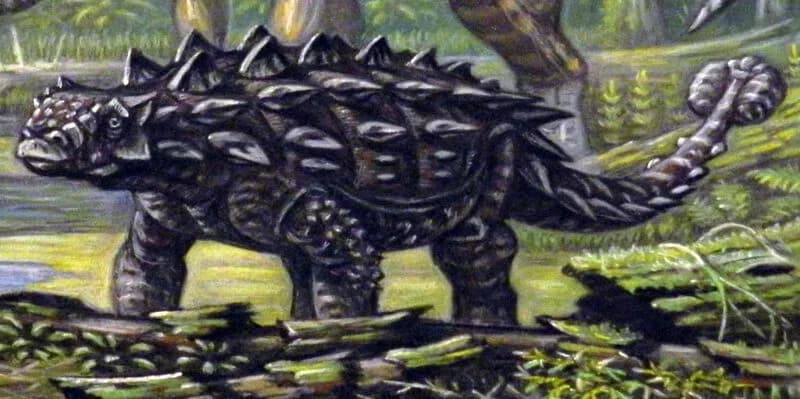
Zuul crurivastator measured approximately 6 meters in total length, with an estimated weight of about 2.5 tonnes. These dimensions place it among medium-to-large ankylosaurs. Its skull, relatively short but extremely robust, was covered in prominent osteoderms that gave it its characteristic demonic appearance. The tail, the most distinctive feature of the animal, terminated in an imposing bony club composed of fused vertebrae and welded osteoderms, forming a natural 'hammer.' The entire body was protected by an armor of osteoderms and lateral spines, creating a nearly impenetrable defensive shell.
A strict herbivore, Zuul fed on low-growing vegetation typical of Late Cretaceous North America: ferns, horsetails, cycads, and primitive angiosperms. Its horny beak at the front of the jaw allowed it to crop tough stems and leaves, while its small leaf-shaped teeth at the back ground plant material before swallowing. Its stocky build and short legs suggest it primarily grazed at ground level, at a maximum height of about one meter. Its ecological niche was comparable to that of modern giant land tortoises, but on a much larger scale.
Zuul inhabited the coastal plains and fluvial environments of western North America, in the region corresponding to modern-day Montana. The Judith River Formation, where the holotype specimen was discovered, represented a landscape of subtropical floodplains bordered to the east by the vast Western Interior Seaway that divided the continent in two. This rich and productive ecosystem harbored a remarkably diverse fauna including hadrosaurids such as Gryposaurus, ceratopsians like Coronosaurus, and predatory theropods such as Gorgosaurus. Dense conifer forests, fern prairies, and seasonal wetlands provided abundant year-round vegetation for armored herbivores like Zuul.
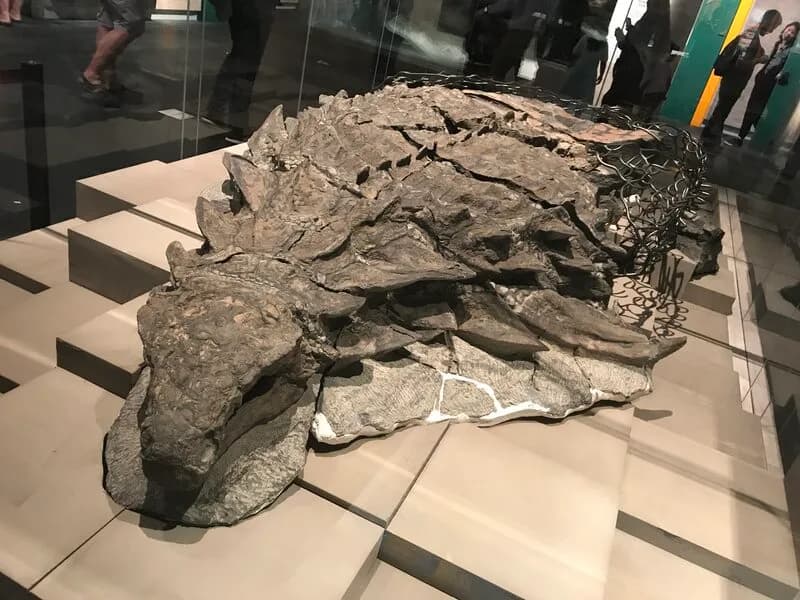
Zuul's anatomy is dominated by its exceptional defensive armor. The skull features prominent squamosal horns and ornamental osteoderms that give it its 'gargoyle-like' appearance. Along the back and flanks, rows of variously shaped osteoderms — oval plates, conical spines, rounded nodules — form a protective mosaic remarkably preserved on specimen ROM 75860. The flanks bear sharp lateral spines, providing additional protection against predators. The rigid tail, reinforced by ossified tendons, terminates in the tail club characteristic of Ankylosauridae, which is absent in the related Nodosauridae.
The most revealing discovery regarding Zuul's behavior comes from injuries observed on the osteoderms of its flanks. In 2022, a study led by Arbour and colleagues demonstrated that these lesions were consistent with blows from another ankylosaur's tail club — not from a predator. This observation suggests Zuul used its club for intraspecific combat, likely male-to-male competition during the mating season. The species epithet 'crurivastator' ('destroyer of shins') refers to this ability to deliver powerful strikes to the lower legs of opponents, whether conspecifics or predatory theropods.
The holotype specimen ROM 75860, housed at the Royal Ontario Museum in Toronto, is one of the best-preserved ankylosaurs ever discovered. Unearthed in 2014 in the Judith River Formation of Montana, this exceptional fossil includes a complete skull, articulated dorsal armor, the complete tail with its club, and fossilized soft tissues including skin impressions and keratinized scales. The fossil's preparation required several years of meticulous work. Officially described in 2017 by Arbour and Evans in the journal Royal Society Open Science, the specimen was displayed to the public at the ROM in the exhibition 'Zuul: Life of an Armoured Dinosaur' in 2022.
| Period | Crétacé supérieur / Late Cretaceous |
| Era | Mésozoïque / Mesozoic |
| Age | 76-75 Ma |
| Location | Amérique du Nord (Montana) / North America (Montana) |
| Length | ~6 m |
| Height | ~1.7 m |
| Weight | ~2.5 tonnes |
| Diet | Herbivore |
| Discovery | 2014 |
The holotype specimen ROM 75860 of Zuul crurivastator, housed at the Royal Ontario Museum in Toronto, is one of the best-preserved ankylosaurs ever discovered. Unearthed in 2014 in the Judith River Formation (Montana), it includes a complete skull, articulated dorsal armor, the tail with its club, and fossilized soft tissues including skin impressions and keratinized scales — an extremely rare occurrence for a 76-million-year-old fossil.
A 2022 study by Victoria Arbour and colleagues demonstrated that the lesions observed on the flank osteoderms of Zuul crurivastator are consistent with blows from another ankylosaur's tail club — not from a predator. This observation proves that Zuul used its club during intraspecific combat, likely for male-to-male competition during the breeding season, explaining the species name 'crurivastator' (destroyer of shins).
Zuul crurivastator measured approximately 6 meters in length with an estimated weight of 2.5 tonnes. It lived approximately 76 to 75 million years ago (Campanian, Late Cretaceous) in present-day Montana. Belonging to the Ankylosauridae (subfamily Ankylosaurinae), it was a close relative of Ankylosaurus itself. It was described in 2017 by Arbour and Evans in Royal Society Open Science.
Life reconstruction of Zuul crurivastator in its natural environment
ABelov2014, CC BY-SA 3.0
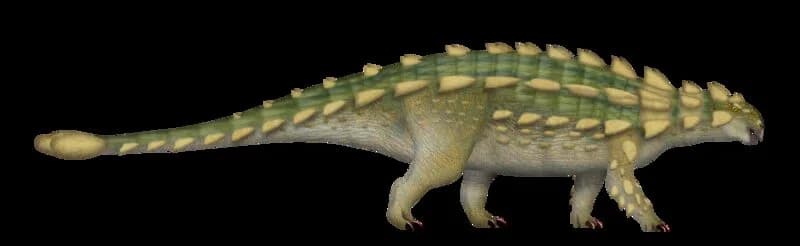
Illustration of Zuul crurivastator showing its armor and tail club
TotalDino, CC0