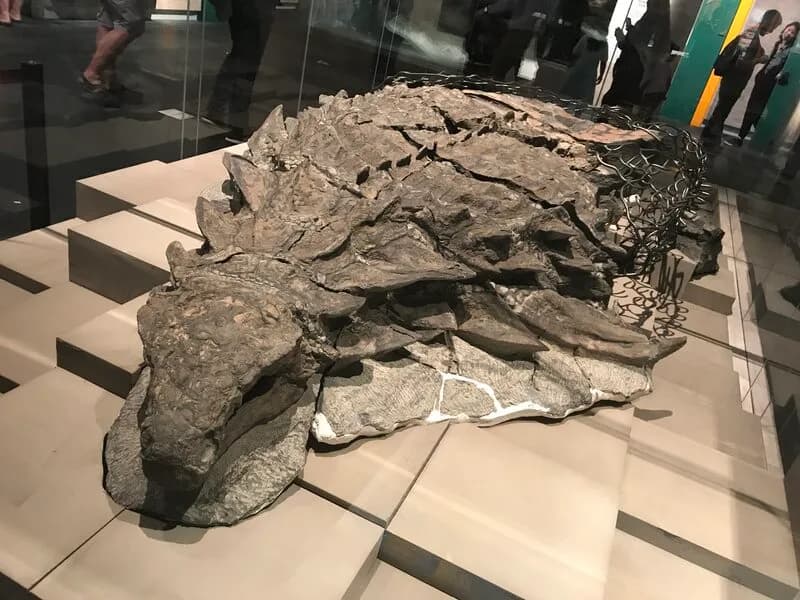
Bouclier du Nord
Borealopelta markmitchelli was an armoured herbivorous dinosaur of the Early Cretaceous, living 110 million years ago in what is now Alberta. Its holotype TMP 2011.033.0001, uncovered on 21 March 2011 in an oil sands mine, preserved skin and osteoderms in place. That preservation revealed its countershading: dark back, pale belly, camouflage rarely seen in an animal weighing 1300 kilograms.
Borealopelta lived during the Early Cretaceous period, approximately 110 million years ago, during the Albian stage. This period corresponds to a time when North America was partially divided by the Western Interior Seaway, which was beginning to extend from the Gulf of Mexico toward the Arctic. The climate was significantly warmer than today, with no polar ice caps, and present-day Alberta enjoyed a humid subtropical climate. Borealopelta lived on the coastal plains bordering this nascent interior sea, in an environment rich in conifer, fern, and primitive flowering plant vegetation. The ecosystem hosted a diverse fauna of dinosaurs, including ornithopods and other herbivores, as well as predatory theropods. The fact that the specimen was found in marine sediments suggests the carcass was carried out to sea after the animal's death, probably by a river flood.
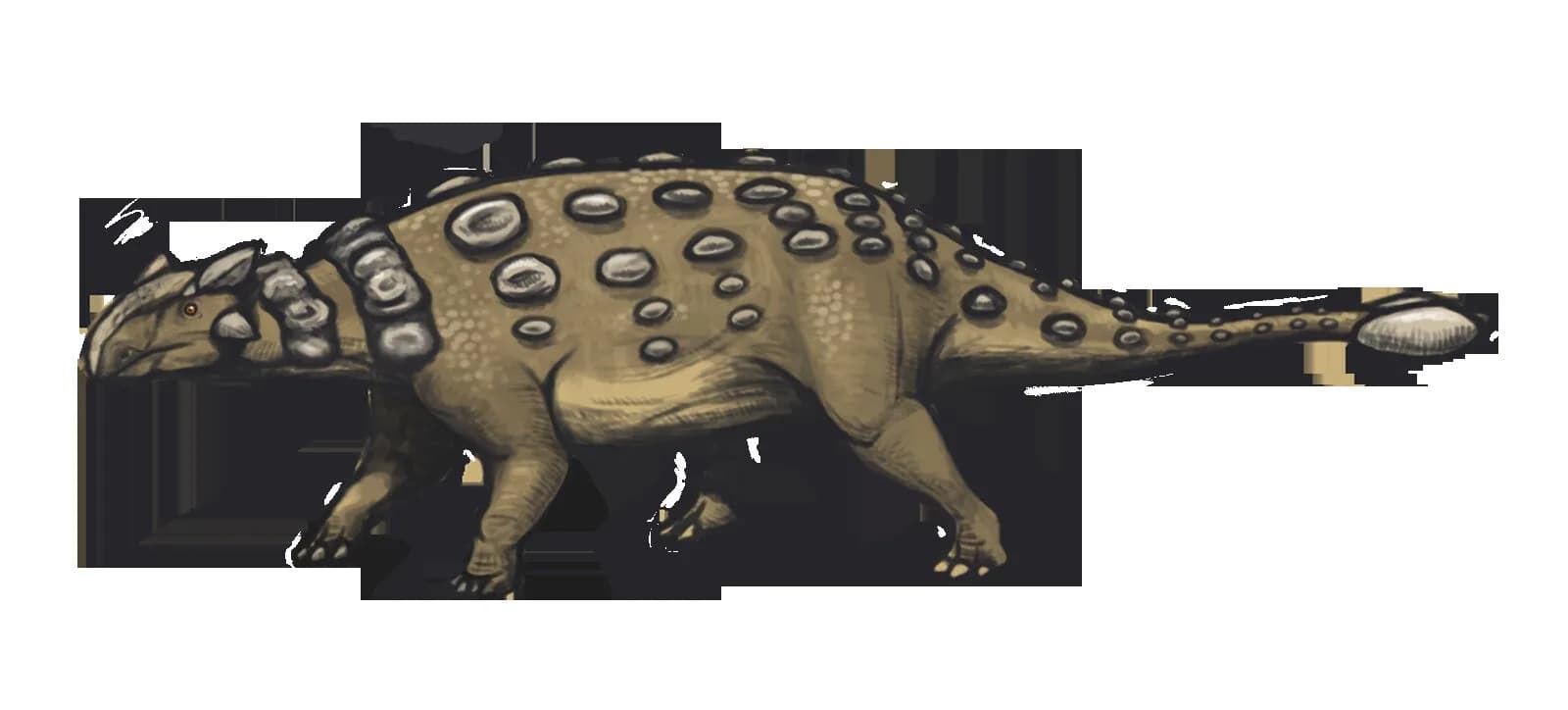
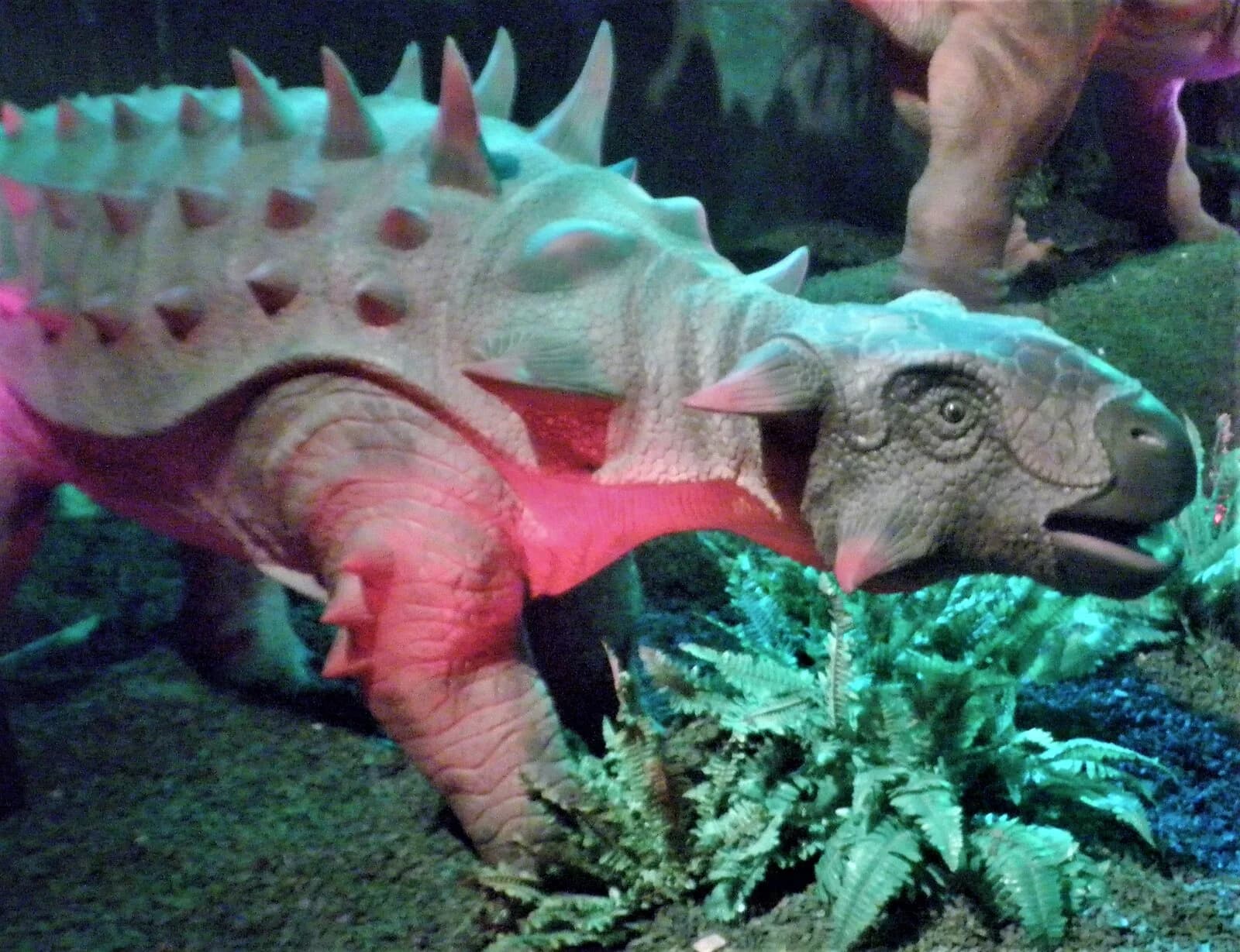
Borealopelta measured approximately 5.5 meters in total length and weighed between 1,300 and 1,500 kilograms. Its body was low and wide, built like a biological tank, with a hip height of approximately 1.2 meters. The skull was relatively small compared to the body, measuring about 36 centimeters in length, with a horned beak at the front of the jaw adapted for tearing low vegetation. The entire back and flanks were covered in armor composed of osteoderms — bony plates embedded in the skin — of varied shapes and sizes. Two large prominent parascapular spines, measuring over 50 centimeters, jutted from each shoulder, giving the animal an intimidating silhouette. The belly was devoid of armor, constituting the typical vulnerable point of nodosaurids. The limbs were robust and short, with broad feet adapted to support the considerable weight of the bony armor.
A strict herbivore, Borealopelta fed on low vegetation, primarily ferns, as revealed by exceptional analyses of its fossilized stomach contents. The study published in 2020 in the journal Royal Society Open Science identified in the preserved abdominal mass a predominance of fern leaves from the Gleicheniaceae family, representing about 88% of the contents, mixed with fragments of carbonized wood (charcoal) suggesting the animal fed in areas recently ravaged by forest fires. This discovery indicates that Borealopelta practiced selective browsing rather than generalist herbivory. The presence of gastroliths (stomach stones) was not confirmed in this specimen. The horned beak, lacking teeth at the front, was perfectly adapted for shearing fern fronds, while the small leaf-shaped cheek teeth served for minimal mastication before swallowing.
Borealopelta inhabited the coastal plains of western North America, in what is now northeastern Alberta, Canada. Its environment was that of a coastal alluvial plain bordering the western shore of the nascent Western Interior Seaway. The landscape was dominated by conifer forests (araucarias, primitive sequoias) and dense fern understories, interspersed with watercourses and wetlands. The subtropical climate offered mean annual temperatures markedly higher than present-day Alberta, with no winter frost. Forest fires were frequent, as evidenced by the charcoal found in the specimen's stomach, and Borealopelta took advantage of vegetation regrowth in burned areas to feed. The fact that the fossil was discovered in marine sediments of the Clearwater Formation, more than 300 kilometers from the estimated coastline of the time, indicates that the carcass drifted at sea for several days before sinking and being buried in marine muds.
Borealopelta anatomy is known in unprecedented detail thanks to the spectacular three-dimensional preservation of the holotype specimen, often described as a 'dinosaur mummy.' Unlike most fossils that are flattened by sediment pressure, this specimen retained its three-dimensional shape, including skin, scales, keratinous sheaths of the osteoderms, and even traces of organic pigments. The dorsal armor was organized in symmetrical rows of osteoderms of varied sizes, ranging from small polygonal plates of a few centimeters to large oval plates exceeding 20 centimeters. The parascapular spines, the largest defensive structures on the body, were covered in keratinous sheaths that doubled their apparent size. Chemical analyses revealed the presence of pheomelanin in the skin, giving the animal a reddish-brown coloration on its back with a lighter belly, a countershading pattern used by many modern animals for camouflage. This remarkable discovery suggests that despite its imposing size and armor, Borealopelta still needed camouflage, implying the presence of predators dangerous enough to threaten such a well-protected animal.
Borealopelta was likely a solitary herbivore or one living in small loose groups, moving slowly through plains and understories in search of low vegetation. Its stocky morphology and short limbs suggest an animal with slow but steady locomotion, covering large distances to exploit different grazing areas. The discovery of plant charcoal in its stomach indicates a behavior of following ecological disturbances, moving toward recently burned areas where tender vegetation regrew rapidly. Facing predators, its defensive strategy was primarily passive: the dorsal armor, shoulder spines, and countershading constituted a multi-layered defense system. The parascapular spines, pointing laterally and forward, were effective at deterring lateral attacks. The countershading, by reducing the three-dimensional appearance of the animal seen from a distance, could make it less visible in its forested environment. Unlike Ankylosaurus and Euoplocephalus which possessed a tail club as an active weapon, Borealopelta lacked one and relied exclusively on its passive protection.
The holotype specimen of Borealopelta markmitchelli (TMP 2011.033.0001) was discovered on March 21, 2011, by excavator operator Shawn Funk during excavation work at Suncor Energy's Millennium oil sands mine, near Fort McMurray in Alberta, Canada. This fossil is considered one of the best-preserved dinosaur specimens ever discovered, conserving not only the skeleton but also the skin, scales, keratinous sheaths of the osteoderms, and even traces of organic pigments. Extraction and preparation of the fossil, encased in a siderite concretion weighing over 2,500 kilograms, took more than six years under the direction of technician Mark Mitchell, in whose honor the species was named. The specimen represents the anterior portion of the animal, from the snout to the hips, in three-dimensional preservation. The species was formally described and named in 2017 by Caleb Marshall Brown in the journal Current Biology. The fossil is now permanently displayed at the Royal Tyrrell Museum of Palaeontology in Drumheller, Alberta, where it constitutes one of the centerpieces of the collection. Geochemical analyses of the specimen have enabled revolutionary discoveries about dinosaur coloration and diet, establishing new methods of study in molecular taphonomy.
| Period | Crétacé inférieur / Early Cretaceous |
| Era | Mésozoïque / Mesozoic |
| Age | 110 Ma |
| Location | Amérique du Nord (Alberta, Canada) / North America (Alberta, Canada) |
| Length | 5.5 m |
| Height | 1.2 m |
| Weight | 1300-1500 kg |
| Diet | Herbivore |
| Discovery | 2011 |
A study published in 2020 in Royal Society Open Science identified in the preserved abdominal mass of Borealopelta markmitchelli a predominance of Gleicheniaceae fern leaves (88% of contents) mixed with plant charcoal. This finding reveals the animal selectively grazed in areas recently burned by forest fires, taking advantage of tender regrowth — behavior previously unrecorded in ankylosaur dinosaurs.
Chemical analyses of the holotype specimen (TMP 2011.033.0001) detected pheomelanin in the skin, revealing a reddish-brown coloration on top and lighter on the belly — a countershading pattern. This camouflage suggests that despite its 5.5 meters and complete nodosaurid armor, Borealopelta markmitchelli was still threatened by predators dangerous enough to make concealment worthwhile.
On March 21, 2011, excavator operator Shawn Funk unearthed the specimen during excavation work at Suncor Energy's Millennium mine, near Fort McMurray, Alberta. The carcass, buried 110 Ma ago in marine sediments (Clearwater Formation), was preserved three-dimensionally in a siderite concretion weighing 2,500 kg. Preparation at the Royal Tyrrell Museum took over six years, under technician Mark Mitchell, whose name is now part of the scientific name.
Borealopelta markmitchelli fossil specimen at the Royal Tyrrell Museum
Wikipedia Commons
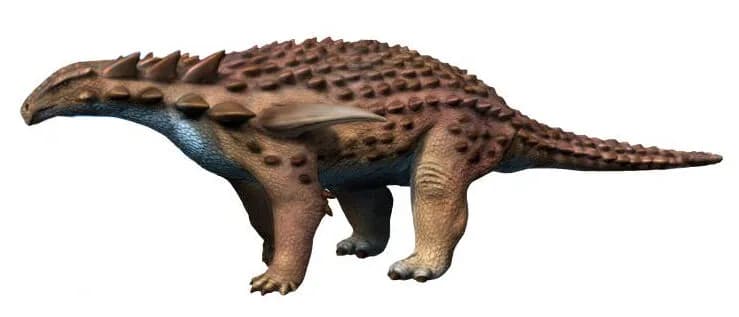
Borealopelta markmitchelli life reconstruction
Nobu Tamura, CC BY-SA 4.0