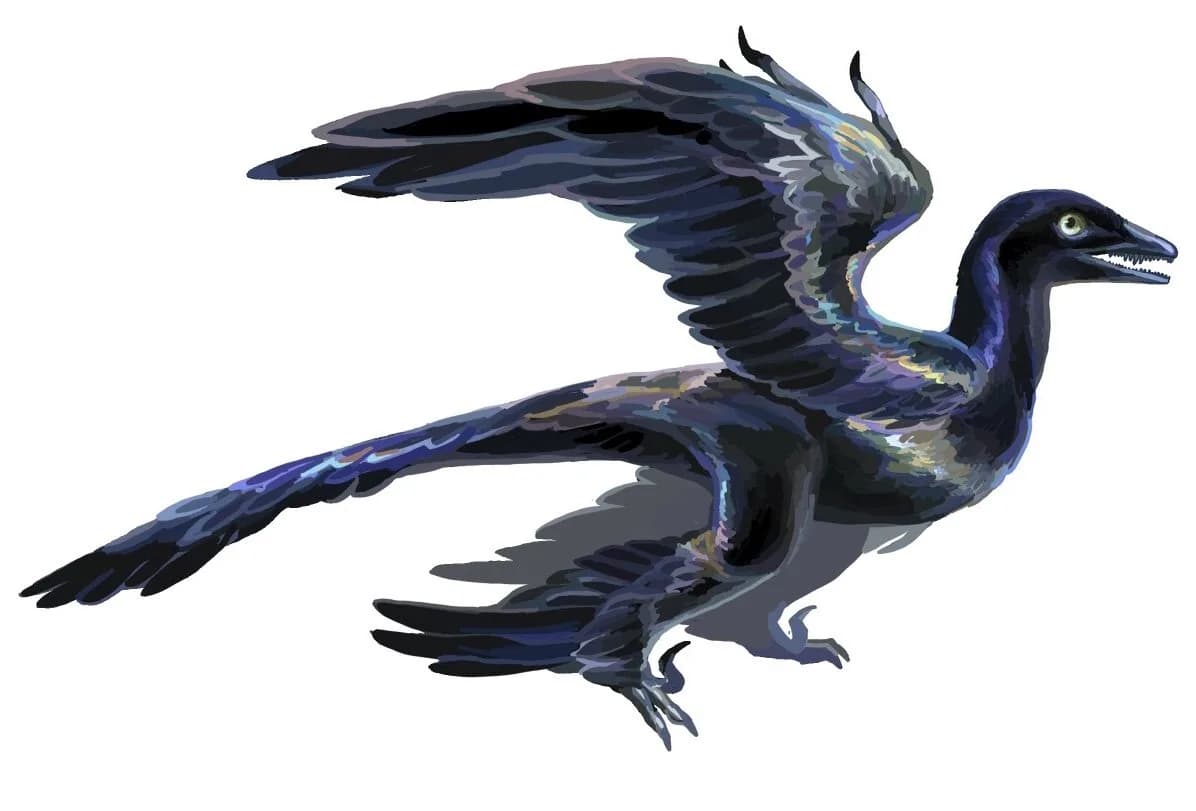
Yi qi carries the shortest binomial name in all of zoology: two letters for the genus, two for the species, meaning « strange wing » in Mandarin. It flew on a skin membrane stretched over an elongated wrist bone, an arrangement close to a bat's and unique among dinosaurs. It measured 30 to 40 centimetres and around 380 grams.
Yi qi lived during the Late Jurassic, approximately 160 million years ago, at a time when the subtropical forests of China served as an extraordinary natural laboratory for the evolution of flight. This pivotal period saw the emergence of a remarkable diversity of arboreal vertebrates experimenting with various aerial locomotion strategies, long before modern birds established the feathered-wing model as the dominant solution. Yi qi stands as testament to the extraordinary evolutionary experimentation of the Mesozoic, when multiple independent lineages were attempting to conquer the skies through radically different anatomical pathways.
Yi qi was a diminutive animal, roughly comparable in body size to a large pigeon or European starling. Its body measured approximately 30 to 40 centimeters in total length, with an estimated hip height of around 15 centimeters. Its body mass likely did not exceed 380 grams, making it one of the smallest non-avian dinosaurs known to science. Its wingspan, with membrane fully extended, reached approximately 60 centimeters. This extreme lightness was an essential adaptation to its arboreal and gliding lifestyle, minimizing the energetic cost of remaining aloft between trees.
Yi qi was very likely insectivorous, consistent with the dietary habits inferred for other members of its family, the Scansoriopterygidae. Its heterodont dentition, featuring conical teeth curved posteriorly, was well suited for catching arthropods, small invertebrates, and possibly juvenile lizards. Its arboreal lifestyle gave it access to insects living within bark crevices, dense foliage, and the branches of the conifers and tree ferns that dominated its habitat. The complete absence of adaptations associated with herbivory firmly supports its status as a small opportunistic predator in the forest canopy ecosystem.
Yi qi inhabited the dense, humid forests of Late Jurassic China, now represented geologically by the Tiaojishan Formation in Hebei Province. These subtropical environments were composed of conifers, cycads, giant tree ferns, and ginkgos, providing a multi-layered canopy ideally suited for arboreal life. The warm and moist climate of the region supported exceptional biodiversity. Yi qi was almost certainly a skilled climber, frequenting the upper stories of the vegetation to forage, escape ground predators, and travel by gliding between trees. The Tiaojishan Formation has yielded many other remarkable feathered dinosaurs and early birds.
The anatomy of Yi qi is absolutely extraordinary and entirely unique among all known dinosaurs. It possessed an elongated styliform bone attached to the wrist, which supported a skin membrane extending between the limbs — a system nearly identical to that of modern bats, but evolved in complete evolutionary independence. Its third fingers were extremely elongated to help extend this membrane. It was also covered in primitive filamentous 'paintbrush-like' feathers, structurally simple and unlike true bird feathers, covering its body but absent from the membranous wing surfaces themselves. This remarkable combination of membrane and feathers has no equivalent anywhere else in the vertebrate fossil record.
Yi qi was almost certainly an agile arboreal animal, capable of climbing trunks and branches using its prehensile feet and curved claws. Its gliding behavior allowed it to travel between trees with minimal energy expenditure, much like modern colugos or flying squirrels. Sustained powered flapping flight was likely beyond its capabilities due to insufficient pectoral musculature. Its lifestyle was probably crepuscular or nocturnal, converging functionally with that of bats in both morphology and insect-hunting strategies. The glide-from-tree-to-tree locomotion represents a striking evolutionary dead end, as this lineage left no known descendants.
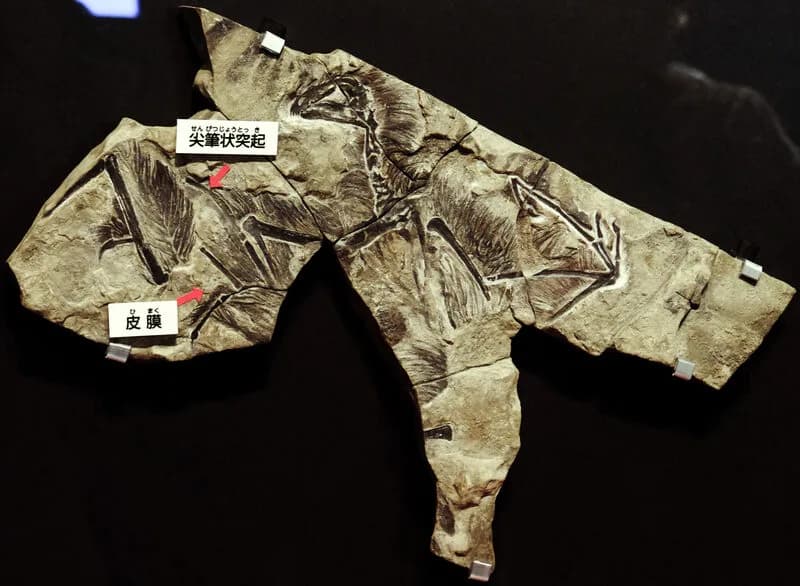
Yi qi is known from a single, exceptionally well-preserved fossil specimen, discovered by a local farmer in Hebei Province, China, within the strata of the Tiaojishan Formation. The specimen was studied and formally described by paleontologists Xing Xu and Xiaoting Zheng, and published in the journal Nature on April 29, 2015. Its authenticity was confirmed through sedimentological and taphonomic analyses as well as computed tomography scanning. The outstanding preservation of the specimen reveals not only the skeletal elements but also impressions of the wing membrane and feather filaments — exceptionally rare soft tissue evidence that proved critical to understanding its unique flight apparatus.
| Period | Jurassique supérieur / Late Jurassic |
| Era | Mésozoïque / Mesozoic |
| Age | 160 Ma |
| Location | Chine / China |
| Length | 30-40 cm |
| Height | 15 cm |
| Weight | ~380 g |
| Diet | Insectivore |
| Discovery | 2015 |
Yi qi holds the record for the shortest valid binomial name in all of zoology: two letters for the genus (Yi) and two letters for the species (qi), meaning 'strange wing' in Mandarin. This name was chosen by paleontologists Xing Xu and Xiaoting Zheng when describing the single specimen found in the Tiaojishan Formation (Hebei, China), published in Nature on April 29, 2015.
Yi qi could not fly in the true sense: it glided from tree to tree thanks to a skin membrane supported by an elongated styliform bone attached to the wrist — a convergent evolution completely independent of bats that appeared 160 million years later. Weighing approximately 380 grams with a 60-centimeter wingspan, Yi qi was probably an arboreal glider rather than a powered flapper capable of sustained flight.
Yi qi measured approximately 30 to 40 centimeters in total length with a hip height of about 15 centimeters, weighing around 380 grams. It was covered in primitive filamentous 'paintbrush-like' feathers on the body, but these feathers were absent from the membranous wing surfaces. This unique combination — membrane and filamentous feathers — has no equivalent anywhere else in the vertebrate fossil record.
Fossil specimen of Yi qi preserving the styliform wrist bone and impressions of the wing membrane, Tiaojishan Formation, Hebei, China
Wikimedia Commons, CC BY-SA
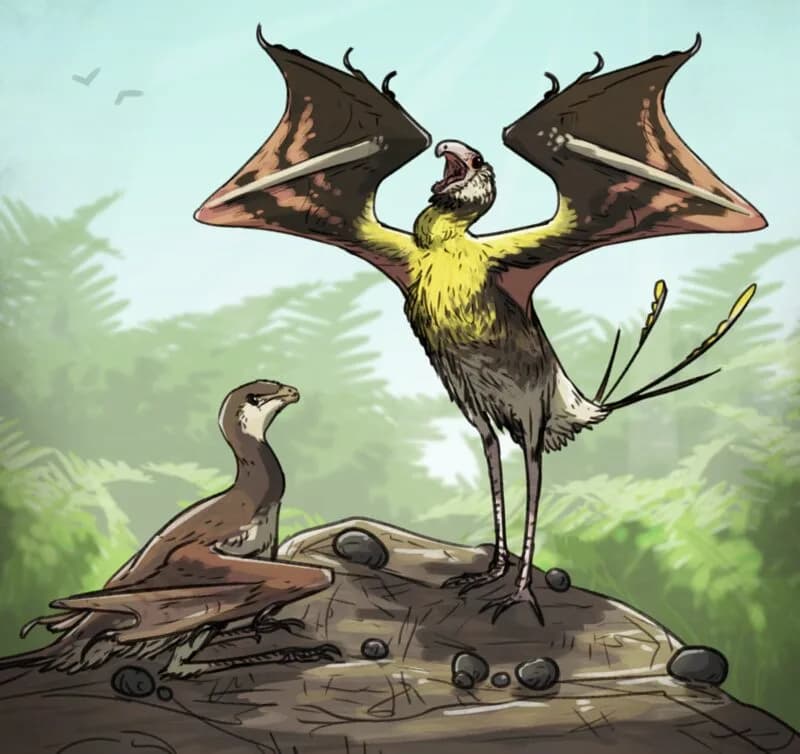
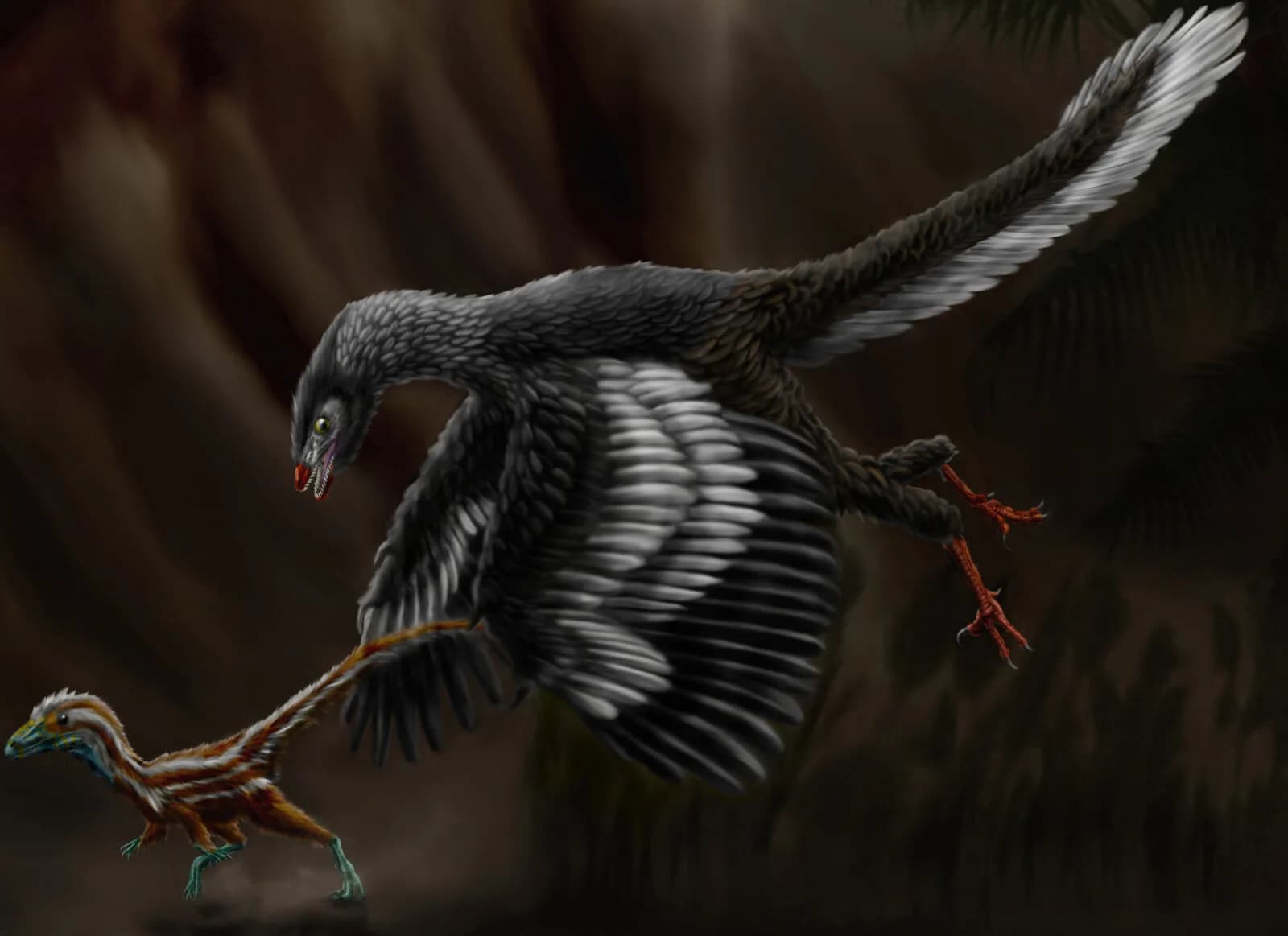
Artistic reconstruction of Yi qi depicting its bat-like membranous wings and coat of primitive filamentous feathers
Wikimedia Commons, CC BY-SA