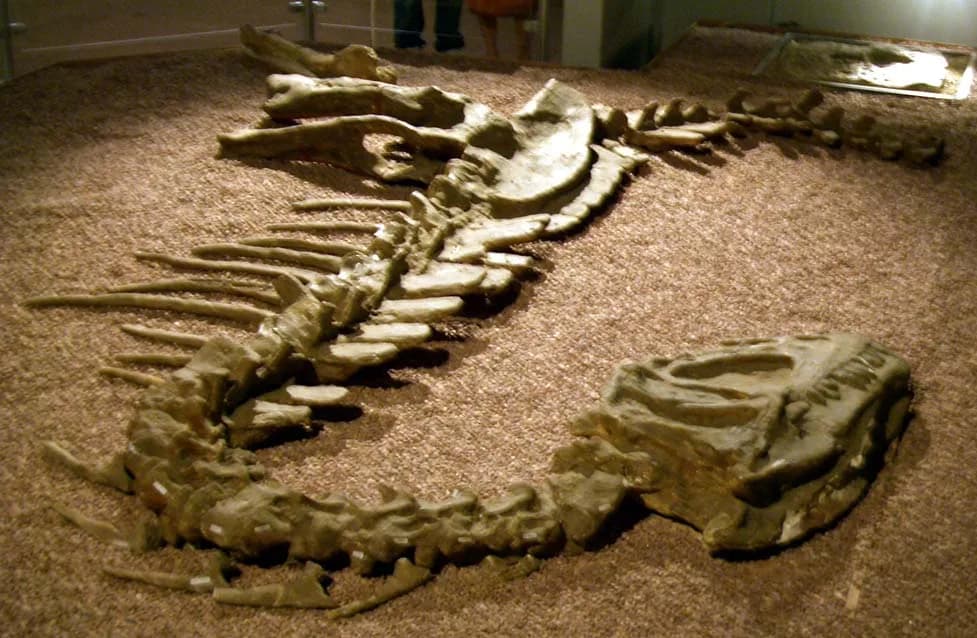
Lézard de Yangchuan
Yangchuanosaurus shangyouensis was a carnivorous theropod from Sichuan, described in 1977 and dated to 163 to 145 million years ago. At 8 to 11 metres and 2 to 3.5 tonnes, it filled in China the role Allosaurus filled in North America. Its bones were found by accident, while digging the foundations of a dam.
Yangchuanosaurus lived during the Late Jurassic, approximately 163 to 145 million years ago, in what is now Sichuan Province, China. This large carnivorous theropod dominated the terrestrial ecosystems of Jurassic China, occupying the role of apex predator in the famous Shaximiao geological formation. It shared its world with a diverse fauna of giant sauropods, stegosaurs, and other herbivorous dinosaurs that constituted its potential prey. Yangchuanosaurus was contemporaneous with Allosaurus in North America, sharing a similar ecological niche, illustrating a remarkable case of evolutionary convergence between two large predators on different continents.
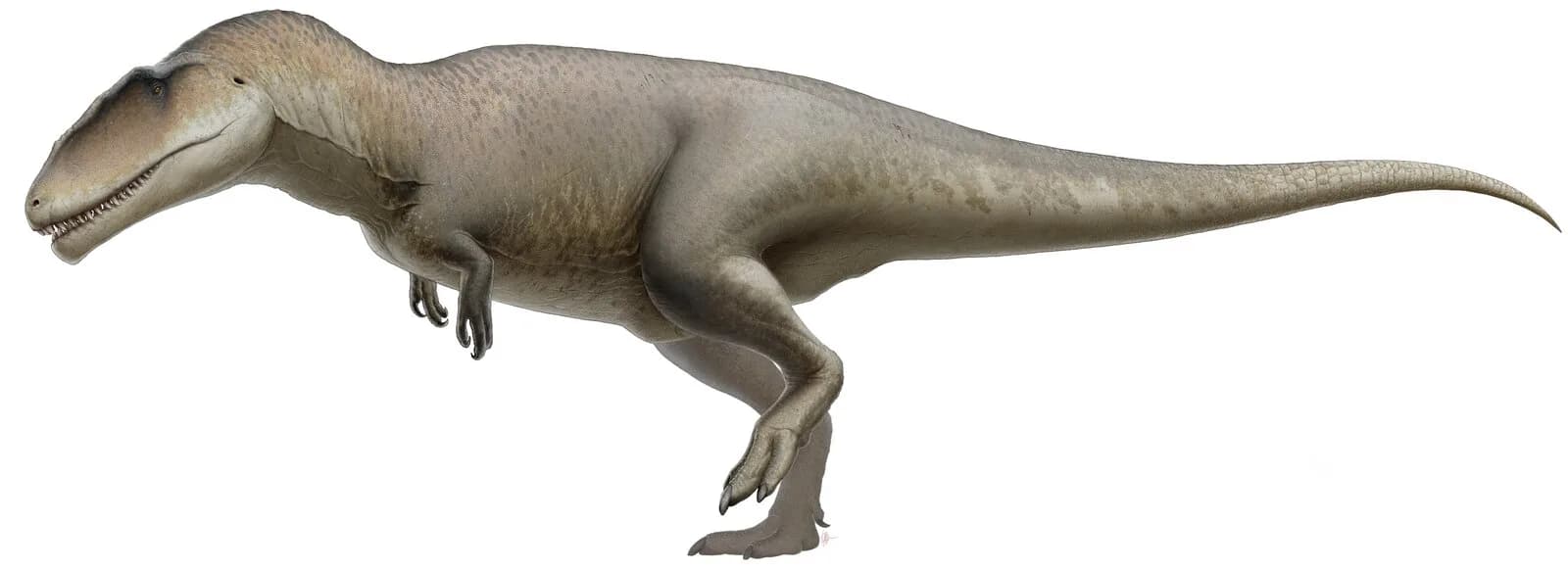
Yangchuanosaurus was one of the largest predators of Jurassic Asia, reaching an estimated total length of 8 to 11 meters depending on the species and a height of approximately 3.5 meters. Its weight was estimated between 2 and 3.5 tonnes, rivaling the largest contemporary North American allosaurs. The type species, Y. shangyouensis, measured about 8 meters, while Y. magnus, described later, reached 10 to 11 meters, making it the largest known theropod of the Shaximiao Formation. Its skull measured approximately 80 centimeters for the smaller species and exceeded one meter for the larger, proportionally more massive than that of Allosaurus.
Yangchuanosaurus was an active carnivore that hunted the numerous herbivores populating the plains and forests of Jurassic China. Its primary prey likely included medium-sized sauropods such as Mamenchisaurus and Omeisaurus, as well as stegosaurs like Tuojiangosaurus and Chungkingosaurus that abounded in the Shaximiao Formation. Its curved and finely serrated teeth were typical of large allosauroids, designed to slice deeply into flesh rather than crush bones. It likely practiced a hunting technique of multiple hemorrhagic bites, weakening prey through repeated attacks before delivering the killing blow, a strategy similar to that proposed for Allosaurus.
Yangchuanosaurus inhabited the alluvial plain and riverine forest environments of Jurassic China, in the present-day Sichuan Basin region. The Shaximiao Formation, where its fossils were discovered, represents a paleo-environment of vast floodplains traversed by meandering rivers, bordered by conifer forests, tree ferns, and cycads. The climate was warm and humid, subtropical in nature, with relatively well-defined seasons alternating between wet and dry periods. This rich ecosystem supported remarkable biodiversity, with numerous species of sauropods, ornithischians, and theropods coexisting in the same environment.
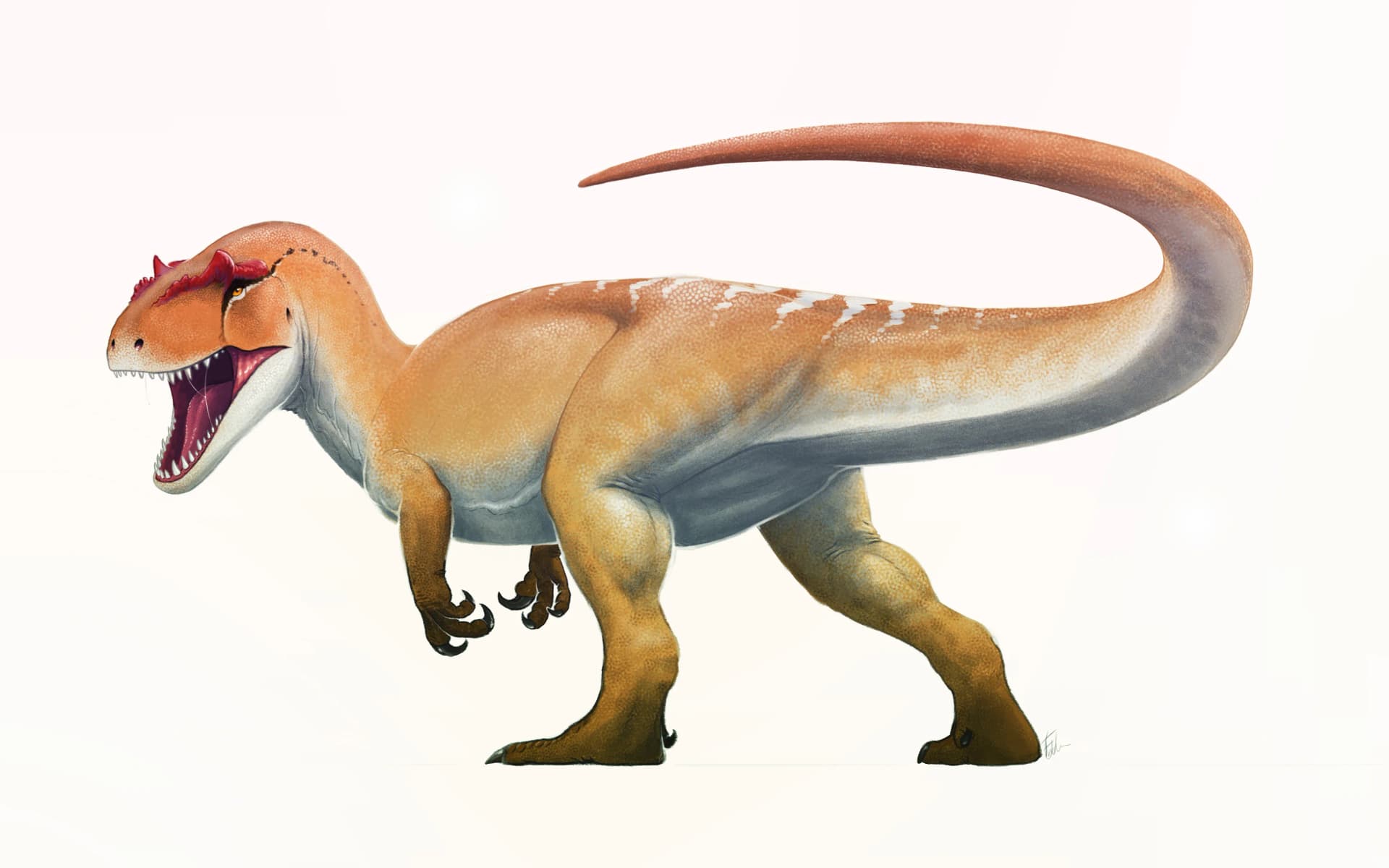
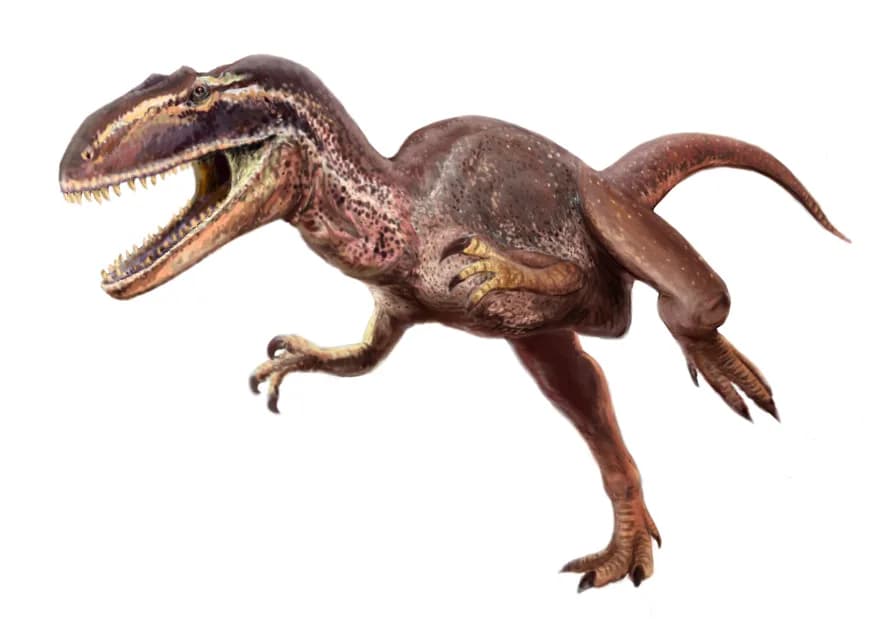
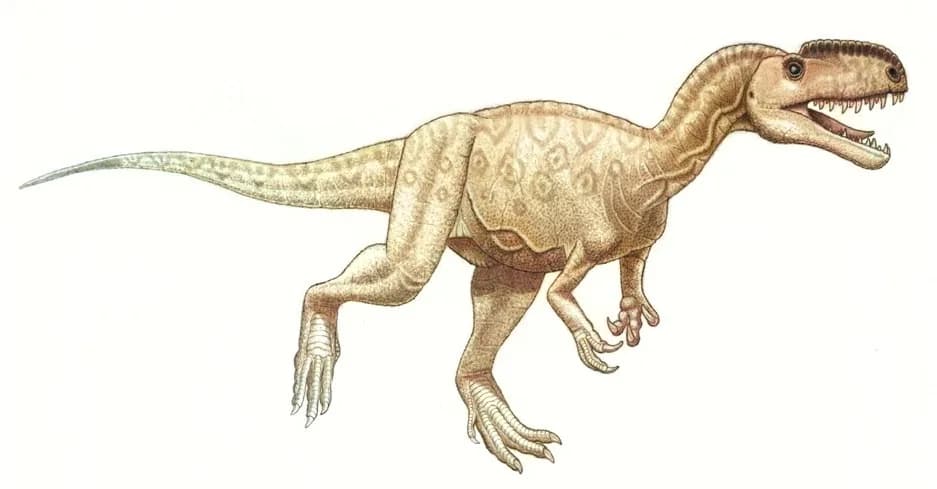
The anatomy of Yangchuanosaurus reveals a large, robust, and powerful theropod perfectly adapted for active predation. Its massive skull possessed a characteristic low, rugose nasal crest, likely covered in keratin in life, which distinguished it from other large contemporary theropods. Its jaws were armed with laterally compressed and finely serrated teeth, typical of metriacanthosaurids. Its forelimbs were relatively short but powerful, equipped with three clawed fingers, while its massive, muscular hindlimbs provided fast and agile bipedal locomotion for its size. Its long, rigid tail served as a counterbalance during running and attacks.
The hunting behavior of Yangchuanosaurus can be inferred from its anatomy and ecological context. As the apex predator of the Shaximiao Formation, it had to adapt its hunting strategies to the size of its prey. For juvenile sauropods and medium-sized ornithischians, it could probably hunt alone, using its power and speed to dispatch them quickly. To tackle large adult sauropods, some paleontologists suggest pack hunting behavior, although direct evidence of sociality is scarce. Its nasal crest likely served as an intraspecific visual signal for individual recognition or during courtship displays.
The first fossils of Yangchuanosaurus were discovered in 1977 during construction of the Shangyou Dam, in Yongchuan County (formerly Yangchuan) in Sichuan, China. The holotype specimen, a remarkably complete skeleton including skull, vertebrae, limbs, and pelvis, was described by Dong, Zhang, Li, and Zhou in 1978. A second species, Y. magnus, larger in size, was described by Dong, Zhou, and Zhang in 1983 from material from the same site. The Zigong Dinosaur Museum, located in the heart of the region where the fossils were found, displays original specimens and spectacular reconstructions. Yangchuanosaurus is one of the best-known Jurassic theropods from Asia.
| Period | Jurassique supérieur / Late Jurassic |
| Era | Mésozoïque / Mesozoic |
| Age | 163–145 millions d'années / 163–145 million years ago |
| Location | Chine (Sichuan) / China (Sichuan) |
| Length | 8–11 m |
| Height | ~3,5 m |
| Weight | 2–3,5 tonnes |
| Diet | Carnivore |
| Discovery | 1977 |
Yangchuanosaurus shangyouensis measured between 8 and 11 meters in length with a weight of 2 to 3.5 tonnes, directly rivaling North American Allosaurus. The species Y. magnus reached 10 to 11 meters — the largest known theropod of the Shaximiao Formation. Both predators occupied similar ecological niches on different continents 163 to 145 million years ago, illustrating a remarkable evolutionary convergence.
The first Yangchuanosaurus fossils were discovered by accident in 1977 during construction of the Shangyou Dam in Yongchuan County (Sichuan). The holotype, a remarkably complete skeleton including skull, vertebrae, and pelvis, was described in 1978 by Dong, Zhang, Li, and Zhou. A second, larger species, Y. magnus, was described in 1983. The Zigong Dinosaur Museum displays original specimens.
The low, rugose nasal crest of Yangchuanosaurus shangyouensis, formed by the nasal and premaxillary bones, was likely covered in colored keratin in life. It probably served as an intraspecific visual signal for individual recognition or courtship displays, similar to the cranial ornaments of other large theropods like Allosaurus or Ceratosaurus. This crest is a diagnostic feature of metriacanthosaurids.
Mounted skeleton of Yangchuanosaurus shangyouensis in museum
Wikimedia Commons
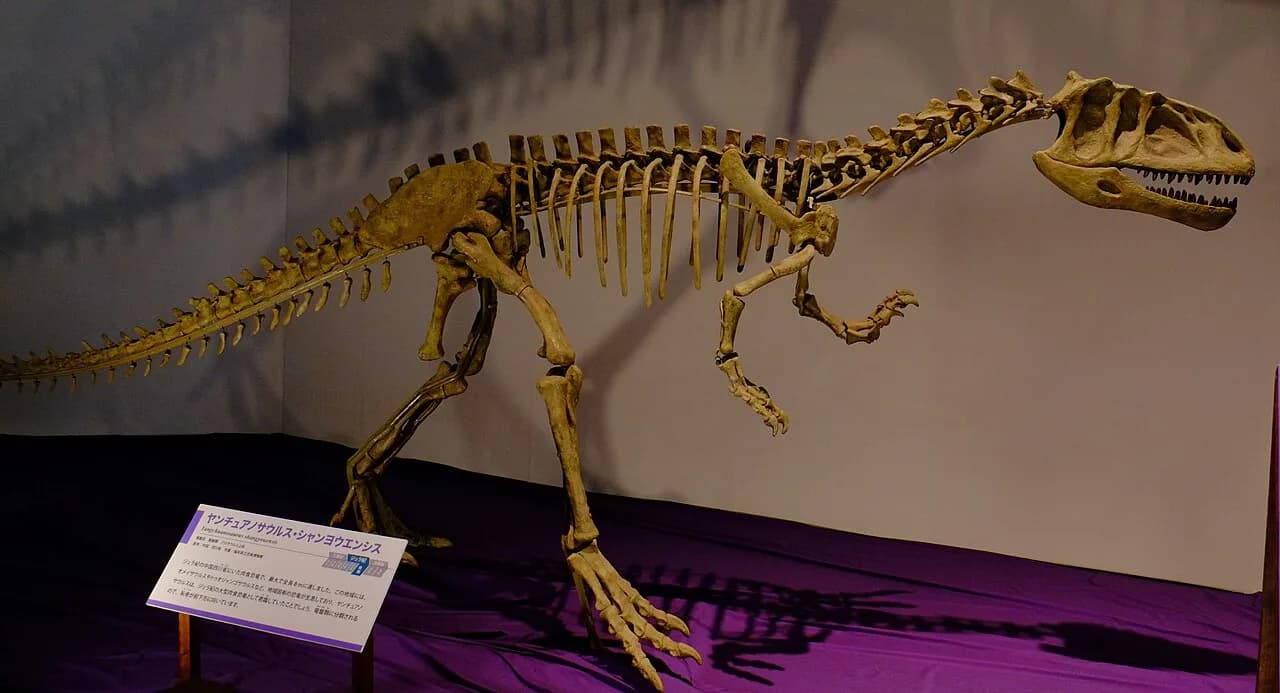
Yangchuanosaurus skeleton at the Zigong Dinosaur Museum
Wikimedia Commons